CIHS – Centre for Integrated and Holistic Studies

Date/Time:

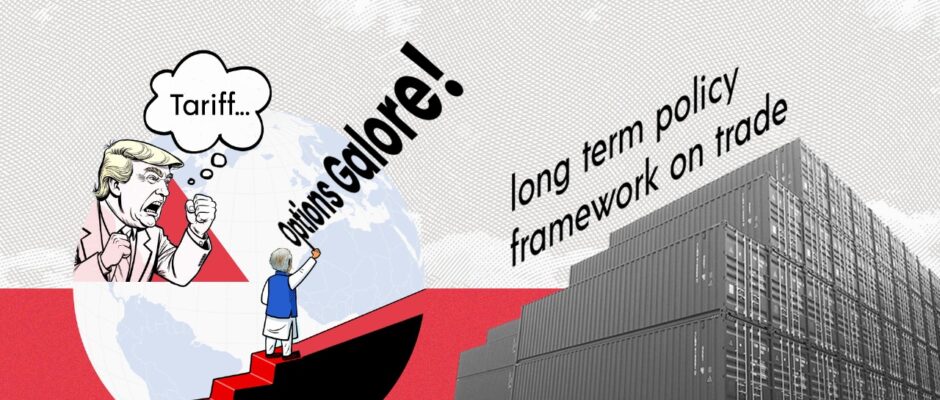
Options Galore!

Options Galore!

Putting in place long term policy framework on trade, investments, currencies, geo-political alignments to protect Bharat’s interests must be priority. K.A.Badarinath United States President Donald Trump’s adversarial tariff policy on India has largely been regarded ‘flip flop’ hinting at fluid stance and diabolical in spirit and content. From being most favoured trading ally with minimal tariff proposal of 10 per cent in April 2025, India has been bracketed in the list of enemy countries that attract highest impost of 50 per cent. Numbers and data apart, there has been a lot of noise, nervousness and anxiety as clock ticked 4 pm in last few days in India. It’s at about that time of the day Trump first announced 25 per cent and later doubled it to 50 per cent triggering a flurry of activity. Old timers did not miss the drama, show shah and high decibel drama that Trump put on these days targeting one or other trading partners.  It was the turn of Bharat in last few days. A 21-day window announced for tariffs to kick in signalled that Trump was open to negotiation before inking the trade deal. It’s one way of exerting pressure on New Delhi’s negotiators to sign on a ‘bad trade deal’ which means granting US unhindered access to agriculture, fisheries and dairy sector in India. President Trump’s optimism to drive a hard bargain also reflects from his statement, “it’s only been eight hours, let’s see what happens…you are going to see a lot more and some secondary sanctions”. The eight hour time frame referred to by Trump hints at his ‘wait, watch and strike’ attitude in the midst of serious negotiations. Contrary to drama associated with Trump’s diatribe, India’s response has been mature, measured and nuanced in last fortnight within and outside the parliament. Unreasonable, unfair and unjustified is how India described Trump’s executive order on 50 per cent levy. For the first time, Prime Minister Narendra Modi stuck his neck out and took it upon himself the consequences of tariffs tantrums thrown by President Trump. Modi said unequivocally that he was willing to pay a heavy personal price as Trump’s tariffs would impact large number of labour intensive and rural sectors. First, Prime Minister Modi has taken personal responsibility for the impact trade pact and tariffs would have on 1.4 billion plus Indians. Modi’s statement at M.S.Swaminathan International Centenary Conference on Thursday is very significant. He’s not willing to compromise on protecting farmers, rural people interests and labour intensive industrial sectors. Also, he was willing to face the political flak and pay heavy personal price on consequences given opposition parties’ intransigent line on United States. Prime Minister Modi understands that throwing open the agriculture sector to US is not only economically unviable but politically unsalable to the core Hindu vote bank, Sangh parivar and the ecosystem. On factual analysis, Modi government will have to deal with adverse impact on GDP growth of 0.2 – 0.4 per cent in case tariffs finally stay at 25 per cent during this fiscal. Top analysts estimate that entire US $ 86.5 billion annual goods exports from India to United States may turn non-competitive or commercially viable. Given that US is top market for India and constitutes about 18 per cent of its global goods exports and constitutes 2.2 per cent GDP, strains have begun to appear on near future. Given Prime Minister Modi’s steadfast commitment to protect India’s national interests, Indian negotiators are breathing easy. The proposed 50 per cent duties, if they kick in finally, translate to unannounced trade sanctions or embargo on India thereby worsening the strain in relations between the two countries. One big fall out that’s largely speculated was that India may not buy F-35 stealth fighter jet aircraft from United States. Factual position so far is that after US offered to sell these jets, formal negotiations have not yet begun. And, these discussions may remain a non-starter. Secondly, India may consider imposing retaliatory duties on 28 US products including its apples and walnuts given the precedent in 2019 to counter restrictive levies Washington DC had imposed on Indian steel and aluminium products. Thirdly, the arc of dis-engagement between India and US may widen for the time being unless recalibrates its trade and tariff policies. Fourthly, an aggressive campaign may be launched by the ruling party and the government to go local and opt for ‘made in India’ products and services. Fifthly, Prime Minister Narendra Modi may mobilize people in socio-economic spheres for adapting ‘swadeshi’. Sixthly, realigning India’s trade, investment, economic, geo-strategic relations may be a big option. Russia, China and other countries engagement may be enhanced to counter-balance US Republican White House under President Trump’s stewardship. Aligning with countries like Brazil who have been put on high tariff line by US could be an option. Seventhly, present developments may lead to expanding time tested foreign policy of strategic autonomy to protect India’s offensive and defensive interests. This may also be the right moment to promote south – south trade engagement. Eighthly, upcoming conclaves of Shanghai Cooperation Organization (SCO), Quad and BRICS may be occasions for India to sharpen its policy framework for global engagement. Ninthly, evolving an independent financial architecture, decoupling from US dollar or hastening BRICS currency to opt for diversification in payments may also be considered. Tenthly, putting in place medium and long term policy on currencies and oil will go the India way. (Author is Director and Chief Executive of non-partisan New Delhi based think tank, Centre for Integrated and Holistic Studies)

Read More
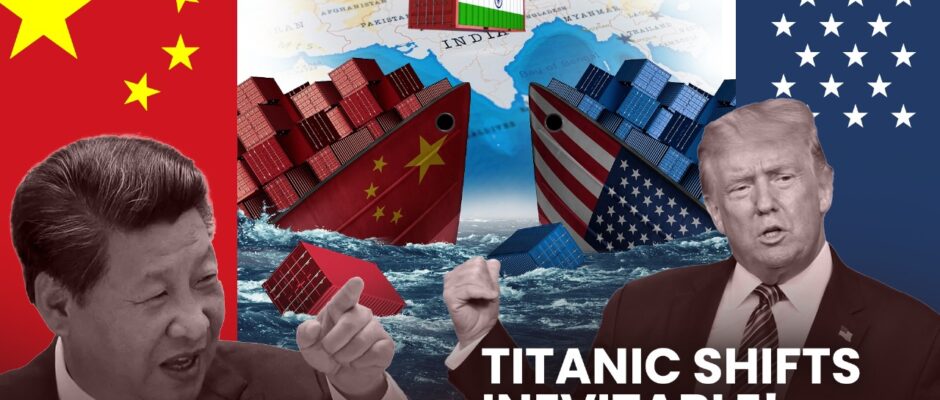
Titanic Shifts Inevitable!

Titanic Shifts Inevitable!

Trump’s tariff wars provide a window of opportunity to Bharat for proving its mettle as a global force to reckon with its own economic development model. K.A.Badarinath There’s a huge body of analyses on possible impact of tariff orders signed by US President Donald Trump in last few weeks. Those in favour and against have argued emphatically leaving room for further discussion given that tariffs, trade and economic engagement has gained pre-eminence and a developing story. Several analysts described recalibration of tariffs as trade war. Yet others have attempted to look at implications of the trade centric conflict overflowing into geo-political stratosphere.  Markets – equities, currencies, commodities, bullion and a host of financial products – felt the immediate impact. There has been roil in the market place. Billions of dollars’ worth investors’ wealth either vanished over night or partially restored as tariff orders were released by the White House in quick succession beginning ‘liberation day’ as Trump pompously described. Companies, services providers and logistics firms scurried for cover even as President Trump essentially targeted European Union with whom US has a trade deficit of $ 200 billion and China with deficit exceeding US $ 300 billion. Sixty countries – friends and foes – were treated by Trump with derision and slapped with counter-tariffs to bring down the US trade deficit that piled up to US $ 1.2 trillion. Some economists also pointed to trade surpluses run by US with about 100 countries which were royally ignored by ‘transactional Trump’ administration. Trump’s political agenda in run up to 2024 Presidential campaign centred around correcting the ‘unfair’ ripping of American people, businesses and denying his ‘voters’ the job opportunities thereby shifting manufacturing out of US. This is also the biggest ‘political agenda’ item of Trump that got him into power for a defining second four-year term. Apart from addressing domestic core whites’ constituency that were central to his ‘Make America Great Again’ agenda, Trump’s belief centre’s around ‘lifting the burden of American people’ on whose shoulders the world rejoices. Now that the trade, tariffs, manufacturing and jobs agenda gets to be implemented in US, the signals are ominous for anyone and everyone to pick up and put their counter-offensive in place. A lot of counter-offensive from US trade partners was kept on hold as 90-days window to fast-track trade and economic partnership negotiations began in Washington DC and elsewhere. China, however, has been treated differently after having slapped 145 per cent duties on most goods and services exported to US. China that countered with 84 per cent tariff on US goods and services was not part of the 90-days pause plan announced by President Trump. For now, trade war has turned direct and vicious between US and China while the latter owed ‘fight to finish’ action plan. Trade centric war is evolving and one may not see much hope in bringing this to an early close as negotiations between trade partners and US would be a long drawn process. Even if trade issues are sorted out, the impact would be profound on Western model of ‘globalization’ that got rolled out post-World War II and setting up of Bretton Wood institutions is bound to hit reset button. A fresh look at global trade and economic engagement is something that’s unavoidable or rather inevitable. This re-engagement will have huge bearing on socio-economic development paradigm of global communities especially with larger number of people reeling under poverty. A more America-centric economic policy roll out by Trump and ‘inward’ looking framework would lead to conceding geo-political and economic space to big players like Communist China. Each country – big or small – will have to learn fast to fend for itself and not depend on big brothers in either US, China or European Union. Next four years may also see ‘many more’ socio-economic self-reliance campaigns. It’s in this context that Bharat’s ‘self-reliance’ campaigns being run last eleven years would gain significance as existing value chains get rejigged, decoupling and re-engagement were definitively on the horizon. Bharat’s ‘strategic autonomy’ in terms of foreign policy and by extension, economic engagement, will hold strong. Unwilling to react in a hurry, announce counter-measures in a huff like several members of European Union or China, Bharat fell back on ‘time tested’ autonomous policy postulation. Free Trade Agreements (FTAs) with US, European Union and United Kingdom may have to be reworked with other economic parameters like investments more closely aligned. Secondly, given that Bharat has been treated ‘even handed’ with 26 per cent additional tariff, New Delhi should resist the temptation of falling into anti-US blocks. This should not translate to closing the door firmly on China that offered to align with Bharat to take on US. Thirdly, Bharat may consider making new partners on equitable and respectable terms that’s ‘mutually beneficial’ and ‘long lasting’ while economic engagement takes on new hue and different shade. Fourthly, measured and nuanced approach to trade, economic, development and geo-political engagement may have to be pursued in the spirit of ‘vasudaiva kutumbakam,’ the world is one big family. Fifthly, given that Bharat is on an ascent mode, wading through economic uncertainties globally and achieving its objective of becoming a ‘responsible economic power house’ will have to be carefully crafted. Sixthly, open, flexible, rules and regulations driven economic engagement with a ‘human face’ in reaching out to last man standing in queue should be basis for Bharat’s approach. Seventhly, this is the perfect time and context to present its own model of socio-economic development model that’s not exploitative, solely driven by consumer centric approach and instead push for synergies between nature and human living that’s sustainable in terms of judicious utilization of resources. Eighthly, realignment of global forces, both geo-political and market centric, is inevitable. And, carving out a distinct role for itself with responsibility is what’s recommended. Ninthly, falling back big on indigenous knowledge, development ecosystem based on sanatan Dharmic values for shared prosperity will test Bharat’s mettle. Tenthly, leadership role cannot be played from

Read More

Mid-course correction is what the good doctor prescribed!

Even if US revises debt ceiling of $ 31.4 trillion, its risk ridden economy may precipitate a larger global crisis of larger magnitude K.A.Badarinath Looming debt crisis in United States with potential to default, showdown between Republicans that control the House and Democratic White House may not augur well for the global economy and developing countries like India. Owing to unsustainable economic policies over few decades and irresponsible handling of resources has led the largest global economic powerhouse into a big mess of its own making. Even if President Joe Biden manages to clinch a last minute deal with Republican top leadership to push up the debt ceiling beyond US $ 31.4 trillion, larger questions continue to haunt the Americans. Mobilizing loans through US bonds or debt paper may not be the immediate concern but potential default on June 1 is what may turn catastrophic to not only Americans but the entire world. For Americans, it means that Democrats will not be able fund their fancied social security payments on medical and health insurance, pension or social development projects. President Biden and his Democratic administration will have to put on hold all fancy projects like waiving students’ loans or fees to providing personal tax concessions to youngsters and new taxpayers Democrats understand the full importance of lifting the already unsustainable debt limit of $ 31.4 trillion. In fact, this also explains US President Biden’s decision to forego the scheduled Quad summit in Australia and head back home after G-7 leaders meeting in Hiroshima. Eventually, the Quad summit had to be called off with heads of US, Australia, Japan and India meeting briefly at Hiroshima on side lines of G-7 congregation. The larger issue that confronts US and the world is a wee bit different and difficult. There’s every possibility of US moving into economic recession thereby stymieing demand for goods and services globally. This will hit the economic growth sentiment internationally big time. Secondly, possibility of banks getting stuck with worthless dollar denominated bonds or debt paper in medium term cannot be ruled out unless both Federal Reserve and political leadership in US takes recourse to mid-course correction that involves massive spending cuts or improve the country’s revenues. Such a policy may be very unattractive for Democratic voters when they have to elect their President in 2024. Thirdly, to contain the contagion effect of US economy moving into abyss will be a herculean task. One cannot easily forget the global financial crisis triggered by real estate linked mortgages that turned worthless in 2007-08. This US housing bubble stirred a perfect storm to impact both large developing countries like India as well as least developed countries alike. Excessive risk exposure taken by banks was the biggest element in this crisis of the worst kind after great depression of 1929. Fourthly, if the US default finally happens, then countries like India having huge exposure to American green back will also face the heat. Thankfully enough, conscious diversification in her currency basket over last decade may limit the adverse impact on India. But, this diversification should go whole hog and consciously lead to pursuing ‘de-dollarization of Indian economy’ as a state policy. Fifthly, while exports to US become attractive and import bills get squeezed, demand slump globally will negate the advantages gained in trade deals. There’s no reason why India should not pursue a more independent trade and currency policy keeping herself at a safe distance from the Federal Reserve and recalibrate her linkages with Washington DC. Sixthly, Democrats and Republicans must work towards mid-course correction on economic and development front rather than recklessly going for borrowing more from Tom to pay Peter. In the past, publicly available data suggests that US debt limits were revised upwards 68 times since 1960. Limiting the fresh debt limit to US $ 1.5 trillion till March 31, 2024 and achieving concomitant cuts in spending by US $ 1.47 trillion would save the perilously placed US economy. Seventhly, precipitating a perfectly cooked crisis is not in anyone’s interest and hence reining in the fresh spending to less than one per cent as per Limit, Save, Grow Act of 2023 makes eminent sense. On the parallel, limiting the mop up of fresh debt and gradual reduction in existing debt stock would augur well for US economy that’s seeking to reposition itself and instil confidence with its trading and investment partners. US Department of Treasury report of 2022 clearly outlines the course correction to be adopted for reversing unsustainability of the country’s economy where primary budget deficits have grown exponentially.  Going by conservative projections made in this report, it will take about 75-years to bring the American economy back on even keel. “The debt-to-GDP ratio rises continuously in great part because primary deficits lead to higher levels of debt. The continuous rise of the debt-to-GDP ratio indicates that current fiscal policy is unsustainable” the report had cautioned. The debt-to-GDP ratio was approximately 97 per cent at the end of FY 2022, and under current policy and based on this report’s assumptions is projected to reach 566 per cent in 2097, it pointed out. While pursuing a revised economy policy dispensation, President Biden should not easily forget the 2011 crisis that was triggered by US Congress. This pushed up the borrowing costs for treasury by a humungous US $ 1.3 billion in just one year. Also, US should not provide any leverage to China for en-cashing on its crisis. China is easily the largest holder of US debt paper, notes and long term bonds with valuations ranging from $ 859.4 billion to $ one trillion. China may like to leverage the US debt paper to rebalance its own resources position that again may not be looking too good.  China’s own debt of US $ 14.34 trillion as of April 12, 2023 and swelling at a whopping $ 3.81 trillion annually may not be something to brag about by President Xi’s oligarchs driven communist party. Potential defaults in US, machinations

Read More

FTAs, free for all?

Free trade agreements with Japan and South Korea have not worked in India’s favour. Will the deals with Australia and UAE deliver? K.A.Badarinath After Canberra ratified the India Australia Economic Cooperation and Trade Agreement (IndAus ECTA) on Tuesday there was huge sense of achievement that overtook the establishment and media outlets. While fine print was still hazy given that second phase of the deal was yet to be concluded, duty cuts and liberalized visa regimes was touted as a big deal for Indian side. There’s no denying that bilateral trade deals are here to stay given that multi-lateral negotiations at forums like World Trade Organization have come to a virtual standstill, limited trade and investment blocks take long time to get going. Taking bilateral trade to US $ 50 billion in five years from the prevailing $ 31 billion with Australia is laudable. Billion-dollar question however, would be which side will the trade balance tilt? The next deal that may get operative is the pact with United Arab Emirates which was also signed eight months ago. Comprehensive Economic Partnership Agreement (CEPA) between Abu Dhabi and New Delhi may be more comprehensive. UAE foreign minister Sheikh Abdullah bin Zayed Al Nahyan is in New Delhi to give a big push to CEPA. Here again, the trade balance is in favour of UAE as of now and it may only widen further after the CEPA.As per Indian commerce ministry figures, imports from UAE were US $ 28.4 billion as against $ 16 billion exports during April – September 2022. Widening trade imbalance may be a source of concern in free trade agreement with Australia or CEPA with UAE. After a hiatus during first three years, Narendra Modi government signed 13 trade deals or operationalized agreements with partners in last five years. Hastening bilateral agreements became a necessity given the $ 5 trillion economic target that India set for itself in its economic expansion game plan. But then, have these agreements done well for Indian industry, exporters, service providers, farmers and consumers is a valid question that needs to be answered. There’s no verifiable data to back any claims of a big benefit to Indian side. Data available with Commerce Ministry, RBI and Finance Ministry also needs to be collated and reconciled. In the past, industry and trading community in India have complained that deals with Japan and South Korea never worked in India’s favour as the trade balance and investment gap only widened with several desi companies, services losing out. Sri Lanka, Nepal, Bhutan, Mauritius, Thailand, Malaysia bracketed as neighbourhood countries or South East Asian neighbours were others with whom free trade deals were operative. Even if trade balance was in their favour, India has the potential to play ‘big brother’ role. But with biggies like Japan, South Korea, UAE and Australia, terms of engagement may be a clinching factor. Two regional deals with ASEAN and SAFTA were also scrutinized on cost benefit issues. In addition, six preferential trade agreements with limited scope became operative between India and its partners like Afghanistan, Chile etc. In this category also falls the agreement India has with Mercosur (South American block) and Asia Pacific nations through APTA. Free trade negotiations will be kicked off with United Kingdom, Canada, European Union and Gulf nations later this week. Here again, the big question is what are India’s gains? While bilateral and limited blocks trade is an imperative, Indian negotiators must be sensitive enough to ensure that FTAs do not turn out to be free for all and nothing much for India. Free trade as a concept has undergone serious makeover especially after Western developed economies including US has shunned the hitherto flexible economic, investment and trade partnerships. There’s no alternative to engaging the world on multiple fronts. But, big question is on what’s in it for India? (The writer is Director and Chief Executive of New Delhi based think tank, Centre for Integrated and Holistic Studies)

Read More

Tread with caution: taxes & resources

Finance Minister may lean on Chanakya and Thiruvalluvar yet again to sell tax reforms, manage meagre resources and still provide relief to honest taxpayers K.A.Badarinath / New Delhi “Taxation should not be a painful process for the people. There should be leniency and caution while deciding the tax structure. Ideally, governments should collect taxes like a honeybee, which sucks just the right amount of honey from the flower so that both can survive. Taxes should be collected in small and not in large proportions” said Chanakya in arthashashtra of 1534 BC vintage. This should hold good for finance minister Nirmala Sitharaman when she rises to present her tax proposals for 2022-23 as part of the union budget in parliament on February 1. Chanakya’s celebrated treatise, arthashastra on socio-economic principles has been her beacon in last three budgets. Her predecessor and mentor, late Arun Jaitley had leaned heavily on the celebrated Indian administrator to tide over tight economic situation in the past. This time round, it may not be any different. And, one can expect Nirmala Sitharaman to dip into Chanakya’s teachings next Tuesday in articulating her taxation package. Her tax proposals in all probability should not only push growth but allow enough resources in the hands of individuals, families and companies to meet expenses, consume and invest as the case may be. Buoyant GST collections that ranged between Rs 130,000 – 140,000 crore during April – December 2021 and improving situation following Omicron induced Covid 19 third wave should provide her the confidence to roll out an acceptable tax package that will push consumption led demand for goods and services. First thing the finance minister may attempt is heed the advice on pruning the ten corporate income tax rates that range between 5.2 per cent to 42.744 per cent applicable to domestic and foreign companies based on their turnover, area of operation and uniqueness. Effective taxation will have to be brought down taking revenue considerations on board. Can effective tax rates for companies actually be brought under 5 – 35 per cent bracket is perhaps what Finance Minister should consider? Her corporate tax proposals may have to include the foreign companies that may expand their presence as part of on-going Make in India and Production Linked Incentives campaigns. Getting rid of all surcharges and cesses levied at every touch point on corporate income tax and GST may have to be considered by the finance minister though its easy said than done. Revenue considerations notwithstanding, reining in the fiscal deficit to below six per cent should be considered while rejigging the tax table. Same is the case with redrawing income tax rates for individuals. While there have been suggestions for aggressively taxing the rich individuals, wealth creators and job givers may be allowed the leeway to get on their work without liquidity squeeze. There have been suggestions to consider the work from home allowance provided by companies for inclusion under standard income tax deductions provisions owing to over two years pandemic. Similarly, professionals and workers have lost their pay big time and millions have been given the pink slips. Finance Minister Sithraman may have to find ways for providing them some relief as has been done in last budget. Her predecessor Arun Jaitley has been popular with both companies and individual taxpayers as he managed to provide succour to each one of these categories in every one of his five unblemished budgets. Sitharaman will do well in adopting this time tested approach. Not just the actual tax burden, as Chanakya’s arthashastra surmises, taxes should be easy to calculate, convenient to pay, inexpensive to administer and equitable in its burden on various stakeholders. Taking forward these tax reforms – on both direct and indirect fronts – is need of the hour. One big avenue for mobilization of revenues has been sale of government stakes in large state-run companies as part of its determined bid to get out of the business of being in business. While LIC initial public offer and offer for sale (OFS) should bring in about Rs 115,000 crore, getting divestment and strategic salee of BPCL where Rs 55,000 crore has been targeted should be done next fiscal. Similarly selling IDBI Bank at a valuation of Rs 25,000 crore and two more state-owned banks should be pursued aggressively, if that helps reorganizing the banking sector. Similarly, selling Shipping Corporation, Pawan Hans and BEML in part or as on where basis should bring in another Rs 40,000 crore. Well most of these companies and banks were on her radar already. But, the sale did not move forward this fiscal for a number of factors. Achieving disinvestment targets may help find resources for ambitious capital investments as well as development expenses especially in infrastructure, health and education apart from providing water at every door step. Barring a few tweaks in GST rates as per recommendations of GST Council that she heads, drastic restructuring on the economic front may have to wait especially from taxation side. As Tamil saint philosopher Thiruvalluvar in Tirukkural postulated, finance minister may have to take a pragmatic view of both domestic and external economic situation while unveiling the finance bill. Yet another predecessor of Sitharaman, Palaniappan Chidambaram had taken refuge in Tirukkural to sell UPA’s economic agenda. The tamil philosopher saint may not have had finance ministers in mind while writing 1300-odd aphorisms. But, saint Thiruvalluvar’s couplets have withstood the test even in twenty first century on tax breaks, prioritizing expenses from the government kitty. Kural’s chapter on knowledge of power came handy for Chidambaram to ward off unwanted pressure from different lobbies and stakeholders. Take care not to give up exertion in the midst of work, the world will abandon those who abandon their unfinished work. Accumulate wealth in order to spend it. These two kurals of Thiruvalluvar can guide finance minister in her jest for reforms, managing resources and economy. Over to Finance Minister! (Author is Director & Chief Executive of Centre for Integrated and

Read More