CIHS – Centre for Integrated and Holistic Studies

Date/Time:

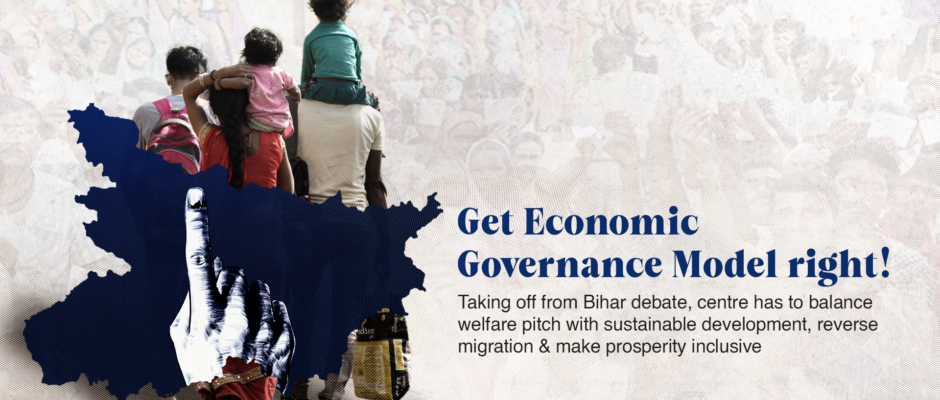
Get Economic Governance Model right!

Taking off from Bihar debate, centre has to balance welfare pitch with sustainable development, reverse migration & make prosperity inclusive K.A. Badarinath Two simultaneous developments have had happened. Both these, though unconnected, have a linkage of sorts. Our most vibrant state, Bihar has gone to polls and a new government will be in place few days from now. On the other end, finance minister Nirmala Sitharaman has begun a mammoth exercise to present her next federal budget on February 1, 2026. One could be wondering as to what’s the linkage between the two albeit even indirectly. This budget will have to put together a new model for socio-economic development taking on board political freebies that are promised in state legislative assembly elections or Lok Sabha polls. Freebies, Revdies & Social welfare Not many socio-economic analysts or thinkers would support the idea of a welfare state in a globally inter-connected world of markets, investments and trade that’s fiercely competitive. Ahead of state elections, Nitish Kumar led BJP – JDU alliance with splinter parties in tow announced two big projects. Through Mukhya Mantri Mahila Rojgar Yojana (MMRY), Rs 10,000 was given to each of 1.5 crore women through direct benefits transfer (DBT). About 1.1 crore elderly women, widows and disabled were given enhanced pension of Rs 1100 from earlier Rs 400 per month. The two schemes alone added an extra outgo of Rs 14240 crore that constitute about six per cent of total revenue expenses of Rs 252,000 crore for 2025-26. Over and above, BJP – JDU led National Democratic Alliance has promised free power, water supply, one crore jobs, higher support to farmers etc in its bid to return with a thumping mandate. Some bracket these freebies as tools for socio-economic empowerment while others call them ‘Revdis’ or vote doles’, the sweet snack made out of sesame seeds and jiggery. Well, the debate is not about direct benefit transfers which have been refined by Narendra Modi government as surest way of reaching benefits to the needy, eliminate inefficiency and pilferage of funds. Larger question is what’s the sustainable model of economic governance that Bharat should adopt to expand, deepen her growth story and spread prosperity? Cash doles can at best act as booster dose for economic empowerment on temporary basis but unsustainable in the long run as experienced in several states including Karnataka, Himachal Pradesh and now Madhya Pradesh and Maharastra. Skilling and competencies, creating work opportunities for goods and services, low-cost credit support to making large chunk capital investments that create jobs may be sustainable. No two economists agree on either of the models for development. A blend of these two approaches may be workable in the medium to long term. Taking Bihar as latest to join the bandwagon of states on the cusp of economic development, Finance Minister Nirmala Sitharaman would do well in providing clarity on approach to economic development. For several years, NDA, BJP and Prime Minister Narendra Modi resisted temptation of going populist through their campaigns in states and centre. But, competitive populism practiced by its political rivals has pushed NDA to rethink on ‘freebies’ or cash doles as a ‘winning formula’ and ‘economic empowerment’ tool. Both, Karnataka and Himachal Pradesh states have been pushed into economic chaos or deep debt burden by respective Congress governments that promised the moon in their political campaigns drawing inspiration from Aam Admi Party’s manifestos in Punjab and Delhi. Therefore, big question to be addressed by finance minister Sitharaman was salience of freebies. Mirgration & Economic Empowerment Both NDA and opposition parties led Maha ghatbandan have made huge promises on jobs to win votes in Bihar. One crore jobs have been promised by NDA and one government job in each Bihar family is what Rashtriya Janata Dal has promised. Jobs creation, investments and migration have direct and intricate linkages in Bihar and elsewhere. As per New Delhi based Institute for Human Development, over 65 per cent households in Bihar cutting across caste lines have at least one migrant each. Their remittances constitute at least 50 per cent of a household’s income. Outward migration from Bihar tripled rural wages centred in construction and agriculture sectors. The data suggests manufacturing employs a measly five per cent people. It’s near impossible to provide jobs to growing youth population. As per the institute, in 2025, 12.8 lakh youngsters completed secondary school education and over 27 per cent of state’s population was aged below 15 years. For different states, these numbers may differ. But still, youngsters below 15-years age would constitute a whopping 15.6 per cent of total population in Bharat. Creating opportunities in manufacturing, services and agriculture apart from exports from rural India is relatively more sustainable to tackle migration. A comprehensive survey on opportunities, jobs, industry, agriculture and exports in each state should dictate our policy priorities. Sridhar Vembu of Zoho Corporation has demonstrated that he could lead a global corporation even while being in a remote Tamil Nadu village. Remote working by professionals across sectors has allowed them to move out of cities while they discharged job related tasks. Huge network of roads, rail, ports, airports infrastructure, data and telecom connectivity in semi-urban and rural areas should come handy in formulating a policy against migration. First step will be to stop this migration out of villages. Secondly, reversing the migration back to villages and finally reversing brain drain from the country should be an economic priority. Re-modelling our economic development paradigm with migration at centrality of policy making should be attempted. Ultimately, economic growth should be sustainable in long run, translate into prosperity for last man standing in the spirit of Antyodaya, make welfare and opportunities inclusive while expanding global linkages. Getting the economic governance model right is the challenge. (Author is Director & Chief Executive of New Delhi based non-partisan think tank, Centre for Integrated and Holistic Studies)
Read More

Mayor Mamdani: Socialist agenda in Capitalist New York

India-Focused Rhetoric Risks Splitting New York’s Diaspora, Straining US-India Ties and Fueling Political Firestorms N. C. Bipindra Zohran Mamdani’s victory marks a striking moment in New York politics: a young, Muslim, democratic socialist, son of filmmaker Mira Nair and Mahmood Mamdani, will lead US largest city at a time of heightened identity politics and global polarization. His biography helps explain ferocity of the debate around him. It’s his stance on India-related issues, Kashmir, Palestine, criticism of Prime Minister Narendra Modi and pointed public comments about Gujarat that has transformed what might otherwise be a municipal governance story into a transnational political flashpoint. This is not just about ideology; it is about how rhetoric issued from City Hall can fracture diaspora coalitions, complicate diplomatic ties and provide political fodder for opponents at home and abroad. Mamdani’s critics, ranging from conservative commentators to influential diaspora organizations argue that some of his statements are one-sided, factually shaky and politically inflammatory. Misinformation on Gujarat Row over his remarks about Muslims in Gujarat is instructive. Opponents in India and beyond called out a claim he made suggesting a dramatic demographic or social shift in Gujarat’s Muslim population; fact-checkers and Indian commentators quickly disputed that account, saying it mis-states census data and on-ground socio-economic diversity of Muslims in the state. Whether these were careless rhetorical flourishes or substantive errors, they gave immediate ammunition to critics who charge Mamdani with repeating misleading narratives about India. No Sympathy for Israelis, Kashmiri Pandits On Palestine and Kashmir, Mamdani’s record reflects unmistakable activism. His vocal support for Palestinian rights, his positions on settlement funding and public statements criticising Modi government’s purported human rights record have resonated with some New Yorkers particularly youngsters and left leaning advocacy networks. But these positions have alarmed others. Jewish social groups and centrist constituencies have warned that his rhetoric can blur lines between legitimate criticism of Israeli policy and statements that some interpret as insufficiently condemnatory of extremist violence; that perception has hardened a political fault line in a city with world’s largest Jewish population outside Israel. Jewish Reactions to Mamdani Several mainstream Jewish organizations issued cautious, measured statements after the election, underscoring their vigilance about anti-semitism while also acknowledging internal divisions over Israel policy – a reflection of broader tension Mamdani now inherits. Importantly, most stinging critiques do not simply target Mamdani’s policy preferences; they attack his credibility. Opponents say his India-related assertions sometimes rely on sweeping narratives rather than granular, verifiable evidence. In public fora and on social media, detractors frame those statements as kind of moralising shorthand that, in a globalised information environment, can be magnified into misinformation or selective history-telling. Indian Americans Call Him Biased For New York’s diverse South Asian community that encompasses people with attachment to India, Pakistan, Bangladesh and beyond: such simplifications risk alienating those who do not see their lived realities reflected in Mamdani’s public claims. The result is a fractured coalition: socialist base that propelled him to victory and diaspora groups who feel caricatured or dismissed. Another dimension is geopolitical optics. Mayors generally have limited formal capacity to change US foreign policy, but New York’s Mayor remains a global figure whose words carry diplomatic weight. Misinformation as a Weapon Critics warn that incendiary or ill-substantiated claims about India could complicate US–India municipal and cultural ties, from sister-city arrangements to trade and philanthropy, and could be seized upon by political actors in New Delhi eager to paint American democrats as biased or hostile. That risk is magnified because India has a politically active and often transnational diaspora that reacts swiftly to public statements by prominent figures; controversy can therefore ripple back to New Delhi and become a bilateral talking point. Indian American community in New York has sharply criticised his comments on India, as “bigotry and bias” against Indian communities, and called him “divisive, discriminatory, and unbecoming.” Fanning Domestic Polarisation Domestically, Mamdani’s India-focused controversies also feed a very immediate vulnerability: nationalised political polarisation. President Donald Trump and conservative pundits have already shaped a narrative casting Mamdani as dangerously radical, a framing Trump used in the campaign to argue that federal funds should be withheld should Mamdani assume office. That nationalisation of a municipal election transforms local disputes over housing and transit into existential fights over patriotism, security and cultural loyalty. In a hyper-partisan media environment, claims about “misinformation” on issues like Gujarat riots or about Pakistan/India politics can be weaponised to de-legitimize policy initiatives, no matter how pragmatic their intent. Keeping Governance Promises Policy implications matter. If Mamdani wants to deliver on his agenda, rent stabilisation, transit relief, childcare expansion, he must secure broad administrative cooperation, funding and buy-in from constituencies that feel threatened by his rhetoric. That requires the kind of political translation that sanctified rhetoric rarely achieves: careful, evidence-based communication; clear sourcing for claims about international events; and consistent, unequivocal condemnations of violence and extremism coupled with nuanced critiques of state policies. Failing that, even feasible policies will be cast through the prism of identity and foreign-policy controversy, making compromise harder and governance costlier. Gujarati Muslim Father, Punjabi Hindu Mother There is, however, an opening: Mamdani’s background and family story provide him with a platform to reframe the debate. His parents’ Indian origins, public intellectualism, and filmmaking sensibility give him rhetorical gifts that could be used to de-escalate rather than inflame. By commissioning independent fact-finding on contested claims, clarifying past statements and engaging directly with South Asian and Jewish community leaders not as adversaries but as partners in city governance, he could shift the narrative from cultural combat to municipal competence. That won’t please hardliners on either side, but it could blunt attacks that center on his credibility rather than his policies. Fueling Identity Politics Finally, case of Zohran Mamdani is a cautionary tale about modern urban leadership: global identity politics are now inseparable from municipal governance. Mayors must navigate local service delivery while managing transnational reputations and diaspora sensibilities. For Mamdani, pragmatic path is clear even if politically costly: root his public statements

Read More
Tax Reforms Ahoy!

Tax Reforms Ahoy!

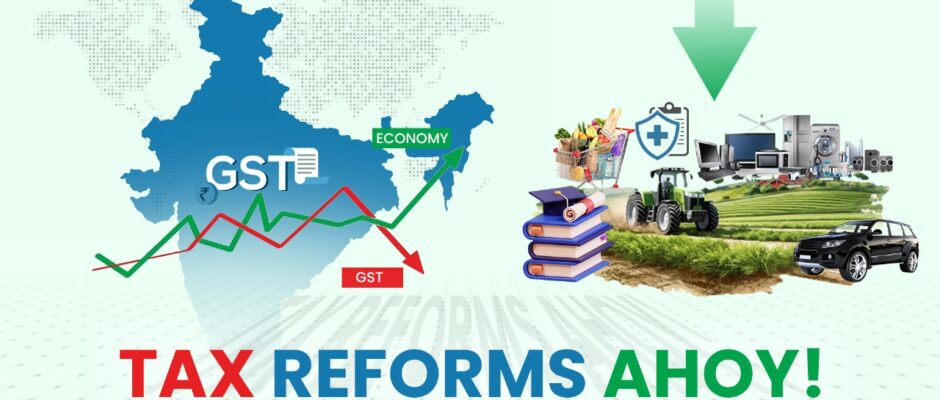
Modi government’s GST 2.0 reforms would make taxation more compliant, leave more money with people, take Bharat into a different league. K.A.Badarinath Goods and Services Tax was once sold as ‘one nation one tax’ by Narendra Modi led NDA government when it was first introduced on July 1, 2017 in Bharat. After 13-years of painful and protracted negotiation with states led by different political formations, multiple taxes at different levels were subsumed into this federal tax aimed at easing burden on businesses, taxpayers and reduce evasion. This single biggest tax reform brought in by Modi government was however seen with apprehension by a few stakeholders and several opposition parties that headed state governments. Today, most Indians are convinced that the reform path laid down by Narendra Modi government was firm, forward looking and easy to comply with. As on date, about 160 countries implement the GST or Value Added Tax (VAT) in some form or the other beginning with France in 1954. Though, India has been a late entrant into this taxation regime, it matured fast, compliance improved and held the tax mobilization campaign in last eight years on an even keel without disturbing the delicate applecart with 29 states and eight union territories. Revenue neutral rates for GST report put together by then Chief Economic Advisor, Arvind Subramanian, in December 2015 ahead the rollout studied Canada, European Union, China, Australia and Indonesia to make his recommendations. Subramanian had pointed to challenges in implementing a ‘dual rate structure’ in a federal system like ours. Similarly, Reserve Bank of India (RBI) report of 2017 had emphasised on big implementation risks faced by sovereign governments globally while implementing the GST. From evasion, under-reporting, cash deals, unregistered businesses, splitting invoices to making false claims, RBI flagged several issues in the implementation. World Bank that tracked initial years of GST implementation in India had underscored huge risks given the complexity of Bharat’s markets driven by states and local governments. But, the political leadership under Prime Minister Modi took a conscious call to implement GST, ease out the taxation burden on the system and get into the global league of ‘best compliant nations’. There were several naysayers across the spectrum. Prime Minister Modi and his economic ‘A’ team did not relent. It went ahead with roll out and implementing the dual GST with multiple rates akin to Canada which is the nearest in comparison. And, it’s for everyone to experience the impact and resultant taxation regime that delivered in eight years. Value Added Tax, State and Central Sales Tax apart from a multitude of imposts were replaced by the unified GST. This successful model served as a big trigger for Modi government to take up the next big reform measure and ring in the GST 2.0 regime beginning September 22 this year. On Wednesday, GST Council headed by Finance Minister, Nirmala Sitharaman, went into ten hour marathon huddle to thrash out two rate structure replacing the multiple slabs, provide massive relief to the hoi polloi. More than reworking the GST slabs to two at five per cent and 18 per cent, the biggest move was to do away with the12 per cent and 28 per cent slabs that were huge on revenue earnings for the government. One estimate suggests that by moving 99 per cent goods and services from 12 per cent to five per cent bracket or completely exempting daily use items from tax impost, Modi – Sitharaman played big by foregoing Rs 48,000 crore revenues in next two quarters of this fiscal. If one were to factor in the huge tax concessions of Rs 100,000 crore announced in Union Budget on February 1, 2025 and GST rate cuts as well as exemptions, middle-class and salaried classes gain substantially. Exempting both life and non-life insurance products from levy of GST is yet another big reform measure given the social security gaps prevalent across sections. Big gainers in this GST reform are farmers, women, youth and vulnerable sections that feel the pinch of high taxation. Most daily use items have been taken away from GST ambit with nil taxes. From bread, channa to paneer, all these come without taxes. Latest round of GST reforms have a serious socio, economic and political messaging as well. Leaving more money with the people that would widen and deepen the consumption basket would also push up economic growth from expected 6.5 per cent this fiscal. If one were to take exempted items, ‘sin’ and ultra-luxury goods  rate of 40 per cent that include tobacco products, the two trick-ponies would partly offset the impact of US tariffs at 50 per cent and trigger economic growth. These tax reforms have not come in without adequate confabulation and computation by the economic managers. This was coming! Prime Minister Modi himself had hinted at GST reforms from ramparts of Red Fort in his Independence Day speech last month. It’s not fait accompli or desperation. It’s a well thought out reform measure that would lay an important brick in the foundation for developed Bharat. It’s early Deepawali for all! Companies, service providers – both domestic and foreign – are bound to rejoice and make merry like the consumers. Great festivities ahead! (Author is Director and Chief Executive of New Delhi based non-partisan think tank, Centre for Integrated and Holistic Studies)
Read More
Options Galore!

Options Galore!

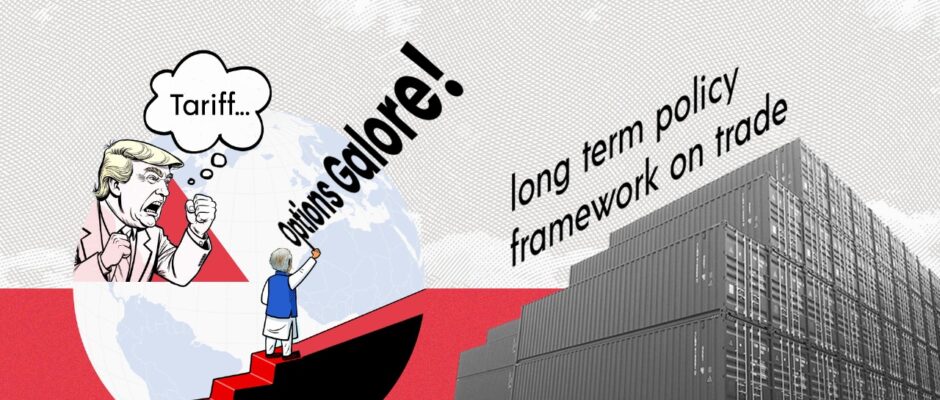
Putting in place long term policy framework on trade, investments, currencies, geo-political alignments to protect Bharat’s interests must be priority. K.A.Badarinath United States President Donald Trump’s adversarial tariff policy on India has largely been regarded ‘flip flop’ hinting at fluid stance and diabolical in spirit and content. From being most favoured trading ally with minimal tariff proposal of 10 per cent in April 2025, India has been bracketed in the list of enemy countries that attract highest impost of 50 per cent. Numbers and data apart, there has been a lot of noise, nervousness and anxiety as clock ticked 4 pm in last few days in India. It’s at about that time of the day Trump first announced 25 per cent and later doubled it to 50 per cent triggering a flurry of activity. Old timers did not miss the drama, show shah and high decibel drama that Trump put on these days targeting one or other trading partners.  It was the turn of Bharat in last few days. A 21-day window announced for tariffs to kick in signalled that Trump was open to negotiation before inking the trade deal. It’s one way of exerting pressure on New Delhi’s negotiators to sign on a ‘bad trade deal’ which means granting US unhindered access to agriculture, fisheries and dairy sector in India. President Trump’s optimism to drive a hard bargain also reflects from his statement, “it’s only been eight hours, let’s see what happens…you are going to see a lot more and some secondary sanctions”. The eight hour time frame referred to by Trump hints at his ‘wait, watch and strike’ attitude in the midst of serious negotiations. Contrary to drama associated with Trump’s diatribe, India’s response has been mature, measured and nuanced in last fortnight within and outside the parliament. Unreasonable, unfair and unjustified is how India described Trump’s executive order on 50 per cent levy. For the first time, Prime Minister Narendra Modi stuck his neck out and took it upon himself the consequences of tariffs tantrums thrown by President Trump. Modi said unequivocally that he was willing to pay a heavy personal price as Trump’s tariffs would impact large number of labour intensive and rural sectors. First, Prime Minister Modi has taken personal responsibility for the impact trade pact and tariffs would have on 1.4 billion plus Indians. Modi’s statement at M.S.Swaminathan International Centenary Conference on Thursday is very significant. He’s not willing to compromise on protecting farmers, rural people interests and labour intensive industrial sectors. Also, he was willing to face the political flak and pay heavy personal price on consequences given opposition parties’ intransigent line on United States. Prime Minister Modi understands that throwing open the agriculture sector to US is not only economically unviable but politically unsalable to the core Hindu vote bank, Sangh parivar and the ecosystem. On factual analysis, Modi government will have to deal with adverse impact on GDP growth of 0.2 – 0.4 per cent in case tariffs finally stay at 25 per cent during this fiscal. Top analysts estimate that entire US $ 86.5 billion annual goods exports from India to United States may turn non-competitive or commercially viable. Given that US is top market for India and constitutes about 18 per cent of its global goods exports and constitutes 2.2 per cent GDP, strains have begun to appear on near future. Given Prime Minister Modi’s steadfast commitment to protect India’s national interests, Indian negotiators are breathing easy. The proposed 50 per cent duties, if they kick in finally, translate to unannounced trade sanctions or embargo on India thereby worsening the strain in relations between the two countries. One big fall out that’s largely speculated was that India may not buy F-35 stealth fighter jet aircraft from United States. Factual position so far is that after US offered to sell these jets, formal negotiations have not yet begun. And, these discussions may remain a non-starter. Secondly, India may consider imposing retaliatory duties on 28 US products including its apples and walnuts given the precedent in 2019 to counter restrictive levies Washington DC had imposed on Indian steel and aluminium products. Thirdly, the arc of dis-engagement between India and US may widen for the time being unless recalibrates its trade and tariff policies. Fourthly, an aggressive campaign may be launched by the ruling party and the government to go local and opt for ‘made in India’ products and services. Fifthly, Prime Minister Narendra Modi may mobilize people in socio-economic spheres for adapting ‘swadeshi’. Sixthly, realigning India’s trade, investment, economic, geo-strategic relations may be a big option. Russia, China and other countries engagement may be enhanced to counter-balance US Republican White House under President Trump’s stewardship. Aligning with countries like Brazil who have been put on high tariff line by US could be an option. Seventhly, present developments may lead to expanding time tested foreign policy of strategic autonomy to protect India’s offensive and defensive interests. This may also be the right moment to promote south – south trade engagement. Eighthly, upcoming conclaves of Shanghai Cooperation Organization (SCO), Quad and BRICS may be occasions for India to sharpen its policy framework for global engagement. Ninthly, evolving an independent financial architecture, decoupling from US dollar or hastening BRICS currency to opt for diversification in payments may also be considered. Tenthly, putting in place medium and long term policy on currencies and oil will go the India way. (Author is Director and Chief Executive of non-partisan New Delhi based think tank, Centre for Integrated and Holistic Studies)
Read More
Damn EU Oil sanctions!

Damn EU Oil sanctions!

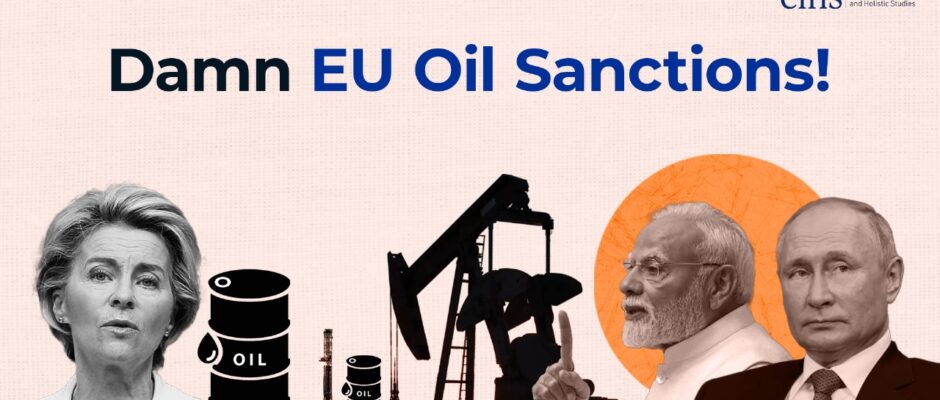
Strategic autonomy coupled with its right to source crude at affordable prices and quality is non-negotiable. Here’s New India… By NC Bipindra Latest round of sanctions announced by European Union on July 18, 2025, has opened a new chapter in the growing geopolitical standoff between Brussels and New Delhi. For the first time, EU has directly targeted Indian oil trade, specifically naming Nayara Energy’s Vadinar refinery which is majority-owned by Russia’s Rosneft. The EU sanctions, coming as it does within days of NATO Secretary General Mark Rutte’s warning about secondary sanctions on India, are part of these regional institutions’ crackdown on what it calls indirect financing of Kremlin’s war in Ukraine. At the heart of this issue lies India’s continued and unapologetic purchase of discounted Russian crude. India has been refining this oil and exporting resultant diesel and jet fuel, some of which flows back into Europe. While New Delhi views this as a perfectly legal and economically sound strategy, Brussels sees it as a dangerous workaround that weakens Western sanctions regime. What makes this clash more than a bureaucratic quarrel is its broader significance for global energy markets, economic diplomacy and tests limits of Western pressure in a multipolar world. Why Is the EU Escalating Pressure on India over Russian Oil Purchases? EU wants to isolate Russia economically. India, however, is determined not to compromise its energy security and strategic autonomy, the principles it considers non-negotiable. From European perspective, India’s growing role as a refinery hub for Russian crude threatens to undercut its sanctions framework. Eighteenth package of EU sanctions which includes lowering price cap on Russian crude to about $ 47.60 per barrel and sanctioning over 100 tankers in Russia’s so-called “shadow fleet,” is aimed at choking off alternative routes for Russian oil revenue. By focusing on Indian exports and targeting refineries like Vadinar, Europe is sending a clear message that it will go after any actor — state or private — that contributes to propping up Moscow’s war chest. What are Its Strategic Imperatives? But India isn’t taking this lightly. Ministry of External Affairs responded swiftly and sternly, calling the EU’s actions unilateral and unjust. Officials in New Delhi accused the bloc of practicing double standards, pointing to Europe’s own imports of Russian LNG and uranium even after war in Ukraine escalated. Energy security, Indian leaders assert, is not just a matter of policy but a constitutional duty, especially for a developing nation with over 1.4 billion people striving for economic growth and social stability. From New Delhi’s standpoint, its trade with Russia is both lawful and pragmatic. Indian officials frequently cite EU Regulation 833 / 2014, which states that once a good is substantially transformed in a third country, it is no longer considered to originate from the sanctioned country. India’s External Affairs Minister Dr. S. Jaishankar and Petroleum Minister Hardeep Singh Puri have made this argument repeatedly, maintaining that diesel refined in India is legally distinct from the Russian crude it was made from. The economic logic behind this policy is also compelling. Minister Puri has stated that importing discounted oil from Russia has saved India billions of dollars, helped stabilise inflation and shielded consumers from worst of global energy shock. In a world still reeling from economic aftershocks of the pandemic and the war, these savings have helped India remain on a steady growth trajectory while other economies faltered. India’s position is also shaped by deeper strategic calculations. The country has long prided itself on its foreign policy of non-alignment, now recast as “strategic autonomy.” This allows New Delhi to navigate complex relationships with both the West and traditional partners like Russia without being forced to pick sides. India’s close defence and energy ties with Moscow continue, even as it deepens cooperation with the United States and European Union in other areas like technology, trade, and counterterrorism. What are India’s Strategic Options? Rather than cave in to external pressure, India has quietly but effectively diversified its oil imports. Over past year, it has increased purchases from Middle Eastern countries, United States, Brazil and new suppliers in Africa and Latin America. This diversification has enabled India to demonstrate that it is not wholly dependent on Russian oil, even as it defends its right to continue buying it. At the same time, India has expanded its investment in natural gas, renewables and long-term energy security. A 15-year LNG deal with United Arab Emirates’ ADNOC, for example, will bring in one million tonnes of gas annually, supporting the country’s gradual shift toward cleaner fuels. India’s resilience is also built on its ability to conduct trade outside of Western financial and logistical systems. Russia has set up rupee-based trade settlements, used vostro accounts through Indian banks and relied on non-Western insurance and shipping firms. This alternative infrastructure insulates India-Russia energy trade from Western sanctions to a large extent and helps maintain stability despite external disruptions. Even as EU tightens restrictions and hints at possible secondary sanctions, India continues to find new export markets for its refined petroleum products. Africa, Southeast Asia and Latin America have emerged as key destinations where buyers are less concerned about the origins of crude and more focused on price and availability. These regions offer India a buffer against any loss of European markets, keeping its refineries running and export revenues intact. At the legal level, India has pushed back forcefully the very idea of violating sanctions. Indian legal experts argue that under international law, unilateral sanctions not backed by United Nations are not binding. New Delhi has taken this position consistently and has also pointed out hypocrisy of Europe’s own uneven implementation of sanctions where Russian LNG and enriched uranium remain untouched by embargoes. Behind all this lies a larger philosophical question. Should developing countries bear the brunt of economic disruptions caused by conflicts they did not start and do not control? India has answered this with a firm no. It argues that energy access at affordable prices is a matter of global

Read More
Titanic Shifts Inevitable!

Titanic Shifts Inevitable!

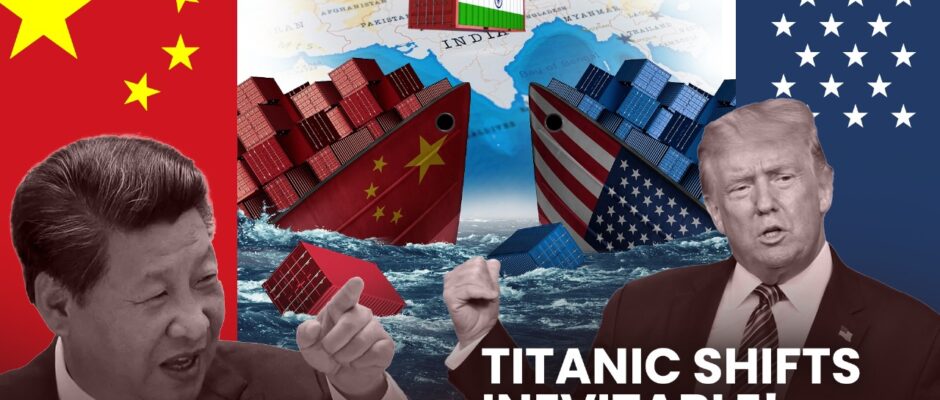
Trump’s tariff wars provide a window of opportunity to Bharat for proving its mettle as a global force to reckon with its own economic development model. K.A.Badarinath There’s a huge body of analyses on possible impact of tariff orders signed by US President Donald Trump in last few weeks. Those in favour and against have argued emphatically leaving room for further discussion given that tariffs, trade and economic engagement has gained pre-eminence and a developing story. Several analysts described recalibration of tariffs as trade war. Yet others have attempted to look at implications of the trade centric conflict overflowing into geo-political stratosphere.  Markets – equities, currencies, commodities, bullion and a host of financial products – felt the immediate impact. There has been roil in the market place. Billions of dollars’ worth investors’ wealth either vanished over night or partially restored as tariff orders were released by the White House in quick succession beginning ‘liberation day’ as Trump pompously described. Companies, services providers and logistics firms scurried for cover even as President Trump essentially targeted European Union with whom US has a trade deficit of $ 200 billion and China with deficit exceeding US $ 300 billion. Sixty countries – friends and foes – were treated by Trump with derision and slapped with counter-tariffs to bring down the US trade deficit that piled up to US $ 1.2 trillion. Some economists also pointed to trade surpluses run by US with about 100 countries which were royally ignored by ‘transactional Trump’ administration. Trump’s political agenda in run up to 2024 Presidential campaign centred around correcting the ‘unfair’ ripping of American people, businesses and denying his ‘voters’ the job opportunities thereby shifting manufacturing out of US. This is also the biggest ‘political agenda’ item of Trump that got him into power for a defining second four-year term. Apart from addressing domestic core whites’ constituency that were central to his ‘Make America Great Again’ agenda, Trump’s belief centre’s around ‘lifting the burden of American people’ on whose shoulders the world rejoices. Now that the trade, tariffs, manufacturing and jobs agenda gets to be implemented in US, the signals are ominous for anyone and everyone to pick up and put their counter-offensive in place. A lot of counter-offensive from US trade partners was kept on hold as 90-days window to fast-track trade and economic partnership negotiations began in Washington DC and elsewhere. China, however, has been treated differently after having slapped 145 per cent duties on most goods and services exported to US. China that countered with 84 per cent tariff on US goods and services was not part of the 90-days pause plan announced by President Trump. For now, trade war has turned direct and vicious between US and China while the latter owed ‘fight to finish’ action plan. Trade centric war is evolving and one may not see much hope in bringing this to an early close as negotiations between trade partners and US would be a long drawn process. Even if trade issues are sorted out, the impact would be profound on Western model of ‘globalization’ that got rolled out post-World War II and setting up of Bretton Wood institutions is bound to hit reset button. A fresh look at global trade and economic engagement is something that’s unavoidable or rather inevitable. This re-engagement will have huge bearing on socio-economic development paradigm of global communities especially with larger number of people reeling under poverty. A more America-centric economic policy roll out by Trump and ‘inward’ looking framework would lead to conceding geo-political and economic space to big players like Communist China. Each country – big or small – will have to learn fast to fend for itself and not depend on big brothers in either US, China or European Union. Next four years may also see ‘many more’ socio-economic self-reliance campaigns. It’s in this context that Bharat’s ‘self-reliance’ campaigns being run last eleven years would gain significance as existing value chains get rejigged, decoupling and re-engagement were definitively on the horizon. Bharat’s ‘strategic autonomy’ in terms of foreign policy and by extension, economic engagement, will hold strong. Unwilling to react in a hurry, announce counter-measures in a huff like several members of European Union or China, Bharat fell back on ‘time tested’ autonomous policy postulation. Free Trade Agreements (FTAs) with US, European Union and United Kingdom may have to be reworked with other economic parameters like investments more closely aligned. Secondly, given that Bharat has been treated ‘even handed’ with 26 per cent additional tariff, New Delhi should resist the temptation of falling into anti-US blocks. This should not translate to closing the door firmly on China that offered to align with Bharat to take on US. Thirdly, Bharat may consider making new partners on equitable and respectable terms that’s ‘mutually beneficial’ and ‘long lasting’ while economic engagement takes on new hue and different shade. Fourthly, measured and nuanced approach to trade, economic, development and geo-political engagement may have to be pursued in the spirit of ‘vasudaiva kutumbakam,’ the world is one big family. Fifthly, given that Bharat is on an ascent mode, wading through economic uncertainties globally and achieving its objective of becoming a ‘responsible economic power house’ will have to be carefully crafted. Sixthly, open, flexible, rules and regulations driven economic engagement with a ‘human face’ in reaching out to last man standing in queue should be basis for Bharat’s approach. Seventhly, this is the perfect time and context to present its own model of socio-economic development model that’s not exploitative, solely driven by consumer centric approach and instead push for synergies between nature and human living that’s sustainable in terms of judicious utilization of resources. Eighthly, realignment of global forces, both geo-political and market centric, is inevitable. And, carving out a distinct role for itself with responsibility is what’s recommended. Ninthly, falling back big on indigenous knowledge, development ecosystem based on sanatan Dharmic values for shared prosperity will test Bharat’s mettle. Tenthly, leadership role cannot be played from

Read More
It’s Yagna & Sadhana

It’s Yagna & Sadhana

Economic Survey for 2024 – 25 pushes for deregulation and reforms as sure shot prescription for higher economic growth, resilience, employment, lower business costs amid global uncertainties. V. Anantha Nageswaran It will be over six months since the last Economic Survey when you lay your hands and cast your eyes on this document and this preface. In theory, there should not be much to write in this preface, given the short time lapse since the last Survey. In reality, there is. The world is perhaps evolving more rapidly than we realise. In the longer span of history, this is par for the course. But, we will leave that contemplation for another occasion. 2024 was a year of elections. Three big democracies went in for elections: India, America, and Indonesia. India returned the incumbent to office for a third term. The ruling party continued in Indonesia with a different leader at the helm. In America, there was a change in the presidency. The new President has been in office for less than two weeks now. The world has had an early inkling of policy changes that will affect the global movement of goods and labour. Europe faces both political and economic uncertainties. Europe’s biggest economic engine, Germany, experienced economic contraction for two successive years. Political uncertainty, too, is a factor since elections are due to be held in February this year. France has had political uncertainty due to developments in the wake of the snap elections called there. The United Kingdom had a change of government. After a long gap, the Labour Party came into office amidst fiscal pressures and a slowing economy. In general, Europe is facing competitiveness pressures amidst much higher energy costs caused, in part, by the transition towards renewable energy. To a large extent, these developments have affected the global economy. The Index of Global Economic Activity of the Federal Reserve Bank of Dallas has been volatile since the pandemic began slowing at the end of 2023. The reopening of the Chinese economy after the Covid shutdown has not led to a spurt in economic growth rate as overcapacity and financial strains in the real estate sector have come to the fore. Due to weak aggregate demand, the economy is in deflationary mode. The absence of a significant policy stimulus to boost domestic consumption has seen excess capacity spill over into external markets. Chinese exports are thriving. China’s trade surplus in 2024 was nearly one trillion US dollars. Recent strength in the US dollar and rethinking in the Federal Reserve about the path of policy rates in America have caused emerging market currencies to weaken. Fiscal strains and low real rates relative to history have led to rapid erosion of value in some currencies compared to others. Borrowing costs for sovereigns are also rising as financial markets re-evaluate the outlook for inflation, policy rates and fiscal prudence. Several stock markets worldwide are at elevated levels and do not appear unduly concerned about economic growth and earnings uncertainties. Nor have financial stability risks fazed investors even though serious concerns are re-emerging about securitisation, leveraged loans. “The Future of European Competitiveness” Mario Draghi wrote: “The EU also benefitted from a favourable global environment. World trade burgeoned under multilateral rules. The safety of the US security umbrella freed up defence budgets to spend on other priorities. In a world of stable geopolitics, we had no reason to be concerned about rising dependencies on countries we expected to remain our friends. But the foundations on which we built are now being shaken. The previous global paradigm is fading. The era of rapid world trade growth looks to have passed, with EU companies facing both greater competition from abroad and lower access to overseas markets.” This is the global backdrop for India as it seeks to steady and sustain the growth momentum that the economy has experienced post-Covid. The passing of the era of rapid world trade growth clouds the outlook for India’s export growth because, historically, India’s export growth has been a high beta play on global export growth. This means domestic growth levers will be relatively more important than external ones in the coming years. The report on European competitiveness could easily have been written for India. Most of the challenges cited therein apply to India, except that India is an aspiring nation, and the European continent has the cushion of a higher per capita income. Europe is, by and large, ageing, but India has a more youthful demographic profile. That is an advantage, but it comes with a huge responsibility. One of the refrains in the Draghi report is the ‘China Challenge’ to European competitiveness. It is no less for India. Several commentators have recently written about the manufacturing colossus that China has become in the last six years. India faces limitations in producing critical goods at the scale and quality required to serve the infrastructure and investment needs of an aspiring economy. For instance, India has low production capacity in the solar energy sector for key components like polysilicon, ingots, and wafers. The production capacity of monocrystalline silicon ingot is expected to quintuple by 2035 from 2 GW in 2023, but it won’t be enough to meet the demand in the country. Several solar equipment manufacturers in the country significantly depend on Chinese supply chains and related services. The single-source concentration risk in several product areas exposes India to potential supply chain disruptions, price fluctuations, and currency risks. India’s task is cut out. It means going all out to attract, promote and facilitate further domestic and foreign investments that India needs to become a competitive and innovative economy. It will not be easy because competition for investment is not only with other emerging economies but advanced economies, too, who are determined to keep their businesses at home. Equally, investing in and strengthening domestic supply-chain capability and resilience will be the hallmarks of strategic and long-term thinking on the part of the private sector. Alternative sources of supply,

Read More

Growing Clout, Footprint

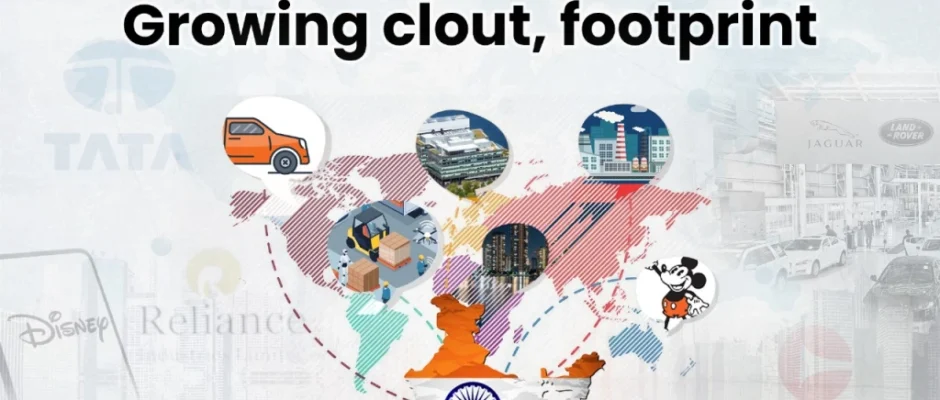
Bharat’s businesses have come off age, taken over several global brands, top line corporates lock, stock, barrel or partnered in US, UK & Europe K.A.Badarinath Two large deals sealed in just one week speak volumes about Indian corporates verve, gut and appetite for going global. Reliance Industries Ltd (RIL) and Walt Disney tango in Bharat’s media, television and entertainment industry is not limited to creation of US $ 8.5 billion behemoth. It opens up a zillion opportunities for Indian companies, vendors and challenges competition to surpass this milestone. This joint venture also marks Bharat’s film-makers, entertainment and media firms going global hand in hand with best in the industry. Asia’s richest businessman Mukesh Ambani and his wife Nita Ambani being hands on RIL – Walt Disney gives a spicy twist to the deal. Going forward, the joint venture model can work well and logically in global territories and it throws up an opportunity for Reliance – Disney – Century Fox to become a formidable player in media and entertainment sectors internationally. Another home grown billionaire from The Punjab, Sunil Bharti Mittal sent tongues wagging when Bharti Airtel group heralded by him emerged biggest stakeholder in the British iconic telecom services provider, British Telecom. Buying out the Israeli magnate Patrick Drahi led Altice group’s entire stake and cornering 24.5 per cent in British Telecom for US $ 4 billion is the icing on cake for Sunil Bharti Mittal whose Bharti group provides telecom services in 17 countries. In the process, Mittal has emerged largest stakeholder in British Telecom, hitherto the public telecom services provider. What would have been more satisfying for Sunil Bharti Mittal is that life has come full circle. Before 2010, British Telecom held over 21.5 per cent stake in Mittal’s then fledgling Bharti Airtel. This deal not only provides high-stakes branding push but allows Bharti Airtel access to United Kingdom’s 5G technologies, artificial intelligence networks and cutting edge technologies. Deutsche Telecom and T-Mobile Holdings with 12 per cent each are the two other large owners of British Telecom. Strategic insights in telecom, media and corporate markets in United Kingdom and Europe are something Sunil Bharti Mittal should look forward to being at head table of British Telecom. Bharti is not the first Indian company to go shopping in United Kingdom, US or Europe for iconic companies and brands that were seen as value enhancing prepositions. Most talked British brand and company acquired was Jaguar Land Rover by Tata group that was once mocked at for having produced the smallest and modest ‘Nano’ car. Uptight United Kingdom honchos could hardly come to terms with being led by a coloured team of Tata professionals to turn around the JLR that was once seen as a drain on the company and Britain was struggling to save the automobile brand. When Ratan Tata, easily the most celebrated businessman walked into the boardroom of Ford on March 26, 2008 to acquire JLR business at US $ 2.3 billion, disbelief and disconnect confounded top leadership team of British company. In 15-years, the group has turned around JLR into a kicking Bharat – British brand that’s hard to compete with. Tata group was labelled audacious when it took Corus Steel in $ 12 billion bid around the same time to emerge UK – Europe’s one of the largest players in steel market. While this was happening, Reliance bought out one of the oldest and most recognized British toy company Hamleys with 259-years corporate history and British battery technology company, Faradion made global industry sit up to the onset of Indian buyers. Reliance acquisitions were relatively more modest, around the same time, Kumarmangalam Birla, yet another Indian billionaire had set eyes on Atlanta-based Aluminium major Novelis and acquired it in 2007 for a whopping US $ six billion. This catapulted the Aditya Birla group into fortune 500 companies list. After initial rush of half a dozen big ticket takeovers about 15-years back, scores of global brands and businesses came the Indian way or partnered to stay afloat. The list seems quite a long one and this phenomenon is across sectors. Several of them were risky investments and the familial story of turnaround for many Western companies was scripted by Indian businesses that stayed nimble footed for quite some time. For instance, none would have imagined that fourth Indian billionaire Anand Mahindra owned diversified group, Mahindra and Mahindra pumped life into BSA Motorcycles that stopped production about five decades ago. Birmingham Small Arms Company founded way back in 1861 known for producing motorcycles after Mahindra and Mahindra took over this defunct brand in 2022. As per Grant Thornton research, Indians own about 964 companies in UK alone as of last year if one were to go by a Reuters despatch earlier this month. It may not be an overstatement, to say that Bharat’s businesses have arrived. (Author is Director & Chief Executive of Centre for Integrated and Holistic Research based in New Delhi)

Read More

Bharat, force for Strength & Stability

In 78-years post-British imperialistic occupation, Bharat is on way to become ‘Vishwa Guru’ and pursuer of ‘Vishwa Maitri’ in right earnest. K.A.Badarinath Bharat is celebrating her seventy eighth independence day after having fought imperialist British occupation and monarchy. Before the ignominious exit of 1947, Britain has had for decades looted Bharat’s wealth, resources and hit at her backbone by Anglicizing the country’s millennial education system. The indomitable spirit, valour and strong civilizational connect based on ‘Sanatan Dharma’ could not be dented even after decades of inhuman rule that pushed Bharat into poverty owing to continued laundering and misrule of British imperialists. Post-1947, Bharat moved on its own with twists and turns in its socio-economic paradigm. What kept the Hindustan together last 78 years was the determination of this 1.4 billion people to regain its place as ‘guiding light’ in the comity of nations. Most Indians – be it Hindus, Buddhists, Jains, Muslims or Christians – get nostalgic and wee-bit emotional while celebrating the Independence Day. It was a struggle that none globally would easily forget as British rule was marked by White supremacist mindset laced with monarchial expansionism and human subordination and slavery of inhuman variety. Then on, Bharat re-discovered herself on all fronts. It’s her day today and centuries to follow as it moves methodically to become a developed country by 2047 that also marks 100 years of independence from British tyranny. Bharat’s rise as an economic powerhouse and her march to become third largest economy in two – three years with $ 5 trillion spread is something that did not come easily given the hard work of her farmers, services professionals, industry and exporters. It’s only a matter of time when Bharat would challenge US and China from their coveted positions. None can be scared or distraught with Bharat’s rise given her standing that strives continuously for peace, tranquility and harmonious living sans conflict, violence and expansionism of any hue or shade. Going by Bharat’s Prime Minister Narendra Modi speech on Independence Day from ramparts of the historic Red Fort, New Delhi will play a stabilizing role in the world marred by conflicts between Russia – Ukraine, Israel – Hamas and the coup of sorts in Bangladesh. Strength and determination is what Prime Minister Modi emphasized upon to tackle global challenges. Bharat being at the ‘High Table’ in international affairs would only bring sanity to deliberations and negotiations at strategic level or economic management. Even in tackling new challenges, Bharat has shown the way. After having been party to Paris agreement on cutting carbon footprint and shifting to environment friendly economic structures, Bharat is the only country that has met all climate targets among G-20. Notwithstanding her energy consumption demands, shift to green options rapidly towards ‘net zero’ voluntarily and leading by example is something Prime Minister Modi referred to in his speech on Thursday. His call for end to end chip designing for the world is an extension of Bharat’s huge strides made in industrial manufacturing including defence products, services across sectors and deft management of her economy. This will push up Bharat in global pecking order for modernizing her economy to meet international demand. Bharat’s list of ‘to do’ things seem endless if one were to look at reversing brain drain especially in key sectors like medical education. Adding 75,000 new medical colleges’ seats to 100,000 plus existing capacity is something that will help Indian youth and talent pursue their education here and cater to the world as professionals. Prime Minister Modi had clearly hinted that ‘overseas students should come to India for top class education’ and reverse prevailing outflow to foreign shores. Becoming global educational hub in five years may be a tough target to meet. But, its doable. These are transitioning times for Bharat to become ‘vishwa guru’ and pursuer of ‘vishwa maitri’. (Author is Director & Chief Executive of Centre for Integrated and Holistic Studies based in New Delhi)

Read More

Seven Red Flags That Can Sour India’s Growth Story

By Balbir Punj The 2024-25 budget is a smart fusion of political stratagem, coalition compulsions and a slew of deft moves to accelerate economic growth to help realise PM Modi’s resolve to turn India into a developed nation by 2047. However, given the domestic constraints and dismal emerging global economic scenario, the NDA Government’s quest to make India a global financial powerhouse is fraught with serious challenges. The wars in Ukraine and Gaza have disturbed global supply lines and devastated the world markets a great deal. No wonder the latest forecast for global growth five years from now, at three per cent, is the lowest in decades. The rise of India would be hamstrung by a bleak international scene, for a vibrant Indian economy will need to increasingly engage with the rest of the world. The budget is undoubtedly an exercise to retrieve the political ground the BJP lost to the opposition in the last Lok Sabha polls. But it’s not populist or irresponsible. The underlying theme is fiscal prudence and consolidation. The promise to peg the fiscal deficit at 4.9 per cent of GDP in 2024-25 is a significant reduction from 5.6 per cent last year. Finance Minister Nirmala Sitharaman has also reiterated her resolve to reduce the deficit to below 4.5 per cent by next year. The misgivings about India emerging as a developed nation over two decades from now aren’t entirely misplaced. India faces some insurmountable challenges that are difficult to deal with, particularly with a fractured polity that has evolved post-2014. Outrageous toxic narratives – completely divorced from facts and reality – are banded about to derail the public discourse.  ‘Caste-identity’ – a divisive signature tune – is the season’s flavour. What’s the basis for believing that Modi’s vision of a developed India is not just a pipe dream but something doable? His track record. During his previous two terms, Modi managed to break the mould. Defying the system, he ensured the delivery of benefits to ordinary people sans any leakage. Modi made available gas connections, foodgrains, toilets, housing, drinking water, and road connectivity to crores of Indians. As a result, poverty levels dropped drastically, and today, India is among the world’s fastest-growing large economies, with a GDP growth above eight per cent. But here is the proverbial catch. The aspirations of millions who have moved out of morasses of poverty have since outgrown what the state freebies can offer. This exploding phenomenon is full of unchartered challenges and unexplored opportunities for the country. The expectations of India’s young millions have soared to unprecedented levels. They now want access to a decent standard of living. But can India meet their aspirations? Seven red flags can hold the country back and sour its dreams. #Education and Jobs: Among the “real” challenges India faces, the Economic Survey (2023-24) has outlined the lack of jobs. According to the survey, the country must create an estimated 78.5 lakh jobs annually. The government has launched five schemes to fix the problem. It’s a patchwork solution and leaves the core of the problem untouched. The issue is not unemployment. It’s that of ‘unemployable’. Leaving aside some islands of world-class academic excellence, most organisations styling as educational institutions don’t dispense education or talent but degrees. The state-run educational system is broken. There is no serious effort to resurrect it. According to the 2023 Annual Survey of Education, almost a quarter of all youth (14-18 years) cannot fluently read a class 2 text in their regional language. Only 43% can solve simple division sums. There are millions of slots waiting for qualified candidates. India ranked seventh in a talent shortage, with 81 per cent of employers reporting difficulty finding a skilled workforce. The skill gap is estimated at 2-2.5 million. It’s difficult to miss the irony – millions of jobs are going abegging, and countless remain unemployed. Rising Trade Gap with China: India-China trade touched almost $118 billion, with India’s exports at only $16.67 billion, with a trade deficit of over $100. The Economic Survey has termed it a “challenge”, a “Chinese Conundrum”, and a problem sans a solution. There appears to be no escape from the fact that China would continue to be the overbearing trade partner, with sinister implications for India’s security. Bureaucracy: Rampant corruption and inefficiency have been India’s bane. To Modi’s credit, corruption is nearly extinct in the top echelons of politics and babudom at the centre. However, the twin evils of graft and sloth continue to gnaw at the system from within. The raging NEET controversy and the scandal involving Puja Khedkar, a probationary IAS officer (now under investigation), underline the unsavoury fact of the extent to which the rot has set in. No plans, however perfect they may be, can work till the delivery mechanism is fixed. Judicial Reforms: To repeat an adage, justice delayed is justice denied. These statistics speak for themselves.  In 2024, the total number of pending cases of all types and at all levels stood at 5.1 crores, including over 180,000 court cases pending for more than 30 years in district and high courts. Agriculture: The growth in agri-GDP in 2023-24 (FY24) was just 1.4 per cent as per the latest provisional estimates. The second advance estimate was, in fact, only 0.7 per cent. This sector engages 45.8 per cent of the workforce. Most of those claiming to be ‘kisans’ are, in fact, victims of disguised unemployment. Giving 5 kg/per capita/month of free rice or wheat is a dole. Vested interests (read so-called farm protests of 2020-21) successfully sabotaged all efforts to introduce reforms in this sector. This large section of India’s population has to be partnered in the country’s success story. Distorted Narratives: Foreign-funded groups have been hijacking popular mandates using globally tested tool-kits by building narratives based on white lies, half-truths and twisted facts. The ‘toolkit’ was used during India’s CAA and farm law protests. Power Outage: Per capita electricity consumption in India jumped from 16 units in 1947 to 1327

Read More