
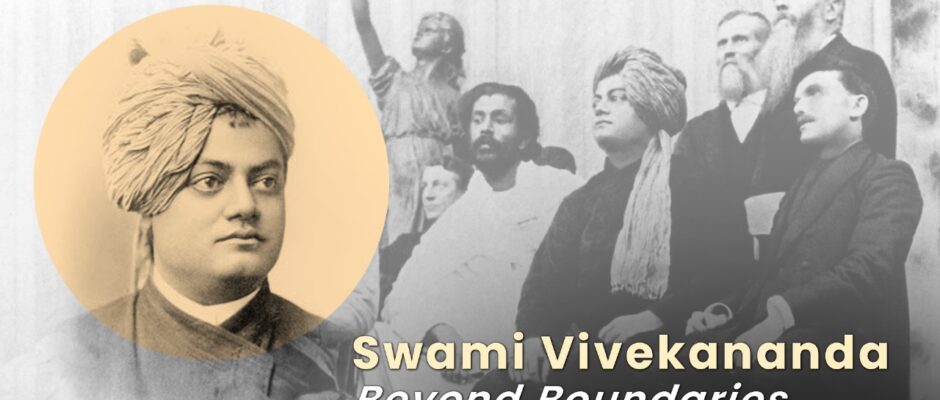
Vivekananda, Beyond Boundaries
Swami Vivekananda’s holistic vision—where reason, faith, science, and philosophy converge—guides us today. His belief in the unity of existence inspires us to seek deeper truths beyond boundaries. Dr. Shailendra Kumar Pathak Swami Vivekananda, a luminary whose wisdom bridged epochs and disciplines, stands as a timeless exemplar of how ancient Bharatiya philosophy can illuminate the most advanced scientific inquiries. His epochal address at the 1893 World’s Parliament of Religions introduced Vedantic thought to the global stage, but this was merely a fraction of his intellectual legacy. Vivekananda’s profound grasp of Vedantic principles, combined with his reverence for scientific inquiry, inspired a generation of thinkers and continues to resonate in domains ranging from quantum physics to biotechnology. His vision was not a mere reconciliation of two seemingly divergent streams—spirituality and science—but a revelation of their shared foundation as pathways to universal truth. Vivekananda’s insights on the nature of reality anticipated many aspects of modern scientific discourse. His interpretation of Vedantic concepts such as Akasha (space or ether) and Prana (energy) aligns remarkably with contemporary explorations in quantum physics. During his conversations with Nikola Tesla, he explained how the Vedas described the fundamental unity of matter and energy. This dialogue inspired Tesla to explore these ideas in his experiments on energy transmission and wireless communication, underscoring the universality of Vivekananda’s thought. The Vedantic assertion that the universe is a manifestation of one underlying reality resonates with the principles of quantum mechanics, particularly the idea of quantum entanglement, which reveals the interconnectedness of particles regardless of spatial separation. The relevance of Vivekananda’s ideas extends beyond theoretical physics to the burgeoning field of biotechnology. His emphasis on the sanctity of life and the interconnectedness of all beings provides a philosophical framework for addressing the ethical dilemmas posed by advancements in genetic engineering, cloning, and artificial intelligence. Biotechnology, which often grapples with questions of purpose and responsibility, can draw inspiration from Vivekananda’s vision of a science guided by spiritual values. He believed that scientific progress should serve the greater good, aligning with the Vedantic principle of Lokasangraha—the welfare of the world. His call for integrating morality and science offers a crucial counterbalance to the unbridled pursuit of technological power. In the realm of neuroscience, Vivekananda’s insights into the nature of consciousness have found an uncanny echo in contemporary research. His assertion that the mind and body are interconnected systems aligns with modern understandings of neuroplasticity and the mind-body connection. The Vedantic idea of Chitta (consciousness) as a continuum that transcends individual experience mirrors the quest in neuroscience to comprehend the origins of consciousness and its universal aspects. As scientists explore meditation and mindfulness as tools for mental health and cognitive enhancement, Vivekananda’s teachings on the transformative power of concentrated thought and inner discipline gain renewed significance. Swami Vivekananda’s vision also anticipated the global shift toward interdisciplinary collaboration in research and innovation. He recognized that no single discipline could adequately address the complexities of human existence. His advocacy for blending the rigor of Western science with the depth of Bharatiya spirituality prefigured the integrative approaches now prevalent in fields such as bioethics, environmental science, and systems biology. His belief in the complementarity of external and internal exploration reflects the ethos of holistic science, which seeks to harmonize the empirical and the experiential. Moreover, Vivekananda’s philosophy has practical implications for contemporary education systems, particularly in fostering innovation and critical thinking. His call for self-reliance, Shraddha (faith in oneself), and the pursuit of knowledge as a sacred endeavor offers a compelling model for nurturing creativity and ethical responsibility in the next generation of scientists and technologists. In a world increasingly driven by artificial intelligence and machine learning, Vivekananda’s emphasis on the primacy of human values and the cultivation of wisdom over mere information remains profoundly relevant. The advancements in cosmology and astrophysics, too, bear an intriguing alignment with Vivekananda’s vision. The Vedantic view that the universe emerges from and dissolves into an infinite consciousness parallels theories of the cyclical nature of the cosmos, such as the Big Bang and the Big Crunch. Scientists probing the origins of the universe are increasingly acknowledging the limits of purely materialistic paradigms, opening the door to perspectives that transcend conventional boundaries. Vivekananda’s assertion that the universe is a dynamic interplay of energy and consciousness offers a metaphysical lens through which to interpret these discoveries. The impact of Vivekananda’s ideas is not confined to philosophical musings or theoretical sciences. It extends to applied sciences, such as renewable energy and sustainable development. His emphasis on simplicity, self-discipline, and respect for nature aligns with the principles of sustainable living, providing a moral compass for addressing the environmental crises of our time. In a world grappling with climate change and resource depletion, his teachings encourage the pursuit of technologies that harmonize with nature rather than exploit it. Vivekananda’s ability to see science and spirituality as mutually enriching pathways to understanding underscores his enduring relevance in a world increasingly shaped by technological advancements. His life and work serve as a reminder that the highest purpose of knowledge is not domination over nature but harmony with its deeper truths. As the boundaries of science expand into realms once deemed metaphysical—whether in exploring the multiverse or decoding the nature of consciousness—Vivekananda’s vision stands as a guiding light, urging humanity to balance the pursuit of knowledge with the cultivation of wisdom. In reflecting on Swami Vivekananda’s contributions, it becomes evident that his ideas transcend the limitations of time and place. He did not merely harmonize the East and the West or religion and science; he revealed their underlying unity. His vision of a science imbued with spiritual depth and a spirituality informed by scientific rigor offers a transformative paradigm for addressing the challenges of the modern age. As humanity stands on the cusp of unprecedented advancements in quantum computing, genetic engineering, and space exploration, the need for a moral and philosophical grounding becomes ever more critical. Vivekananda’s teachings provide that grounding, reminding us that true progress lies not in the