CIHS – Centre for Integrated and Holistic Studies

Date/Time:

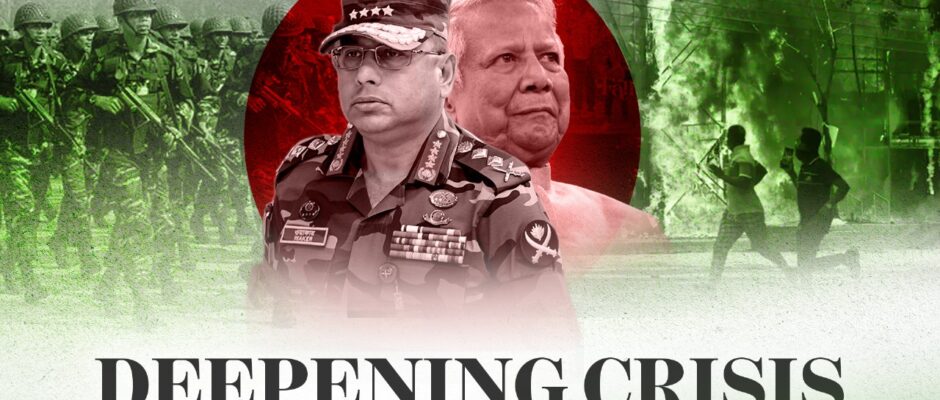
Deepening Crisis

Deepening Crisis

Shrinking democratic space, Yunus going jihadist way and western powers weary of his idiosyncrasies has turned Bangladesh a hotspot.  Rohan Giri Bangladesh is in the midst of a major crisis given the political chessboard that exposes changing power dynamics, jihdist takeover, assertion of the military junta and people left to fend for them with the state giving up on governance. It’s not mere domestic political reconfiguration but a crisis in the making with both national and regional consequences. At the heart of this narrative lies decline of a figure once championed in Western capitals, Muhammad Yunus and subdued recalibration of power that tells extensively about where Bangladesh is headed and how the world must understand this transition. Muhammad Yunus, once hailed as a Nobel laureate and Grameen Bank microfinance model builder, was long seen as a link with Western liberal values.  But in today’s Dhaka, Yunus no longer commands the stature of a unifying reformist and an elderly statesman. His legal troubles, political marginalisation and increasing distance from the country’s current power centres suggest a systemic and perhaps irreversible break from liberal-democratic experiment that he once symbolised. His estrangement from the Bangladesh Nationalist Party (BNP), historically the principal opposition to erstwhile ruling Awami League, marks a decisive shift. Even Yunus lacks institutional support from security establishments, rendering such alliances practically ineffective. A recent massive rally titled “Rally for Establishing Youth Political Rights” was held in Dhaka by three BNP-affiliated groups, Jatiyatabadi Chhatra Dal, Jubo Dal, and Swechchhasebak Dal as Yunus left for a four-day visit to Japan. BNP Acting Chairman Tarique Rahman addressed the rally virtually, criticising the Yunus-led government. Days earlier, a BNP delegation demanded an election roadmap by December and urged the interim government to avoid long-term policy decisions especially on issues like the Rohingya corridor and Chattogram port. The political gap left after fall from the Awami League’s unquestionable supremacy has not resulted in democratic transition, realignment of democratic forces.  Once a prominent player in Bangladeshi politics, Awami League under Sheikh Hasina, has been accused of authoritarian drift, methodical repression of opposition and getting alienated from voters. The conditions are ripe for alternative centres of power to emerge not necessarily from existing political formations but actors whose influence is wielded from behind the veil of legitimacy. One such actor is Bangladeshi military that has distanced from Yunus. Historically, taking a cautious, if not aloof, approach to overt governance. The current climate indicates its willingness to fill the power vacuum. Notably, words and postures emanating from within the army reflect displeasure with both existing political leadership and personalities, like Yunus, who are frequently portrayed as associated with Western liberal objectives. The military’s reluctance to re-embrace Yunus reveals a deeper strategic concern: aligning too closely with an internationally admired but locally polarising individual risks alienating burgeoning nationalist sentiments and undermining internal cohesion. Compounding the uncertainty is reemergence of hardline Islamic factions, particularly the Jamaat-e-Islami, long banned but far from being irrelevant. In times of institutional fragility, such groups often find space to maneuver, projecting themselves as defenders of moral order and religious authenticity. Their attempt to “call the shots” politically, often through proxies and sympathetic networks, is no longer a fringe development but a potential axis of influence, especially in disenfranchised and conservative constituencies. Under the guise of populism and faith-based legitimacy, ideological extremists are bound to acquire traction due to the Awami League and BNP’s combined weakness or non-existence in political arena. In this calculus, pro-democracy actors, while vocal and active, remain largely performative in impact. The civil society fabric of Bangladesh, which once brimmed with journalistic bravery, legal advocacy, and grassroots mobilisation, now finds itself overpowered by a combination of state repression, media censorship and judicial intimidation. Though aligned ideologically with purported liberal reformists such as Yunus, these elements are neither organised nor empowered to counter the influence of either the security apparatus or resurgent Islamist formations. Individuals who are more concerned with maintaining institutional or ideological domination than with preserving democracy are increasingly filling the gap left by middle-ground political participation. From a geopolitical standpoint, these internal realignments have not escaped the attention of regional and global powers. United States, under shifting administrations, have shown signs of strategic disinterest in Yunus continued involvement in Bangladeshi politics. At the same time, US seems to be investing in other forms of influence projection, most notably through declaration of interest in Saint Martin’s Island, a location with increasing significance due to its naval and logistical potential. Although formally within Bangladeshi territory, US maneuvers signal a willingness to challenge regional hegemonies through presence rather than partnership. Interestingly, the Bangladeshi army’s own worldview appears increasingly decoupled from traditional alignments. While military engagement with China continues through defence procurements and limited logistical cooperation, the army remains skeptical of Pakistan, a country with which historical scars and ideological differences remain deeply etched. Since New Delhi is well aware of Pakistan’s ongoing attempts to retain influence in Dhaka through both ideological and illegal means, this suspicion may be a means of fostering understanding with India. India’s own perspective on these developments is complex and evolving. New Delhi has traditionally favoured stability over unrest in its eastern neighbourhood. Assam Chief Minister Himanta Biswa Sarma has however articulated concerns about Bangladesh’s vulnerability to becoming a chokepoint, a potential “chicken neck” in a broader strategic contest involving China, US and radical Islamic networks. The parallel highlights a concern about India’s own strategic bottleneck, the Siliguri Corridor and how instability in Bangladesh could lead to logistical and security issues in the northeast. Indian engagement, therefore, is not only about diplomatic alignment but about protecting crucial linkages and resisting China’s growing influence. The present course of Bangladesh raises uneasy concerns for democracies in the West. Common trends that are frequently disregarded in favour of short-term strategic collaboration or economic stability include the emergence of hardline forces, dwindling liberal voices and the assertion of military prerogative. If these trends are not addressed, they run the risk of combining to

Read More
Yunus is Lying, Plain and Simple

Yunus is Lying, Plain and Simple!

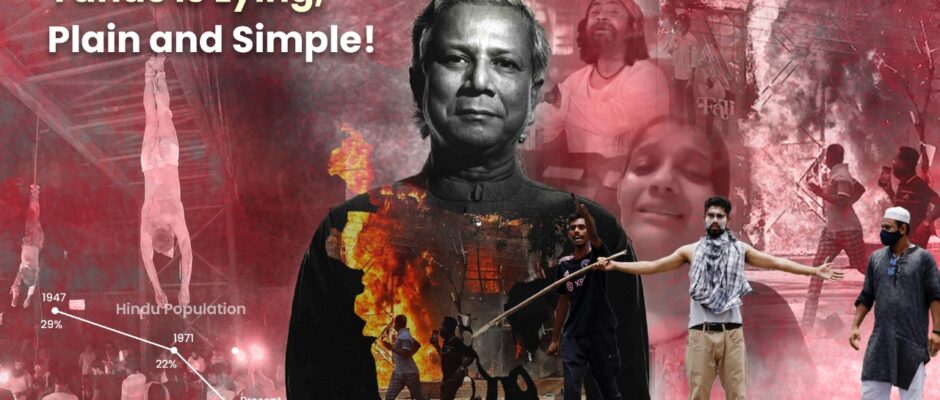
Bangladesh government has no plausible explanation for Hindus exodus while jihadists and jamaatis have a field day. Vinod Kumar Shukla The person who would have been in jail serving life time in Bangladesh on graft charges was hurriedly acquitted by Bangladesh’s anti-corruption commission  after his sworn in to run an interim government. Sheikh Hasina’s unceremonious ouster was reduced to a brief item in most media coverage on turn of events in Bangladesh. The Commission acquitted Muhammad Yunus, head of caretaker government and 13 others from corruption charges. Had Yunus been found guilty of money laundering charges, he would have been in jail for life. The caretaker government freed Jashimuddin Rahmani, the chief of Ansarullah Bangla Team (ABT), an al-Qaeda-affiliated terrorist outfit. And, Mohammad Yunus is making desperate attempts to speak from the high podium with teachings on good neighbour etiquette to India. In the melee, Hindus in Bangladesh faced a tricky situation with a government that took the lead in unleashing terror on her own minorities. Backing from Democratic White House till Kamala Harris bit the dust in recent US elections lent credibility to the genocide of Hindus in Bangladesh front-ended by Jamaatis, army, civil police and para-military forces. The government mandated to protect Hindus lives, property, jobs and honour was not just turning a blind eye but went on a denial mode by saying that reports of attacks on Hindus and other minorities were exaggerated. This lie has been repeated from August 5, 2024 when the then Prime Minister Sheikh Hasina was forced to flee in view of students’ protests actually orchestrated by radical Islamist organisations. Yunus not just downplayed attacks on Hindus but claimed that violence against minorities “only in some cases” and most complaints were “completely exaggerated”. Yunus ascribed  political angle to attacks are more of politics rather than acting against jihadist elements that unleashed terror on Hindus, Budhists, Jains, Christians, Ahmadis and other minor groups of colour. His opined that attacks against Hindus was more political and on afterthought said that such reports were more exaggerated. On the contrary, Bangladesh government has taken an anti-Hindu stand notwithstanding that jihadists have had a free run. Atrocities on Hindus post-August 5 is reminiscent of direct action by Mohammad Ali Jinnah, first Governor General of united Pakistan that began from Noakhali in Bangladesh killing thousands of Hindus. Hindus had been subject to persecution by Islamists in the region from pre-independence days asurping their basic right to live with dignity. Islamists were very strongly poised even in erstwhile East Pakistan but after Bangladesh Liberation war they had gone underground albeit for a very short period. Testimony to this is that Hindus who made up 22 per cent of Bangladesh’s population in 1971 and 29 per cent in 1947 were reduced to about 8 per cent of 17 crore population. Genocide on Hindus continued in full glare and was not hidden from anyone except that Yunus who apparently doesn’t read newspapers and listen to scholars of his own country. One scholar predicted way back in 2016 that no Hindus would be left in Bangladesh in 30 years if current rate of “exodus” at 632 people from minority community leaving each day continued.“The rate of exodus over past 49-years point in that direction,” Dr Abul Barkat, a Dhaka university professor had said in 2016. If things were hunky dory for Hindus in Bangladesh as Muhammad Yunus is trying to portray, there’s no plausible explanation for continued and enhanced exodus. One needs to reflect as to why Taslima Nasreen was forced to flee Bangladesh for writing Lajja that documented killings, rapes, conversion and capturing properties of Hindus in Bangladesh. In the present context, Sheikh Hasina was big hurdle in giving free run to jihadists in whose hand Muhammad Yunus seems to be playing along. Big questions therefore loom large before Muhammad Yunus. As chief of interim government, does he have anything to say about an Islamic song being recited at a Durga Puja gathering in Chittagong?  Was the case filed in connection with the incident?  Were reports on arrest of two people by his government fake? The incident occurred on September 26, 2024 at Durga Puja celebration at JM Sen Hall in Rahmatganj area of the city. Insaf Keemkari Chhatra-Janta, a radical Islamic group, staged a protest in Dhaka against use of playground by the Hindu community for Durga Puja celebrations. There were many instances where Aarti and Bhajan were not allowed and organisers of Durga Puja were threatened with dire consequences. In certain cases, immersion Durga idols were not allowed in flagrant violation of basic right to practice one’s ‘faith’. On September 19, 2024 violent muslim mobs attacked Buddhist Chakma and Hindu Tripuri communities in Dighinala and Khagrachhari Sadar in the Chittagong Division of Bangladesh. They set fire to over 200 shops and homes belonging to the minority groups. The Muslim mob also attacked a Buddhist temple and carried out an arson attack in which many people were killed. Some of the deceased identified were 20-year-old Junan Chakma, 60-year-old Dhananjoy Chakma and 30-year-old Rubel Tripura. Prime Minister of India Narendra Modi on August 15, expressed hope that the situation in violence-hit Bangladesh would return to normal soon and said 1.4 billion Indians were concerned about safety of Hindus and minorities in the neighbouring country. President-elect Donald Trump appointed Tulsi Gabbard as Director of National Intelligence (DNI) in his administration and often condemned the atrocities against Hindus and other minorities in Pakistan and Bangladesh. This could be one factor for Yunus trying to whitewash the hundreds of crimes committed against Hindus and minorities. Social media is replete with instances of attacks on Hindu villages, houses, temples and many other installations. The minority Hindu population faced vandalism of their businesses and properties, as well as the destruction of Hindu temples. They were forced to resign from government jobs. And, it was irony that Yunus urged them to protest as citizens of the country with equal rights and not as Hindus. Bangladesh Hindu Buddhist Christian

Read More

China-Pakistan Agenda in Bangladesh Protests

Violent protests by students against job quotas may have been conveniently used by Beijing & Islamabad to further their interests Rahul Pawa China, Pakistan, geo-political interest groups and international stakeholders may have muddied Bangladesh waters. They may have either directly or indirectly contributed to current wave of violent protests that resulted in 130 fatalities. These players may have conveniently used the anger against quotas for government jobs as a cover to stroke flames of dissent against Prime Minister Sheikh Hasina and her Awami League government. The current spate of violent incidents seems to have been triggered by Communist Party of China and Pakistan that have taken an adversarial position and spread discontent against Sheikh Hasina’s government. Protests erupted after Appellate Division of the Supreme Court decided on July 10, 2024 to maintain status quo on quota system intended for freedom fighters and their families for four weeks. This came after a High Court ruled on June 5, 2024 that declared 2018 government circular canceling 30 per cent quota for freedom fighter’s descendants in government jobs illegal. This sparked widespread anger among students and larger population, culminating in violent clashes and a death toll that continued to rise. Students from various universities in Dhaka united to demand quota reforms. After initial postponement owing to Eid and summer holidays, students movement resumed on July 1 with demonstrations. Students and teachers from public universities like University of Dhaka, Rajshahi University of Engineering and Technology and Jahangirnagar University, among others were soon joined by counterparts from private institutions such as North South University and BRAC University. Under the banner of Anti-discrimination Students Movement, they launched ‘Bangla Blockade’ (Bangladesh Shutdown) thereby disrupting domestic train and road transportation networks. Online activism surged with calls for “another 2018” in reference to previous quota reform movement. Subsequently, protestors call for a ‘Bangla Blockade’ intensified on July 7. As demonstrations spread nationwide, clashes with police on July 11 marked a significant escalation. Prime Minister Sheikh Hasina’s remarks on July 14, referring to Razakars (Bangladeshis who collaborated with Pakistan during 1971war) made during a press conference after her return from China coupled with the ruling Awami League’s hardened stance intensified the situation. This led to violent suppressions by Chhatra League and resulted in hundreds of injuries. The kindling for this unrest had been laid well before the court’s ruling as flames were fanned earlier this month during Prime Minister Sheikh Hasina’s visit to Beijing from July 8 to 10, 2024. The visit, intended to secure significant financial aid and strengthen bilateral ties ended abruptly, hinting at Hasina’s deep-seated dissatisfaction with the Communist Party of China (CPC). China offered only $100 million in financial assistance, a far cry from the initially promised $5 billion. Adding to the discord, Xi gave Hasina very little time as Beijing proposed a controversial ten-year re-education policy aimed at countering Islamic culture and promoting Chinese lifestyles, similar to measures implemented in Pakistan during 2010. This proposal, perceived as racist and a direct affront to Bangladesh’s cultural sovereignty, significantly strained Dhaka – Beijing relationship. The protests in Dhaka quickly escalated as protesting students and citizens voiced their dissatisfaction with reinstated job reservation quota. This policy initially abolished in 2018 reserved 30 percent government jobs for families of 1971 independence war veterans. The new quota system, viewed as unreasonable and discriminatory, exacerbated existing frustrations amid high unemployment and rampant inflation. Pakistan-backed Islamist groups such as Jamat-e-Islami, which have significantly undermined Bangladesh’s private sector, exacerbating economic challenges the country already faces.This influence, funded by the Middle East via Pakistan, has made government jobs even more sought after. The resulting volatility in the private sector has created a hostile environment, where economic grievances easily morph into political unrest. This destabilising influence was earlier evident during the violent response to the Bangladesh government’s attempt to modernise labor laws in 2018. The proposed changes aimed to attract more foreign investment by aligning local labour practices with international standards. However, Islamist groups, heavily funded by Pakistan vehemently opposed these changes arguing they would undermine Islamic values and worker rights. Jamat-e-Islami with its significant political clout mobilised large-scale protests and strikes which paralysed many sectors of the economy including the vital garment industry. This unrest discouraged foreign investment and highlighted the fragility of private sector in the face of Islamist political and religious extremism. Moreover, China’s involvement in Bangladesh’s student unions further escalates the situation. Reports indicate that CPC has infiltrated Bangladesh universities through education and student exchange programmes. Five Chinese universities in Yunnan province alone teach Bangla language and culture, sending students to Dhaka to create intelligence assets and funding channels for student wings. This strategy aims to mobilise Bangladeshi students against their own government’s policies thereby creating more space for CPC influence. Notably, student unions that staunchly defended Islam in Bangladesh remained conspicuously silent on CPC policies against Uyghur Muslims. The current situation reiterates CPC’s potential to influence and organise student protests in Bangladesh. Earlier, on April 13, 2021, students gathered at the Dhaka Press Club, demanding better arrangements from Hasina Administration for studying in China. The protest pressuring the Bangladeshi government nearly turned violent, demonstrating CPC’s influence and capability to mobilise students in Dhaka, highlighting its broader strategy of using education and cultural programs as tools of influence. Moreover, China-Pakistan nexus in Bangladesh adds another layer of complexity. Pakistani students often affiliated with Jamat-e-Islami collaborate with their Bangladeshi counterparts facilitating communication and coordination for protests. The human intelligence (HUMINT) capacity of Pakistan’s ISI has been instrumental in channeling Chinese funds to stage ongoing protests in Dhaka. Bangladeshi workers in Chinese companies are reported to have been trained to mobilise pro-China rallies as seen in 2019 when workers of Jingjiu Group in Bangladesh who were seen chanting Pro-China slogans in Mandarin. Intriguingly, CPC’s interest in Bangladesh extends beyond financial aid. Beijing aimed to establish strong foothold in South Asia leveraging its Belt and Road Initiative (BRI) aspiring to integrate Bangladesh into its economic sphere. Despite the disappointing loan offer, China has

Read More