
Swami Vivekananda Unpacked Dharma for Global Communities
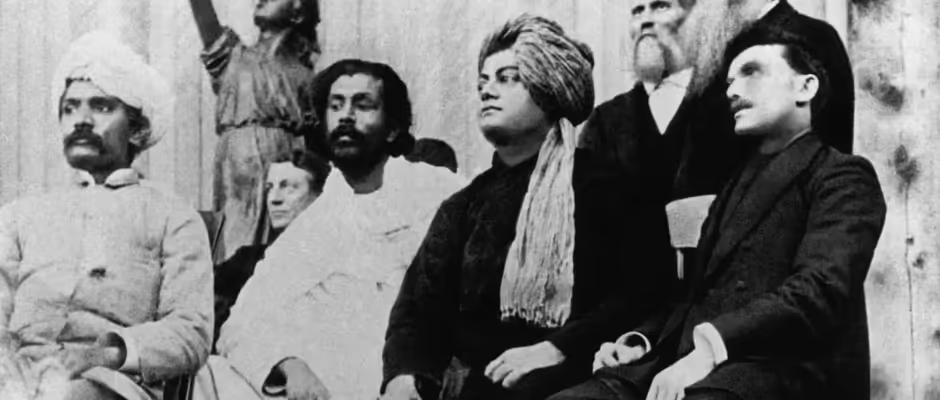
‘Us’ versus ‘them’ is passé. The great Bharatiya sage unveiled vedic vision of entire humanity being part of the wholesome ‘Supreme’. Dr Aniruddh Subhedar Very few people know that “Juggernaut” is derived from Sanskrit word “Jagannath,” most revered Hindu god literally meaning “Lord of the world”. In early 19th century, Christian missionaries spread malicious propaganda that during popular Rath Yatra of Bhagwan Jagannath, a huge chariot crushed devotees under its wheels. Many influential people in England including William Wilberforce who is admired in Western world for his advocacy to abolish slave trade demanded an end to the so-called devilish practices. Over the years, western world got enlightened about Jagannath Rath Yatra. But, even today, English word “Juggernaut” is seen as a destructive, unstoppable force serving as living testimony to the smear campaign against Bharat’s culture and Hindu dharma. Truth behind this one word illustrates the hostile world in which Swami Vivekananda had to work at a time when Hindus were considered savages, their philosophy and traditions viewed as devilish. Amidst these hostile forces, Swami Vivekananda hoisted the banner of Bharat’s spiritualism to Western world and emerged victorious. Throughout her history, Bharat produced great sages and scholars, each one greater than the other. But, in modern times, Swami Vivekananda is seen as harbinger of sanskritik (cultural) and adhyatmik (spiritual) revolution in India. He was the pioneering monk who understood the need to spread sublime and profound philosophy of Advaita Vedanta throughout the world. Global awakening to Yoga and Vedanta is fruition of Swamiji’s pioneering efforts. World’s Parliament of Religions World Parliament of Religions held in Chicago in September 1893 can be termed the first organized interfaith gathering internationally. Swami Vivekananda participated in this parliament which was held during September 11 – 27, 1893. From his first rendition on September 11 which opened with touching lines “Brothers and Sisters of America,” up to his address at the final session on September 27, Swamiji addressed the parliament six times. Each of these speeches focused on Bharatiya philosophy, universal brotherhood and need for global unity. Swamiji not only expounded on the philosophy of Vedanta but amplified teachings of Lord Buddha and their intricate relationship to Sanatan Dharma. While he criticized evangelical activities of Christian missionaries, he stressed the need for every individual to walk the path of self-realization. Quoting Lord Krishna’s words from Bhagavad Gita: “ये यथा मां प्रपद्यन्ते तांस्तथैव भजाम्यहम्। मम वर्त्मानुवर्तन्ते मनुष्या: पार्थ सर्वश:।।” (O Arjuna! In whatsoever form one seeks Me, I reach him in that form, for all mankind is but following the paths I laid down for them.) Swami Vivekananda told the world that the path to reach Supreme Being is not and cannot be monopolized by one religion. It is open to every honest seeker. Bharat’s Soul Unveiled Swamiji’s words were not just verbose discourse on philosophy for armchair intellectuals, nor were they a recounting of Bharat’s long-lost past. Rather, what Swamiji presented to the world was Bharat’s very soul. When Swamiji said, “I am proud to tell you that we have gathered in our bosom the purest remnant of the Israelites… I am proud to belong to the religion which has sheltered and is still fostering the remnant of the grand Zoroastrian nation,” he was not merely recounting Bharat’s glorious past but presenting reality of Bharat that was rooted in spirituality even during most testing times of colonial oppression. This legacy continues today when Iran, the original land of Zoroastrians is suffering religious fanaticism, riots and theocracy. Zoroastrianism continues to flourish in India. It is this soul of Bharat that prompted Indian Government to offer citizenship to persecuted religious minorities in its neighbouring countries through Citizenship (Amendment) Act, 2019. Arguments and conspiracy theories floated against the all-inclusive act was from those that did not realize Bharat’s Soul. Swami Vivekananda and World Peace Swami Vivekananda’s work had lasting impact not only on people of Bharat but global communities. His teachings led to setting up Vedanta societies across United States that continue to thrive even today. Vedanta Society of New York and that of Northern California, San Francisco were centres established by Swami Vivekananda. Today, the world going through conflicts and wars may have missed an enlightened soul like Vivekananda. We see racial crimes, bigotry, wars and persecution. Religious fanaticism is raising its head in the form of Khalistani terrorism. The land of Bengal (both Bangladesh and West Bengal) has descended into religious persecution and chaos as it has strayed from the path shown by Swami Vivekananda. At the World’s Parliament of Religions, Swami Vivekananda said: “Sectarianism, bigotry and its horrible descendant fanaticism, have long possessed this beautiful earth. They have filled the earth with violence, drenched it often and often with human blood, destroyed civilization and sent whole nations to despair. Had it not been for these horrible demons, human society would be far more advanced than it is now”. These words of Swamiji are more relevant today than ever. For long, organizations like United Nations have attempted at maintaining global peace. But, the world tends to lapse into chaos and violence periodically. Limited success is seen by UN as its efforts are mainly aimed at political level. What Swamiji preached was the path of emancipation of every soul where every individual strives for self-realization. September 11, when Swami Vivekananda delivered his speech at World’s Parliament of Religions, is commemorated by his disciples and admirers as ‘Vishwa Vijay Diwas’ (the day when he conquered the world). But this conquering is not a dystopian dream of military victory and subjugation; it is a victory through message of peace. For those harbouring malice, the “Lord of the World” (Jagannath) becomes a “destructive force.” But for noble minds nurtured by Swamiji, even “conquering” loses its bloodshed and becomes an exercise in love and mutual respect. To a world that knew only the logic of “us vs. them,” Swami Vivekananda introduced the idea of “आत्मवत् सर्वभूतेषु”. It signifies all living entities as part of one’s self. It’s time the world revisits