CIHS – Centre for Integrated and Holistic Studies

Date/Time:

Unite to Lead by Example

RSS message of unity transcending caste, creed, gender, region and faiths will strengthen Bharat’s social fabric, signal global leadership role K.A.Badarinath ‘Reconciliation, security and peace’ are what Hindu centric Rashtriya Swayamsevak Sangh (RSS) Sarsanghchalak, Mohan Bhagawat articulated while delivering his annual Vijay Dashami speech at the organization’s headquarters in Nagpur. This is at variance with ‘radicalism’ and ‘fundamentalism’ sought to be attached to Hindus and RSS by self-styled ‘liberal minds’, conspiracy theorists and those opposed to Bharat’s unity. RSS chief’s Dussehra speech is widely recognized in Bharat and internationally as firm indicator of the organization’s outlook towards issues, happenings and unfolding developments on socio-economic and political front. ‘Sulah, Salamati & Aman’ is what Mohan Bhagawat pushed for with diverse communities that form larger Bharat’s society. Bhagawat appealed for reconciliation, security and peace as against discord, strife and violence (Fitna, Fasad & Kitan) to realize vast breadth of unity in diversity that Bharat’s 1.4 billion population is known for since millennia. Use of Arabic and Persian root words by RSS chief to drive home the point of unity rising above differences seems a firm signal to over 210 million Muslims in India and their counterparts around the world especially the Sunnis that eye RSS and Hindus with suspicion and distrust. His reference to Christians and other minorities that may have differences with Hindus is again significant given ‘tolerant, embracing attitude’ of Bharat’s citizens to all those that made this country their home. There was very little or no mention of RSS chief’s reconciliatory note in Bharat’s media or dispatches of foreign writers. Forging unity by rising above selfish and divisive tendencies disrupting Bharat’s growth seems to be central theme of RSS chief’s speech. RSS appeal for forging unity as ‘mantra’ is refreshing and assuring given the false propaganda unleashed by Bharat’s rivals on reported Muslims ‘genocide’ or Christians being targeted post-2014. A couple of Christian and Muslim organizations have being propagating globally on their being targeted by RSS, BJP and Modi Government, in that order. Sangh chief spoke for his organization unequivocally and plain terms that RSS does not believe in such an agenda. Playing victimhood, looking at each other with suspicion and seeking political dominance have been identified as three big evils that come in the way of achieving unity. RSS chief also made it clear that his push for unity did not tantamount to ‘ceasefire’ between the so called warring parties. It was RSS chief’s way of reflecting on cultural continuity, unity and vast diversity. Rightly so, RSS targeted ‘cultural Marxists’ and ‘woke’ that have sought to dominate the narrative and peddle confusion, chaos and corruption’ through deceitful means to meet selfish ends and discriminatory in attitude. RSS chief came down heavily on these elements that promoted anarchy and indiscretion in public life as individuals and groups. A lot of what Mohan Bhagawat said makes sense when one looks at disruptive campaigns, ‘tool kits’ and physical demonstrations that are done by anti-Hindu conglomerations that are indoctrinated by misplaced Marxism, jihad, evangelism and of all extremism and violence that breed divisiveness. Case in point is the aggressive, violent and extremist minority Khalistani elements in otherwise calm and quiet larger Sikh community. These vocal groups and individuals, not very large in numbers in Bharat, UK, US, Canada and Europe have threatened to derail perception about Bharat globally. Line of conciliation and message of unity propounded by RSS chief Mohan Bhagawat is significant given that Bharat is celebrating 75-years post adoption of the country’s constitution and in a year or so, RSS turns 100-years old with rich legacy of its founders Dr Keshav Baliram Hedgewar and his successor, Madhav Sadashivrao Golwalkar. Sangh’s message of unity cannot be more apt given the challenges that Bharat faces within and outside as a country and ‘classical civilization with rich heritage. It’s no denying that this unity should also be the driving force for Bharat to provide leadership globally especially after an eventful G-20 Presidency, forging bilateral and regional pacts with equanimity at centre. RSS chief seems to have exercised huge restraint in his commentary on the Russian onslaught of Ukraine and Hamas terror attack on Israel that have led to ‘conflicts’ which will have disruptive impact on humanity and economic recovery that’s nascent post-Covid 19. Briefly, RSS chief referred to basic tenets of Sanatan Dharma as the guiding principles that shaped Hindu way of life. He seems to have exercised a lot of restraint in calling out the likes of Tamil Nadu’s first political family that view Sanatan Dharma as ‘dengue’ and ‘malaria’ to be weeded out. One issue that’s dear to Hindus on which RSS chief came out unambiguously is ‘grand’ Ram temple to house Ram Lalla at Ayodhya whose consecration has been scheduled for January 22 next year. RSS and likeminded organizations view Ram temple as a ‘unifying factor’ for all citizens in Bharat transcending castes, creed, sex, region and faiths. His call for holding programmes that send out a strong message of unity across Bharat and globally is extension of his extrapolation to rise above narrow mind-set. (Author is Director & Chief Executive of New Delhi based non-partisan think tank, Centre for Integrated and Holistic Studies)

Read More

Israel’s Right to Defend is Absolute

Hamas and Hezbollah have just escalated their threat level, nuisance value thereby altering the delicately balanced West Asia power equations Rahul Pawa As Saturday dawned bright and sunny on the important Jewish day of observance, Israel was jolted by unexpected assault from Palestinian terrorists linked to Hamas in Gaza. With cold precision, Hamas backed by Hezbollah orchestrated a sweeping, multifaceted assault against Israel presenting one of the gravest challenges to the Jewish nation faced in half a century. In this nefariously orchestrated operation, diverse array of tactics was employed by Hamas, the dreaded Sunni Islamist outfit. This included gliders and parachutes with weapons that took to skies, naval vessels for maritime intrusion and heavily-armed terrorists advancing on foot. Hamas audacity became evident with launch of rockets in thousands, some daringly aimed at Jerusalem. The sheer scale of this aggression not only resonates with its immediate impact but raises significant concerns, setting off global alarm, attention and unease. In a recorded message, Hamas terror commander Mohammed Deif referred to the assault as “Operation Al-Aqsa Storm.” He urged Palestinians in various regions to unite in the fight and emphasized on return to their revolution. He pointed to alleged Israeli hostilities and tensions surrounding Al-Aqsa Mosque in East Jerusalem as a catalyst. This sentiment was echoed by Hamas political leader Ismail Haniyeh who rallied Muslims worldwide to defend Al-Aqsa and Islam’s sacred mission. The overarching message to Israelis was not just about Palestinian cause but conveyed deep religious conviction, viewing Israelis, predominantly Jews as betrayers of the ‘Islamic divine will’. Fallout of this Hamas terror attack was catastrophic. About 22 Israeli towns and critical military installations were under siege with human toll painting an even grimmer picture. For Israelis, the ordeal was nightmarish, ceaseless, and unimaginable. As hours ticked by, families huddled in their homes, in hope of getting relief from encroaching Hamas terrorists infiltrating their communities. At a music festival southern Israel, young attendees from around the world faced a tragic and ruthless fate. In a dark twist, Hamas brazenly broadcast their acts turning their reign of terror into a spectacle for the world. Israeli families including women and children bore the brunt of this mindless violence with numerous abductions and heart-wrenching scenes streamed live. The world witnessed trauma of a wounded young Israeli woman dragged into Gaza and an Israeli Defense Forces (IDF) soldier’s tragic fate displayed for all. Shockingly, the reaction to this brazen act of terrorism in certain quarters was inconceivably jubilant. Pro-Hamas videos found enthusiastic distribution and received cheers from its supporters around the world, including far-left factions in the West and India. Celebrations erupted in Tehran and Ramallah with Iran’s own parliamentary body voicing chilling chants of “Death to Israel” inside its Parliament. The intent was clear: every harrowing moment inflicted on the Israelis was meant not just as an act of terror but also as a message, an open humiliation. In response to multiple infiltrations and rocket launches from Gaza Strip, Israel’s Prime Minister Benjamin Netanyahu declared that Israel was now in a state of war. He vowed retaliation against Hamas and underscored Israel’s unwavering right to self-defense. By Saturday, prominent global leaders including Joe Biden, Narendra Modi and Rishi Sunak voiced their solidarity with Israel. Their condemnation of unprecedented aggression by Palestinian terror group, Hamas was resolute. Moreover, the US, UK and several nations unequivocally affirmed Israel’s right to defend itself. Several hours later, Israel retaliated fiercely in Gaza resulting in significant casualties. The conflict’s ripple effects were felt as far as Lebanon with clashes between Israel and Hezbollah and in Alexandria, where two Israeli tourists were killed. Israeli airstrikes targeted strategic points in Gaza including residences and Hamas officials’ homes leading to over 300 fatalities. With ongoing ground confrontations in southern Israel, the military was criticized for not thwarting the initial attack. Israel has now deployed a substantial force around Gaza and plans to evacuate Israelis near the territory’s border. Hamas attacks which commenced in early hours of Saturday has to date tragically resulted in loss of over 800 lives and injuries to more than 2000 individuals. Importantly, implications of the events in Israel stretch far beyond the immediate trauma and retaliatory defense response. Streaming pro-Hamas videos depicting grave violations against Israeli civilians and detained IDF personnel amount to crimes against humanity. In a startling breach, Hamas terrorists from Gaza managed to infiltrate southern Israeli border in a very short span of time catching Israeli defense posts off guard. This raises eyebrows given the sophistication and depth of Israel’s intelligence and surveillance operations especially focused on monitoring Hamas. Several Western commentators point to serious intelligence lapse from within Israel and its global partners. Inefficiency of Israeli Defense Forces (IDF) funded at a staggering $23.6 billion annually also posed serious questions. When Israeli citizens found themselves enmeshed in their darkest hour, the defense forces seemed conspicuously absent. Even hours into the crisis, rapid response from the military was lacking and the political leadership appeared equally paralyzed, failing to provide clarity or direction. The nation, so often lauded for its security prowess seemed collectively stunned. With the state’s apparatus seemingly in a state of inertia, a haunting silence enveloped the nation’s psyche. The events challenge conventional beliefs about the robustness of Israel’s defense and political machinery.   Hamas, with swift terror acts sought to humiliate Israel. By kidnapping children, desecrating the fallen and broadcasting their acts, they aimed to instill fear and expose perceived Israeli vulnerabilities. These actions by Hamas, once considered a mere regional irritant, have substantially shifted the strategic landscape. Their provocations have transcended previous boundaries, deeply challenging Israel’s long-held defensive strategies.  These events have catalyzed unity among Israelis across political and social spectra. While internal differences persist, Hamas actions have crystalized the pressing need for a united front against the common enemy. The images and narratives from recent events serve as painful reminders of perils of a divided stance.  In the face of this enhanced threat level, Israel’s stance is bound to evolve.

Read More

India’s Space Supremacy on Ascent

Chandrayaan-3, ISRO’s premier lunar exploration is a milestone in its path to achieving greater excellence, cost competitiveness and emerge as space power Rahul Pawa Human space exploration has predominantly been shaped by superpowers of the Cold War era, with US space agency, NASA and its Russian counterpart, Roscosmos leading the way. This is a thing of the past. In recent decades, the biggest surprising candidate in contention is the Indian Space Research Organisation (ISRO). Though it started late and faces financial limitations as well as technological constraints, ISRO has demonstrated remarkable resilience and determination, carving out a unique path as a top-tier global space agency. Established in 1969, almost two decades after NASA, ISRO embarked on its journey amidst a space race that was already in full swing. Tasked with the formidable mission of propelling India into the age of space technology and catching up with technologically advanced nations, ISRO’s journey has been far from smooth. In the aftermath of India’s nuclear tests in 1974 and 1998, the nation faced broad international sanctions. This development dealt a significant blow to India’s space aspirations when Russia, succumbing to pressure from the Western world, cited the Missile Technology Control Regime (MTCR) and withdrew from an agreement to transfer crucial cryogenic engine technology to India. The cryogenic engine technology was indispensable for the development of heavy-lift launch vehicles. Such a setback could have easily derailed India’s ambitions. Instead, it ignited ISRO’s determination, fuelling its drive towards self-reliance and innovation. Over next two decades, ISRO focused its efforts on developing its own cryogenic engine technology. Despite numerous challenges, India’s space agency remained unwavering and in January 2014, it successfully launched the GSLV-D5 launch vehicle, powered by an indigenously developed cryogenic engine. This achievement serves as an exemplary showcase of perseverance and resilience in the face of adversity, a testament to ISRO’s unwavering commitment to its mission and the Indian Republic. Yet, this is just one chapter in the compelling saga of ISRO, where hurdles are transformed into springboards for success. It is a testament to ISRO’s prowess in transforming adversity into opportunity, illuminating India’s flourishing technological capabilities. As ISRO navigated its journey, it pioneered a new paradigm in space exploration, combining cost-effectiveness with ambition, establishing itself as a trailblazer in affordable space technology. The Mars Orbiter Mission, known as Mangalyaan, epitomises this innovative spirit. Accomplished at a fraction of the cost of similar missions by other agencies, Mangalyaan was not just a frugal exploration but a powerful demonstration of ISRO’s formidable capabilities to the world. A vivid illustration of ISRO’s economical yet ambitious spirit is its mastery of multi-launch capabilities, allowing multiple satellites to be taken into orbit with a single rocket. ISRO showcased this brilliantly in February 2017 when it successfully launched a record-breaking 104 satellites aboard a single PSLV-C37 rocket. This launch included not only India’s own earth observation satellite but also miniature satellites from several international players, underscoring ISRO’s leading role in the global commercial space industry. Furthermore, ISRO’s ability to maintain budgetary controls without compromising on scientific endeavours sets it apart from many international counterparts. Whether it is launching the world’s lightest satellite or sending a mission to Mars at a cost lower than a Hollywood blockbuster, ISRO’s exemplary record reflects that cost-effectiveness and ambitious exploration can indeed go hand in hand.  Chandrayaan-3, the latest iteration of ISRO’s flagship lunar exploration mission, is poised to embark on its momentous journey, aiming to achieve a soft landing in the Moon’s South Polar region on August 23, 2023 at 5:47 pm. This extraordinary endeavour, born out of years of rigorous scientific inquiry, stands as evidence of India’s expanding influence as a formidable force in space exploration. Chandrayaan-3 aims to succeed where its predecessor fell short, achieving a precise and controlled landing on the lunar surface. The proposition for an Indian moon mission was formally announced by former Indian Prime Minister Atal Bihari Vajpayee during his 2003 Independence Day address, and in 2008, Chandrayaan-1 was launched, marking a significant milestone in India’s cosmic journey. Comprising a lunar orbiter and impactor, Chandrayaan-1 not only fulfilled its scientific ambitions but also propelled India into an elite group of lunar explorers. Even before Chandrayaan-1 landed, ISRO and Roscosmos planned its sequel, Chandrayaan-2, with the goal of a moon landing and rover exploration. Due to delays from Roscosmos, ISRO independently developed a lander, pushing the launch to 2019. Technical setbacks and rescheduling notwithstanding, Chandrayaan-2 finally took off on July 22, 2019. Tragically, a software glitch on September 6, 2019, caused the Chandrayaan-2 lander to malfunction, resulting in the loss of communication with ISRO and loss of both the lander and the rover. This incident led to the development of Chandrayaan-3, the next phase of the mission, with the ambitious aim of achieving a successful soft lunar landing. With the clock ticking down, ISRO is diligently overseeing the timeline for the lunar touchdown, taking into account elements such as lunar sunrise. In case circumstances demanded, the landing can be pushed to September from the scheduled August 23 this year. Every step forward brings India’s Chandrayaan-3 closer to a ground breaking achievement on the moon. Successfully achieving this would place India in an elite group of nations; to date, only the US, Russia, and China have accomplished this feat. Odyssey of ISRO embodies the indomitable spirit of human endeavour—an unwavering resolve, tireless perseverance, and self-reliance that magnify India’s ascent as an increasingly formidable space superpower, bolstering its commanding presence within the global space community. Having begun as a latecomer, ISRO has transcended the confines of limitations and boldly challenged established order, thereby demonstrating that constraints are merely catalysts for boundless opportunities. ISRO’s unwavering dedication to perpetual learning, adaptability, and evolution has empowered it to overcome formidable obstacles and lay a robust groundwork for future triumphs. Through a multitude of accomplishments, it has forged an upward trajectory for India, shaping it into a rising space superpower of exceptional versatility. (Author is Research Director at Centre for Integrated and Holistic

Read More

Bangladesh’s Crossroads: Navigating Rising Extremism and Anti-Hindu Persecution

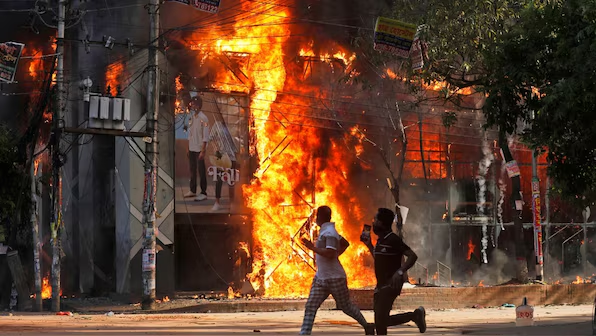
Rahul Pawa Since its inception in 1971, Bangladesh has borne witness to an alarming trend of persistent human rights violations against the Hindu minority. The initiation of this harrowing journey can be traced back to the Bangladesh Liberation War, which tragically saw hundreds of thousands – some estimates even escalating to 2.4 million – of Hindus losing their lives. In the subsequent two decades, from 1971 to 1991, the Hindu demographic saw a significant drop from constituting 13.5% of the population to a mere 9.2%. As time went by, the situation didn’t improve; the 2011 census data further revealed the Hindu population dwindling to 8.5%, showcasing the grim reality of a consistent Hindu exodus induced by relentless persecution. Instances of violence, particularly the distressing post-election attacks of 2001 where an estimated 200 Hindus were killed, and many more were displaced, serve as stark reminders of this sustained oppression. The history, darkened by the tales of these atrocities, underscores the urgent need for robust and comprehensive action to protect the rights and wellbeing of Bangladesh’s Hindu minority. Recently, the persecution of Hindus has taken an even more disturbing turn with the rise of Islamist extremism, spearheaded by the Bangladesh Nationalist Party (BNP) and their ideological ally Jamaat-e-Islami (JeI). On Friday, July 28, 2023, these radical Islamist factions orchestrated a series of deplorable acts, magnified by a rally staged in the Naya Paltan area of Dhaka city. This gathering, attended by over one hundred thousand Islamists, served as the platform for the announcement of a continuous agitation program, delivered through a video message by BNP’s acting chairman and convicted terrorist, Tarique Rahman. This climate of fear and hostility has effectively marginalised Hindus, relegating them to the status of second-class citizens in their own homeland. Such developments pose serious challenges to Bangladesh’s secular fabric and its commitment to uphold human rights. On multiple instances, a host of leaders from the BNP have fearlessly expressed their intentions to strike back against every member of the Sheikh Hasina lead Awami League. Their rhetoric ominously suggests that the “agents of Awami League,” which includes Hindu supporters and India (Bharat), would be subjected to severe consequences should the BNP regain power. This hostile stance was reflected at the recent gathering as well, with attendees zealously participating in anti-India and anti-Hindu chants. A particularly disconcerting sentiment emerged from the crowd as they proclaimed, “Bangladesh is Muslimstan, Hindus go to Hindustan” – a blatant effort to exclude and marginalise the Hindu community, this sets a dangerous precedent for a potential escalation in an already volatile and strained environment. In stark contrast to the ominous atmosphere generated by the BNP rally, another event, a peace rally organised by the youth front of the Awami League, presented a deeply human and sympathetic face to the issues at hand. The rallying cry came from Purnima Rani Shil, a Hindu woman who suffered an unthinkable ordeal at the hands of BNP members at the tender age of 14, in the Ullapara area of Sirajganj district in 2001. In her moving testimony, Purnima conveyed the stark reality of what a BNP return to power might mean: “If BNP regains control, I fear thousands of Hindu girls may become victims of this notoriously anti-Hindu party. They stole my childhood and my youth. They exiled my family from our village. I found no justice anywhere, as from 2001 to 2006, the country fell into the clutches of Pakistani agents and enemies of humanity. Khaleda Zia is the matriarch of anti-Hindu atrocities, with her son, the convicted terrorist Tarique Rahman, functioning as a marionette of the Pakistanis. They aim to transform a secular Bangladesh into another Pakistan.”  Alarmingly, the Bangladesh Nationalist Party recently declared what they ominously labeled as the “final part of war” against Prime Minister Sheikh Hasina and her governing body, the Awami League. Urging their supporters to make Dhaka city their stronghold until the ruling government is unseated, this call to arms rings a dangerous bell, not just in Bangladesh, but echoes ominously across the globe. What’s particularly disconcerting are the financial streams that the BNP is purportedly benefiting from. Media reports suggest that the party is being showered with millions of dollars from dubious sources. These funds, murkily acquired, are directed towards sustaining a challenge against the incumbent government. Even in the face of severe economic collapse, Pakistan appears to be pumping substantial sums into the coffers of the BNP, raising concerns over its vested interests. Disturbingly, infamous figures such as terrorist Dawood Ibrahim are believed to be aiding the ultra-Islamist party with substantial financial support. This level of global backing raises serious questions about the international networks of radicalism and the ideological hatred driving these alliances. The BNP is also believed to be deploying the power of propaganda to influence minds and fuel divisiveness. It has reportedly poured millions into lobbying activities across the United States and Europe.  Simultaneously, the BNP is staging an alarming media assault against Prime Minister Sheikh Hasina and her government. Utilising the reach of social media and international news outlets, the party is disseminating a narrative steeped in extremist ideologies. This massive propaganda drive seeks to undermine the established peace and unity, as it fuels societal divisions on a large scale, aided and abetted by the malignant forces of Islamist hatred. The dangerous undertones of their activities are a stark reminder of the relentless threats that peace-loving societies face around the world and how nations that fall for such extremist views and ideas are destined to collapse. The persistent plight of the Hindu minority in Bangladesh, marked by rising religious extremism and significant financing of such factions, highlights the pressing challenges to peace, social harmony, and human rights in the region. As Bangladesh continues to grapple with these complex issues, the manner in which it safeguards minority rights and counters religious extremism will be pivotal. These developments, resonating far beyond national boundaries, necessitate vigilant observation and strategic intervention from regional and international stakeholders, underscoring the critical

Read More

Academic Research or Hit Job?

Ashoka University paper deviously questions Indian electoral outcomes in the guise of research with very little basis or evidence Vinod Kumar Shukla It took over four years for Ashoka University to come up with 50-page research paper ‘Democratic Backsliding in the World’s Largest Democracy’ by Sabyasachi Das which terms 2019 Lok Sabha polls outcome as electoral fraud. The paper lacks objectivity when it outlines that polls were manipulated in closely contested constituencies. Manipulations at the time of voter registration, voting and counting are other findings that this paper boasts of. Insinuations that Muslims were deliberately de-franchised by removing their names from voter lists too figured in the report as one of the tools of manipulation. The research paper suggests that manipulation has its impact on nine to 18 seats with victory margin of three to seven per cent. Even if one were to believe that the data and findings were on dot, the outcomes would not have been tilted or would have remained unaffected as BJP had won 303 seats out of 543. BJP would have still formed the government even if it had lost all 18 seats as the paper claims. Another twisted argument claims that BJP won a disproportionately higher number of closely contested seats where it was in power. State cadre officers’ credentials have also been questioned in the report, They have been squarely held responsible for votes manipulation by charging that observers from state services of BJP-ruled states were in large numbers. Now, the interpretation that all state level officers resorted to manipulating outcomes to ensure a BJP victory was neither backed with evidence nor data or facts. This conclusion is more imaginary rather than being a fact. It’s libellous too. Let’s do a fact check on closely contested 98 seats with less than five per cent victory margins of which BJP had won 43 seats (roughly 44 per cent). Out of these seats, the BJP won 22 in states that it was in power. The paper in guise of research ignores the fact that BJP won equal number of seats from opposition parties ruled states. Ashoka University paper does not have any plausible explanation to insidious job in the name academic research.   Contrary to what Ashoka University academic claims, 2019 elections were not at all closely contested as BJP led by its mascot Narendra Modi had secured over 50 per cent votes share in 224 seats. This constitutes about 75 per cent seats that BJP garnered. Why does Ashoka University paper set aside a glaring fact that BJP bagged more seats in Uttar Pradesh in 2014 Lok Sabha polls at 71 when SP was in power. This is against 62 seats won in 2019 when it was in the saddle. In 2019, there was a Congress government in Madhya Pradesh but BJP had won 28 seats out of 29; it had won all seats in Rajasthan while nine out of 11 in Chhattisgarh. Karnataka too was ruled by the opposition when BJP and its ally had won 26 seats out of 28 seats. West Bengal, Odisha and Telangana were such states where BJP did well despite opposition governments. The Quint was quoted in the Ashoka University paper to point out variance in votes polled through Electronic Voting Machines (EVMs) and votes counted. The paper claims that there was variance in 373 seats but was able to provide examples of 11 seats where it purportedly found discrepancies. Of these, five were won by the BJP and six by others. Actually the author needs basic lessons in politics and election dynamics as closely contested seats won by any political party by no means suggest manipulation. They have won with organisational strength, social engineering, compatibility of alliance partners, campaign strategy, strength of economic and development agenda, star campaigners and benefits provided to people by the government. In closely contested elections, taking voters to booths on polling day matters the most and BJP is good at it. Election management in BJP is done with such precision that it goes for person to person, door to door contact with volunteers or party people marked to each voter or the family. So, BJP predictions on victory or outcomes made periodically is based on its extensive campaign machinery inputs and not conjecture, predictions made by media outlets or hear say. Asoka University paper also talks about deletion of Muslim votes from electoral lists thereby questioning the very basic electoral credential in India that has been hailed as ‘biggest festival of democracy’ by international agencies as well. The report commits another big blunder by completely ignoring notices given to parties like Samajwadi Party of Akhilesh Yadav to provide proof in support of his allegations on deletion of muslims names from the electoral lists. Actually, the case of Muslim vote banks is the other way round as Bangladeshi and Rohingya infiltrators are illegally getting inducted into voter lists not only changing demographies but are a threat to democracy. So, Ashoka University report is not academic work but a hit job done on behalf of certain political parties.  Report findings or observations in such cases are predetermined and arguments, data points or methodology is designed to such false narratives. Such reports are later amplified by leaders like Arvind Kejriwal and Mamata Banerjee to drive their own nefarious agenda. They have always been questioning Election Commission of India, Electronic Voting Machines and voter verified paper audit trail (VV PAT) whenever they lost elections or people rejected them. If non-BJP parties were to be elected, then these very parties hail such ‘electoral outcomes’ as ‘victory to democracy’.  As if in second thought, Ashoka University meanwhile distanced itself from findings in the paper commission by the institution. But question remains, who assigned the project? Who funded it? The university must come clean as it puts a big question mark on credibility of constitutional bodies of the country like Election Commission of India. Ashoka University in any case is known in academic circles for debunking alternative socio-economic

Read More

Trudeau goes Khalistan, Pakistan way!

Latest reshuffle in his council of ministers may not have addressed concerns on Canadian soil becoming fulcrum of anti-India elements Rohan Giri Canadian Prime Minister Justin Trudeau has recently reshuffled his council of ministers ahead of the upcoming general elections. This reshuffle involved making change of portfolios and work responsibilities of ministers along with four Indo-Canadians. As Canada reconfigured its leadership, discerning and assessing its implications for the country’s partners like India becomes pertinent. Evolving political dynamics in Canada and resulting strategic adjustments warrant careful consideration in the global arena. In specific, four Indo-Canadian ministers’ responsibilities were changed or promoted: Anita Anand, Kamal Khera, Harjit Sajjan, and Arif Virani. Notably, Anita Anand was promoted as President of Treasury Board, transitioning from her previous role as the Minister of National Defense. Similarly, Kamal Khera moved from a senior portfolio to become Minister for Diversity, Inclusion, and Persons with Disabilities. Harjit Sajjan, having served as International Development Minister, now holds the position of Minister for Emergency Preparedness. Arif Virani, another Indian-Canadian and the representative of Parkdale-High Park in Toronto made his cabinet debut as the Minister of Justice and Attorney General. Understanding their influence and engagement within the sizeable Indo-Canadian community and Indian affairs becomes crucial owing to the significant role overseas Indians play in influencing New Delhi’s relations with Ottawa. Professor-turned-politician Anita Anand is particularly vocal about her Indian heritage taking immense pride in her grandfather, freedom fighter VA Sundaram, who worked alongside Mahatma Gandhi during the freedom struggle. Anand’s involvement extended to assisting the panel in investigating tragic 1985 Air India Kanishka bombing. On 35th anniversary of the bombing, she tweeted, “The victims of the bombing of Air India 182 and their families are in my thoughts today and always. I am privileged to know some of you and honour the memories of your loved ones with you.” Anita Anand also held a position on advisory board of the Canada India Foundation, an organisation established in 2007 to bolster bilateral ties. During the cabinet transition, Kamalpreet Khera, representative for Brampton West in the House of Commons has taken on significant role of Minister for Diversity, Inclusion, and Persons with Disabilities. Khera’s Indo-Canadian background goes back to her ancestors from Ropar in Punjab. She is known to have close ties with Navdeep Bains, a former Canadian politician who served as Minister of Innovation, Science, and Industry during 2015 – 21. There have been reports pointing to strong links Navdeep Bains has with Khalistani movement. Bains has allegedly been groomed by World Sikh Organization (WSO), a pro-Khalistan hard line organisation accused of radicalizing Sikh community and fostering divisions apart from piloting anti-India propaganda. Relationship between Navdeep Bains and Kamalpreet Khera is said to be more than just acquaintanceship. Bains is regarded as mentor and guide to Khera. Indian authorities have expressed their concern to the Canadian government multiple times regarding separatist activities on the latter’s soil. Prime Minister Trudeau’s cabinet reshuffle also sparked reports on Harjit Sajjan, his association with Khalistani elements and his tacit support for their radical activities. Hitherto Punjab Chief Minister, Captain Amarinder Singh had publicly ostracised Sajjan as a “Khalistani supporter”. Singh had been a proponent of imposing sanctions on Canada for its ‘open and covert’ support to Khalistani terrorists. Captain Singh had called for global pressure on Canada to prevent the use of its soil for perpetrating terror against India, particularly the Sikh community targeted by Khalistani terrorists. Reports pointed to Harjit Sajjan’s parents, Kundan Singh Sajjan and Vidya Kaur Sajjan’s long term membership of WSO. Another notable Indo-Canadian that figured in the latest cabinet reshuffle is Arif Virani, who spent 15 years as human rights and constitutional lawyer before entering politics. Virani is vocal about purported Islamophobia and remained deeply committed to the trumped up issue. Since his initial election, he consistently advocated against Islamophobia, both on the ground and within the Parliament. Notably, he sought inputs from Muslim groups on how to tackle online hate faced by Muslims before Liberals introduced Bill C-36 in June 2021. Primary objective of this bill was to combat online hate with focus on addressing Islamophobia that Virani thinks is prevalent. Arif Virani was involved in a study on M-103, a non-binding motion in the 42nd Canadian Parliament urging the government to condemn Islamophobia and all forms of systemic racism and religious discrimination. Additionally, he is associated with the Aga Khan Foundation of Canada, an organisation working in various countries. The foundation faced accusations of involvement in money laundering Canadian Prime Minister Justin Trudeau’s decision to include Khalistani and Pakistani jihadist elements in his council of ministers may not go well with New Delhi. Comprehensive research conducted by veteran journalist Terry Milewski titled, “Khalistan: A Project of Pakistan” unequivocally demonstrates that the Khalistan movement poses not only a threat to India but also significant concern for Canada. Prime Minister Justin Trudeau’s undeniable link with anti-India elements underscore the risk it poses to bilateral relations and global security environment. (Author is operations manager at Centre for Integrated and Holistic Studies, non-partisan think tank based in New Delhi)

Read More

India, smart power in the making!

G-2 – US and India – super power grouping may not work for either side. Emerging and critical tech at fulcrum of bilateral engagement K.A.Badarinath The very talk of stitching up G-2 super power group between US and India during Prime Minister Narendra Modi’s state visit is rather an unforgettable moment. In a fluid global situation, whether G-2 would finally be reality or not is something for geo-strategic experts to analyse, separate grain from chaff and derive the implications. US press has been abuzz with possibility of President Joe Biden ably assisted by secretary of state Jake Sullivan to bring focus to the idea of G-2 – US and India – forming a super power group. This is akin to what was talked about in early ‘80s by the US security establishment that attempted such a grand grouping with the then reluctant and recalcitrant China. Later, there were reports that President Barack Obama had revived this G-2 grouping with China when Hu Jintao was the powerful general secretary of Chinese Communist Party and country’s President. This grand idea of US – China group gained popularity after two major think tanks, Center for Strategic and International Studies and the Peterson Institute for International Economics had revived the conversation in 2011. Pomp and show that surrounds Prime Minister Modi’s visit as globally most popular leader, forming a G-2 – US and India – is something that needs deeper understanding and analysis. US, world’s largest economic power and strategic powerhouse thinking of India as a G-2 ally is elating. Jack Sullivan is reported to be harbinger of this idea, if at all it works for both sides. As G-2, identifying common rivals, partners and competitors, may not after all be a good idea for both US and India in an ever evolving world order. From US perspective, depending heavily on its allies like Japan, Australia and India to checkmate China in Asia theatre and elsewhere including Asia Pacific is a calculative move. At the same time, complete breakdown of relations between China and US is not a feasible preposition. In fact, this complex security matrix explains why democratic white house under President Joe Biden is interfacing with all the three – Japan, India and China – this week to finalize its Asia strategy. US being a great ‘strategic ally’, the first to go to, may continue to work for India. That does not allow Indian foreign affairs establishment under Subrahmanyam Jaishankar to shed the ‘independent policy’ stance that has come to smart focus in recent past. India’s independent policy stance gained credence for New Delhi’s stand on Russia – Ukraine conflict, Covid-19 management, multi-faceted engagement as G-20 President. Not becoming part of a military alliance has been stated policy of India and there’s little or no scope for a change in this stance. It’s in this backdrop that India not joining NATO forces should be viewed notwithstanding the standing invitation from US. In the Russia – European Union standoff, India refused to side with one group or the other unlike China and US taking respective sides. As G-20 President, batting for African Union’s full membership speaks volumes. At the same time, engaging with Shanghai Cooperation Organization and Quad with equanimity brought was recognized by world powers as a responsible way for the 1.4 billion strong India as the largest growing economy for two consecutive years and hat trick to be hit. In this backdrop, emerging and critical technologies, removing export controls on transfer of this knowhow by US to its most trusted partner India could be the starting point to taking bilateral relations one notch above. Artificial intelligence, quantum computing, space, semi-conductors, dedicated telecom infrastructure for strategic heft, biotechnology, aerospace are among areas where export controls may have to be lifted and shared with India. For instance, buying ‘predator’ drones to enhance surveillance and ‘jet engines’ must make technology transfer integral to the two governments level defence deal. Refurbishing and servicing the US Naval ships in India should become more of a common practice rather than one off events. Areas like education, affordable healthcare, vaccines, medicines; solar energy and green hydrogen as well as joint defence production deals can be the next big step for the two large democracies that are open, flexible and transparent in their relations. Independence in foreign policy engagement at bilateral level and multi-lateral issues is something that India takes pride in. And, this independence in policy will have to be assiduously protected, cherished and propagated for India to play a larger, responsible and compassionate power to reckon with. Smartness with soft power image of India goes well to realize her dreams of ‘Vasudaiva Kutumbakam’, world as ‘one big happy family’ that’s humane. (Author is Director and Chief Executive, Centre for Integrated and Holistic Studies, non-partisan think tank based in New Delhi)

Read More

Is China’s paradigm on ‘mutual success’ real?

Beijing has to come clean on larger issues, shift in outlook welcome. India never lost its ‘eastern wisdom’ while engaging with Western partners. Rohan Giri In an editorial, Chinese Communist Party’s mouthpiece, Global Times on May 30 indicated a possible shift in its India outlook. For a change, it captioned the edit, “We morally, emotionally support India’s de-colonization”. This comment on inauguration of a new Parliament building getting rid of the British colonial re definitely reflects Chinese establishment’s intent to go a wee bit soft on India. It has also garnered the attention of leaders across the globe. This change of heart, if it bears out in reality, cannot be ignored. Pleasing gestures like this editorial as exhibited by China present an intriguing subject for examination. As per reports from Chinese embassy and consulates, over 60,000 visas have been issued to Indians visiting China in first five months of this year. Furthermore, Chinese missions globally have affirmed their readiness to grant more visas for purposes such as business, studies, tourism, work, and family reunions, should the need arise. Global Times editorial last week emphasized India’s commitment to de-colonization and self-reliance. It applauded India’s efforts to remove vestiges of colonial authority, such as renaming iconic buildings and limiting English usage. The article advised India to focus on its national strengths rather than seeking legitimacy through techniques and accolades from outside sources. Rational interpretation to ‘outside sources’ would be India’s multi-nodal foreign policy engagement with western powers. While congratulatory editorial in Global Times is in order, its caution against Western manipulation is old communist line seeking exclusive engagement with India. Global Times asking India to embrace the Eastern Wisdom is possibly a benign attempt to wean India away into its fold. Its emphasis on ‘mutual success’ of China and India is yet another line that many in India’s Left and centrist political discourse also subscribe to. The editorial does not mince words while warning India to stay away from US with the standard communist dogma that US was fueling enemity between India and China. In this context, there are big questions that Chinese communist leadership will have to come up with plausible and convincing answers. President Xi Jingping and his cronies may have to come straight on Galvan border mis-adventurism that led to troop’s deployment on either side of Indo-Chinese borders. China will have to offer an explanation on its collaboration with Pakistan on terrorism in the United Nations (UN) and mutual prosperity pitch with India which may not go hand in hand. Continued expansionist bids in Eastern Ladakh and Arunachal Pradesh, opposition to G20 conferences in Indian state Arunachal Pradesh, Jammu and Kashmir, providing Chinese names to Indian cities and towns is something that China will have to justify.  Can this be the template for China’s Paradigm of mutual success? Tsinghua University’s Center for International Security and Strategy in 2022 report on “Chinese Outlook on International Security” has toed a different line on India. The study has bracketed India on par with US vis-à-vis threat posed to Chinese interests.  India’s threat to China has also been compared what was perceived in Japan vis-à-vis China even today. China has come up openly on its stand towards India rather than sending out mixed signals that confuse its communist cadres and their counterparts in India.   Global Times editorial also said, “In Chinese society, few people believe that India’s economic and social development will become a threat to China. The vast majority of people believe that the two countries can succeed together. We hope India can demonstrate more clarity and confidence in its dealings with China and the West.” In last three years, India’s position on Chinese threat perception has been consistent. It has in no uncertain terms said on more than one occasion that threat from China has risen multifold. Global Times editorial exhorting India to stay away from Western manipulations has come ahead of Prime Minister Narendra Modi’s visit to Washington DC for a state visit later this month. China’s expectation that should not protect its defensive and offensive interests is rather unrealistic. India’s right to pursue an independent foreign and economic policy formulation, choice of friends in sync with its view seeking global peace needs to be respected. (author is operations manager at non-partisan think tank, Centre for Integrated and Holistic Studies based in New Delhi)

Read More

Much ado about something

Digital India bill should democratize information highways, digital ecosystem, address stakeholders concerns & not limit benefits to a big few Prachi Mishra In a few days from now, Narendra Modi government is likely to come up with first draft of the much-awaited Digital India Bill. If one were to go by officials, the bill is intended at strengthening information technology, security and information infrastructure in India. The Bill, when finally adopted by Parliament and enacted, will complement the Digital Personal Data Protection Bill, 2022 and Indian Telecommunication Bill, 2022. In last two decades, after IT Act, 2000 became operative there have been astronomical developments in technological innovation. To keep pace with these innovations, the act’s regulatory framework was amended. The IT Act Amendment of 2008 and IT Rules 2011 were rolled out to define cyberspace and provided ground for handling of digital activities in India. But, the Act was inadequate to address present-day concerns of cyber security, crime and do justice to privacy concerns of Indian people. Emergence of Artificial Intelligence and Machine Learning, Quantum technologies, Metaverse, Big Data, Block chain, etc has thrown up new challenges in the regulatory framework. Given the limitations within the existing IT Act, a separate act has been in the work for a few months to address the growing digital and cyber demands of Indian people. In this backdrop, India’s economic interests can be furthered when the technological development and innovation apart from related regulatory framework is aligned. With growing penetration of digital technologies and increasing vulnerabilities of cyberspace, there is a need to ensure India’s national security was primacy. Reportedly, Digital India Bill, 2023 is intended at catering to India’s rising aspirations and become a catalyst in her growth and development while upholding people’s fundamental rights and country’s security concerns. Given the delicate balance that needs to be achieved through the new framework, the expectations from various stakeholders may have to be enlisted. Firstly, the Bill may have to address ethical concerns that are emerging as a consequence of disruptive technologies. Technological development will have to be seen as being morally correct, legitimate, and ethical. For instance, India should be able to address and counter adverse impact of artificial intelligence like deep fakes and misinformation. The new framework may evolve a robust and holistic mechanism to address issues related to cyber security. In 2022, as per CERT-in data, there were over 1.39 million cyber-attacks on India. This roughly over 253 per cent more than suck attacks reported for 2018. Hence, the Bill should put in mechanisms to resolve high volume and velocity of these cyber-attacks seen across sector, be it finance, banking, security establishment to political theatre.  Also, with highly disruptive Quantum technologies round the corner, the Bill must suggest ways to ensure cyber security in the new environment. The proposed bill may have to find solution to tackle the manifold rise in misinformation, hateful content and fake news that’s become the new normal in India. In last couple of years, big technology firms like Facebook and Twitter have been at loggerheads with the government on dealing with mis-formation on their respective platforms. The Bill will have to reflect a possible consensus of all stakeholders on dealing with misinformation, disinformation and fake news that’s rampant. The bill’s provisions should be aligned with innovation. At present, India’s patent tally is dismal and most technology is imported from the Western countries. Be it hardware or software, India’s patents fall behind big time. The Bill should give impetus and incentivize innovation in digital technologies. Additionally, it should augur well for all the stakeholders of digital ecosystem and not restrict the benefits disproportionately to a handful tech firms. The new dispensation may have to address issues like liability, accountability, and ownership of data and its usage. Of late, there have been cases where social unrest resulted in violence and arson because content guidelines for these platforms were amiss. Or, even the existing norms were violated. The Digital India Bill, 2023 will be discussed at a time when India has moved many notches above in many different fields of technological and digital innovation. Being home to 113 unicorns and third largest start-up economy, India’s innovation ecosystem is booming like never before. Also, with the Semiconductor Mission, the strong impetus on adopting digital technologies, and the National Quantum Mission in place, India is bound to grow steadily in the coming years. Stakeholders expect the bill to empower them, democratize the information high way and digital ecosystem, aid other relevant economic policies. India should ensure that all voices of the entire stakeholder ecosystem are heard and it is enacted in time. (Author is Research Consultant at Centre for Integrated & Holistic Studies, New Delhi based non-partisan think tank)

Read More

Kashmir on way to new vistas

G-20 summit next week will showcase India’s commitment to transform the valley into cradle of human peace, tourism and economic activity Japanese Prime Minister Fumio Kishida showcased Hiroshima as harbinger of peace, fulcrum of development and civilizational connect by hosting G-7 summit. This high level global engagement happened 77-years after it was devastated by atomic bombs detonated by United States on August 6 and 9 in 1945 killing about 226,000 civilians. Change and makeover is law of life. And, Kashmir aligns perfectly well in India’s decision host the G-20 tourism working group next week in Srinagar. This provides perfect opportunity for India to showcase development, democratic transition, peace and tranquility brought to the paradise on earth in less than a decade. The decision to take G-20 to Kashmir may not be palatable to India’s adversaries that rake up non-issues. Showcasing Kashmir’s potential to become part of global tourism circuit cannot be missed by India’s friends and foes alike. Terror, islamist jihad and across the border meddling by non-constitutional actors is virtually a thing of the past as Jammu & Kashmir picked up pieces and moved on. Perceptible change that has dawned on Kashmir following the exodus of over 150,000 Hindus in 1990 is something to write home about. India’s decision to G-20 in Kashmir is part of its larger strategy to fully leverage its Presidency of the most influential global group this year and pep up the valley’s local economy and cater to upwardly mobile aspirations of the youth that have firmly said ‘no’ to violence, mindless killings in the name of jihad. The 200-odd meetings under India’s G-20 presidency have been spread to over 50 cities from Humpi in Karnataka to Siliguri in Assam moving away from the usual Delhi and Mumbai based engagements. Normally, cities spotlighted globally become big tourist destinations globally and that’s perhaps the idea in taking G-20 tourism summit to Kashmir. Let us not forget that Reykjavík, the capital city of Iceland turned into a global tourist hotspot after the US President Ronald Regan and General Secretary of Communist Party of Soviet Union Michael Gorbachev held their summit level talks in run up to nuclear power treaty between the two countries way back in October1986. Similarly Marrakesh, the western city of Morocco emerged as topline city for holidaying and tourism after it gave birth to the World Trade Organisation in 1994. Bringing new cities, locales and areas to global attention has not limited to leaders elsewhere. Historic summit level talks between Prime Minister Narendra Modi and Chinese President Xi Jingping held in Ahmedabad after landslide victory of the Indian leader in 2014 has etched in the memory of global tourism circuit. In fact, as reports suggest, this gave idea to President Xi to host Modi in Chinese province of Shaanxi. Shaanxi also being the birthplace of President Xi’s father emerged as a regular tourist destination for both domestic and international travellers. From being friction point between India and Pakistan since 1947, Kashmir has moved on unrest and violence. India’s significant focus to restore peace and stability, political changes in 2019  has begun pay off dividends in the form of development, attracting investments, and enhancing tourism opportunities. On August 5, 2019, Union Home Minister Amit Shah piloted a proposal in Parliament to end Jammu and Kashmir’s special status and this also led to bifurcation of the state into two Union Territories. The amendment in Article 370 of Indian Constitution also turned out to be the turning point for positive changes and integration that paved the way for prosperous future, including economy, infrastructure, governance, and social welfare. Massive makeover of road networks, bridges, tunnels, and power infrastructure and enhanced connectivity with rest of the country is just one part in Kashmir returning to normalcy. Completion of the Zojila tunnel, the Ujh multipurpose Project and the engineering marvel Chenab rail bridge — the world’s highest railway bridge — are among major infrastructure projects that provided heft to transportation as well as unlock the region’s immense economic potential. Revival of grassroots democratic institutions, such as Block Development Councils leading to delegation of governance enabled people to have direct say in their affairs. This decentralization of power fostered inclusivity, accountability, and efficient utilization of resources, ensuring that development reached every corner of Jammu and Kashmir. While showcasing the development thrust, India may also go overboard to sell Kashmir as cradle of peace ready to host the international travelers seeking to find an alternative to Swiss Alps. Hosting G-20 meetings in Kashmir is also a tight slap on anti- India propagandists, jihadists and their handlers globally. G-20 tourism summit should be seen as just a beginning in transformation of the Kashmir valley.

Read More