
CIHS – Centre for Integrated and Holistic Studies

Date/Time:

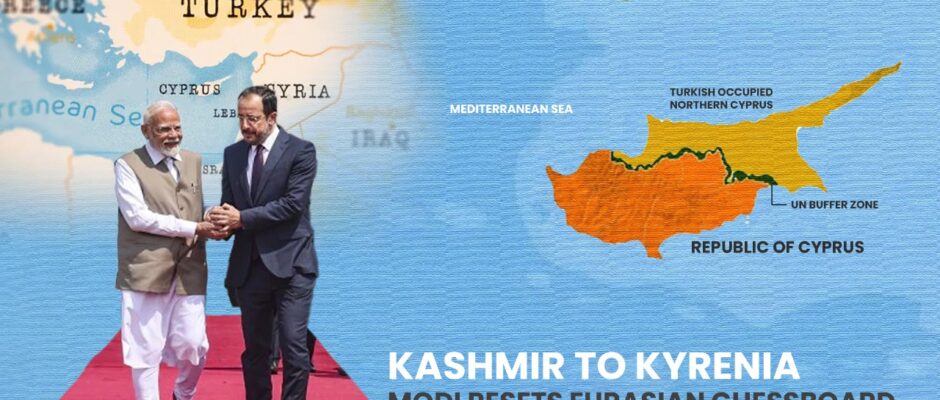
Kashmir to Kyrenia, Modi Resets Eurasian Chessboard

Kashmir to Kyrenia, Modi Resets Eurasian Chessboard

Modi’s choice of gift, a hand-knotted Kashmiri silk carpet, was a polite but firm reminder that Jammu and Kashmir is unquestionably India’s sovereign terrain, just as a reunited Cyprus remains Nicosia’s non-negotiable objective. Rahul Pawa The world took only passing notice when Prime Minister Narendra Modi touched down in Nicosia on June 15. Yet for close watchers of Eurasian geopolitics, the visit was a strategic inflection point: New Delhi’s most pointed riposte to Ankara’s unabashed support for Islamabad and a deft assertion of India’s own red lines on sovereignty. Turkey’s dictatorial President Erdogan has, for years, amplified Pakistan’s Jammu and Kashmir narrative at the UN, transferred unlawful killer drone technology to Rawalpindi, and aligned diplomatically after every India-Pakistan flare-up in May 2025.  For New Delhi, Indo-Pacific is no longer the only arena where coercive partnerships need balancing; the Eastern Mediterranean now figures prominently in India’s “extended neighbourhood.” With its 1974 invasion of Cyprus, Turkey occupies roughly 36 percent of the island, a fait accompli recognised only by Ankara. The occupation like the Pakistani Occupation of Jammu and Kashmir and territories of Ladakh namely Gilgit-Baltistan is rarely headline news.  But Modi’s landing in Cyprus made sure it briefly elbowed Gaza war, Red Sea shipping routes and Ukraine off analysts’ front pages. Nominally, the trip produced standard diplomatic deliverables: a joint declaration pledging intensified defence – industrial collaboration, an information-sharing framework on counter-terrorism & cyber security and expanded naval cooperation, Indian warships will make more calls at Cypriot ports and conduct joint search-and-rescue drills. What made the optics powerful was less the paperwork than symbolism. Modi’s choice of gift, a hand-knotted Kashmiri silk carpet, was a polite but firm reminder that Jammu and Kashmir is unquestionably India’s sovereign terrain, just as a reunited Cyprus remains Nicosia’s non-negotiable objective. The Cypriot leadership reciprocated by publicly thanking India for “standing up for sovereignty,” words that landed like a shot across the bow in Ankara, where strategic planners have banked on the Islamic world’s silence over Northern Cyprus. Modi offered no press-conference grandstanding; the statement of support appeared in the joint communiquéé and in Cyprus gratitude, proof that deliberate ambiguity often resonates louder than televised barbs. For decades Eastern Mediterranean has been Turkey’s strategic back-yard. The Turkish Navy exerts sea control; Turkish petroleum parastatals map offshore gas blocks; and Ankara leverages the “Cyprus question” to box out European Union pressure. India’s arrival alters that mental map. Regular Indian Navy port calls, if operationalised, will put a blue-water Asian presence at the doorstep of NATO’s southern flank. That has twin signaling value: to Turkey, that its actions in South Asia carry costs in its own neighbourhood and to the EU-27, that India is willing to shoulder limited security responsibilities in Europe’s periphery. The visit also dovetails neatly with the nascent India-Middle East-Europe Corridor (IMEC). Cyprus, an EU member and chair in 2026 with convenient trans-shipment facilities and legal clarity, can serve as the Mediterranean gateway for IMEC sea–land–rail lattice, reducing dependence on Suez chokepoint and giving Indian exporters a predictable entry point into the European single market. By grafting strategic access onto an economic corridor, New Delhi builds dual-use leverage without flaunting gunboat diplomacy. Domestically, Modi’s subtle poke at Ankara offers an answer to critics who argue that New Delhi is often too restrained when foreign capitals weaponise the Jammu and Kashmir discourse. Internationally, the gambit helps India consolidate support among small and medium European states that resent Turkish maximalism but lack the heft to counter it alone. For Nicosia, partnering with G-20 heavyweight boosts deterrence far beyond what Brussels has provided. There is a United Nations angle, too. Turkey’s military presence in Northern Cyprus violates multiple Security Council resolutions, but enforcement has languished. By throwing India’s diplomatic weight behind Cyprus’s territorial integrity, Modi has effectively globalised what Ankara hoped would remain a regional wrinkle. Elevated visibility complicates any future attempt by Turkey to extract concessions, whether on gas exploration blocs or on a two-state settlement, by holding European unity hostage. Great-power statecraft often hinges on narrative as much as kinetics. In Cyprus, Modi wrote a concise but compelling script: sovereignty is indivisible, occupations are unacceptable, and India has the agency to intervene, politically and symbolically, well beyond the Indian Ocean. In doing so, New Delhi inserted itself into a theatre where it had little historical presence, turned Turkey’s Cyprus problem into a talking point in South Asia, and reminded Pakistan that its external backers have vulnerabilities of their own. Analysts inclined to dismiss the visit as a minor European detour miss the slow-burn strategic dividend. Like Cheniere’s gas cargoes that transformed LNG markets after years of obscurity, today’s silk-carpet diplomacy may look mundane until the first Indian Navy destroyer docks in Limassol or the first IMEC freight train off-loads Indian pharmaceuticals bound for Central Europe. By then, the message to Ankara will require no amplification: alignments have consequences, and India now writes a few of the footnotes in the Eastern Mediterranean ledger. For a world fatigued by protracted altercations, Cyprus often feels like a frozen footnote to history. Modi’s masterstroke reminds us that frozen conflicts can thaw and when they do, new actors will shape the meltwater. The sooner chancelleries from Washington to Brussels internalise that reality, the better prepared they will be for the next iteration of Mediterranean geopolitics. (Rahul Pawa is director, research at New Delhi based think tank Centre for Integrated and Holistic Studies)
Read More
Bharat – Islamic Confluence

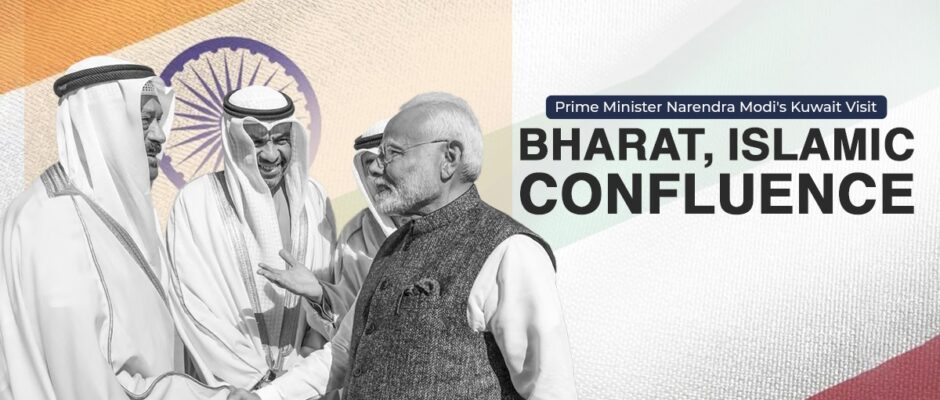
Bharat – Islamic Confluence

From Decades of Dormancy to Dynamic Diplomacy: How PM Modi’s Kuwait Visit Redefined Bharat’s Global Engagements. Vinod Kumar Shukla There is a misnomer that foreign policy of any country remains more or less the same while governments come and go. This is not true. Actually, it changes with the kind of government a country has from being submissive to assertive. Look at the case of Bharat where, ever since Prime Minister Narendra Modi took over, engagements with gulf countries have been of mutual interest by de-bracketing them from solely being Islamic nations, a great departure from the erstwhile Pakistan-centric foreign policy. Bharat has made its Western neighbour’s self-styled claim of being a stakeholder everywhere especially with Islamic nations meaningless. The engagement of Bharat with rest of the global communities are on equal footings. Ushering in a new era of global engagements, Prime Minister Narendra Modi expressed his concern during his Kuwait visit from December 21-22, 2024 stated that “it takes four hours to reach Kuwait from India but it took four decades for the Prime Minister.” This is despite the fact that over a million people of Bharat in Kuwait are the largest expatriate community which is regarded as the community of first preference among expatriates. The Gulf nation is a key source of investment for Bharat from the current president, Shaikh Mishal Al Ahmad Al Jaber Al Sabah, the Amir of Kuwait, of the Gulf Cooperation Council (GCC). Approximately 89 per cent of the total FDI from the GCC has been received in the last decade and bilateral trade between India and Kuwait in the last financial year was over $10 billion. The PM’s Kuwait visit is to further strengthen bilateral ties, operationalise security agreements that have been moving at a snail’s pace. Prime Minister Modi has been trying to make West Asia a trade gateway for the rest of Asia and Europe and create a business-friendly environment to invite and secure investments in the region. Bharat’s bilateral relations with most of the Gulf countries by de-bracketing Pakistan is no less than an achievement for any government. Now most of the countries are keen on deeper bilateral ties. But the way Kuwait facilitated PM’s interactions with diaspora and respected New Delhi’s sensitivities on cultural and religious matters, it clearly indicates Bharat’s growing diplomatic clout not only in the region but globally as well. West Asian countries are generally considered as oil supplying nations but Modi dispensation looks at them with mutual trust and opportunity in gamut of issues. Besides trade, regional security is another concern. The ongoing Israel-Hamas conflict and post-Assad instability in Syria are matters of concern. They are not only impacting regional security but also business prospects. Diplomatically cornering Pakistan, the two sides unequivocally condemned terrorism in all its forms and manifestations, including cross-border terrorism and called for disrupting of terrorism financing networks and safe havens, and dismantling of terror infrastructure during PM’s visit. They agreed to enhance cooperation in counter-terrorism operations, information and intelligence sharing, developing and exchanging experiences, best practices and technologies, capacity building and to strengthen cooperation in law enforcement, anti-money laundering, drug-trafficking and other transnational crimes. The two sides discussed ways and means to promote cooperation in cybersecurity, including prevention of use of cyberspace for terrorism, radicalisation and for disturbing social harmony. Defence cooperation is another area of mutual benefit and a Memorandum of Understanding (MoU) was signed between India and Kuwait to institutionalize bilateral cooperation in defence that included training, exchange of personnel and experts, joint exercises, cooperation in defence industry, supply of defence equipment, and collaboration in research and development, among others. India is gradually emerging as a defence exporting nation in a big way with its Make in India programme. The other issue that is very dear to the PM is solar energy (green energy) and making an oil exporting country like Kuwait the member of International Solar Alliance (ISA) is certainly a big deal. The world knows it well that solar energy is the future as fossil fuels are not forever. The ISA collectively covers the deployment of solar energy and addresses key common challenges to scale up its use to help member countries to develop low-carbon growth trajectories. Reducing carbon footprint is a global challenge and India has lived up to its global commitment. It wants others including developed nations to follow suit. Cultural linkages with West Asia are age-old and Bharat has always been wanting to continue which the PM has always been mentioning in his speeches. An understanding about Cultural Exchange Programme (CEP) between India and Kuwait for the years 2025-2029 has been reached about which would facilitate greater cultural exchanges in art, music, dance, literature and theatre, cooperation in preservation of cultural heritage, research and development in the area of culture and organizing of festivals. Sports is another area where India needs to do better and cooperation with friendly nations will help them to excel together. Executive Programme (EP) for Cooperation in the Field of Sports (2025-2028) is a similar measure that India and Kuwait have arrived at during PM’s recent visit which will strengthen bilateral cooperation in the field of sports by promoting exchange of visits of sports leaders for experience sharing, participation in programs and projects in the field of sports, exchange of expertise in sports medicine, sports management, sports media, sports science, among others. Most importantly, the persona and initiatives of Prime Minister Narendra Modi has been so overwhelming that Kuwait has bestowed upon him its highest knighthood order ‘The Order of Mubarak Al Kabeer’ which is the 20th international honour given to him. During his visit, the PM met with Crown Prince of Kuwait Sheikh Sabah Al-Khaled Al-Hamad Al-Mubarak Al-Sabah and discussed the importance to Bharat’s bilateral relations with Kuwait acknowledging that bilateral relations were progressing well and welcomed their elevation to a strategic partnership. They emphasized on close coordination between both sides in UN and other multilateral fora where India is not only seeking major reform and is emerging as an important player. In the context of the UN reforms, both leaders emphasized on the

Read More

Reforms Should Go Beyond Economy, Touch Every Facet of Life

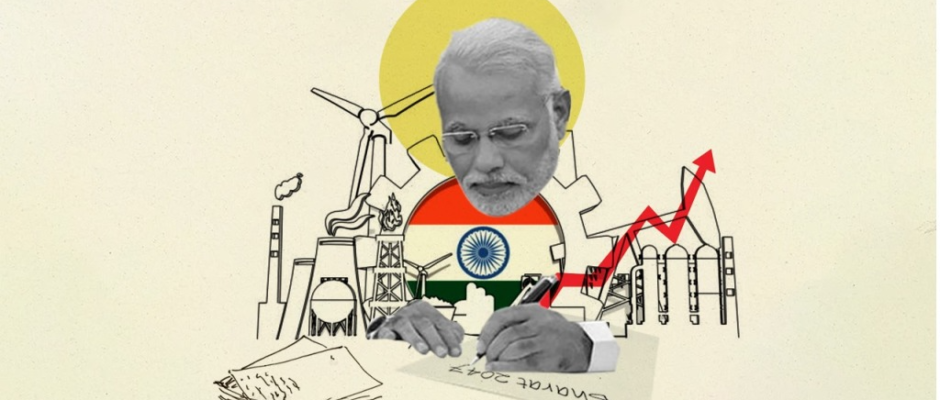
Let’s leverage strengths for global good, meet aspirations of Bharat’s citizens as we progress to become a developed country by 2047 Narendra Modi The biggest festival of democracy, the 2024 Lok Sabha Elections, is concluding today in our nation, the Mother of Democracy. After a three-day spiritual journey in Kanniyakumari, I have just boarded the plane for Delhi. Through the day, Kashi and numerous other seats have been in the midst of voting. My mind is filled with so many experiences and emotions… I feel a boundless flow of energy within myself. The 2024 Lok Sabha elections are the first in the Amrit Kaal. I began my campaign a few months ago from Meerut, the land of the First War of Independence of 1857. Since then, I have traversed ac-ross the length and breadth of our great nation. The final rally of these elections took me to Hoshiarpur in Punjab, the land of the great Gurus and a land associated with Sant Ravidas Ji. After that, I came to Kanniyakumari, at the feet of Maa Bharti. It is natural that the fervour of the elections was echoing in my heart and mind. The multitude of faces seen in rallies and road shows came in front of my eyes. The blessings from our Nari Shakti… the trust, the affection, all of this was a very humbling experience. My eyes were getting moist… I entered into a ‘sadhana’ (meditative state). And then, the heated political debates, the attacks and counter-attacks, the voices and words of accusations which are so characteristic of an election… they all vanished into a void. A sense of detachment came to grow within me… my mind became completely detached from the external world. Meditation becomes challenging amidst such huge responsibilities, but the land of Kanniya Kumari and the inspiration of Swami Vivekananda made it effortless. As a candidate myself, I left my campaign in the hands of my beloved people of Kashi and came here. I am also grateful to God for instilling in me these values from birth, which I have cherished and tried to live up to. I was also thinking about what Swami Vivekananda must have experienced during his meditation at this very place in Kanniyakumari! A part of my meditation was spent in a similar stream of thoughts. Amidst this detachment, amidst the peace and silence, my mind was constantly thinking about the bright future of Bharat, the goals of Bharat. The rising sun at Kanniyakumari gave new heights to my thoughts, the vastness of the ocean expanded my ideas, and the expanse of the horizon continuously made me realise the unity, the Oneness, embedded in the depths of the universe. It seemed as if the observations and experiences undertaken in the lap of the Himalayas decades ago were being revived. Kanniyakumari has always been very close to my heart. The Vivekananda Rock Memorial in Kanniyakumari was built under the leadership of Shri Eknath Ranade ji. I had the opportunity to travel extensively with Eknath ji. During the construction of this memorial, I had the opportunity to spend some time in Kanniyakumari as well. From Kashmir to Kanniyakumari… this is a common identity that is deeply ingrained in the heart of every citizen of the country. This is the ‘Shakti Peeth’ (seat of Shakti) where Maa Shakti incarnated as Kanya Kumari. At this southern tip, Maa Shakti performed penance and waited for Bhagwan Shiva, who was residing in the Himalayas at the northernmost parts of Bharat. Kanniyakumari is the land of confluences. The sacred rivers of our country flow into different seas, and here, those very seas converge. And here, we witness another great confluence – the ideological confluence of Bharat! Here, we find the Vivekananda Rock Memorial, a grand statue of Saint Thiruvalluvar, Gandhi Mandapam, and Kamarajar Mani Mandapam. These streams of thought from these stalwarts converge here to form a confluence of national thought. This gives rise to great inspirations for nation-building. This land of Kanniyakumari gives an indelible message of unity, especially to any person who doubts Bharat’s nationhood and the sense of unity. The grand statue of Saint Thiruvalluvar in Kanniyakumari seems to be looking at the expanse of Maa Bharti from the sea. His work Thirukkural is one of the crown jewels of the beautiful Tamil language. It covers every aspect of life, inspiring us to give our best for ourselves and for the nation. It was my great fortune to pay my respects to such a great figure. Swami Vivekananda once said, “Every nation has a message to deliver, a mission to fulfil, a destiny to reach.” For thousands of years, Bharat has been moving forward with this sense of meaningful purpose. Bharat has been a cradle of ideas for thousands of years. We have never considered what we have acquired as our personal wealth or measured it purely by economic or material parameters. Therefore, ‘Idam-na-mama’ (this is not mine) has become an inherent and natural part of the character of Bharat. Bharat’s welfare benefits our planet’s journey to progress as well. Take the freedom movement as an example. Bharat gained independence on Aug 15, 1947. At that time, many countries around the world were under colonial rule. Bharat’s independence journey inspired and empowered many of those countries to achieve their own freedom. That same spirit was seen decades later when the world came face to face with the once in a century Covid-19 pandemic. When concerns were raised about the poor and developing countries, Bharat’s successful efforts provided courage and assistance to many nations. Today, Bharat’s governance model has become an example for many countries around the world. Empowering 25 crore people to rise above poverty in just 10 years is unprecedented. Innovative practices such as Pro-People Good Governance, aspirational districts, and aspirational blocks are being discussed globally today. Our efforts, from empowering the poor to last-mile delivery, have inspired the world by prioritising individuals standing at the last rung of society. Bharat’s Digital India campaign is now an example for the entire

Read More

Explainer: Citizenship Amendment Act (CAA)

The Citizenship (Amendment) Rules, 2024 have been released by the Ministry of Home Affairs (MHA) today. These guidelines will specify the steps and prerequisites needed for qualified individuals to apply for Indian citizenship in accordance with the terms of the 2019 Citizenship (Amendment) Act (CAA-2019). The religious minorities, viz., Christians, Sikhs, Buddhists, Jains, Parsis, and Hindus, from Afghanistan, Bangladesh, and Pakistan who arrived in India prior to December 31, 2014, because of persecution or were afraid of being persecuted on account of their faith, the CAA-2019 offers a route to Indian citizenship. The documentation, forms, and other requirements that must be met by anyone wishing to apply for citizenship under this act will be detailed in the regulations notified by the MHA. An important step towards operationalizing the CAA-2019 has been taken with the notification of the Citizenship (Amendment) Rules, 2024. This ensures efficiency and transparency in the process of granting citizenship to eligible applicants and clarifies the procedures. The CA Rules 2024 will provide clarification and direction to applicants and pertinent authorities engaged in the CAA-2019’s implementation.

Read More

Beyond Brick and Mortar!

Opening of magnificent Hindu mandir in Abu Dhabi mark tectonic shift in India – UAE friendship that’s transcended commercial, diplomatic & strategic issues BAPS Hindu Mandir that rose majestically in Abu Dhabi is a symbol of Middle Eastern tolerance of different faiths and cross-cultural mosaic. This architectural wonder represents harmony and understanding across cultures and is much more than just a place of worship. When Pramukh Swami Maharaj visited United Arab Emirates in 1997, he floated the idea of building a temple in Abu Dhabi that would unite two “countries, closer together by cultures, and religions.” This is how journey to the temple began. In August 2015, UAE government declared that land for a Hindu temple (mandir) would be provided in Abu Dhabi. The land was gifted for mandir (temple) by Sheikh Mohamed bin Zayed Al Nahyan who was then crown prince of Abu Dhabi & Deputy Supreme commander of UAE Armed force.

Read More

Indo-Japanese Relations Go Beyond the Pacific

Modi and Kishida talks point to evolving common strategies that may spill over to multi-lateral engagement at G-20 and G-7 Amritpal Kaur Prime Minister Narendra Modi’s recent Japan visit was not limited to paying tributes to Abe San. Apart from representing India at his former Japanese counterpart’s funeral, Prime Minister Modi seems to have established a rather similar working understanding with the host government led by Fumio Kishida. Kishida, who was foreign minister in Shinzo Abe’s government, did not want to miss the opportunity in striking a relationship with Prime Minister Modi and his right wing BJP government in India. The two sides have thrown enough hints that Shinzo Abe’s vision for Indo Pacific partnership and larger alliance will continue to be the guiding principle in their relationship. Both sides have recognized that Quad was evolving as the operative group to implement the Abe’s vision for Indo Pacific region. Enough commitments were also made to move substantively in the path laid out by Shinzo Abe. Ease of doing business between two countries spread across trade, investments and manufacturing as well as services were a given in the whole gambit of bilateral relations. While this is second time Fumio Kishido met Modi on September 27 after having been anointed as Prime Minister, evolving intricate relations between the two countries has become a talking point in global diplomatic circles for right reasons. Insiders in Modi government do reveal that the Prime Minister chose to head to Japan for paying tributes to his friend Abe San rather than descending on London for Queen Elizabeth’s funeral. Increased relevance of the East Asia in Indian diplomacy matrix is yet another talking point. This was at display a few days before when Defense Minister Rajnath Singh and foreign minister S. Jaishankar were in Tokyo for two plus two dialogue. Defence Minister Rajnath Singh visited Inner Mongolia in September to forge defense and diplomatic ties between India and Mongolia. Minister Singh met Mongolia’s President Ukhnaagiin Khurelsukh and the Chairman of State Great Khural of Mongolia G. Zandanshatar. Apart from holding delegation level talks with his Mongolian counterpart to hasten implementation of strategic partnership between the two countries, Rajnath Singh inaugurated Cyber security Training Centre built with Indian assistance at the National Defense University in Ulaanbaatar. India Mongolia Friendship School also got wings during Singh’s visit.  On September 8, Indian Defence Minister and Foreign Minister held a two plus two ministerial dialogue at Tokyo with Japanese leadership centred around substantive engagement between Joint Staff of Japanese Self Defense Forces and Integrated Defense Staff of India. Japan participated for the first time in multilateral exercise MILAN. Both countries have operationalized the Reciprocal Provision of Supply Service Agreement. It was agreed that in the near future, Indian and Japanese Air forces will hold Air Force fighter exercise. India invited Japan to engage in development of the emerging and critical technology domains and Japanese defense companies to invest defense corridors in India. India pushed for maritime cooperation with Japan through its Indo-Pacific Oceans Initiative (IPOI) which is in line with Japan’s Free and Open Indo-Pacific (FOIP). Also, through Asean’s framework India and Japan have moved ahead to work on a greater Asian region. Rightly so, S. Jaishankar noted that given the tumultuous international environment, the 2+2 meeting between India and Japan promoted Rules-based order ensuring respect for international laws, norms and commitment to safeguard common resources of the world. Interestingly, both sides seem to have utilized the 2+2 meeting to reflect and coordinate approach on international issues. Also, in the scenario of aggravated environmental concerns, grim economic situation, Indo-Japanese cooperation seems to have moved beyond the immediate region, into the multilateral frameworks like QUAD, ASEAN platform, Re-CAAP and Supply Chain Resilience Initiative. Fortified India – Japan relations will come handy when New Delhi takes over as G-20 chair and Tokyo taking charge of G-7. (Author is a contributing scholar with CIHS)

Read More