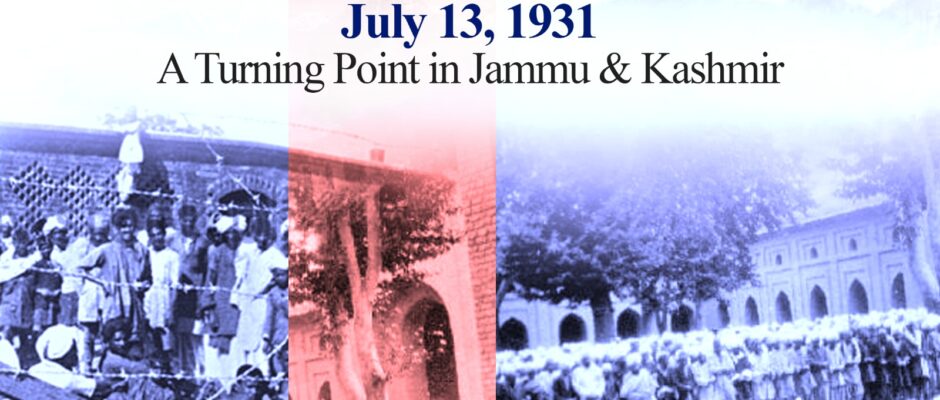
July 13, 1931: A Turning Point in Jammu & Kashmir
Vivek Raina Hundreds were burned alive and many others were thrown into the rivers, it was a heinous episode of Hindu fate in Jammu and Kashmir & the day is still being shamelessly celebrated to honour dead rioters of July13 1931 as Martyrs. One of the most significant and divisive moments in Jammu and Kashmir’s history occurred on July 13, 1931. In the erstwhile princely state, the date was formally recognised as “Martyrs’ Day” for many years, honouring those killed during the disturbances outside Srinagar Central Jail. According to historical accounts, a sizable crowd tried to break into the jail premises to interfere with the court proceedings and threw stones at the security personnel in spite of numerous warnings from the authorities. Several people were killed as state authorities opened fire to scatter the crowd in response to an intensifying law-and-order issue. The day’s events changed Jammu and Kashmir’s political course and left a legacy of competing historical accounts that still affect public opinion today. For the minority communities of Jammu and Kashmir, memories of 13 July 1931, remains a day of mourning, pain and remembrance of the well planned and organised attack on their civil rights, dignity and existence and also the emergence of a radical movement that permanently altered the region’s social and political landscape. The princely state of Jammu and Kashmir was ruled by Maharaja Hari Singh, whose kingdom included Jammu, Kashmir Valley, Ladakh, Gilgit, Baltistan, Mirpur, Muzaffarabad, Aksai Chin and several frontier regions. Following the First Round Table Conference in London in 1930, Maharaja Hari Singh openly advocated for the independence of Bharat from British. This stance placed him at odds with the British Occupation, which had significant strategic interests in Jammu Kashmir, particularly regarding the Gilgit frontier. The British sought to weaken the Maharaja politically after he refused to lease the strategically important Gilgit Agency on terms favorable to British interests. British knew his Achilles’ heel. They propped up an agent (who was already in their circuit) Abdul Qadeer, a non-state subject from Peshawar, and assigned him the un-coveted job to incite the Muslim population of Jammu and Kashmir against the Maharaja. He did his job meticulously on various fronts. Sheikh Mohammad Abdullah founded the All Jammu and Kashmir Muslim Conference in 1932 alongside Mirwaiz Yusuf Shah and Chaudhry Ghulam Abbas against Maharaja Hari Singh. In 1939, Abdullah converted it into the National Conference (currently headed by his son and current CM of Jammu and Kashmir) and later founded the Plebiscite Front, sowing the earliest seeds of separatism in Jammu and Kashmir. A key figure in the chain of events preceding July 13, 1931, was Abdul Qadir, a non-state subject who had come from Peshawar. At a gathering in Khanqah-e-Mohalla, Srinagar, he allegedly delivered a highly provocative speech, calling upon Muslims to rise against the Maharaja’s administration. Framed in explicitly religious intolerance, his address inflamed public sentiment and encouraged open defiance of the state administration. The speech marked a decisive escalation in the political atmosphere, leading to his arrest on charges of sedition and incitement. His trial became seeds of separatism in the Jammu Kashmir. On July 13, 1931, thousands of violent extremist gathered outside Srinagar Central Jail and tried to force their way into the central jail, where proceedings had been shifted because of repeated disruptions in court. Many prisoners inside attempted to burst open prison gates, police officers were hit with stones and the Islamic radicals grew more hostile and even tried to storm the jail. After being called to the scene, the District Magistrate identified the mob to be a “unlawful assembly” and issued an order for their dispersion, which was disregarded by extremists. When the violent extremist refused to disperse despite numerous warnings and the declaration that the assembly was illegal, the District Magistrate ordered authorities to use forces and maintain the law and order. The violent extremists under the supervision and leadership of social, religious and political activists like Sheikh Mohammad Abdullah, looted Hindu properties and houses at Vicharnag, Maharaj Ganj (the hub of business activity), Amirakadal, Hari Singh High Street and parts of Bohrikadal. In Kanikoot Village (now in Badgam district) Hindus were mercilessly beaten, their properties vandalised and the members of one family were thrown out from the windows of their three-storey house and brutally killed. Vicharnag, a locality with a significant Hindu population, is remembered by survivors as one of the worst-affected areas. Homes being looted & burned, businesses destroyed, and families assaulted. Sexual violence against Hindu women and extensive destruction of property, the attacks specifically targeted members of the Hindu minority. Hindu community of all hues in the valley was taken aback; this carnage shook its confidence because of the fact that it did not become victim of any riots but had to face a one sided raid, for no fault of theirs. Thousands of Muslim conference workers and other extremists joined the criminals who broke out of the jail and started looting the Hindu proprieties, burning the religious places of Hindus & assault on women of minorities i.e., Hindu, Sikh, Buddhist etc. Prof. Ram Nath Kaul, educationist and Principal (Retd.) of Government Degree College, Bemina, Srinagar in his book titled “Sheikh Mohammad Abdullah: A Political Phoenix”, described how Muslim Conference mobsters, after creating havoc, were greeted by Shiekh Abdullah at Mujahid Manzil, headquarters of Muslim Conference. One of the injured activist fell into the lap of the Sheikh and said, “Sheikh Sahib, Aap ney hamen jaisa kaha tha, humney vaisa kar diya” (whatever you had told us, we did the same), and with this he breathed his last in the lap of the Sheikh. This persecution of Hindus, Sikhs & Buddhists spread beyond Kashmir valley into areas such as Rajouri, Kotli, Mirpur, Khui Ratta, Seri, Dhana, Panjera and other parts of Jammu. Hindu and Sikh homes, temples, and gurdwaras were allegedly attacked, looted, or burned. Refugee families from these regions which are presently living in the Jammu district have preserved memories of the