
CIHS – Centre for Integrated and Holistic Studies

Date/Time:

India, Japan, and Buddha

India, Japan, and Buddha

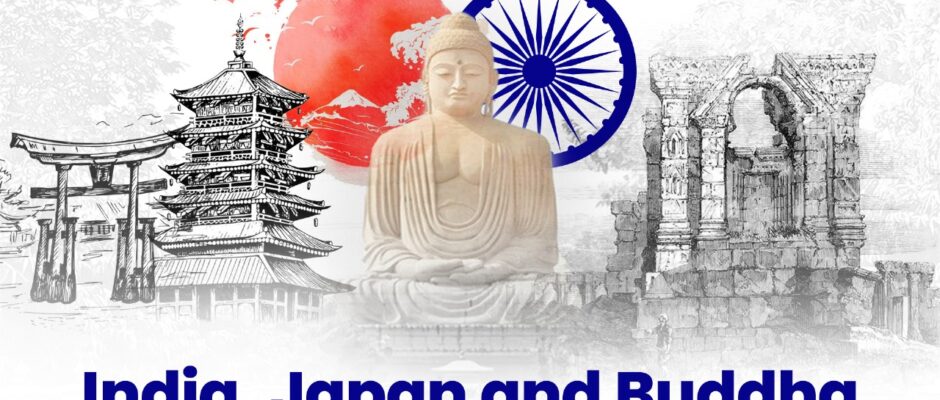
Dr. Jay Prakash Yadav Japan’s National Day embodies a legacy shaped by cultural wisdom and strategic foresight. Since Buddhism’s arrival from India in 552 AD, Japan has integrated its principles into governance. The history of cultural friendship between India and Japan dates to AD 552, the time when Japan was introduced to Buddhism. It was the time when Japan began to drink from the Indian spring of culture, sharing the Buddhist ideals of wisdom and compassion, faith and sacrifice, purity and enlightenment. India resulted in ushering in of a new era. Since then, Buddhism has remained the core and culmination of our friendship and will continue for generations to come. Japan drew its first constitution based on the Buddhist principles of Panchasila, Triratna- Buddha, Dharma and Sangha thus gave a humanized face to the administrative system in Japan. India and Japan have a unique relationship devoid of ideological, cultural, or geographical disagreements. It is distinct and exudes warmth from giving deeds and feelings of support for one another in difficult times. Japanese culture and thinking have been influenced by Indian culture, which has been filtered through Buddhism. This is precisely why Japanese people feel very close to India. A global vision of peace, security, and shared prosperity founded on sustainable development is now shared by Japan and India. The foundation of the two nations’ international cooperation is their shared democratic principles and dedication to pluralism, human rights, open society, and the rule of law. A wide convergence of India and Japan’s long-term political, economic, and strategic interests, aspirations, objectives, and concerns can be seen in their worldwide relationship. Japan and India see each other as partners who can and should respond to regional and global issues in a way that is consistent with their global cooperation. Thus, India’s strength, prosperity, and vibrancy are beneficial to Japan, and vice versa. It has been determined to strengthen the strategic focus of Japan-India’s global collaboration in light of the given circumstances and the state of the world. With a shared interest in and complementary roles in furthering global peace and equitable development as well as the security, stability, and prosperity of Asia, India and Japan are peace partners. In April 2005, during the then-Japanese Prime Minister Junichiro Koizumi’s visit, it was decided that the two nations would deepen their cooperation and work toward a comprehensive and all-encompassing development of their bilateral relations, with a specific and pressing emphasis on bolstering economic ties by making the most of their economies’ potential and current complementarities. It was determined that both nations will work to establish stronger communication and cooperation in order to safeguard peace, stability, and prosperity in Asia; advance democracy and development; and investigate a new framework for tighter regional cooperation in Asia. Taking advantage of and expanding upon existing strategic convergences, two nations also decided to increase collaboration in a variety of fields, including energy, disarmament, non-proliferation, security, and the environment. In the context of globalization and the growing concern over the use of military power for achieving foreign policy objectives, the importance of soft power has increased considerably, and Buddhism offers many advantages. Buddhism has international appeal and is highly conducive to spreading among all nations, cultures, and civilizations because of its core teachings, which include equality, non-violence, and its dialogical approach. Furthermore, there is no more effective soft power tool for Asian nations that share a Buddhist spirituality. Buddhism has played a significant role in Japanese culture and religion for over 1500 years, despite its foreign appearance. It is currently Japan’s soft power diplomacy’s most enduring tenet. Through several private and government agencies, Japan has been from time to time at the forefront in restoring the Buddhist relics, developing the major Buddhist pilgrim sites in various countries including India. Japan has thus rendered a great service to Buddhism and the land of its birth by rediscovering, reclaiming, and keeping alive the ‘wonder that was India. India has now woken up and is using Buddhism as the focal point of its soft-power campaign throughout Asia to highlight its strong Buddhist credentials. During the past one-decade, Indian policy-makers are making conscious efforts to utilize its allure for fostering deeper engagement with Asian countries – especially in the east and southeast, as part of its “Act East” policy. This involves not just sprucing up and showcasing Buddhist sacred sites and monuments, but also establishing people-to-people contacts and promoting cultural exchanges via tourism. (Author is Assistant professor at Dr. B.R. Ambedkar University of social sciences, Mhow, Madhya Pradesh and Scholar of Buddhist Studies.)

Read More
Japan & Bharat: Friends for Eternity

Japan & Bharat: Friends for Eternity

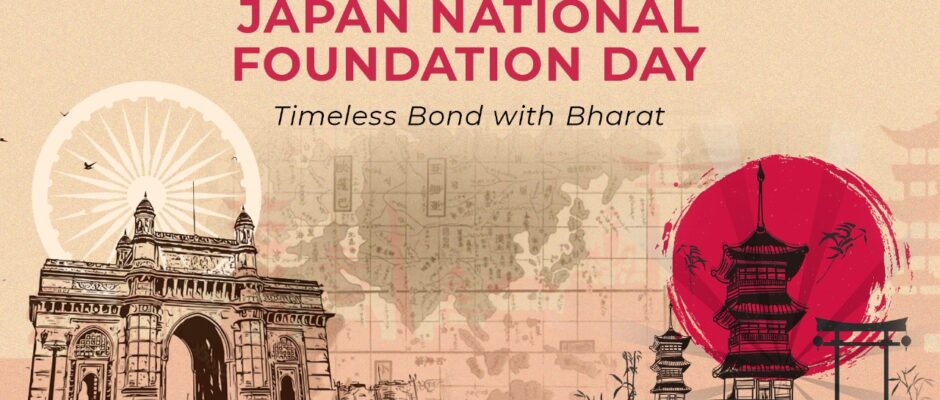
As Japan rings in its national foundation day, Bharat is on the curve joining this momentous occasion in shared values & principles of righteousness based on ‘dharma’. Rahul Pawa Across vast expanse of time and geography, few relationships between nations carry the depth and grace of one shared by Bharat (India) and Japan. Rooted in shared values, spiritual kinship and mutual admiration, this bond transcends transactional nature of alliances. Instead, it thrives on profound cultural, philosophical and historical ties that unite these two ancient civilizations. It is a connection that reflects the very essence of human harmony, a quiet testament to enduring power of shared ideals and aspirations. In rich history of human civilization, where threads of culture, faith and tradition intertwine, relationship between Bharat and Japan stand out as a masterpiece of enduring harmony and shared aspirations. This bond, etched into hearts of both nations, is not merely a product of modern diplomacy but connection spanning millennia. As Japan commemorates its National Foundation Day on February 11, celebrating ascension of Emperor Jimmu in 660 BCE and founding of the nation, it is an opportune moment to reflect upon rich and layered bond between these two great civilizations. In intricate cartography of Edo period, Japan placed India at centre of the world. Not out of geographical ignorance, but as a conscious act of reverence. Bharat—Tenjiku, as they called it—was more than a distant land; it was a spiritual homeland, birthplace of a philosophy that shaped Japan’s moral compass. For a nation that revered teachings of Buddha, India was not a foreign country but sacred extension of its identity. Long before ink of modern diplomacy touched parchment, flow of ideas between these two ancient civilizations had begun. When Indian monk Bodhisena arrived in Japan during eighth century, it was not a fleeting encounter but a moment of profound resonance. Invited to preside over consecration of the Great Buddha at Todai-ji Temple, he embodied the living bridge between two people united by in search for enlightenment. The ceremony, performed with sacred intent, symbolized more than the completion of a statue—it was consecration of a bond, a promise that these two cultures would remain intertwined. Maps of Edo period tell another story, quiet but potent. They show an India shaped not by geography but by imagination—a land of myths, wisdom and cosmic order. For Japan, steeped in Buddhist cosmology, India was not merely a place but metaphor for spiritual awakening. These maps, with their sprawling ovoid depictions of Tenjiku held India as axis of a world harmonized by Dharma. Such reverence is rare, even in annals of history. It speaks of a relationship not driven by conquest or commerce but by shared ideals and mutual awe. As tides of time shifted, threads of this bond remained unbroken. The rise of Zen Buddhism in Japan was deeply inspired by Indian Mahayana traditions transforming not just religious practice but essence of Japanese culture. The simplicity of Zen gardens, quiet grace of tea ceremony and meditative depth of haiku—all bear faint yet indelible imprint of India’s spiritual heritage. In turn, Japan’s refinement of these traditions added new dimensions to them, demonstrating unique capacity to absorb and elevate what it embraced. Culinary exchanges between Bharat and Japan are yet another testament to this quiet partnership. The artful simplicity of Japanese sushi finds an echo in intricate preparation of Indian thalis. The reverence for natural flavours in Japanese cuisine resonates with vegetarian traditions of India born from principles of ahimsa. Every shared meal, every borrowed recipe, is a silent acknowledgment of the kinship that transcends borders. The 20th century, with all its upheavals, tested this ancient bond but never weakened it. During India’s struggle for independence, figures like Fujii Guruji, founder of the Nippozan Myohoji Buddhist Order, stood in solidarity with India. His belief that the land of Buddha must be free to realize its spiritual destiny reflects depth of understanding between the two nations. Even as Japan pursued its own path of modernization, the connection to India remained alive, quietly influencing its worldview and aspirations. Today, the relationship between Bharat and Japan has evolved into a partnership of equals.  “Special Strategic and Global Partnership” is not a mere diplomatic phrase but continuation of an ancient dialogue. It is a collaboration born out of trust and shared values, manifesting in initiatives like Mumbai – Ahmedabad High – Speed Rail and Quad Alliance. These are not just projects or policies—they are modern expressions of an enduring friendship that began in monasteries and temples. Yet, essence of this bond lies not in its politics but in its people. Japanese tourists bow in reverence at Bodh Gaya, site of Buddha’s enlightenment, while Indian students embrace precision and innovation of Japanese education. The principle of Vasudhaiva Kutumbakam—the world as one family—and Kizuna—bonds of friendship—find living expression in these interactions. They remind us that this is not a relationship of convenience but one of conviction. As Japan celebrates its National Foundation Day, it is a moment to reflect on the legacy of this bond. February 11, marking ascension of Emperor Jimmu, symbolizes beginning of a journey, not just for Japan but for a relationship that has stood test of time. It is a day to honour ideals that have united Bharat and Japan: pursuit of harmony, reverence for tradition, and unyielding belief in a better tomorrow. This is not just a tale of two nations—it is a story of two spirits, kindred and enduring. As the cherry blossoms bloom in Japan and sacred rivers flow in Bharat, they carry with them whispers of an ancient friendship, timeless and unbroken. (Author is Research Director at Centre for Integrated and Holistic Studies, New Delhi based non-partisan think-tank)

Read More

Tactical Power Shift

India & Japan for open Indo-Pacific, game changing bilateral ties define Prime Minister Fumio Kishida’s visit to New Delhi Prachi Mishra Japanese Prime Minister Fumio Kishida’s two-day visit to India is part of on-going bilateral engagement between the countries agreed in 2006. Since then, Indian and Japanese leaders have consistently worked on strengthening ties and auguring a stronger and open Indo-Pacific. Prime Minister Kishida’s visit signals growing influence of QUAD. It is also significant as India and Japan presently hold the G20 and the G7 presidencies respectively. Kishida’s visit comes in the wake of San Shinzo Abe’s tragic death. Prime Minister Abe is regarded as a great friend of India seeking to reconnect two classical civilizations. Kishida’s statements have pointed to a turning point with continuity in bilateral strategic relations. Highlight of his visit was to unveil a plan on Open and Free Indo-Pacific for which he committed US $ 75 billion. Japan and India have a long and shared history of bilateral relations, strategic cooperation, and a resolve to build a peaceful Indo-Pacific.   Historical connect India and Japan share centuries-old relationship. Their ties can be traced back to the sixth century when Buddhism was introduced in Japan and adopted as a way of life in Japanese society. In 752 AD, Bharatiya Buddhist monk Bodhisena consecrated the Todaiji Temple at Nara. The towering Buddha statue at Tara has weathered many storms and stood the test of times. All through the last few centuries, India and Japan have never been adversarial towards each other and their relations have been free of disputes. In the recent past, Swami Vivekananda, Netaji Subhash Chandra Bose, Rabindranath Tagore, and JRD Tata have been Indian cultural ambassadors to Japan[1]. In contemporary times, India and Japan signed a peace treaty after the Second World War which not only established India’s diplomatic relations in Japan but also uplifted morale of Japanese people who were recovering from the aftermath of the war. India also extended its iron resources to the war-torn Japan and helped immensely in its reconstruction. The first yen-loan was extended by Japan to India after Premier Nobusuke Kishi’s official visit to India in 1957. The two nations also find a lot of commonality in upholding democratic principles and rule of law. There have been umpteen trade and commerce deals between India and Japan. Set up in 1903, the Japan-Indian Association is the oldest global informal organisation in Japan. Economic and commercial cooperation Trade and commerce ties between India and Japan have steadily strengthened over last few decades. Both nations have a mutually beneficial relationship; Japan has tapped into India’s emerging and expanding market while India has relied on Japan for technology transfers and financial assistance. India-Japan Comprehensive Economic Partnership Agreement signed in 2011 is the most holistic agreement that not only facilitates movement of goods and services but also human resource, shared development of intellectual property, and custom processes. Japan has been the largest financial donor for India. Over the years, Japan has supported India in infrastructure and technological development in sectors like railways and roadways, power, and environment. The most recent and the most relevant projects are Ahmedabad – Mumbai High Speed Rail, Western Dedicated Freight Corridor, Delhi-Mumbai Industrial Corridor, and the Chennai-Bengaluru Industrial Corridor. The Delhi Metro Rail Corporation was also facilitated by Japanese assistance. Table 1 lists items of trade between India and Japan. Table 1. Import-export goods in Indo-Japan trade ties. Imports from Japan to India Exports from India to Japan Machinery and instruments Petroleum products Transport equipment Chemicals and compounds Iron and steel goods Fish and by-products of fisheries Electronic equipment and goods Metal ores and scrap Organic chemicals Clothing, textiles, accessories Tools Iron and steel products During financial year ending March 31, 2022, India was the 18th largest trading partner for Japan. Concomitantly, Japan was the 13th largest trading partner for India. Also, Japan’s foreign direct investment has soared in the last few years, with India becoming the 5th largest investing country for 2021-22. India has seen a sharp rise in the number of Japanese firms totalling to 1455 that operate in India. Fig. 1 and Fig. 2 show the value of trade carried out between the two countries since 2008. Fig. 1.Trade values of Indo-Japan trade. Source: Ministry of Trade and Commerce, Government of India. Ministry of Economy, Trade, Industry, Government of Japan. CIHS Analytics Fig. 2. Foreign direct investment from Japan to India in the last few years. Source:  Ministry of Trade and Commerce, Government of India. Ministry of Economy, Trade, Industry, Government of Japan. CIHS Analytics. India has been the biggest recipient of the Japanese Official Development Assistance (ODA) loans in the last few years. India receives these loans from Japan under the latter’s “Act East” policy and “Partnership for Quality Infrastructure”. Table 2 summarises Japan’s ODA towards India. Table 2. Japan’s ODA towards India[2] Loans 312.25 billion Yen 2021-22 Grants 5.12 billion Yen 2020-21 Technical Cooperation 8.5 billion Yen 2021-22 The two countries have strengthened their relationship by focusing on developing strong supply chains through the India-Japan Industrial Competitiveness Partnership. Both India and Japan have also been striving for environmental protection and reduction of greenhouse gases. Their Clean Energy Partnership which was formulated in March 2022 focuses on achieving carbon neutrality and working towards energy security. Along with the Japan-India Energy Ministerial Dialogue, it also aims for a strategic cooperation plan in the fields of hydrogen, ammonia, and LNG. Science and technology cooperation Both India and Japan have benefitted from their science and technology cooperation over last several decades. While Japanese firms have revolutionised the Indian technology market, Indian software engineers, scientists, mathematicians, and technologists have contributed immensely to scientific research and development in Japan. India and Japan signed bilateral Science and Technology Cooperation Agreement in 1985 to foster an era of scientific advancement in the Indo-Pacific. Subsequently, the India-Japan Science Council (IJSC) was set up in 1993 facilitated several advancements. Till date, it has[3] Over 550 students have attended exchange programs through a

Read More

Indo-Japanese Relations Go Beyond the Pacific

Modi and Kishida talks point to evolving common strategies that may spill over to multi-lateral engagement at G-20 and G-7 Amritpal Kaur Prime Minister Narendra Modi’s recent Japan visit was not limited to paying tributes to Abe San. Apart from representing India at his former Japanese counterpart’s funeral, Prime Minister Modi seems to have established a rather similar working understanding with the host government led by Fumio Kishida. Kishida, who was foreign minister in Shinzo Abe’s government, did not want to miss the opportunity in striking a relationship with Prime Minister Modi and his right wing BJP government in India. The two sides have thrown enough hints that Shinzo Abe’s vision for Indo Pacific partnership and larger alliance will continue to be the guiding principle in their relationship. Both sides have recognized that Quad was evolving as the operative group to implement the Abe’s vision for Indo Pacific region. Enough commitments were also made to move substantively in the path laid out by Shinzo Abe. Ease of doing business between two countries spread across trade, investments and manufacturing as well as services were a given in the whole gambit of bilateral relations. While this is second time Fumio Kishido met Modi on September 27 after having been anointed as Prime Minister, evolving intricate relations between the two countries has become a talking point in global diplomatic circles for right reasons. Insiders in Modi government do reveal that the Prime Minister chose to head to Japan for paying tributes to his friend Abe San rather than descending on London for Queen Elizabeth’s funeral. Increased relevance of the East Asia in Indian diplomacy matrix is yet another talking point. This was at display a few days before when Defense Minister Rajnath Singh and foreign minister S. Jaishankar were in Tokyo for two plus two dialogue. Defence Minister Rajnath Singh visited Inner Mongolia in September to forge defense and diplomatic ties between India and Mongolia. Minister Singh met Mongolia’s President Ukhnaagiin Khurelsukh and the Chairman of State Great Khural of Mongolia G. Zandanshatar. Apart from holding delegation level talks with his Mongolian counterpart to hasten implementation of strategic partnership between the two countries, Rajnath Singh inaugurated Cyber security Training Centre built with Indian assistance at the National Defense University in Ulaanbaatar. India Mongolia Friendship School also got wings during Singh’s visit.  On September 8, Indian Defence Minister and Foreign Minister held a two plus two ministerial dialogue at Tokyo with Japanese leadership centred around substantive engagement between Joint Staff of Japanese Self Defense Forces and Integrated Defense Staff of India. Japan participated for the first time in multilateral exercise MILAN. Both countries have operationalized the Reciprocal Provision of Supply Service Agreement. It was agreed that in the near future, Indian and Japanese Air forces will hold Air Force fighter exercise. India invited Japan to engage in development of the emerging and critical technology domains and Japanese defense companies to invest defense corridors in India. India pushed for maritime cooperation with Japan through its Indo-Pacific Oceans Initiative (IPOI) which is in line with Japan’s Free and Open Indo-Pacific (FOIP). Also, through Asean’s framework India and Japan have moved ahead to work on a greater Asian region. Rightly so, S. Jaishankar noted that given the tumultuous international environment, the 2+2 meeting between India and Japan promoted Rules-based order ensuring respect for international laws, norms and commitment to safeguard common resources of the world. Interestingly, both sides seem to have utilized the 2+2 meeting to reflect and coordinate approach on international issues. Also, in the scenario of aggravated environmental concerns, grim economic situation, Indo-Japanese cooperation seems to have moved beyond the immediate region, into the multilateral frameworks like QUAD, ASEAN platform, Re-CAAP and Supply Chain Resilience Initiative. Fortified India – Japan relations will come handy when New Delhi takes over as G-20 chair and Tokyo taking charge of G-7. (Author is a contributing scholar with CIHS)

Read More