CIHS – Centre for Integrated and Holistic Studies

Date/Time:

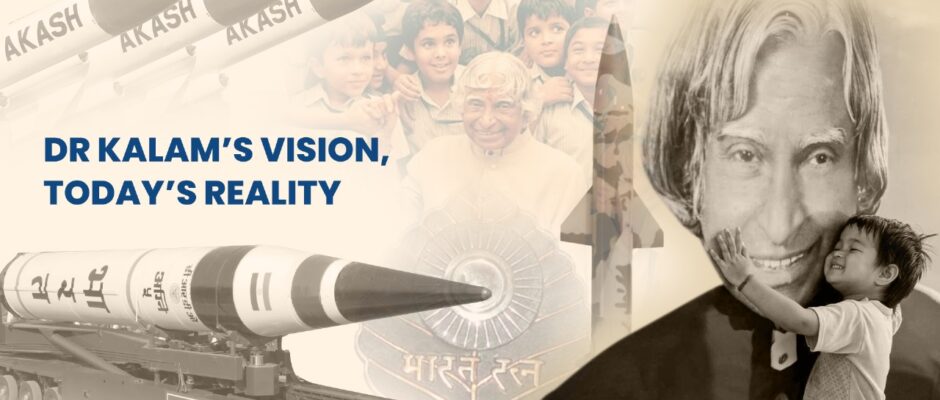
Dr Kalam’s Vision, Today’s Reality

Seeds of self-reliance and technological innovation have led to laying firm foundation for Viksit Bharat in defence domain. Dr G Sateesh Reddy When India gained independence, pressing need to indigenize defence systems was seriously felt, hitherto completely ignored by the British colonial regime.  Bharat of 1950s imported most of its arms and ammunitions from United Kingdom. By the 1960’s, as part of global movement to contain communism, US joined this list by selling arms and ammunition to both India and Pakistan. By 1970s, India had pivoted to polar opposite, relying on Soviet arms for its defence in 80’s as part of non-aligned movement. Through these three decades, there was an Avul Pakir Jainulabdeen Abdul Kalam, better known as Dr APJ Abdul Kalam. Today, we remember him posthumously as eleventh President of India. But, he was once just a school going kid in British India. He was 16 years old when he saw India declare independence and turned 19 when she became a republic. The urge to defend himself, his loved ones and see his country defending its freedom, all constituted Abdul Kalam’s foundational years, and his perspective on defence and self-reliance. Bharat’s journey towards self-reliance in defence did not start with flashy policy announcements or billion-dollar deals. It began in dusty labs and testing grounds where a soft-spoken space scientist turned defence guy named Dr. APJ Abdul Kalam who dreamed of technology leap-frog in his country.  The IGMDP programme to create a range of advanced missiles including Prithvi, Agni, Trishul, Aakash and Nag was his way of this movement forward. Known affectionately as “Missile Man of India,” Dr Kalam was not just building rockets; he was laying the foundation for a nation that could stand on its own in a world full of uncertainties. Clearly, his work in 1980s was built with a vision for twenty first century. As we look back, it is clear how Indian government has fanned those flames into roaring ‘wings of fire’, pushing defence modernization into overdrive across every branch of Armed Forces. From cutting-edge R&D to booming manufacturing, India’s defence ecosystem is transforming, turning the country from a major importer to an emerging exporter. The last ten years have witnessed a paradigm shift in Bharat’s defence policy, approach and ecosystem, driven by the government’s commitment to “Make in India” and “Atmanirbhar Bharat (self-reliant Bharat).” India’s defence sector has undergone profound transformation driven by a clear governmental vision to achieve strategic autonomy and reduce dependence on foreign suppliers. The shift from being one of world’s largest importers to becoming a rising exporter and manufacturer of defence products and services has been orchestrated through a clutch of policy reforms, infrastructure investments and collaborative initiatives involving both public and private stakeholders. At the heart of this transformation lies government’s flagship “Aatmanirbhar Bharat” initiative, that placed defence manufacturing at the forefront of national development. Complementing this is the “Make in India” campaign, launched in 2014, which has galvanized domestic production across sectors. As a result, India’s defence production has surged from Rs 46,000 crore in 2014 to a whopping Rs 1.5 lakh crore in 2025 with the private sector contributing over Rs 33,000 crore, a clear indication of its growing role in the ecosystem. To streamline procurement and promote indigenous manufacturing, the government introduced Defence Acquisition Procedure (DAP) 2020. This policy prioritizes domestic sourcing and includes Positive Indigenisation Lists that restrict imports of thousands of items, thereby creating a predictable demand for Indian manufacturers. Additionally, Defence Procurement Manual 2025 and Defence Offsets Policy have been refined to encourage innovation and ease of doing business. Establishment of Defence Industrial Corridors in Uttar Pradesh and Tamil Nadu has further catalyzed growth attracting investments and fostering partnerships between industries and state governments. The government has focused on empowering start-ups and medium, small and micro enterprises through iDEX (Innovations for Defence Excellence) and Technology Development Fund. These programs have supported over 650 start-ups with prototype procurements and accounting for more than Rs 3,000 crore, reflecting a vibrant innovation ecosystem. Digital platforms such as SRIJAN-DEEP portal and Defence Exim Portal have enhanced transparency and streamlined export-import processes. Bharat’s achievements in defence exports are equally noteworthy. From less than Rs 1,000 crore in 2014, exports have soared to Rs 23,622 crore in 2025, with targets set at Rs 50,000 crore by 2029. Bharat made platforms and systems like BrahMos missile and Akash air defence system are now being exported to nearly 100 countries showcasing her growing reputation as a reliable defence partner. Indigenous development has reached new heights with successful deployment of platforms such as Prachand Light Combat Helicopter, Advanced Towed Artillery Gun System (ATAGS) and INS Vikrant, India’s first indigenously built aircraft carrier. Operation Sindoor has reiterated that today many asymmetric technologies are playing a crucial role in modern warfare. And, given that this was an out and out airborne and contactless war fought by leveraging its own indigenously designed and developed weapons, it adds more stars to Indian domestic industry’s repertoire. Home grown air defence systems and missiles like Akash and BrahMos, indigenously manufactured radars were leveraged during Operation Sindoor. Bharat has reiterated its dominance in missiles segment which began with IGMDP by the visionary Dr Kalam himself. This underscores the nation’s technical prowess and effectiveness of government support in nurturing complex defence projects. This is not just about numbers; it is about real change. The government has nurtured start-ups through schemes like iDEX and TDF and evolved an ecosystem much more competitive while making it investor and industry friendly. This fast-tracking across strata of stakeholders from industry to policy makers, has put India’s defence modernization in full swing, touching every segment: army, navy, air force, homeland security and even space and cyber domains. Modernization today focuses on mobility, firepower and technology integration. Drones are a big push – from surveillance UAVs like Drishti-10 to swarm drones developed under iDEX. Manufacturing has witnessed a significant transformation. Artillery systems, aircraft platforms, missiles systems and ammunition are today not just made in Bharat

Read More
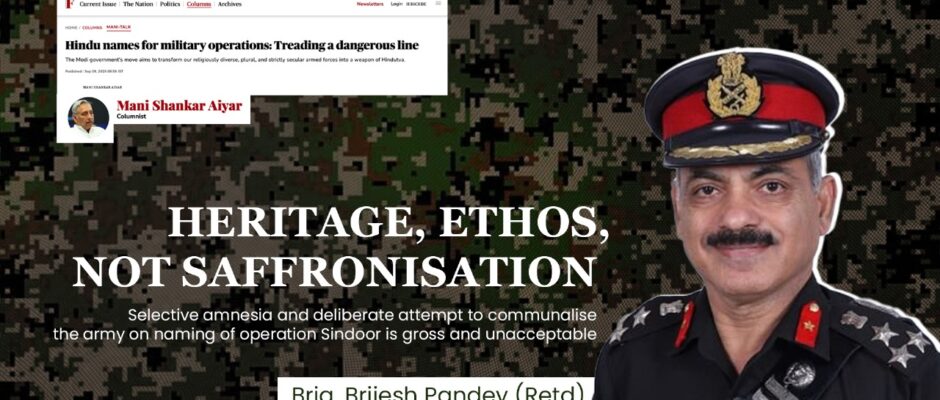
Heritage, Ethos, Not Saffronisation

Heritage, Ethos, Not Saffronisation

Selective amnesia and deliberate attempt to communalise the army on naming of operation Sindoor is gross and unacceptable. Brig Brijesh Pandey Frontline column “Hindu Names for Military Operations: Treading a Dangerous Line” by Mani Shankar Aiyar published on 09, September 2025 argues that naming of military operations by the present government – most recently Operation Sindoor reflects a deliberate “saffronisation of Indian Army.” The argument is provocative, selective and highly misleading. Having served for 35 years in Indian Army, I never felt that I’m a Hindu or so to say only a Hindu. Being from a pure Sikh Regiment, felt more like a SIKH, behaved like a Sikh and whenever there was a chance to name an institution, exercise or force, the first name that would come to the mind was one that related to Sikh traditions of valour. Yet no one, including my parents, questioned my secular or Hindu credentials. This is so, because anyone who understands armed forces – the history, military tradition and institutional structure – knows that operation or force names are cultural symbols, not ideological manifestos. The culture of naming operations and exercises is older than modern warfare and militaries across the globe use evocative names for operations and exercises – sometimes as a code for secrecy, motivation and more often for messaging deterrence to the adversary as much as public consumption. From earliest days of independent India, armed forces have drawn names from mythology, Sanskrit, geography and abstract concepts. This practice cuts across political regimes led by Congress, BJP or coalitions. In 1984, almost four decades prior to the debate, Indian Army launched Operation Meghdoot to secure Siachen Glacier. The name comes from Kalidasa’s Sanskrit classic Meghaduta (Cloud Messenger from Hindu Cosmology) where an exiled Yaksha asks a cloud to carry a message to his beloved in the Himalayas. Name was chosen, as it was apt reflection of the nature of operation wherein Indian troops were airlifted like clouds into Himalayan heights. It was nothing but a cultural resonance. The name of recently concluded operation Sindoor has been used as evidence to create a discourse that Army is getting communalized or saffronised. Rationale for the name is very clear. Terrorists in Pahalgam targeted married Hindu men, widowing women overnight.  Sindoor (vermilion) symbolizes marital bond in Indian culture. Naming the operation which was primarily a retaliatory action against such a heinous crime selectively inflicted on the majority community of the country was meant to be a tribute to victims and their families, not as a religious decree. Branding it as ideologically motivated reflects ignorance as well as crafty effort to question secular credentials of the armed forces. The act of symbolism and resolve when questioned post-operation Sindoor, a defense ministry official had said, “There is no single written policy on naming. Choices are pragmatic, contextual and meant to evoke resolve.” More often than not, the ideas get generated at very junior level and accepted as such to keep the initiative alive. The writer of “Hindu Names for Military Operations: Treading a Dangerous Line” has been selective about names in recent times, without considering full spectrum since evolution of Indian Armed Forces. When names like Operation Trident (1971), Operation Shakti (1998) or Exercise Ashvamedha (2007) were chosen, no one accused the government of the day – the Congress-led in each case – of religious indoctrination. In the name “Operation Trident”, famous naval strike on Karachi in 1971, “trident” is nothing else than “Trishul”, the weapon of Lord Shiva. Operation Shakti, India’s nuclear test in 1998 drew the name from Goddess power in the Hindu philosophy. But then, these names were accepted as civilizational, not sectarian. When no questions were Congress raised then, why do it now? To illustrate that there is neither any disruption in naming the operations nor is any correlation with appointment of CDS, it is important to analyze few names that relate to the pre and post-2014 era. Era Operation/Exercise Name Year Origin/Meaning Mythological/ Cultural link Pre-2014 Operation Meghdoot 1984 Kalidasa’s Meghadoota Yaksha sends clouds to Himalayas   Operation Trident 1971 Trident (Trishul) Weapon of Lord Shiva   Operation Pawan 1987 Pawan = Wind Vedic Deity   Operation Shakti 1998 Shakti = Power Goddess Power   Exercise Ashvamedha 2007 Royal Horse sacrifice Ancient Hindu Ritual   Exercise Sudarshan Shakti 2011 Sudarshan Chakra Vishnu’s discus   Missiles Prithvi, Agni, Akash, Nag Ongoing Fire, Earth, Sky, Serpent Vedic / Hindu roots   Exercise Indra Ongoing Indra = God of rain Vedic deity Post 2014 Operation Maitri 2015 Maitree = Friendship Sanskrit, Budhist ethos   Exercise Shatrujeet 2016 Shatrujeet = Enemy Conqueror Sanskrit motivational If Armed Forces were being transformed to suit a particular religion, their names and demography would also have started changing. Instead, the regimental system remains plural – Sikh Regiment, Rajputana Rifles, Maratha Light Infantry, Punjab Regiment, Assam Regiment, Madras regiment, Gorkha Regiment, Brigade of Guards, and so on – each maintaining regional, caste or faith-based traditions. The very regimentation of Indian Armed Forces is proof of pluralism. If the army was being saffronised as claimed by Aiyar, there would be a written directive mandating Hindu names. Whether it is regiments, exercises or operations, they would all start assuming names relating to Hindu religion only. Unlike compulsory recruitment of persons of religions based on which regiments exist only Hindus will get recruited. Likewise, promotion criteria will change. There would be no non-Hindu tenanting critical appointments such as Chief of Army / Navy / Air Force. Contrary to this, what we see is continuity: a mixture of neutral, mythological and cultural names chosen for operational and symbolic value. Seen through Cognitive Warfare lens, such narratives follow a familiar toolkit: disinformation (casting doubts on facts by portraying cultural symbolism as ideological capture), amplification (mainstreaming selective examples while ignoring historical continuity) and de-legitimization (eroding trust in one of the most patriotic institutions). We saw a similar pattern when opposition leaders questioned authenticity of 2016 Surgical Strikes and 2019 Balakot airstrike. In each case, rumour and

Read More
Operation Sindoor: India’s justified calibrated kinetic strikes Against Terror

Operation Sindoor: India’s justified calibrated kinetic strikes Against Terror

An unbroken thread links India’s 21‑year struggle against cross‑border terrorism, from the 2001 Parliament attack to the 2016 “surgical strikes” and the 2019 Balakot air strikes, into the present moment. On  22  April  2025 five Lashkar‑e‑Taiba gunmen slaughtered twenty‑six mostly Hindu tourists at Baisaran meadow near Pahalgam, Anantnag district, after segregating the victims by religion.[1] Within twenty‑four hours New  Delhi’s Cabinet Committee on Security (CCS) validated   “cross‑border linkages,” suspended the Indus Waters Treaty and ordered a graduated response “to bring the perpetrators and their sponsors to justice.”[2] Economic and diplomatic screws turned first: a blanket ban on Pakistani imports (2  May)[3] and reciprocal port closures (4  May)[4] reduced bilateral trade to zero and shrank the two High Commissions to skeletal staffs. Yet Pakistan army mortar fire persisted across the Line of Control, and Indian intelligence traced the Pahalgam cell to Lashkar training clusters in Pakistan and Pakistan‑occupied Jammy and Kashmir (PoJK). With public outrage mounting, the government authorised a justified calibrated kinetic strike, Operation  Sindoor.

Read More

Lessons from Kargil Ignited India’s Defense Revolution

Rahul Pawa Under PM Modi’s leadership, lessons from Kargil have driven significant reforms in military, intelligence, border security, and indigenous manufacturing, ensuring a more resilient and self-reliant India. In the summer of 1999, several high-altitude regions of Ladakh, including Mushkoh Valley, Dras, Kargil, Batalik, Chorbat La, and Turtuk, became the epicentres of a fierce battle between India and Pakistan. What began as a surprising discovery of armed intruders on the Indian side of the Line of Control (LOC) swiftly escalated into a full-blown military standoff. Initially mistaken for insurgents, these infiltrators were soon identified as regular soldiers of the Pakistan Army in disguise. The ensuing hostilities, fraught with the threat of nuclear escalation, lasted for eleven tense weeks. The limited war-like standoff finally drew to a close on July 26, 1999, when India thwarted the intruders and won the war. Now, 25 years later, as India marks the anniversary of its resolute campaign to defend its motherland, the nation pays tribute to the 527 martyrs and over 1,100 wounded. However, this anniversary also serves as a catalyst for a new national security paradigm, shaped by the lessons learned on the battlefield. Even before the dust had settled on the graves of Pakistani soldiers in the highest reaches of the Himalayas—soldiers whom the Pakistan Army and their Islamic Republic refused to acknowledge—New Delhi, under the leadership of Prime Minister Atal Bihari Vajpayee, planned a thorough investigation into the events leading up to and during the standoff. Within three days of the victory in Ladakh, the Indian government began “to examine the sequence of events and make recommendations for the future” by formally setting up the Kargil Review Committee (KRC). The committee, chaired by K. Subrahmanyam and including Lt. Gen. K.K. Hazari, B.G. Verghese, Satish Chandra, and National Security Advisor Brajesh Mishra, formally submitted is report on December 15, 1999, merely 5 months after a hard earned victory. Based on over a hundred interviews with senior military personnel, diplomats, intelligence officers, journalists, and politicians, the report offered recommendations on border management, civil–military liaison, counter-terrorist operations, defense budget and modernisation, LOC policy, nuclear policy, intelligence, media relations, the National Security Council, national security management, and technology. This year, in a speech delivered in Dras, Ladakh, during the 25th Kargil Vijay Diwas, Prime Minister Narendra Modi highlighted the strategic importance of the Agnipath scheme, drawing from the lessons of the 1999 battles in Ladakh. The initiative aims to revitalise the army by reducing the average age of its personnel through a four-year enlistment of young recruits, thus infusing the force with fresh energy and technical skills. An approach recommended in the KRC, which advocated for maintaining a youthful and fit army. Yet, this marks only the beginning of a broader wave of strategic, technical, and policy shifts inspired by the KRC’s findings and recommendations, with some measures already in place and others still underway. As part of the KRC’s robust recommendations for reform and modernisation, the Indian military embarked on extensive structural changes. This led to the appointment of the first Chief of Defence Staff (CDS), a position filled by General Bipin Rawat on December 24, 2019, under the PM Modi-led NDA government after two decades of deliberation. Aligned with the KRC recommendations, the Indian military underwent extensive modernisation and structural reforms. This included the creation of several tri-services organizations to enhance coordination and efficiency. Notably, the Integrated Defence Staff, Andaman and Nicobar Command, Nuclear Command Authority, Strategic Forces Command, and the Department of Ex-servicemen Welfare were established. Additionally, the Defence Technology Council and the Defence Acquisition Council were created to streamline technological advancements and procurement processes, reflecting the KRC’s emphasis on comprehensive technical reforms. Additionally, the Kargil Review Committee’s recommendations led to significant upgrades in border infrastructure and intelligence, addressing key issues revealed during the 1998-1999 Pakistani infiltration. Under National Security Advisor Ajit Doval, the establishment of the Multi-Agency Centre (MAC) and the Joint Task Force on Intelligence (JTFI) enhanced coordination. New airstrips and advanced landing grounds were developed to counter potential threats from China and Pakistan, significantly improving border security and readiness. Enhancing military preparedness has been another critical area significantly improved by the KRC’s findings and recommendations. Under the leadership of PM Modi and the NDA government, the adoption of advanced technologies, such as Chinook helicopters and upgraded airstrips, has notably boosted rapid force deployment capabilities. These advancements ensure that the Indian military can respond swiftly and effectively to threats. The success of Uri surgical strikes, Balakot Air strikes and decisive responses to People’s liberation Army (PLA) aggression in regions like Galwan and Pangong Tso further highlight India’s heightened state of readiness and strategic agility, demonstrating a robust defense posture that aligns with the KRC’s vision for a more secure and responsive military framework. In a fast-evolving globalised world, challenges like the ongoing Ukraine conflict and the escalating threat from Communist Party of China (CPC) showcase the need for a robust, indigenous defense supply chain. This necessity was also highlighted in 1999 when the U.S. denied India’s request for GPS data during the 1999 Ladakh aggression by Pakistan, prompting India to develop its own GPS system, the Indian Regional Navigation Satellite System (IRNSS), an autonomous satellite navigation system that provides accurate position information services to users in India and the surrounding region, covering up to 1,500 kilometres beyond India’s borders. Learning from these  lessons, the 2020 “Atmanirbhar Bharat” initiative was launched to reduce reliance on foreign suppliers and foster self-sufficiency in defense production. This ambitious program aims to build a strong domestic defense manufacturing sector, ensuring India can independently meet its military needs. The initiative promotes research and development, encourages public-private partnerships, and incentivises domestic production of critical defense technologies and equipment. In the contemporary landscape, under PM Modi’s leadership, these measures reflect a broader strategic shift towards a more secure and resilient India, aligning with the foresight provided by the KRC report. The Indian government’s commitment to strengthening the nation’s defense capabilities is evident in various initiatives designed to

Read More