CIHS – Centre for Integrated and Holistic Studies

Date/Time:

Sangh@100 with People’s Support

Sangh@100 with People’s Support

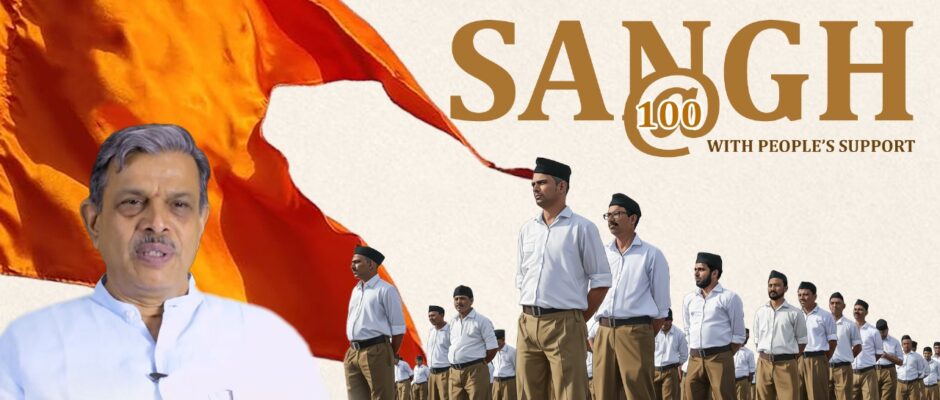
Dattatreya Hosabale The work of the Rashtriya Swayamsevak Sangh has now completed one hundred years. In this long journey, countless people have been companions, contributors, and well-wishers. This journey was full of hard work and challenges, but the unwavering support of ordinary citizens turned it into a fulfilling one. As we pause in the centenary year and look back, memories of many such moments and people come alive—those who devoted their everything to ensure the success of this mission. In the early years, young karyakartas set forth across the country like dedicated warriors, driven entirely by their love for the nation. Family man like Appaji Joshi or full-time pracharaks such as Dadarav Parmarth, Balasaheb and Bhaurao Deoras brothers, Yadavrao Joshi, Eknath Ranade—all of them, under the guidance of Dr. Hedgewar, took Sangh work as a sacred vow of lifelong service to the nation. The progress of the Sangh has always rested on society’s constant support. Because its work remained in tune with the spirit of the people, acceptance grew steadily over time. Once, Swami Vivekananda was asked during his foreign travels: “Most of your countrymen are uneducated, they don’t even know English, so how will they understand these profound things you talk about?” Swamiji had replied, “Just as ants do not need to learn English to find sugar, my people do not need foreign tongues to recognise a noble and spiritual cause. Their inner wisdom will guide them.” This statement turned out to be remarkably true. Similarly, despite the slow pace, society at large has continuously recognised and supported the Sangh’s sincere efforts. From the very beginning, Sangh Karyakartas received blessings, shelter, and encouragement from ordinary families. In fact, the households of swayamsevaks themselves became the foundational centres of the work. The contribution of mothers and sisters has been critical in giving completeness to this journey. Inspired figures like Dattopant Thengadi, Yashwantrao Kelkar, Balasaheb Deshpande, Eknath Ranade, Deendayal Upadhyaya, and Dadasaheb Apte drew strength from the Sangh and went on to build several organisations in different walks of social life. Today these organisations, with immense growth, have brought about constructive changes across many fields. Among women too, towering personalities like  Mausiji Kelkar and Pramila Tai Medhe, through the Rashtriya Sevika Samiti, have offered a motherly strength that has been central to this mission. Over the decades, the Sangh has raised several issues of national importance, always with society standing in support. At times even those publicly opposed have lent their voices for the larger Hindu cause. The Sangh consistently sought consensus and cooperation on matters of Hindu unity, national security, social harmony, democracy, and preservation of culture. Thousands of Swayamsevaks endured unimaginable hardships, and many laid down their lives. Through all this, society’s hand of support was always there. In 1981, when a few Hindus in Meenakshipuram, Tamil Nadu, were converted under misleading circumstances, a massive Hindu awakening movement followed. A conference attended by nearly half a million people was presided over by Dr. Karan Singh, then a senior Congress leader. In 1964, the Vishwa Hindu Parishad was founded with the active participation of renowned spiritual leaders like Swami Chinmayananda, Master Tara Singh, Jain muni Sushil Kumar, Buddhist bhikshu Kushok Bakula, and Namdhari Sikh Guru Jagjit Singh.  The initiative was inspired by Shri Guruji Golwalkar, with the purpose of reaffirming that untouchability had no place in Hindu scriptures. To uphold this principle a grand  World Hindu Conference was conveyed in Udupi where revered spiritual leaders, saints and mahants came together extending their blessings and support. The spirit voiced earlier at the Prayagraj conference—that Na Hindu patito bhavet (No Hindu can ever fall from grace) was echoed at this conference as Hindavah Sodara Sarve (All Hindus are brothers, children of Bharat Mata.)  From the campaign for cow protection, to the Ram Janmabhoomi movement, Sant-samaj (saintly fraternity) has always given blessings to the Sangh swayamsevaks. After Independence, when political reasons led to a ban on the Sangh’s activities, it was not only ordinary people but also highly respected figures who openly stood by it, giving courage in those difficult times. The same was experienced during the Emergency. That is why, despite so many obstacles, Sangh work has continued seamlessly and steadily. Through crises, it has often been the mothers and sisters who shouldered the responsibility of keeping Swayamsevaks and their work intact, becoming a constant source of inspiration. Looking ahead, in this centenary year, Sangh Swayamsevaks will make a special effort to reach every household—across big cities, remote villages, and among all sections of society—to invite wider cooperation and participation in the mission of national service. With the coordinated effort of all well-meaning forces of society, the next stage of our nation’s journey—towards holistic development—will certainly be smoother and more successful. (The writer is the Sarkaryavah of the Rashtriya Swayamsevak Sangh)Sangh@100 with People’s Support

Read More
100 Years’ Journey of RSS: New Horizons

100 Years’ Journey of RSS: New Horizons

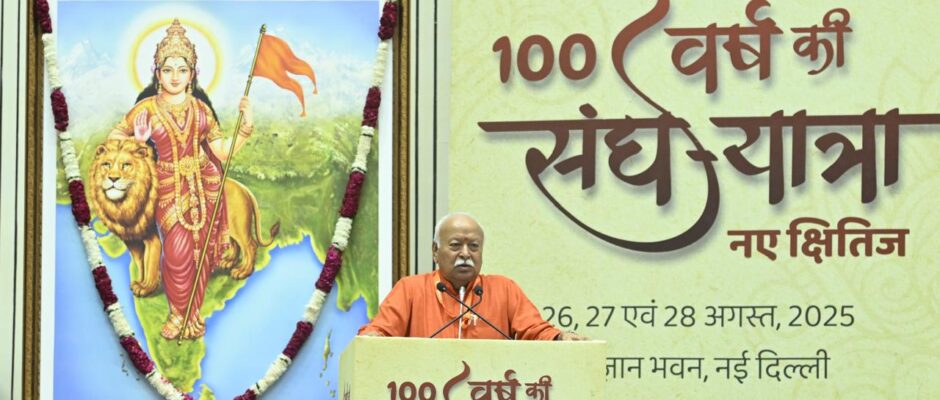
As the Rashtriya Swayamsevak Sangh enters its Centenary Year, a special 3-day lecture and interaction series of “100 Years’ Journey of RSS: New Horizons” was organised at Vigyan Bhawan, New Delhi, from 26–28 August 2025. The event, marked by thoughtful deliberations and inspiring addresses, brought together swayamsevaks, intellectuals, foreign dignitaries from more than 20 countries viz., US, UK, Russia, China, Germany, Japan, Australia, Nepal, Sri Lanka, Argentina, Malaysia, Indonesia, New Zealand, Uzbekistan, ⁠Kazakistan, Denmark, ⁠ Isreal, (to name a few), foreign media viz., BBC, AFP, DW, Sputnik, Reuters, NYT, WSJ, Kyodo News and many others, to look back and see the future. Sarsanghchalak, Dr. Mohan Bhagwat Ji, in his keynote address presented a deep insight into the Sangh’s journey since 1925. He brought before the gathering the fact that the Sangh had not been born due to some passing cause, but due to a timeless civilisational requirement, to cultivate character, cohesion, and service in society. He noted that whereas Sangh’s first one hundred years have been committed to establishing a robust infrastructure and national consciousness, the coming century will require newer models of involvement in the areas of education, technology, nature, culture, and international discoursed. During the three days, there were thematic sessions discussing crucial aspects of the Sangh’s contribution: Nation First and Social Harmony, Civilisational Continuity in a Changing World, and Empowering Communities for Self-Reliant Bharat. Representatives from various walks of life deliberated on how the Sangh’s quiet and consistent efforts in villages, towns, and cities have brought up a generation with sanskars and with the confidence to tackle contemporary issues. The exchanges brought out one shared spirit: that the 100-year RSS pilgrimage is not so much a history of expansion, but a living witness to the dynamism of selfless service and cultural consciousness. As Sangh embarks on its second century, the challenge is to widen horizons, adopting inclusiveness, innovativeness, and greater social connect, yet staying rooted in the fundamental vision of ekatmata, sewa, aur rashtra-nirman (unity, service, and nation-building). Three day event at Vigyan Bhawan ended with a fresh commitment, that the Centenary of RSS will not only marks a glorious past but also plant the seeds of a brighter, harmonious, and self-assured Bharat for the future generations. “Sanghachhadhwam, Samvadadhwam, Sam Vo Manamsi Janatam” (Let us move together, let us speak together, let our minds be in harmony.) — Rig Veda

Read More
Insight - Explaining Caste

Insight: Explaining Caste

Pre-colonial Indian studies, historic roots, social practices expose Christian, Western framework on caste to drive agenda-based narratives. In Hindutva, Varna and Jaati are distinct concepts often conflated as “Caste” in Western discourse, causing confusion. Varna, rooted in texts like Rig Veda and Bhagavad Gita, is a theoretical framework dividing society into four functional roles based on capacities, qualities and duties they undertake: Brahmins (scholars, priests), Kshatriyas (rulers, warriors), Vaishyas (merchants, farmers) and Shudras (labourers, service providers). Bhagavad Gita (4.13) stresses that Varna depends on actions and character, not birth, though it later became hereditary. Jaati, by contrast, refers to thousands of birth-based, localized groups linked to specific regions, occupations or traditions shaping social interactions in India. For instance, a single Varna like Kshatriya may encompass multiple Jaatis varying by region and time (Srinivas, M.N., 1985, Caste in Modern India). The term “Caste,” introduced by Portuguese colonizers (“casta,” meaning lineage) oversimplifies Varna and Jaati into a rigid hierarchy. Western views often mischaracterize Caste as a uniform, oppressive system unique to Hindutva ignoring its historical fluidity, regional diversity and parallels to class or guild systems elsewhere. This perspective overstates Brahmin dominance sidelining non-Brahmin roles in Hindu society (Dirks, Nicholas B., 2001, Castes of Mind). In paragraphs below, usage of caste refers to this complex, interdependent and layered architecture of Jaati and Varna and is used for simplicity purposes only.

Read More

Interview – RSS Pursues Five Grand Transformative Ideas

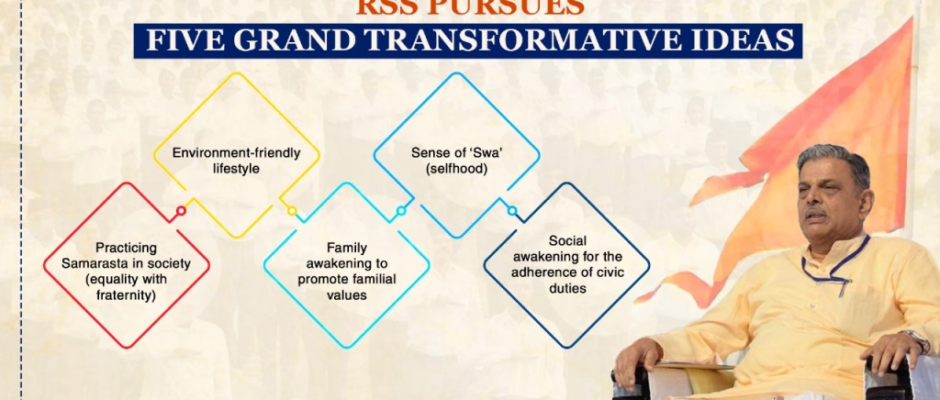
It is beyond doubt that the work of the RSS is progressing steadily. Bharat is fast assuming a distinct and powerful identity on the global stage. Rashtriya Swayamsevak Sangh has contributed significantly towards social enlightenment by championing the aforementioned truth, and also by countering the challenges posed by demonic detractors of Bharat. To proliferate nationalistic thoughts at an even greater pace and to deepen and expand its work, the Sangh is now ready with the idea of ‘Panch Parivartan’ (Fivefold Transformations). On the occasion of the Akhil Bharatiya Pratinidhi Sabha held in Nagpur from March 15 to 17, 2024, decisions have been made to work on dimensions that will mark the completion of a century of the Sangh’s existence. This year, the number of representatives present in the Pratinidhi Sabha seems to have suddenly increased. How did this happen? It is not true that the number has suddenly increased; it has happened gradually. With the expansion of our work, the number of Swayamsevaks was bound to jump, and as a result, the number of representatives also increased. When the Shakhas grow, the number of active Swayamsevaks automatically increases, and based on that, the number of representatives also increases. Additionally, a large number of invited brothers and sisters are also present in this Pratinidhi Sabha. Several inspired organisations were also invited to send representatives in Nagpur. Finally, due to the COVID-19 pandemic in the past three years, there were some restrictions on the number of representatives. We had to keep the number limited, so we didn’t invite some groups as expected. For example, in a certain year, the Vibhag Pracharaks were not expected, and in another year, workers from various fields were not expected. This is the reason why the number was low at that time, and now it seems to have suddenly increased. What special goals and objectives have been set for the centenary year of the RSS? In the context of the centenary year, we have identified two goals from an organisational perspective—increase the number of Shakha units and the qualitative improvement in the activities. All the members are expected to have this common goal in mind. By increasing the quality of work, its impact will increase too. The thrust is on qualitative growth along with the quantitative expansion. Secondly, from a social perspective, we have put forth the subject of Panch Parivartan (Fivefold Transformation). Our objectives include changing the intellectual narrative  from a national perspective, and to mobilise the sajjan shakti ( righteous power of the society) for social change. Therefore, in the centenary year of the RSS, we have made plans to take initiatives on all these subjects at both organisational and societal level. How do you propose to explain this entire concept of Panch Parivartan to the common masses and what challenges do we see there? When times are favourable and circumstances are conducive, extra caution, more effort, and deep contemplation become all the more necessary. Today, the time seems favourable for the dissemination of national thoughts. However, this favourability is not for sitting idly and enjoying the good time; it is a time to reach the very zenith of endeavours. The idea of Panch Parivartan is to deepen our approach to fundamental reforms by making the workers of the Sangh and various organisations its torchbearers. Anyway, today, Panch Parivartan is the need of the society in general. Panch Parivartan includes dimensions such as the insistence of practicing Samarasta in society (equality with fraternity), environment-friendly lifestyle, family awakening to promote familial values, inculcating sense of ‘Swa’ (selfhood) based on Bharatiya values in all aspects of life and social awakening for the adherence of civic duties; all these issues concern the society at large. Secondly, these topics need to be addressed to individuals, families, and the areas in the vicinity of Shakha. It needs to be taken to a wider society. We have kept these topics in front of the Swayamsevaks in general. Therefore, there should be an effort to bring about change through self-examples. This is not just a subject of contemplation and academic debate, but one of action and behavior. Also, we hold meetings of social leaders on social harmony and goodwill. We have contacts in wider society. So, we will take this subject among them and appeal from this perspective. In this year’s Pratinidhi Sabha, there was a special mention of Devi AhilyaBai Holkar. Do we have special programmes planned for her tercentenary year? The name of the Devi Ahilyabai Holkar, a symbol of valour and Shakti, appears in our Ekatmata Stotra with reverence. If we analyse her history properly, she has presented several excellent examples in various fields—from society, religion, governance, to administration. Today, on her tricentenary (300th birth anniversary), we have identified two to three objectives. Generally, in Hindu society, there is a flawed perception that the deprived sections of society did not get any opportunity to contribute towards nation building. Similarly, there is a distorted perception about women. However, if we delve deeper, Devi Ahilyabai Holkar’s life provides a precise answer to all such flawed perceptions. From a social perspective, the way she emerged from her community, and the way she set a shining example of administration, even after her husband’s untimely demise, present a powerful statement in Hindu society. Secondly, there is a lot of discussion about the empowerment and participation of women in present society. This year as well, our sisters in the Rashtra Sevika Samiti and Mahila Samanvay of other organisations have organised more than 400 conferences across the country, ensuring the participation of more than five lakh women. From this perspective, Devi Ahilyabai’s tercentenary is a good opportunity to further that good work too. Instead of organising programmes specifically by the Sangh, a Celebration Committee will be formed under a comprehensive plan, which will organise celebrations along with other women’s organisations and other members of society. We have plans for lectures and discussions on various dimensions of the great lady, including  publishing literature. “Panch Parivartan is the need of the society in general. Panch Parivartan includes dimensions such as insistence of practicing Samarasta

Read More

Ridiculing Hindutva is new fashion fad!

Textbooks revision in sync with new education policy, India’s contribution to science & technology must be taught. Prachi Mishra From magazines like Scientific American, Nature to British evolutionary biologist extraordinaire Richard Dawkins, many in global community seems to have been needlessly worked up about revision in syllabi for school going students in India. Dawkins, who is renowned for his work, The Selfish Gene, took to twitter and bashed Indian government for removing the periodic table from Chemistry lessons and Darwin’s Theory of Evolution in other Science classes. In his tweet, Dawkins made an inapposite remark, stating that “Hinduism is at least as ridiculous as Islam” attributing the revisions in text books that happen periodically to Hinduism. While the tweet was not only condescending, it was baseless and irrational. In the process, Dawkins joined some media houses globally that have made it their stated policy of intolerance towards ‘Hindus’ spread over 100 countries. First, revision or restructuring school syllabi has nothing to do with Hindu dharma. Secondly, both Mahatma Gandhi and Jawaharlal Nehru were practising Hindus and did not deny their religious beliefs or practicing faith. Thirdly, India’s turn to ‘secularism’ was after 42nd Amendment of the country’s constitution in 1976 during height of internal emergency days, a dark period India went through. It was never a stated ideal which both Nehru and Gandhi agreed upon. The figure below shows his tweet. Last week, when the National Council of Education, Research, and Training (NCERT) reported moving some parts of the existing syllabi like the periodic table from class X to class XI, it was not just Dawkins who misreported the incident. Global news and media agencies around the world caused a stream of misinformation by incorrectly quoting the NCERT report. Both, Nature and Scientific American, have a long-standing history of publishing information about pure science and have been widely recognised as pillars of science reportage. However, by driving an anti-India narrative globally, they have dented their own reputation. Additionally, incessant criticism of Hindu culture and dharma in every aspect of Indian life has become a ‘virtual fashion statement’ for a few. For instance, Dawkins tweet condemning Hinduism is bogus. At a time when the world and global scientific community is looking towards India and its contributions towards modern science and technology, biased scientists like Dawkins are living in their closed echo chambers. In fact, for Dawkins and the likes, it is crucial to acknowledge that Christianity took centuries to debate on whether Earth was the centre of solar system or the Sun, or whether the Earth is flat or ellipsoid. In fact, the Church executed several key scientists and philosophers of 16th, 17th, and 18th centuries just because they contested the former’s opinions. Hence, natural implication is that Dawkins’ hateful comments were indicative of deep-seated Hindu-phobic sentiment. India’s rich shastriya traditions have immensely contributed to modern scientific development. The New Education Policy, 2020 which attempts to make Indian education more holistic, inclusive, and integrated, will require fundamental changes in the way STEM, languages, and arts are taught at present. For instance, Three Language Formula that encourages young students to study subjects in their mother tongue, English, and another Indian language will require rejigging of the current education paradigm. Similarly, the NEP 2020 will also focus on teaching students history of science. And so on. In the light of mis-reportage on Periodic Table, it is quite relevant to look at present system of education and tweak it to suit needs of the future. To nurture societies and youth which can build their lives on ethos of sanatana culture, there is a need to make the school curriculum inclusive, integrated, and holistic. For instance, students should be exposed to shastriya (scientific) history of India rather than just focus on scientific and technological temper of the Western societies. For instance, concept of gravitation should be traced to its origins in the Vaisheshika sutra penned around 600 BC, much before Newton derived the concept and usurped credit for it. Similarly, Trigonometry should be taught as derivation from Surya Siddhanta and not from the works of Hipparchus. History of science could be walked through the centuries but its true origin must be taught to students of all age groups. One among these scientific marvels is Ayurveda, the ancient Indian system of medicine. Rooted in the belief that the human body is a microcosm of the universe, Ayurveda seeks to restore balance and harmony through a holistic approach to health. Its practitioners, known as Vaidyas, recognised that the key to well-being lay not merely in treating symptoms, but in addressing the underlying imbalances that gave rise to them. By meticulously studying properties of plants, minerals and animal products, they developed a vast pharmacopoeia of remedies that could alleviate suffering and restore vitality. India’s contribution to mathematics and astronomy was nothing short of groundbreaking. It was here that the concept of zero was conceived, laying the foundation for decimal numeral system that is now ubiquitous worldwide. Scholars like Aryabhata and Brahmagupta made remarkable advances in algebra, geometry and trigonometry, formulating theories that were centuries ahead of their time. Additionally, their prowess in astronomy was evident in the accurate calculations of celestial phenomena and the development of sophisticated astronomical instruments. Furthermore, ancient Indians delved deep into mysteries of the mind and consciousness. The science of yoga emerged as a transformative practice that sought to unite the individual self with the cosmic consciousness. Through rigorous discipline and meditation, yogis explored the depths of their own being, unraveling the profound wisdom that lay within. Intriguingly, the ancient Indians also possessed an advanced understanding of metallurgy and chemistry. Their expertise in metallurgical techniques allowed them to craft intricate sculptures and construct awe-inspiring architectural wonders. They also experimented with chemical processes, creating pigments and dyes of exquisite. India’s school and university curriculum needs a complete revamp. The world’s largest democracy is on the path to restructuring its national curriculum and it is natural to reorganise syllabus as per needs of the evolving

Read More

Sanatan Dharma is the essence of Hindu Rashtra

Mohan Bhagwat, chief of Hindu centric Rashtriya Swayamsevak Sangh (RSS) based in India speaks frequently and eloquently on issues like religious harmony, faith, Hinduness, Rashtra (nation or nationhood), Sanatan Dharma and essence of Hindu way of living. At the recent Dharma Bhaskar Awards programme at Nagpur, a western Indian city that also houses RSS headquarters, Bhagawat said that Dharma was centrifugal to Indian ethos and equated Sanatan Dharma to Hindu Rashtra that looked intimidating for some. The phrase Hindu Rashtra may need clarity given huge misconception on what it means or whom it relates to. Most misgivings are due to carefully carved anti-Hindu campaigns run by interested groups. So, Hindu and Rashtra may have to be seen as two different words that mean differently. As per reports, RSS consistently said that Hindus had a distinct vision for life that’s beyond particular mode of worship or faith. Supreme Court of India recently upheld the view that Hindutva was not a religion but way of life. A person living in India and that believes in any religion is regarded as a Hindu. Changing faith by personal preference for any reason does not alter one’s life vision. That is why they all have a life vision of India, i.e., Hindu.[1] This is what RSS believes in. The concept of Rashtra has flummoxed several critical commentators on Hindus and RSS.  Rashtra is loosely described as a nation that embodies ancient Indian civilization and diametrically opposite to European view. European nationalism has roots in Benito Mussolini, a fascist dictator’s view. When it came to guarding their interests, European nationalism was opportunistic and oppressive. In contrast, Indian nationalism as propagated by Hindutva forces is based on unity in diversity and reformative to purge its society of evil. The term Rashtra or nationhood has its place inVedic literature to describe the national ethos of Bharatavarsha, a contiguous land mass between the snow-capped mountain peaks of the Himalayas in the north and the deep ocean in the south. Rashtra also encompasses the land of seven rivers i.e. Sapta Sindhu. The civilisation that flourished over millennia in this land nation is imbued with spirituality, divinity, purity and motherhood. A Rashtra is not closed, selfish and individualistic bound by boundaries. It respects pluralism and all-inclusiveness with the vision of ‘Vasudhaiva Kutumbakam’ which means the whole world is one big family. In Indian civilizational discourse, the nation is often equated with one’s mother. In the Atharva veda, the Sanskrit verse says, “mata bhumiputroham prithvayah” meaning, this earth is my mother and I am her son. So those who believe in this broad spectrum of Rashtra or nationhood are Hindus. And, the concept of Hindu Rashtra has its moorings in this thinking. On Dharma, Mohan Bhagawat said that it denotes Satva or basic nature of this country. Sanatan Dharma drives the concept of Hindu Rashtra. Bhagawat was quoted as saying that when the Hindu Rashtra progresses, it also translates to progress of Dharma. RSS firmly believes that rise of Hindustan or India was certain and God willing, Sanatan Dharma would take centre stage internationally. RSS’s further amplification was that Dharma is not a cult, sect or a form of worship. Dharmic values include truth, compassion, purity and penance that are equally important. Hindus and RSS, the largest global Hindu organisation, strongly believe that Sanatan Dharma was at the core for India’s global economic dominance for over 1600 years of recorded human history. “India was at the number one economic position for 1600 years and later it ranked in the first five countries. But in 1860, an invader (Imperialist British) understood the importance of “Satva” and introduced a new education system to destroy that “Satva”. Despite many invasions, India remained one of the richest countries in the world as the “Sattva of Dharma” was maintained by its people,” said Mohan Bhagwat. In September 2022, Mohan Bhagwat had met Muslim intellectuals to discuss, strengthen religious harmony and inclusivity in the country. This was one of several such interactions at different levels the Hindu leaders have had with their muslim counterparts to ensure peace, tranquility and holistic development of Indian society. Notwithstanding these efforts, several international outfits and motivated individuals reportedly have had attempted to foment unrest in Indian Muslims and Christians by asserting that RSS was against minorities and caused attacks on them. However, the RSS chief stated that “scare-mongering by some is being done that there is a danger to minorities because of us. This is neither the nature of RSS nor of Hindus. Sangh resolves to stand on the side of brotherhood, amity and peace.”[2] In an interview to Organiser news weekly earlier this week, Mohan Bhagwat said, “foreign invaders are no longer there, but foreign influencers and conspiracies have continued. Since this is a war, people are likely to get overzealous. Although this is not desirable, provocative statements will be uttered.” On way forward during RSS centenary year in 2025, he said, “by the time we reach a hundred, we will have to take Sangh everywhere and forge links with all the segments of the society so that people have better examples to follow. They do not give importance to Bollywood, media and politics. Realising their duties, society should stand with the noble forces. The noble power should work in a harmonious, complementary relationship in the national interest. And whatever strength, expanse and workforce is needed for it, we will have to organise it by 2025. And, based on how much of this we accomplish, we will move ahead.”[3] [1] https://www.rss.org//Encyc/2017/6/3/basic-faq-on-rss-eng.html [2] https://bit.ly/3ZstKsh [3] https://organiser.org/2023/01/09/103852/eweekly/organiser-e-copy-15-january-2023/

Read More