
CIHS – Centre for Integrated and Holistic Studies

Date/Time:

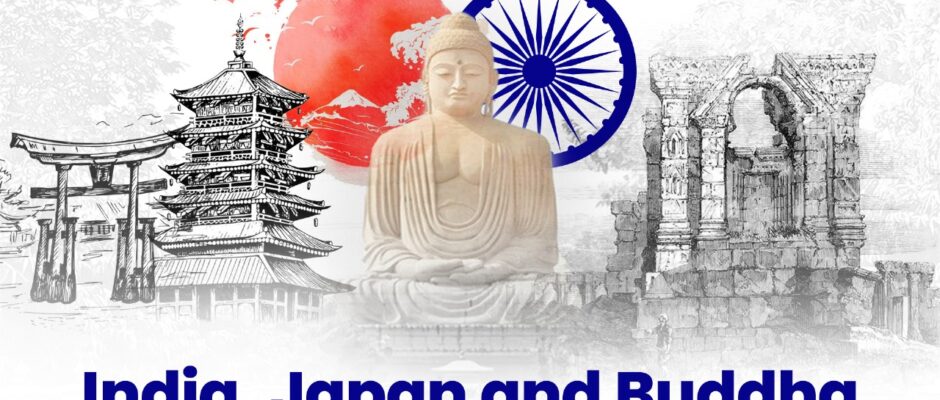
India, Japan, and Buddha

India, Japan, and Buddha

Dr. Jay Prakash Yadav Japan’s National Day embodies a legacy shaped by cultural wisdom and strategic foresight. Since Buddhism’s arrival from India in 552 AD, Japan has integrated its principles into governance. The history of cultural friendship between India and Japan dates to AD 552, the time when Japan was introduced to Buddhism. It was the time when Japan began to drink from the Indian spring of culture, sharing the Buddhist ideals of wisdom and compassion, faith and sacrifice, purity and enlightenment. India resulted in ushering in of a new era. Since then, Buddhism has remained the core and culmination of our friendship and will continue for generations to come. Japan drew its first constitution based on the Buddhist principles of Panchasila, Triratna- Buddha, Dharma and Sangha thus gave a humanized face to the administrative system in Japan. India and Japan have a unique relationship devoid of ideological, cultural, or geographical disagreements. It is distinct and exudes warmth from giving deeds and feelings of support for one another in difficult times. Japanese culture and thinking have been influenced by Indian culture, which has been filtered through Buddhism. This is precisely why Japanese people feel very close to India. A global vision of peace, security, and shared prosperity founded on sustainable development is now shared by Japan and India. The foundation of the two nations’ international cooperation is their shared democratic principles and dedication to pluralism, human rights, open society, and the rule of law. A wide convergence of India and Japan’s long-term political, economic, and strategic interests, aspirations, objectives, and concerns can be seen in their worldwide relationship. Japan and India see each other as partners who can and should respond to regional and global issues in a way that is consistent with their global cooperation. Thus, India’s strength, prosperity, and vibrancy are beneficial to Japan, and vice versa. It has been determined to strengthen the strategic focus of Japan-India’s global collaboration in light of the given circumstances and the state of the world. With a shared interest in and complementary roles in furthering global peace and equitable development as well as the security, stability, and prosperity of Asia, India and Japan are peace partners. In April 2005, during the then-Japanese Prime Minister Junichiro Koizumi’s visit, it was decided that the two nations would deepen their cooperation and work toward a comprehensive and all-encompassing development of their bilateral relations, with a specific and pressing emphasis on bolstering economic ties by making the most of their economies’ potential and current complementarities. It was determined that both nations will work to establish stronger communication and cooperation in order to safeguard peace, stability, and prosperity in Asia; advance democracy and development; and investigate a new framework for tighter regional cooperation in Asia. Taking advantage of and expanding upon existing strategic convergences, two nations also decided to increase collaboration in a variety of fields, including energy, disarmament, non-proliferation, security, and the environment. In the context of globalization and the growing concern over the use of military power for achieving foreign policy objectives, the importance of soft power has increased considerably, and Buddhism offers many advantages. Buddhism has international appeal and is highly conducive to spreading among all nations, cultures, and civilizations because of its core teachings, which include equality, non-violence, and its dialogical approach. Furthermore, there is no more effective soft power tool for Asian nations that share a Buddhist spirituality. Buddhism has played a significant role in Japanese culture and religion for over 1500 years, despite its foreign appearance. It is currently Japan’s soft power diplomacy’s most enduring tenet. Through several private and government agencies, Japan has been from time to time at the forefront in restoring the Buddhist relics, developing the major Buddhist pilgrim sites in various countries including India. Japan has thus rendered a great service to Buddhism and the land of its birth by rediscovering, reclaiming, and keeping alive the ‘wonder that was India. India has now woken up and is using Buddhism as the focal point of its soft-power campaign throughout Asia to highlight its strong Buddhist credentials. During the past one-decade, Indian policy-makers are making conscious efforts to utilize its allure for fostering deeper engagement with Asian countries – especially in the east and southeast, as part of its “Act East” policy. This involves not just sprucing up and showcasing Buddhist sacred sites and monuments, but also establishing people-to-people contacts and promoting cultural exchanges via tourism. (Author is Assistant professor at Dr. B.R. Ambedkar University of social sciences, Mhow, Madhya Pradesh and Scholar of Buddhist Studies.)
Read More
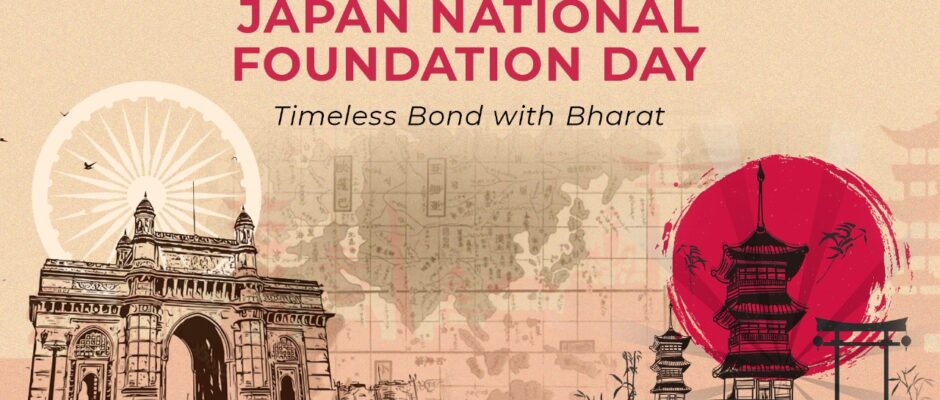
Japan & Bharat: Friends for Eternity

Japan & Bharat: Friends for Eternity

As Japan rings in its national foundation day, Bharat is on the curve joining this momentous occasion in shared values & principles of righteousness based on ‘dharma’. Rahul Pawa Across vast expanse of time and geography, few relationships between nations carry the depth and grace of one shared by Bharat (India) and Japan. Rooted in shared values, spiritual kinship and mutual admiration, this bond transcends transactional nature of alliances. Instead, it thrives on profound cultural, philosophical and historical ties that unite these two ancient civilizations. It is a connection that reflects the very essence of human harmony, a quiet testament to enduring power of shared ideals and aspirations. In rich history of human civilization, where threads of culture, faith and tradition intertwine, relationship between Bharat and Japan stand out as a masterpiece of enduring harmony and shared aspirations. This bond, etched into hearts of both nations, is not merely a product of modern diplomacy but connection spanning millennia. As Japan commemorates its National Foundation Day on February 11, celebrating ascension of Emperor Jimmu in 660 BCE and founding of the nation, it is an opportune moment to reflect upon rich and layered bond between these two great civilizations. In intricate cartography of Edo period, Japan placed India at centre of the world. Not out of geographical ignorance, but as a conscious act of reverence. Bharat—Tenjiku, as they called it—was more than a distant land; it was a spiritual homeland, birthplace of a philosophy that shaped Japan’s moral compass. For a nation that revered teachings of Buddha, India was not a foreign country but sacred extension of its identity. Long before ink of modern diplomacy touched parchment, flow of ideas between these two ancient civilizations had begun. When Indian monk Bodhisena arrived in Japan during eighth century, it was not a fleeting encounter but a moment of profound resonance. Invited to preside over consecration of the Great Buddha at Todai-ji Temple, he embodied the living bridge between two people united by in search for enlightenment. The ceremony, performed with sacred intent, symbolized more than the completion of a statue—it was consecration of a bond, a promise that these two cultures would remain intertwined. Maps of Edo period tell another story, quiet but potent. They show an India shaped not by geography but by imagination—a land of myths, wisdom and cosmic order. For Japan, steeped in Buddhist cosmology, India was not merely a place but metaphor for spiritual awakening. These maps, with their sprawling ovoid depictions of Tenjiku held India as axis of a world harmonized by Dharma. Such reverence is rare, even in annals of history. It speaks of a relationship not driven by conquest or commerce but by shared ideals and mutual awe. As tides of time shifted, threads of this bond remained unbroken. The rise of Zen Buddhism in Japan was deeply inspired by Indian Mahayana traditions transforming not just religious practice but essence of Japanese culture. The simplicity of Zen gardens, quiet grace of tea ceremony and meditative depth of haiku—all bear faint yet indelible imprint of India’s spiritual heritage. In turn, Japan’s refinement of these traditions added new dimensions to them, demonstrating unique capacity to absorb and elevate what it embraced. Culinary exchanges between Bharat and Japan are yet another testament to this quiet partnership. The artful simplicity of Japanese sushi finds an echo in intricate preparation of Indian thalis. The reverence for natural flavours in Japanese cuisine resonates with vegetarian traditions of India born from principles of ahimsa. Every shared meal, every borrowed recipe, is a silent acknowledgment of the kinship that transcends borders. The 20th century, with all its upheavals, tested this ancient bond but never weakened it. During India’s struggle for independence, figures like Fujii Guruji, founder of the Nippozan Myohoji Buddhist Order, stood in solidarity with India. His belief that the land of Buddha must be free to realize its spiritual destiny reflects depth of understanding between the two nations. Even as Japan pursued its own path of modernization, the connection to India remained alive, quietly influencing its worldview and aspirations. Today, the relationship between Bharat and Japan has evolved into a partnership of equals.  “Special Strategic and Global Partnership” is not a mere diplomatic phrase but continuation of an ancient dialogue. It is a collaboration born out of trust and shared values, manifesting in initiatives like Mumbai – Ahmedabad High – Speed Rail and Quad Alliance. These are not just projects or policies—they are modern expressions of an enduring friendship that began in monasteries and temples. Yet, essence of this bond lies not in its politics but in its people. Japanese tourists bow in reverence at Bodh Gaya, site of Buddha’s enlightenment, while Indian students embrace precision and innovation of Japanese education. The principle of Vasudhaiva Kutumbakam—the world as one family—and Kizuna—bonds of friendship—find living expression in these interactions. They remind us that this is not a relationship of convenience but one of conviction. As Japan celebrates its National Foundation Day, it is a moment to reflect on the legacy of this bond. February 11, marking ascension of Emperor Jimmu, symbolizes beginning of a journey, not just for Japan but for a relationship that has stood test of time. It is a day to honour ideals that have united Bharat and Japan: pursuit of harmony, reverence for tradition, and unyielding belief in a better tomorrow. This is not just a tale of two nations—it is a story of two spirits, kindred and enduring. As the cherry blossoms bloom in Japan and sacred rivers flow in Bharat, they carry with them whispers of an ancient friendship, timeless and unbroken. (Author is Research Director at Centre for Integrated and Holistic Studies, New Delhi based non-partisan think-tank)

Read More

Bhutan, Bharat, bhai bhai !

China’s intrusive prevarication may not turn New Delhi – Thimphu relations sour. Trying dirty tricks as in Nepal may not work to Beijing’s advantage Rohan Giri  / New Delhi As of now China has emerged as minor distraction in India and Bhutanese relations that span over millennia, civilizational ties with strong bonds of friendship and close people-to-people contacts. When Bhutan’s king Jigme Khesar Namgyel Wangchuk was in capital earlier last week on three days sojourn, there was enough noise made that growing proximity between Thimphu and Beijing may derail former’s relations with New Delhi. Unflinching commitment to take this friendship to next level may have not gone down well with several Beijing protagonists within and outside India. This should not matter much. Much of arguments that relations between the two countries were not honky dory had been attributed to remarks made by Bhutanese Prime Minister Tshering on India – China – Bhutan border tri-junction, Doklam.  The 73-days standoff between India & Bhutanese troops against Chinese counterparts during June – August 2017 is still fresh in mind. Twist given to Prime Minister Tshering’s comments was interpreted as Bhutan going the Chinese way which was untrue. In this backdrop, India and Bhutan scrupulously moving ahead with their commitment to neighbour-hood first policy assumes significance. Their shared vision for future cooperation including beneficial partnerships, significant reforms will have to be carried forward with vigour. Bhutan king’s meeting with Indian Prime minister Narendra Modi had in fact cleared the air and set the ball rolling for Bhutan in expanded bilateral trade cooperation, technology, cross-border connectivity, mutual investments etc. In the 13th five-year plan, both leaders envisioned successive Druk Gyalpos to guide India-Bhutan relations to new heights. Long-term sustainable bilateral ties in agricultural and critical commodities, setting up integrated checking post on the busiest trading way between both countries were also streamlined. Historical project of cross border rail link between Kokrajhar in Assam to Gelephu in Bhutan along with expansion of energy cooperation beyond hydroelectric project would further round the relations between two inseparable neighbours. Indian foreign secretary Vinay Kwatra said, “India will work to extend an additional standby credit facility. We will work to shape long-term sustainable arrangements for export of agricultural commodities from Bhutan. Also, work to develop long-term bilateral arrangements for assured supply of critical commodities like petroleum and coal.” If joint briefings were anything to go by, Bhutan seems keen to collaborate in financial technology sector, start-ups and emerging technologies. In effect, clear message seems to be on using United Payments Interface and ride piggyback as Indian rupee’s acceptance for making transactional settlements. India and Bhutan are friends in need and in deed. Vaccine Maitri drive launched by India had pulled half a dozen neighbourhood countries out of the humongous Covid – 19 induced pandemic mess. In fact, Bhutan was the very first beneficiary of the Covid-19 vaccine consignment from India. On the other hand, China was on expansionist spree beginning 2017 when it tried to build a road in 2017 through Chumbi Valley of Bhutan. When Narendra Modi was elected Prime Minister of India in 2014, Bhutan was the first country he visited treating the latter as a ‘reliable friend’ that could be trusted as an ally. There’s no denying that prior to this visit, there were some hiccups when Prime Minister Manmohan Singh withdrew cooking gas and kerosene subsidies. But, these were restored in 2014 after India saw a tectonic shift in its own power structure. Besides the bilateral and diplomatic relations, vibrant cultural linkages defined friendship between the two countries made it unique. (Rohan is a journalism graduate from Indian Institute of Mass Communication (IIMC) New Delhi, and Manager Operations at CIHS.)

Read More