CIHS – Centre for Integrated and Holistic Studies

Date/Time:

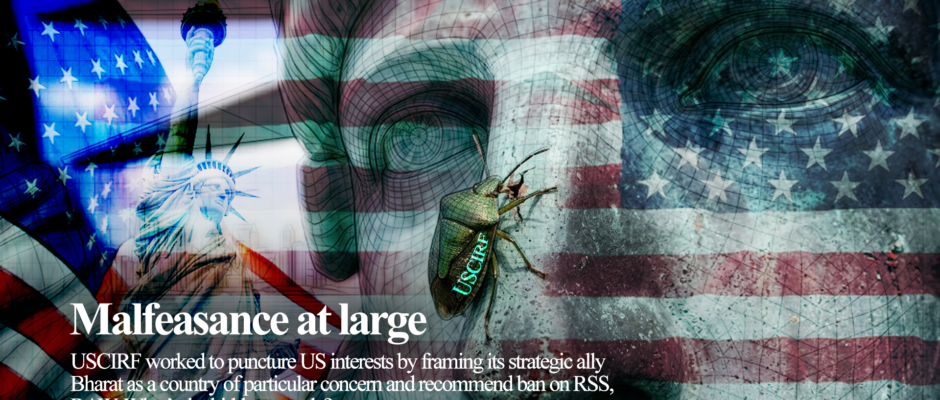
Malfeasance at large

USCIRF worked to puncture US interests by framing its strategic ally Bharat as a country of particular concern and recommend ban on RSS, RAW. What’s the hidden agenda?   K.A.Badarinath Why doesn’t US President Donald J Trump wind up the pugnacious and toxic organization US Commission for International Religious Freedom (USCIRF) that worked against American interests?President Trump cited ‘inefficient’, ‘wasteful’ expenses or ‘anti-US’ working as reasons good enough to withdraw from 66 international bodies including 31 UN agencies beginning January this year.By same yardstick, USCIRF is a fit case for immediate closure, try all six commissioners appointed through Presidential decree for ‘anti-US’ activities and recover state expenses that went into its anti-American propaganda. To begin with, US Congress that funds USCIRF for an ‘independent’ opinion on religious freedom in different countries may have to reconsider and stop bankrolling the redundant outfit. President Trump may have to then go ahead and proceed against these commissioners possibly having a hidden agenda.Now, one would be wondering as to what’s the crime that USCIRF or its commissioners resorted to for such an extreme measure. USCIRF recommendations in its report update of 2026 have the potential to derail American strategic and special relations with its major Asian allies like India.It has recommended limiting security relations, link US assistance and bilateral trade to “improved religious freedom” and pushed for enforcing Section 6 of Arms Export Control Act to halt sale of arms to India.All these recommendations have been made on purported “…continued acts of intimidation and harassment against US citizens and religious minorities (in India)”. Neither of these charges were proven nor evidenced to demand virtual severing of links between US and Bharat.More obnoxious is the recommendation of USCIRF headed by Pakistan linked Vice Chair Asif Mahmood to impose targeted sanctions on individuals and entities like India’s external spy agency, Research And Analysis Wing (RAW) and Hindu-centric civilizational, cultural organization, Rashtriya Swayamsevak Sangh (RSS). Brazenly enough, USCIRF has sought freeze on assets, movement of people associated with these organizations.Incidentally, Asif Mahmood is a Pakistani American Physician and political activist based in California. Mahmood was head of APPNA (Association of Physicians of Pakistani Decent of North America) in South California that was reportedly a lobbying front for Islamabad.Avowed reason, however, offered by the commission is that these two organizations, RAW and RSS, tolerated severe violation of religious freedom in Bharat. Even Republican White House led by Donald Trump will have to think a billion times before restricting RAW or RSS leave alone a US government commission.Does USCIRF have the mandate to get the sovereign national agency of Bharat sanctioned? Larger malfeasance is to recommend sanctions on world’s largest volunteers driven, services oriented movement, the Rashtriya Swayamsevak Sangh.As a commission funded by US government, it’s within its right to undertake critical analysis on issues that may be of importance to American interests. One gets flummoxed as to why the commission picked RAW and RSS in one sweeping recommendation sans logic, reasoning and rationale that’s basic to intellectual activity.RAW is the state-run agency and part of Indian security establishment like the American CIA and Israel’s Mossad. USCIRF has had no reference to RAW in its entire report leave alone irrefutable evidence to recommend sanction against a professionally run agency.On the other hand, RSS is a movement with millions of selfless volunteers providing education, healthcare, rural development, women’s participation, inclusivity and personality development services through tens of thousands projects.As per latest report of RSS Sarkaryavah Dattatreya Hosabale presented to the organization’s general council last week at Samalkha in Haryana, a whopping 152,003 service projects are run to benefit millions of vulnerable individuals, families and communities.Hindu-centric RSS is open to objective scrutiny by communities, stakeholders, friends and foes. But, it cannot be used as whipping boy by USCIRF to pursue its pre-designed anti-Hindu, anti-Bharat narratives globally. Otherwise, how does one explain the commission equating Hindus, Hindutva and Hinduness to ‘religious bigotry’ without having reported convictions, prosecutions or accountability data?After having established in 1925, RSS evolved into the largest Hindu organization working amongst communities. Several RSS inspired Hindu organizations have been active in countries like the US to provide humanitarian services during adverse climatic conditions apart from community centric projects.This is not the first time that USCIRF committed the abomination that seeks to rupture respectful relations between Bharat and United States. USCIRF report of 2026 has outraged Bharat’s intellectuals that came down heavily on its recommendations.About 131 decorated army officers, 131 former bureaucrats that include ten ex-ambassadors and 25 retired judges have openly questioned findings of USCIRF report. They cited lack of intellectual rigour and present a report that’s ‘disturbing’ and imbalanced with regards to religious freedom in Bharat.While designating Bharat as a ‘country of particular concern’, USCIRF showed its true face by picking on every development and governance in Bharat especially under Prime Minister Narendra Modi.Centre for Integrated and Holistic Studies (CIHS) pointed to USCIRF having waded into resolution to Babri structure, decision on Article 370, citizenship amendment act, anti-conversion laws and Waqf amendments done through due process of courts and Bharat’s parliament.For instance, Babri structure was resolved through three decades of patient, painful and at times frustrating judicial process and never by force of Hindu majority. USCIRF to resorted to Bharat bashing without reason or rhythm and points to its hidden agenda. It was gross to primarily denigrate a sovereign nation with irrefutable record of judicial processes, stringent Parliamentary democracy and associated institutions of repute.Let the commission be wound up and not rupture the special and mutually respected ties between Bharat and US. (Author is a veteran journalist, Director & Chief Executive of New Delhi based non-partisan think tank, Centre for Integrated and Holistic Studies).

Read More

Pakistan Bombed a Rehab Hospital. It Is a War Crime.

slamabad called it a military target. International humanitarian law calls it a protected facility. The evidence supports one of those positions. Rahul PAWA | x – imrahulpawa At approximately 9 p.m. on 16 March 2026, an airstrike hit the Omid Addiction Treatment Hospital in Kabul, a 2,000-bed drug rehabilitation facility near the city’s international airport, destroying large sections of the building.  Afghanistan’s Interior Ministry confirmed 408 dead and 265 injured. Rescue crews were still recovering bodies from the rubble the following morning. The patients were civilians in medical treatment for addiction. Pakistan’s Information Minister said the air force had carried out precise, deliberate, and professional strikes on military installations and terrorist support infrastructure, that secondary detonations clearly indicated the presence of large ammunition depots, and that no hospital, no drug rehabilitation centre, and no civilian facility had been targeted.  The factual dispute between Islamabad and Kabul has not been independently resolved. The legal analysis does not require it to be, because under international humanitarian law the evidentiary burden does not rest on the victim. It rests on the state that fired. International humanitarian law does not prohibit civilian deaths in armed conflict as such. It prohibits specific categories of conduct, and attacking medical facilities sits near the top of that list. Article 12 of Additional Protocol I requires that medical units be respected and protected at all times. Article 18 of the Fourth Geneva Convention states explicitly that civilian hospitals may in no circumstances be the object of attack. The Rome Statute, in Article 8(2)(b)(ix), classifies intentionally directing attacks against buildings dedicated to medical purposes as a war crime, provided those buildings do not constitute military objectives. Residents and a Reuters journalist present at the site confirmed it was the hospital that was struck, and that the Omid hospital and Camp Phoenix, the former NATO base Pakistan claims to have targeted, were not the same location.  The facility held protected status under four separate instruments of international humanitarian law. Its location beside a former NATO base that had been repurposed by Afghan authorities after 2021 does not extinguish that protection. The central legal question is whether Pakistan can demonstrate that the facility’s protected status had been lawfully forfeited before the strike was ordered. Under IHL the threshold for forfeiture is narrow and procedurally demanding. A medical facility loses its protection only when it is actively used to commit acts harmful to the enemy, not when a state suspects proximity to militants, not when it occupies ground adjacent to a former military installation, but when the facility itself is engaged in hostile military conduct. Even then, a warning must be issued, a reasonable deadline set, and that warning must go unheeded before an attack becomes lawful. Pakistan issued no warning. Its claim that secondary detonations indicated ammunition storage was made after the strike, not before it. Post-hoc assertion is not pre-strike evidence, and the burden of proof rests entirely on the attacking party. Article 50 of Additional Protocol I is explicit: in case of doubt, civilian status is presumed. That presumption applied to the Omid centre. Pakistan made no demonstrated effort to rebut it before firing, which means the strike was unlawful from the moment the order was given. The proportionality and precaution analysis is an independent and equally serious exposure. Article 57 of Additional Protocol I requires commanders to do everything feasible to verify that targets are military objectives, to select means and methods that minimise civilian harm, and to refrain from attacks where civilian losses would be excessive relative to the anticipated military advantage. These are binding obligations, not operational guidelines. The strike occurred at 9 p.m. in a populated district of Kabul, against a 2,000-bed medical facility, with no warning issued to staff or patients.  Pakistan has not defined the military advantage it anticipated, has not quantified it, and has not demonstrated that any proportionality assessment was conducted before weapons were released. The precautionary duties of Article 57 exist precisely to prevent this scenario. They were not discharged. Pakistan’s stated defences do not survive legal scrutiny. The first is that it struck a legitimate military objective, which requires verified pre-strike evidence of hostile use and established forfeiture of protected status. Neither has been demonstrated. The second is that Afghanistan provides sanctuary to Tehrik-e-Taliban Pakistan fighters, giving Islamabad just cause. This is irrelevant to the targeting legality of a specific building on a specific night. The principle of distinction requires attacks directed at identified military objectives, not at territory as collective accountability for the conduct of armed groups operating there. The third, implicit in Pakistan’s public framing, is that Taliban cross-border attacks on Pakistani civilians provide reciprocal justification. That argument was explicitly and permanently rejected at the Nuremberg Tribunals in 1946. Reciprocity does not suspend the laws of war. An adversary’s violations do not authorise your own. On the mental element, the Rome Statute does not require proof that Pakistan intended to kill patients. It requires that the attack be intentionally directed at a protected site, and recklessness satisfies that threshold. A commander who orders munitions onto a compound at night, without verifying it is a lawful military objective, without issuing a warning, when a civilian medical population is foreseeably present, has met the intent standard through recklessness even absent specific malice. On the present public record, every element of the war crime of attacking a protected medical facility is satisfied. The site held protected status. No forfeiture was established. No warning was issued. The proportionality obligation was not discharged. The UN High Commissioner for Human Rights has called for an investigation and for those responsible to be held to account in line with international standards.  That call will almost certainly go unmet. Pakistan is not a party to the Rome Statute, and a Security Council referral would face veto from states with their own unresolved targeting exposure. The legal classification and the probability of accountability are two entirely separate questions. The strike constitutes a war crime. Whether

Read More

Pakistan’s War of Its Own Making: Durand Line, Pashtun Identity, and Terrorist Blowback

How a colonial boundary drawn in 1893 planted the seeds of war that now threatens to engulf the entire region and why Pakistan is its own worst enemy.  Rahul PAWA | x – iamrahulpawa On February 26, 2026, Pakistani jets struck targets in Afghanistan’s Nangarhar, Paktika, and Khost provinces. Kabul retaliated. Islamabad declared open war. The international community scrambled for its talking points. But for anyone who has studied the Afghanistan-Pakistan relationship with any intellectual honesty, there was nothing surprising about this moment. It was, in every sense, inevitable, the product of a colonial wound never properly healed, an ethnic identity never properly reconciled, and a strategic miscalculation of historic proportions that Pakistan inflicted upon itself In November 1893, British civil servant Sir Mortimer Durand sat across a table from Afghan Amir Abdur Rahman Khan and drew a line across a map. That line, 2,670 kilometres of mountain, desert, and river became the Durand Line, and it bisected the Pashtun tribal homeland with surgical indifference to the people who lived there. It was a colonial instrument of administrative convenience, not a meaningful border between two nations.  When Pakistan was carved out of British India in 1947, it inherited the Durand Line as its western frontier. Afghanistan refused to accept it. Kabul was, in fact, the only country in the world to vote against Pakistan’s admission to the United Nations that year, a remarkable act of diplomatic hostility toward a nation barely days old, driven entirely by the conviction that Pakistan had absorbed Pashtun lands that had no business being part of a new Muslim state in the subcontinent. Every Afghan government since; monarchy, communist, mujahideen, the first Taliban, the Western-backed republic, and now the second Taliban has refused to formally recognise the Durand Line as an international border. Pakistan has spent 75 years insisting the matter is settled. It is not settled. It has never been settled. And that unresolved dispute is the tectonic fault line beneath everything that has erupted in 2026. Fifty Million People Who Refuse to Be a Border  Roughly 50 million Pashtuns live across both sides of the Durand Line. They share language, tribe, genealogy, and code,  the ancient honour system of Pashtunwali that governs loyalty, hospitality, and revenge in equal measure. To a Pashtun tribesman in Waziristan, the line on Pakistan’s map means little when his cousin lives in Khost. Cross-border movement, cross-border marriage, and cross-border allegiance are not insurgent behaviour. They are culture.  Pakistan’s military establishment has never fully grasped or chosen to accept this reality. Its periodic attempts to fence and fortify the border, most aggressively from 2017 onward, have been met with fierce resistance from tribal communities that view the fence not as a security measure but as a colonial imposition. Skirmishes between Pakistani border forces and Afghan fighters over the fence are practically routine. The current war did not materialise from a vacuum; it escalated from a slow-burning conflict that has been claiming lives along the Durand Line for years. The Monster Pakistan Built To understand how Pakistan arrived at this catastrophic juncture, one must understand the doctrine of “strategic depth.” Pakistan’s generals, perpetually preoccupied with the Indian infatuation on their eastern border, became obsessed with ensuring that Afghanistan would never side with India, or worse, open a second front. The solution, as conceived by Pakistan’s Inter-Services Intelligence (ISI) through the 1970s and 1980s, was to cultivate a network of jihadist proxies in Afghanistan that Islamabad could control and deploy. The Afghan mujahideen. The Taliban. Assorted terrorist networks that moved through Pakistan’s tribal areas with impunity. The Taliban of 1994 were, in significant measure, a Pakistani creation. The ISI funded them, armed them, and provided the political scaffolding that allowed them to sweep to power in Kabul in 1996. For five years, Pakistan had the compliant Afghan government it had always wanted. Then came 11 September. Under intense American pressure, and out of greed for US dollars, Islamabad was forced to publicly disavow the very asset it had spent two decades cultivating. What followed was perhaps the most cynical double game in modern geopolitical history. Pakistan publicly cooperated with the American-led war on terror while elements of its intelligence apparatus continued to shelter, fund, and facilitate the Taliban through two decades of conflict. Safe houses in Quetta. Sanctuaries in Baluchistan. The Haqqani network operating from Pakistani soil. American generals and CIA directors said it in public, in congressional testimony, with barely concealed rage. Pakistan denied everything, pocketed billions in American aid, and continued.  Blowback: The Reckoning When the Americans abandoned Afghanistan in August 2021 and the Taliban swept back into Kabul, General Faiz Hameed, Pakistan’s former ISI chief, was famously photographed sipping tea at Kabul’s Serena Hotel. But Pakistan had not fully reckoned with what came next: the Afghan Taliban, now rulers rather than stateless militias, showed little appetite for serving as Pakistan’s instrument. They had decided long ago to govern as Afghans and think as Pashtuns. And they have shown no meaningful inclination to police their eastern border on Islamabad’s behalf particularly not against the Tehrik-i-Taliban Pakistan, the Pakistani Taliban known as TTP. The TTP is, in ideological and genealogical terms, indistinguishable from the Afghan Taliban. They share theology, ethnic identity, and in many cases, blood. The Afghan Taliban’s refusal to launch operations against TTP is not weakness or negligence, it is a deliberate choice rooted in Pashtun solidarity. Pakistan created the militant infrastructure that spawned the TTP. It nurtured the ideology that animates them. It is now being consumed by the very forces it engineered, and it wants the Taliban to solve a problem that Pakistan itself created.  That is blowback in its purest form. TTP has killed thousands of Pakistani soldiers since 2007. It has Pakistani military installations. Pakistan has responded by demanding the Afghan Taliban act, and when they don’t, by launching airstrikes into Afghan territory. Those airstrikes kill civilians. They inflame Pashtun sentiment on both sides of the Durand Line. They validate every Afghan suspicion

Read More

Akhand Bharat is underlying reality in the mural

Indo-Nepalese linkages have depth to handle contentious border issues, illicit drug deals, jihadist madrasas springing up big time! Vinod Kumar Shukla Traces of Indian culture and civilization go beyond Afghanistan in the west and Indonesia in South East Asia. More facts and revelations have been collated over time due to concerted research about length, breadth and its longevity. But myopic Indian media has the tendency of making an issue out of nothing and question anything and everything that glorifies Indian civilization. It’s all done not to scrutinize facts but put Indian government in the dock. Interestingly enough, self-proclaimed holier than thou Indian media failed to see Sengol as being integral to India’s millennium old cultural voyage and its handing over to Jawahar Lal Nehru in 1947 was termed fake history. Select Indian and global media outlets get divine and display false intellect in interpreting 2300-year-old depiction in a mural that’s part of the newly opened Parliament. This has given enough cannon fodder to China and Pakistan. India’s External Affairs Ministry spokesperson Arindam Bagchi was straight when he described the mural as an artwork that depicted the spread of Ashokan Empire. Bagchi took the position, “The mural in question depicts the spread of Ashokan Empire and the idea of responsible and people-oriented governance that he [Ashoka] adopted and propagated.” Bagchi rejected conjectures that the issue figured in bilateral talks between Prime Minister Narendra Modi and his Nepalese counterpart Pushpa Kamal Dahal popularly known as ‘Prachanda’ who was on a bilateral visit to New Delhi last week. But, India’s western and northern neighbours seized upon the opportunity to make mountain out of a molehill. Nepal’s opposition parties, some of them aligned with Chinese think tanks and Chinese Communist Party made every effort to cause mayhem on phone screens, social media handles and hijack the conversation away from Indo-Nepal issues. Apparent objections were on depiction of Lumbini, Uttarapath, Purushpur and Taxila on the mural in question as part of India’s Akhand Bharat plan. Social media was flooded with messages that opposition leaders asked the visiting Prime Minister ‘Prachanda’ to take up the issue with India to get the mural removed from Parliament. But, India insisted that the issue did not figure in bilateral discussion. Big question however remains. Is it not true that India and Pakistan were part of Indus (Sindhu) Water Treaty depicted in the mural reflecting India’s civilizational identity as Bharat? Can Indian forget Takshshila where Vishnugupta (Chanakya) was a teacher and assisted Chandragupta, Ashoka’s grandfather in uniting India? Lumbini where Gautam Buddha was born is Sakya Muni for many in India emphasising his Sakya lineage. And, this region formed one of the ten republics of [Akhand] Bharat during sixth century BC. No political boundary whatsoever was strong enough to restrict Akhand Bharat that had unique lifestyle and behaviour of every civilizational Indian. Reference to Uttarapath is as old as Panini’s Ashtadhyayi where he listed the kingdoms along ‘Uttarapathenahritam’. Pakistan can ignore these facts and consider its history to have begun with 1947 and remain in denial mode for cultural links with India. Pakistan’s tilt towards Arabic nations may not help as the latter view Islamabad with deep disdain. On the parallel, handful of Nepalese leaders denying this cultural unity is not only strange but unfortunate as its cultural connects with India is inseparable and alienated. When Indian Prime Minister Modi visited Lumbini on May 16 last year on birth anniversary of Mahatma Buddha, he inaugurated Kushinagar International Airport. It was meant to bring to focus cultural integration.  Kushinagar airport would help tourists and pilgrims to get easy access to Lumbini contrary to misinformation campaign that India is on some imaginary expansionist mission. Lumbini and Kushinagar are the places where Mahatma Budhdha took birth and died respectively. Further, four-lane Ram Janaki path is being built from Ayodhya to Janakpur. A Buddhist circuit is drawn connecting Gaya, Sarnath, Kushinagar and Lumbini. Modi’s Lok Sabha constituency Varanasi has been an important seat of pilgrimage for Lord Shiva’s devotees. Also,  Kashi has been the seat of learning and place of worship for successive Prime Ministers and Nepal’s royals. They were also associated with Guru Gorakhnath in Gorakhpur bordering Nepal. Ram Van Gaman Path Marg too has Nepal and Sri Lankan linkages while Krishna corridor would connect many cities. Cultural connect transcends political boundaries as former Maoist Guerrilla Prachanda appears to have overcome the dichotomy of his faith and political ideology when he performed Rudrabhishek at Mahakaleshwar Temple in Ujjain. He gifted loads of Rudraksha beads to the temple. What binds India and Nepal is their Hindu identity, so each other’s security concerns are of paramount importance. Therefore, National Security Advisor Ajit Doval’s meeting with the Nepalese Prime Minister was certainly not a courtesy call. Issues like mushrooming Madarsas along Indo-Nepalese border, contraband trade, outlaws committing crime and escaping into Nepal apart from ISI operatives making a foothold on Nepalese soil have reportedly figured in the discussions. There is no denying that border issues continue to be in contention especially Kalapani, Lipulekh and Limpiyadhura areas that Nepal claims to be part of its territory. Both sides seem to agree that there’s enough depth in their relationships to handle these issues. But, one cannot ignore the Chinese Communist Party’s continued needling in Indo-Nepalese affairs. After mishandling1989 blockade aggravated minor differences between the two countries into distrust, China played an iniquitous role. Further, comprehensive Peace Accord in 2006 leading to end of monarchy and general elections, the Constituent Assembly declared Nepal a Federal Democratic Republic that had Chinese footprint all over. On the other hand, what went wrong for India was the erstwhile Manmohan Singh government outsourcing its Nepal policy to Communist Party of India – Marxist that had its allegiance to China. Whenever India and Nepal attempted at ironing out differences, China worked at torpedoing plans to expand its influence in South Asia. Fanning Pahadi versus Madheshi divide in Nepal was its favourite game plan. China supplied oil and arms during 1988-89 to disturb the delicate

Read More

Ten point plan to engage with Afghanistan

Taliban may have to sever its links with all terror outfits if development and economic activity has to return. India can play its positive part K.A.Badarinath Afghanistan is in the vortex of terror. If Afghanistan former intelligence chief  Rahmatullah Nabil was to be believed the country is housing most terror groups including Jaish e Mohammad (JeM) and Lashkar e Toiba (LeT) that have been operating in collaboration and partnership with Islamabad based Inter-Services Intelligence (ISI), dreaded spy arm of Pakistan. All of them have had targeted Indian with help of technology and territory to create havoc in India with an intent to create instability. Shifting bases to Afghanistan would not have had happened without Taliban partnership and consent. Fourth aspect to this terror vortex is Islamic State (ISIS) through its affiliate in Khorasan Province have had accentuated the terror activities in South Asia. Given that the caliphate has virtually collapsed both in Iraq and Syria, ISIS seems to shifted bases too with large centrifuge in Afghanistan. Blow hot, blow cold relationships between different groups of ISIS and Taliban have only turned the South Asia peace situation more volatile. Al Qaeda is yet another significant player in Afghanistan that’s going through the churn. Let’s not forget that Al Qaeda leader Ayman Al Zawahiri would not have operated out of Kabul without active partnership with Taliban before the deadly US drone neutralized him. Another angle to this terror vortex is the innovative financing models evolved by these outfits that involve drug trade and money laundering apart from access to drones to undertake targeted operations. When Central Asian intelligence chiefs and security advisors from Kyrgyztan, Tajikistan, Turkmenistan and Uzbekistan met in New Delhi on Tuesday with their Indian counterparts, Afghanistan turning vortex of terror seems to have been analysed at depth. Unless funding channels are cut off, money laundering curbed, drug trade busted and Taliban dissociates itself from outfits of different shades and hues, peace in India’s extended neighbourhood becomes a far cry. Notwithstanding this grim assessment of Afghanistan by the national security advisors and secretaries of security councils, India seems to have taken calculated risk in resuming work on re-building the infrastructure destroyed by United States in the process of its withdrawal. About 20 such projects that were in various stages of implementation and stalled while Taliban took charge of Afghanistan’s governance will be resumed, going by reports. While India does not recognize the Afghanistan government led by the Taliban, its willingness to partner with the country’s people only speaks volumes. While the entire Indian community got driven out of Afghanistan majority of them Sikhs moved out of the country after terror returned following Taliban’s takeover. Barring a few working hands and those keeping guard of Gurudwaras as well as temples, Afghanistan has virtually turned alien to Indians that enthusiastically partnered earlier in the country’s development. Though the ride is bumpy in normalizing relations between Afghanistan’s Taliban and India, economic and development issues would become central to the process that’s painstaking and slow. Even if India moves forward with its development plan for Afghanistan, most intelligence buffs scoff is that New Delhi should not lower its guard anytime soon. First step before resumption of infrastructure projects development, India will have to ensure that Taliban provides a security cover to its engineers, professionals and companies. Secondly, there’s no guarantee that Pakistan will be a mute spectator to India going about methodically to implement stalled Afghanistan projects. Playing foul is in the nature of Pakistan strategists, military establishment and intelligence sleuths that need to be tackled big time. Getting life insurance cover for such an eventuality should be precursor to engagement with Taliban. Thirdly, keeping a tight watch on terror financing in the region would be a big nightmare for the global community having stakes in peace, stability and development of Afghanistan. Fourthly, US President Joe Biden and his security establishment will do well in supporting India’s ‘soft move’ to pursue projects in Afghanistan to generate employment as well as rebuild basic infrastructure. Fifthly, LeT, JeM, ISIS, Al Qaeda and ISI apart from other terror mongers will have to be kept at bay by Taliban if peace and progress has to return to hapless Afghanis. Sixthly, opening trade routes to central Asia will be one way of attracting investments to the country living on crumbs thrown by aid agencies. Seventhly, restoring confidence of Indians especially the large Sikh community to return and live as part of volatile Afghani society is tough but doable way to sustainability. Eighthly, apart from China and Russian diplomatic core, not many have returned to Afghanistan. It can start with India resuming consular operations, flights and connectivity. Ninthly, mobilizing Central Asian neighbours involvement would be in Afghanistan’s interests in development and reviving negligible economic activity in terror torn country. Tenthly, keeping away from ISIS, Pakistani terror outfits and intelligence agencies would work for others also.

Read More