
CIHS – Centre for Integrated and Holistic Studies

Date/Time:

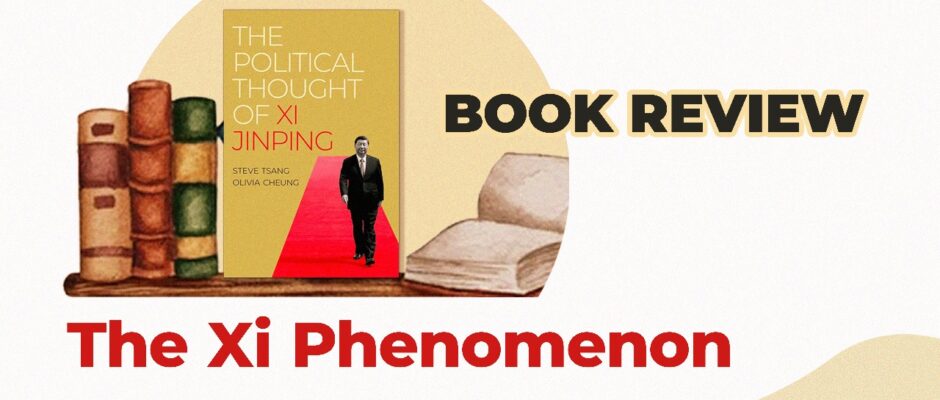
The Xi Phenomenon

The Xi Phenomenon

Book by Tsang, Steve and Olivia Cheung: The Political Thought of Xi Jinping, Oxford University Press, New York, (2024). Dr Amritpal Kaur There are rare moments in contemporary, post second world war history where a single country could challenge international order so comprehensively while sitting in the wings for most of the time. It can only be facilitated by mercurial rise in its fortune and prosperity to propel or make any entity so significant that their actions and reactions generate waves around the world. China story is exactly that which captures its economic rise while the politico-economic-historical antecedents continue to be an enigma for global communities. Yet, it is a country that’s challenging accepted norms for nation-states in international order. At the centre of this debate on China’s rise and its aggressive behaviour is the leadership of President Xi Jinping who has turned a virtual dictator in the communist party order. The book, The Political Thought of Xi Jinping, seeks to deal with the phenomenon called Xi Jinping. Xi’s political thought has become important to understand contemporary China essentially because unlike his predecessors led by Deng Xiaoping, Xi grabbed and held onto the supreme political power within Chinese Communist Party and Peoples’ Republic of China. This surreal rise of Xi’s dictatorship is unprecedented since days of Mao Zedong with implications largely unknown for future of Party-state of China. The book contextualizes Xi thought within Marxist-Leninist framework where the party helmed by a singular entity is lynchpin of domestic political system and international posturing. As far as domestic system is concerned, the debate is largely settled since supremacy of CCP is unquestionable and is unchallenged. Both the power and propaganda of CCP are aimed to ensure regime’s iron-clad grip on the people, their lives and destiny including families. Xi’s over-bearing influence along with his close inner circle coterie is so huge that, even CCP fades away pathetically before this towering personality propped up by business tycoons and oligarchs.  Since China has no democracy, lack of political liberties for the people is sought to be offset by all-encompassing comprehensive state propaganda where Party and its supreme leader Xi are branded as their saviours. Via his politics and propaganda, President Xi has been successful in taking complete hold over the party by appointing his close buddies to key posts. In the process, he has equated allegiance to him akin to the party. Through his Thought he has projected himself as the party and nothing else. The book argues that leaders before Xi had worked in collective leadership mode. Xi on the contrary does not share power with anyone else and hence there is a greater need to project the threat to Chinese state in the absence of Xi and his indispensability as the competent and core Helmsman of China. Centralization of power by Xi has its international implications. It is one thing for Xi to mould Chinese political system as per his ‘whims and fancies’ and portraying it as the Marxist-Leninist-Maoist ideology. But it’s altogether a different ball game if that state becomes second largest economy and second largest state in terms of population. The sheer power projection of Chinese state internationally is concerning enough if President Xi prominently discusses the ‘external dangers’. Under him overt docile appearance of China, given by Deng and his famous quote of ‘Bide the time and hide the capacity’ has been decidedly shed away and in its place has come the aggressive posturing in neighbourhood and ‘wolf-warrior’ diplomacy. The signals are clear, Xi is pressing the accelerator of Chinese foreign policy to bring it at par with ‘comprehensive power’ of China and with the command and respect it should get as one of the leading powers. The book in effect is soft landing the impact of China’s feverish growth aspirations on countries in its vicinity and larger international system. For example, discussion on critical technologies that China seeks to master has a dual purpose; to make it self-sufficient and making the world dependent on it rather the other way round. These technologies include frontier areas like Artificial Intelligence, machine learning and at the same time developing ‘asymmetrical assassin’s maces’ technologies which can give China decided edge over other countries. Coupled with oft-quoted Xi concept of Tianxia which is ‘Sino-centric world order’, a concentration of cutting-edge technologies will only accentuate the Chinese power. If there is one power differential which will decide true security of any country with other dimensions being near equal, it will be technology. The power of future is not much in number of armed personnel or billions in GDP, but in growth sprouts of cutting-edge technology and human endeavour which can fundamentally change human condition itself. President Xi understands this crucial aspect and hence the focus on the scientific developments in China. Secondly dual circulation of economy also seeks to keep the world dependent on China. China must be self-sufficient economically and this too seeks to insulate PRC from global headwinds and to keep the world from weaponizing trade in its dealing with China. Ironically, if that happens international community will be taking a leaf out of the Chinese manual. President Xi, through his thought is asking people of China to be prepared for difficult times ahead. However, the question is, China is preparing for ‘difficult times ahead’ and ‘external danger’ then surely, it’s not seeking to cooperate with comity of nations. The book does not clearly discuss this implication of Xi’s thought. The present book attempts to chart political thought of President Xi in the times when he has emerged as the strongman. It seeks to understand the impact of Xi’s thought on China and countries around China, albeit in a very limited way. For example, the book discusses only East Asian countries and Africa in the segment of China and ‘Common Destiny of Humankind’. Both these segments of international community are either harmless or weak in comparison to PRC. However, real depth of analysis would have come had the book discussed
Read More
Cracks in Xi's Fortress

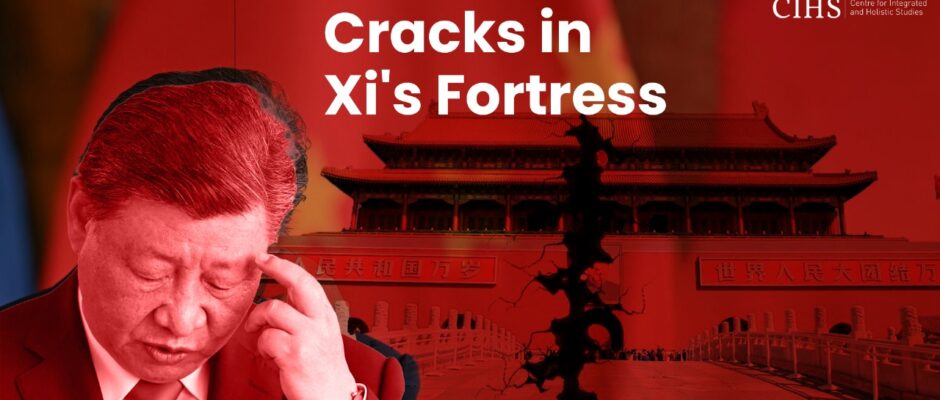
Cracks in Xi’s Fortress

CCP inability and intolerance to resolve people’s grievances, economic woes, joblessness led to rise in number of “Zhang Xianzhong” attacks. Rahul Pawa China in 2024 has seen a startling surge in violent attacks on civilians, with over 20 incidents leaving more than 90 people dead and scores injured. These incidents, often described as “Zhang Xianzhong” attacks or “revenge on society” attacks expose deep societal fractures and challenging the image of stability and control that Xi Jinping’s leadership has meticulously cultivated. The attacks which included car-ramming and mass stabbings reflect a dangerous cocktail of economic despair, social grievances and a government increasingly out of touch with people’s issues. Last month, a 62-year-old man drove an SUV into crowds in Zhuhai, Guangdong Province that led to killing 35 and injuring 43. His motive, reportedly rooted in bitterness over a divorce settlement was a stark reminder of how personal grievances in today’s China are escalating into public tragedies. President Xi, in an uncharacteristically direct response, urged local authorities to “draw lessons” from the case and strengthen prevention measures. Yet, this rare acknowledgment of failure only highlighted limits of Chinese Communist Party’s (CCP) ability to control a society increasingly defined by tensions and resentment. These attacks are not anomalies. In 2024 alone, incidents like a stabbing spree in Wuxi that left eight dead, a car-ramming attack in Changsha that killed eight and at least ten school attacks have painted grim picture of a nation under siege from within. While Beijing’s strict censorship obscures much of the data, social media tallies and local reports suggest that the frequency and lethality of these events are on rise. Schools, once considered safe havens, have become frequent targets with attacks mirroring a wave of school violence last seen in 2010. Then, six schools were attacked in quick succession, killing over 15 children. Today’s resurgence of similar violence points to unresolved structural issues that have only deepened under Xi’s rule. Chinese netizens navigating state’s ever-present censorship have adopted the term “Zhang Xianzhong” to describe these attacks. The phrase refers to 17th-century rebel whose campaigns of mass killing were seen as acts of revenge on society. While officials quickly scrub mentions of the term online, its persistence reflects an undercurrent of fear and frustration among citizens. The attackers largely armed with knives or vehicles due to strict gun control laws often cite grievances ranging from economic hardships to personal injustices. Analysts believe these attacks are symptomatic of an eroding social contract in China where economic slowdown, unemployment and widening inequalities have left millions disillusioned. Economic despair is perhaps the most potent driver of this unrest. China’s post-COVID recovery has been sluggish with youth unemployment exceeding 20 per cent and small businesses closing at an alarming rate. The once-thriving property market has collapsed, household debt is mounting and local governments are grappling with financial insolvency. These pressures are not limited to economic woes; they are deeply personal, affecting livelihoods, aspirations and social cohesion. Promise of prosperity that once underpinned CCP’s legitimacy is faltering and with it, the trust of a society that had largely bought into Xi’s vision of a “Chinese Dream.” Making matters worse is CCP’s shrinking tolerance for dissent. The longstanding system of petitioning where citizens could formally lodge grievances with government has been effectively gutted. Local officials, fearing repercussions for their regions’ perceived instability, now block petitioners from reaching Beijing or dismiss complaints altogether. A 2022 regulatory revision further centralized complaint resolution at the local level, creating a perverse incentive for officials to suppress grievances rather than resolve them. For many citizens, this has closed one of the last remaining avenues for seeking justice in an increasingly opaque and authoritarian state. In such a climate, acts of violence become not just crimes but desperate expressions of discontent. They are, as one netizen put it before their post was censored, “the sound of a society breaking apart.” The CCP, ever wary of its image, has responded by doubling down on surveillance and control. Local governments are now tasked with identifying “high-risk” individuals—those categorized under what the state calls the “four nothings” (no spouse, no children, no income, no assets) and the “five losses” (financial, relational, social, mental or other critical stressors). In Zhuhai, this framework was deployed following the deadly vehicle attack, with authorities instructed to proactively monitor and intervene in lives of these vulnerable groups. While these measures may offer short-term reductions in violence, they do little to address root causes of societal discontent. Instead, they risk further alienating a population already weary of state overreach. Critics warn that treating citizens as potential threats rather than partners in governance will only deepen the divide between people and state. Moreover, China’s increasingly invasive surveillance apparatus, though technologically sophisticated, is ill-equipped to tackle complex, deeply human factors driving these attacks. Xi Jinping’s leadership is at a precarious crossroads. For years, he has positioned himself as China’s most powerful leader since Mao Zedong, centralizing authority and eliminating dissent within the party. But the events of 2024 have exposed vulnerabilities in his governance model. The rise in violent attacks, coupled with economic stagnation and growing public frustration is eroding the very foundation of his rule. Internationally, these issues are undermining Xi’s efforts to portray China as a stable and orderly superpower. The targeting of foreigners in some attacks has added another layer of complexity. In September, a ten year old Japanese boy was fatally stabbed near a school in Shenzhen, an incident followed by similar attacks on Japanese nationals in other cities. While Beijing has labeled these as isolated acts, they point to a growing strain of xenophobia and anti-foreigner sentiment under Xi’s rule. This ethno-nationalism, once a tool for consolidating domestic support, is now proving to be a double-edged sword, damaging China’s global reputation and risking diplomatic fallout. As 2024 draws to a close, CCP is scrambling to project an image of control. Xi’s speeches emphasize stability, his officials announce plans to address grievances and state media highlight the supposed

Read More

Games that China Plays

Psychological warfare, media propaganda, narratives coupled with operations beyond diplomatic relations is what China is known for. Is the world listening? Dr Amritpal Kaur Prima Facie, diplomacy is a well-rehearsed hard bargain negotiation among countries to achieve the best possible outcomes for a nation without resorting to crude force. What does not however meet the eye is that it is an incessant process to resolve outstanding issues lurking around the corners, brewing for years before the final settlement, if ever, is achieved. With core interests at the heart of diplomatic deliberations, the high stakes make this complicated dance on eggshells all more crucial. It is assumed that deliberations conducted by diplomats are a standard process with similar training in negotiation processes and the parlance used in discussions. In reality, diplomatic negotiation is a high-voltage tussle with deep and far-reaching consequences. Even more astounding is that it does not end on the negotiation table but runs like an undercurrent. In the era of Globalization or ‘Complex interdependence’ as much as the international community is reality of domestic national life, diplomacy and diplomatic signals become more significant for nations. If diplomatic engagement is mired in psychological games with the intention of one-upmanship, bilateral engagements become complex and if one of the parties is contemporary China, it raises its own share of issues. Conspicuous silence President Xi Jingping maintained when Prime Minister Modi assumed office for historic third consecutive term was marked by world leaders. This silence seems to have sent out an eloquent underlying message. Though Chinese Premier Li Qiang joined top world leaders in congratulating Prime Minister Modi ahead of swearing in on June 9, 2024, President Xi’s silence was ostensibly aimed at mounting psychological pressure on India. Post-second world war, China and its international relations give us glimpse into the country’s thinking on its relations with others including India. Beginning with Zhau Enlai, average Chinese have relentlessly pursued overt and covert ways to achieve its desired bilateral outcomes with an astonishing disregard for international treaties and modus operandi. Indo-Chinese agreement of 1993, intermittent border skirmishes and war (1962) since 1948 reiterates the point that it’s not over, until the last bell rang. Border dispute with India and People’s Liberation Army operations on Indo-Chinese border comes at crucial junctures. Former National Security Advisor Shiv Shankar Menon recounted in his book Choices (2016) that in 2014 when the first Modi government took office and President Xi came to India, PLA engaged in border skirmishes with India. Similarly, during Prime Minister Modi’s visit to China, a similar tactic unfolded. Probable explanation to such acts, according to Menon is to create psychological pressure on the newly elected Indian prime Minister as to who is the sheriff in town. Richard Solomon, former diplomat in US and former Foreign Secretary of India Vijay Gokhale have written respectively about the Chinese style of diplomacy which is remarkably different from diplomacy of democratic countries. Chinese engage in psychological warfare even in diplomacy at various levels. From setting agenda to building narratives, Chinese are adept at controlling the whole process and go beyond closed doors of diplomatic negotiations. One pattern is to engage in crude coercion and use of force while the other is to leverage media to create narratives. Two examples can be cited here, one is that of 1950s when Pt. Jawaharlal Nehru was called the ‘Bourgeoise Imperialist’ by Chinese media. Earlier this month, the state-sponsored Chinese media and related ecosystem described Prime Minister Modi as ‘weakened’ leader. These reports also suggested possible use of counter measures by China if India maintains policy status quo. Why is it that Chinese takes recourse to multi-pronged games in strategic and diplomatic relations with other countries eventually leading to disturbing regional peace and tranquility? Nature of Chinese state perhaps necessitates such behaviour. To begin with, Henry Kissinger in On China argued that since antiquity China has believed in ‘Middle Kingdom’ phenomenon which places the Chinese state over rest of the world and only beneath the heaven. This perceived middle Kingdom phenomenon has percolated to Communist China as well and hence they believe that other countries can only be vassals to the dragon power. There have been suggestions to the effect that Chinese communist expansionists harbor the idea that bilateral relations cannot be between equal sovereigns. These relations should centre on ‘superior’ China and ‘inferior’ other nations. With regards to Bharat, Chinese terminology includes ‘legalized hegemony’ and perceives India as an inferior state given that it does not have a permanent seat in United Nations Security Council. Chinese may have effortlessly used this aspect to tip balance of power in their favour, as former NSA Shiv Shankar Menon calls it.  Former foreign secretary Gokhale argued that Chinese engage in such tactics to keep power equation in their favour. Communist Party of China is the state itself and officials are appointed by the Party and not the state. Hence, their allegiance is with the Party and not the state per se. Menon sums the Chinese position succinctly when he argues that China is a lonely state rising in a crowded neighbourhood with an acute need for regime survival and internal harmony. Hence, its no wonder that being adventurous in foreign relations was to offset domestic attention from key issues. Since China is viewed as a formidable power, there is critical need to find a mutually beneficial bilateral mechanism. But, there’s no letup in tricky Chinese games loaded with psychological operations that have implications for outstanding bilateral issues. China experts, time and again, underscore that if we had to deal with China, understanding its game is more important. Only then can we find favourable outcomes in diplomatic negotiations. Jiang Zemin was famous for saying in English that it takes two to tango and it is true in this case well. For bilateral relations to succeed, it takes two to clap and a possible egalitarian approach in Chinese diplomacy. (Author is Assistant Professor in Political Sciences, Dayal Singh College, Delhi University, New Delhi)

Read More

Quirky Chinese leadership undependable!

Retake ‘Aksai Chin’ under Chinese occupation, stop its draconian expansionist aggression and bring peace to Indian borders K.A.Badarinath China is at its old dark ways again. Otherwise, there’s no reason why three Indian Wushu sports persons from Arunachal Pradesh, Nyeman Wangsu, Onilu Tega and Mepung Lapgu, were given stapled visas. India’s Wushu team was to head for Chengdu to participate in the World University Games beginning Friday. The stapled visas issue is symptomatic of China’s war games and its claim on Arunachal Pradesh that’s integral to Bharat. The latest fracas seems to be scripted and directed by none other than the Chinese Oligarchs’ frontman and President, Xi Jingping who’s into his third term as head of Chinese Communist Party and also head of all powerful military commission. Most significant Chinese claim on Arunachal Pradesh ala indirectly through stapled visas comes on a day when three key developments were reported. Dichotomy in Chinese military checkers comes to fore on a day when Prime Minister Narendra Modi and Chinese President Xi Jingping spoke on phone to bring about stability on the borders. In fact, this was the first recorded conversation of the two leaders after their brief in person informal interaction at Bali as part of G-20 group at the invitation of Indonesian President. After the Galwan valley Chinese misadventure, there has been no engagement between heads of state and President Xi Jingping was busy ensuring third Presidential term for himself apart from ‘cleansing’ the party from his political rivals and policy antagonists. ‘Stapled visas’ hogged headlines also on a day when reports poured in about the two leaders’ discussion on military standoff during April – May 2020 in Eastern Ladakh. What has induced ‘stapled visas’ issue larger significance is the reports of Peoples Liberation Army (PLA) heightened build up from Eastern Ladakh to Arunachal Pradesh borders during last few weeks? Nineteen rounds of corps commander level talks between Indian and Chinese side have not yielded results nor have led to sensitizing PLA Generals or belligerent Communist leadership in China that rules its own people with an iron fist. Sense that one gets is China’s outright refusal to disengage from at the strategic Depsang plains and Charding Ninhlunh nallah track junction at the Demchock in Eastern Ladakh. On the other hand, reports suggest continued build-up of bunkers, posts, artillery positions, surface to air missile systems, radar sites and ammunition storages. Development of new helipads, roads, dual use villages development and last mile connectivity has also been on the rise across the border leading to beliefs that negotiations at political level may ‘not yield’ on the ground results but discussions have to happen. Stapled visas incident is seen more as one step further in China’s grand expansionist plan and communist vision to occupy others’ land disregarding international treaties, pacts and ‘gentlemen’ agreements to not change on-the-ground goal posts. Only way to put an end to this psycho-warfare like stapled visas is to firmly retake ‘Aksai Chin’ under its ‘illegal’ occupation since 1950s and held after the 1962 war. China’s claim on Aksai Chin was made a couple of years after Indian Constitution was adopted in 1950 that included whole of Jammu and Kashmir along with Ladakh. Aksai Chin was part of Ladakh till the Chinese claim leading to its occupation in ‘50s. In fact, no Chinese maps till 1920s even showed Aksai Chin as part of China. Even in 1930s map of Sinkiang or Xinjiang, Kunlun mountains were marked as Chinese boundary and not the Karakoram range. Chinese posturing and war games that were shaped in ‘wolf warrior’ diplomacy doctrine is essentially unsustainable in any bilateral relations. Beijing will have to realize that false claims, wolf warrior diplomacy combined with on-ground, air and water bound aggression may not help in positioning itself as a leader as well. In fact, Qin Gang who’s been closest aide to President Xi Jingping and later anointed a state councillor was considered architect of wolf warrior diplomacy doctrine adopted by Chinese Communist Party as one of its key principles in engaging with the world. While there’s no trace of ‘missing’ Qin Gang, bringing Wang Li back as top Chinese diplomat and foreign minister may not help clear the air. Openness, flexibility and clarity of thought and attitude make great world powers. China has a long way to go leaving its shady past, false claims and drudgery that the communist regime is known for.  (author is Director and Chief Executive, Centre for Integrated and Holistic Studies,  non-partisan think tank based in New Delhi)

Read More