
CIHS – Centre for Integrated and Holistic Studies

Date/Time:

Why Spew Venom Against RSS & Hindus?

Self-styled Christian lobbyists’ campaign against Hindus outreach in US & Europe has not worked even with scaremongering and demonization tactics. Aniket Pingley There is a genre of writing immune to journalistic standards in gathering evidence, retaining balance and complete disclosure. It is the opinion piece. In its honest form, it declares a position and argues it. In its dishonest form, it uses the opinion format as legal exemption, a space where alarming assertions are made, dehumanising imagery deployed and contested allegations stated as settled fact, all under the protective cover of “these are merely my views.” John Dayal’s piece in UCA News, headlined, “The Indian paramilitary organization’s tentacles in the US,” is a distinguished specimen of the dishonest form. It is tactical scaremongering – calibrated to produce a specific emotional and political effect amongst a specific audience at a chosen moment in Washington lobbying calendar. The article makes claims about the RSS, Gujarat, lobbying firms, FCRA and about Indian-origin officials in the US government. I will not engage those claims here. They are matters of public record, available to any reader willing to search. Readers are capable of forming their own opinions about Gujarat 2002, Modi visa episode, Squire Patton Boggs and India’s FCRA regime. They do not need me to defend the RSS against Dayal’s version of events. What I will do is more useful: identify what this article actually is, what it is attempting at and why its final sentence, the most revealing sentence in the piece, tells the reader everything they need to know. Confession in last sentence Dayal ends his article with, “The RSS has money, access, a friendly executive environment, and the weight of geopolitics on its side, and for the moment seems able to counter the evangelical campaign.” Read it slowly. Counter the evangelical campaign. Not “respond to criticism.” Not “defend itself against allegations.” Counter the evangelical campaign. Dayal told his readers, in his own words, what this is actually about. There is an evangelical campaign, organised, funded and directed, targeting RSS in Washington DC. And, what is Dayal lamenting is that this campaign is not working. RSS is successfully countering it. This is the most important fact in the entire article and it appears in the last line, almost as an afterthought. Everything before it, the alarming language, assembled allegations, USCIRF references, lobbying firm drama, is the infrastructure in that evangelical campaign. The article is a dispatch from one side of an active lobbying contest, written by one of its participants, lamenting that the other side is holding ground. And, RSS has every right to hold its ground. USCIRF’s annual report is not scripture. It is not axiomatic truth. It is not a judicial finding. It is the output of an advisory commission whose India recommendations the US State Department has declined to act upon for six consecutive years, a fact Dayal buries in his final paragraph as if it were a footnote, rather than the most consequential sentence in his piece. American foreign policy operates on classified intelligence, diplomatic relationships and a comprehensive picture of the world that an advisory commission does not possess. What’s this Evangelical Campaign? The campaign Dayal laments, RSS is successfully countering, is a coordinated effort to have United States designate India as a Country of Particular Concern on religious freedom, impose targeted sanctions on RSS and restrict its members from entering the US. It runs through USCIRF, Congressional testimony, UN Special Rapporteur submissions and in coordination with International Christian Concern, National Association of Evangelicals and the Southern Baptist Convention’s Ethics and Religious Liberty Commission. Its substance: Christian organisations in India are being persecuted, FCRA restrictions choke Christian churches and anti-conversion laws are religious oppression. Each of these claims deserves a question Dayal never asks: why are there so many foreign-funded Christian organisations operating in India and what precisely are they doing? The answer is not theoretical. It is on the record. Compassion International (CI), a major US-based Christian child sponsorship charity that operated in India for 48 years, provides the most precise forensic answer available. In 2017, Indian Government placed CI on “prior permission” list under FCRA, requiring explicit case-by-case approval for every financial transaction, effectively halting flow of approximately $50 million annually. The government’s case rested on CBI First Information Report and Income Tax investigation into CI’s primary Indian affiliate, Chennai-based Caruna Bal Vikas (CBV). CBV was registered under FCRA with its legally declared nature of association as “economic, educational and social.” The CBI found it had, in its own documents, “invariably indulged in religious activities.” More precisely, in CBV’s own stated long-term organisational objective, the goal was “converting poor children into fulfilled Christian adults.” That is not a characterisation by the Indian government. It is what the organisation wrote about itself. Furthermore, CI was identified as part of an organised international missionary industry focused on what its own practitioners call  “10-40 Window”, a geographic band encompassing majority of the world’s Hindus, Muslims and Buddhists, deliberately targeted as a conversion frontier. This is what the FCRA regime was responding to. Not the practice of Christianity, the Saint Thomas Christians of Kerala have worshipped in this land since the first century, and nobody has targeted them. What was being regulated is a specific, documented, foreign-funded, institutionally organised project of converting economically vulnerable children using charitable cover. When an organisation tells CBI investigators, through its own documents, that its goal is to convert poor children, it is not a policy concern. That is evidence. India’s state governments have enacted anti-conversion laws through elected legislative assemblies using constitutional procedures with clear majorities. These laws do not prohibit practice of Christianity. They regulate coercive, fraudulent or inducement-based conversions. Twelve states have enacted such legislation. That is Indian democratic federalism functioning as designed. Whether those laws are sound policy is a matter for Indian courts and voters, not for an American advisory commission whose mandate derives from US domestic legislation with no jurisdiction over a sovereign parliament. FCRA regime applies
Read More

Rebuttal of USCIRF India Entry and Issue Update on Alleged Religious Persecution

Centre for Integrated and Holistic Studies (CIHS) has released a comprehensive rebuttal of the USCIRF Annual Report 2026 and its accompanying Issue Update on India. The rebuttal finds that USCIRF’s recommendation to designate India a Country of Particular Concern rests on methodological failures, unsourced assertions, and recommendations disconnected from the document’s own findings. Most strikingly, the report proposes sanctioning Rashtriya Swayamsevak Sangh (RSS), the world’s largest voluntary organisation and India’s Research and Analysis Wing without a single evidentiary basis anywhere in its text. CIHS concludes that documents of this kind, issued under the authority of a U.S. government commission, do not serve the cause of religious freedom. They damage the mutual respect on which one of the world’s most consequential democratic partnerships depends.

Read More
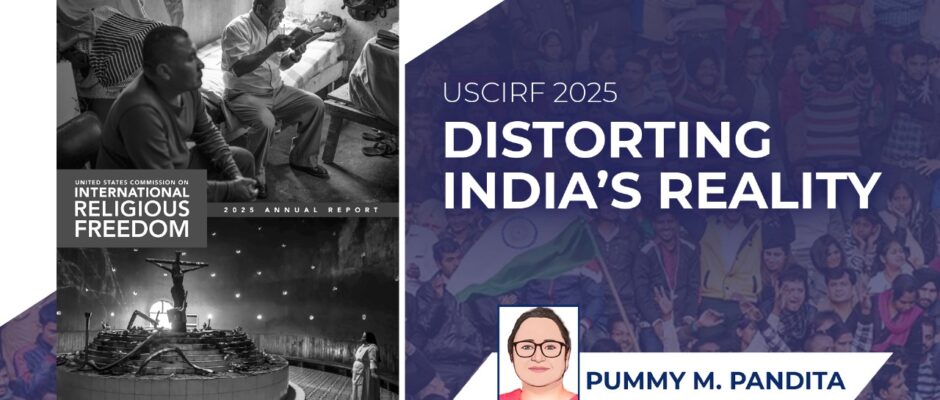
USCIRF 2025 - Distorting India’s Reality

USCIRF 2025: Distorting India’s Reality

The USCIRF time and again spins a one-sided tale cherry-picking facts, sidelining India’s constitutional pluralism, and pushing a loaded narrative that fits their playbook more than ground realities. Pummy M. Pandita The U.S. Commission on International Religious Freedom’s (USCIRF) 2025 India report has once again revealed the commission’s fundamentally flawed methodology, dependence on biased data sources & selection, lack of transparency in evaluating religious freedom, and a one-sided narrative that misrepresents India’s thriving democracy and plural society. By selectively choosing incidents, depending on questionable sources, and willfully avoiding India’s constitutional framework, USCIRF has created a report that is neither objective nor credible. In selectively pointing out incidents in a vacuum and ignoring the broader framework of India’s constitutional protections for all religions, USCIRF goes against its own credibility. Not only does this report misrepresent the situation on the ground, but it also unfairly defames a nation that enshrines the rights of all its citizens. USCIRF has repeatedly refused to provide its sources of data in a manner that meets rigorous journalistic or academic transparency standards. Much of the incidents quoted in the report rely on politically driven NGOs,  lobby groups, and reports from organisations that have a recorded history of ideological bias against India. Reports tend to be based on media reports instead of official government statistics, police records, or independent judicial evaluations. This selective information distorts the actual picture of religious freedom in India. Most of these sources have already been identified as previously misreporting or manipulating facts to fit a specific agenda. The lack of primary research, government interaction, or varied local opinions in the report questions its credibility. India is targeted for scrutiny, yet the USCIRF overlooks or disparages such incidents or worse in other democracies, showing a distinct double standard. The report ignores the emergence of religious extremism among some minority communities, such as instances where religious radicalization put national security at risk or affected communal harmony. It disregards the constitutional protection afforded to minorities in countries like India’s strong judicial protections, affirmative action measures, and full participation of minorities in public life. USCIRF selectively reports on local incidents without context, repeatedly leaving out legal proceedings, counter-reports, and government action taken to respond to grievances. USCIRF consistently misinterprets India’s legal structure, labeling good governance actions like anti-conversion laws and policies regarding citizenship as discriminatory, although they are founded on constitutional provisions. The report also underplays violent extremism, secessionist forces, and foreign interference in Indian internal affairs, selectively labeling state reactions as “persecution” without drawing attention to threats to national security. USCIRF’s record of going after India has followed a general geopolitics design wherein reports have been used to lever diplomatic engagements. The USCIRF has specifically targeted the Citizenship (Amendment) Act 2019 (“2019 CAA”) passed by the Indian Parliament in 2019 and its continued criticism since then reveals an inaccurate understanding of the genesis of the law and the disrespect towards sovereign Indian democratic institutions. CAA is designed to offer refuge to persecuted religious minorities—Hindus, Sikhs, Buddhists, Jains, Parsis, and Christians—from neighboring Islamic states like Pakistan, Afghanistan, and Bangladesh. These minorities have long faced systemic oppression in their home countries. CAA does not affect Indian Muslims, who are in no way disadvantaged by the law. Yet USCIRF frames it as a discriminatory tool, conveniently ignoring that it aims to address religious persecution in neighboring Islamic nations. For good order sake, United States too has a similar Citizenship Act in the form of the Lautenberg Amendment, led by US Senator Frank Lautenberg in 1989-90, which facilitates citizenship to recognized persecuted religious minorities in the former Soviet Union. Iran was added subsequently through the Specter Amendment, that provided refugee status and ultimately citizenship to a group of minorities from three nations.  Why is USCIRF silent on that and not condemned this act also? The commission has also been accused of disproportionately targeting on some nations and ignoring serious religious freedom abuses in many other nations, which puts its motives and geopolitical agendas in question. Its inability to speak out against growing cases of persecution of Hindus, Sikhs, Buddhists, and other minority groups in the neighboring countries where blasphemy laws and institutional discrimination are prevalent. This inconsistency erodes the credibility of the USCIRF and raises questions about whether its reports are motivated by facts or political goals. Suggesting India as a Country of Particular Concern (CPC) is not only factually wrong but also smells of a conscious effort to mislead about India’s religious scenario. India is still one of the most religiously plural and diverse countries, where individuals from all religions are involved in government, business, and public life. However, USCIRF’s failure to recognize this diversity and continued legal protections for religious communities reveals its biased agenda. The report also criticises India’s anti-conversion laws, which are in place to prevent coerced religious conversions, often under the guise of marriage or social coercion. These laws, intended to protect vulnerable individuals from exploitation, have become a focal point of controversy. USCIRF dismisses this as Hindu nationalist propaganda, sidestepping the genuine concerns that prompted these laws. By recommending punitive measures like sanctions and diplomatic pressure against India, USCIRF has gone beyond its mandate and attempts to intrude into the sovereign decisions of a democratic country. These suggestions are not only counterproductive but also demonstrate a basic misunderstanding of India’s democracy and devotion to pluralism. USCIRF Report 2025 is an extremely defective, ideologically charged document that fails objective scrutiny. Its selective ire, methodological shortcomings, and transparency deficiencies make it unsuitable for serious policy discussion. It is an instrument of geopolitical politics, not an objective evaluation of religious freedom. India’s commitment to religious freedom is classified in its Constitution and defended by its democratic institutions. It is essential that any honest evaluation of India is provided based on verifiable data, integrated analysis, and a recognition of India’s pluralistic fabric USCIRF 2025: Distorting India’s Realitysomething the USCIRF report utterly fails to accomplish. USCIRF’s biased reports are not an isolated phenomenon. They fit into a larger pattern

Read More

US Figures Big On Human Rights Violations

Republicans & Democrats that point to rights violation and abuse elsewhere turn a blind eye on their own dubious record Neha Dahiya & Rohan Giri New Delhi US has turned out to be the biggest hub for racism, discrimination by colour, lack of freedom to express and is the biggest violator of basic human rights. While successive democratic and republican administrations at White House have made it their prime business to talk about purported rights violation elsewhere, they chose to turn blind eye to grave crimes in its own territory. Though several global organizations have been located in US, the country has failed miserably to stop wrong doings, ensure pluralism find uphold basic rights of its citizens. US has also been charged with massive rights violations in other countries While these crimes go either unreported or US administration has allowed racist violence to happen, the political leadership is now in a binge given that facts have come to light. Centre for Democracy, Pluralism and Human Rights (CDPHR), an Indian organisation working on human rights and democracy released a report on Wednesday highlighting massive violation of these basic rights in US. The well documented report running into over 140 pages has come into public domain at a time when American organizations have levelled charges against foreign governments on not enabling safeguard of religious freedom and human rights. Case in point is the routine reports released by United States Commission on International Religious Freedom (USCIRF) that talk about human rights violations in other countries. These US organizations by design or connivance with the political leadership in Washington DC seem to have ignored wrongdoings back home that they seek to eradicate elsewhere. People in US seem to have been kept in dark on such violations with a purpose said CDPHR in its latest report by Prerna Malhotra (Faculty at University of Delhi) and Arvind Kumar (Civil Rights Activist and writer based in US). Restrictions on free expression & media, violence, threats of violence, and unjustified arrests are some of the grave crimes that go unreported in US, said the report. The report charges US with building structural racism as part of its Constitution itself. Three-fifth clauses in US constitution violate the principle of equality. Fugitive Slave clause does not permit people to escape slavery. Third clause of fourth article in US Constitution authorises the enslavers to seize enslaved people. No person held to service or labour in one state under the laws was allowed to escape to other states.  Unless discharged from such slavery, such labourers would be delivered back to the aggressors, as per US Constitutional provisions. Discrimination against those practicing non-Abrahamic faiths such as Hindus, Sikhs, Buddhists and Jain was on the rise in US. The holy symbols of Hindus, Sikhs, and Buddhists were desecrated or denigrated by politicians. For instance in January 2021, New York Senator Todd Kaminsky introduced a bill in New York Senate that proposed making it mandatory for schools in his state to teach ‘Swastika’, an auspicious and revered sign of Hindu Dharma, as an example of Hate. The Bill titled Senate Bill S2727 conflates the Dharmic Swastika with the Nazi sign of Hakenkreuz or Hooked Cross and mandates that the Swastika should be taught as an emblem of Nazi Germany. Therefore it should be taught as a Hate symbol from grade 6 through 12 in schools. The report points to normalization of gender discrimination and sexual violence in the USA. A study conducted on 1965 students in grade 7 – 12 revealed that 48 per cent students had faced some form of sexual harassment. Girls get sexually exploited by men in Power. Statistics show that nearly one in every five American women has been victims of rape or attempted rape. Big political names have figured in sexual exploitation, including the Presidents of the country. According to a study, one out of every five women has been raped at some point in their lives and nearly half of rape victims in the United States are raped by an acquaintance. In the workplace, women were discriminated in the United States that boasts of providing equal opportunities. The report revealed that 42 per cent of working women had experienced gender discrimination in the workplace, and 25 per cent paid fewer wages vis a vis their male counterparts for the same work. Children were also not spared in America. As per a report, in 2014, there were an estimated 42 million survivors of child abuse. It is rampant among government officials and politicians, but such cases are either covered up or the perpetrators are let off with light sentences. Racism against Black is always at a peak in the USA. Blacks were always used as pawns and puppets by the White supremacists, even the organisations of black were also controlled by whites. In America, poverty is higher among Blacks. They were routinely targeted with the intention to cull their population. Black women have the highest abortion rate in the country. Native Americans were also caged to poverty by the US Government. They were not allowed to manage their own lands since 1831, yet tribes were unable to make good their losses. Native Americans have their income 68 per cent below the national average, 20 per cent households earn less than $ 5000 annually as against 6 per cent national average, rape rate of wome n is 2.5 times higher and child abuse rate double. USA that talks big on humanitarian crises in the world may have to take responsibility for such crises in Afghanistan, Iraq, Syria and Ukraine. Over 241,000 people including 71,000 civilians were killed in the Afghan War initiated by the US in 2011on false pretext that it was in response to terror attacks against USA carried out on September 11, 2001. Taliban regime in Afghanistan itself was a creation of the US government. The takeover by the Taliban has precipitated another humanitarian crisis with 3.5 million Afghans internally displaced and another 2.2 million refugees with millions

Read More