
CIHS – Centre for Integrated and Holistic Studies

Date/Time:

Venezuela Case & UN - Crisis of Global Institutions

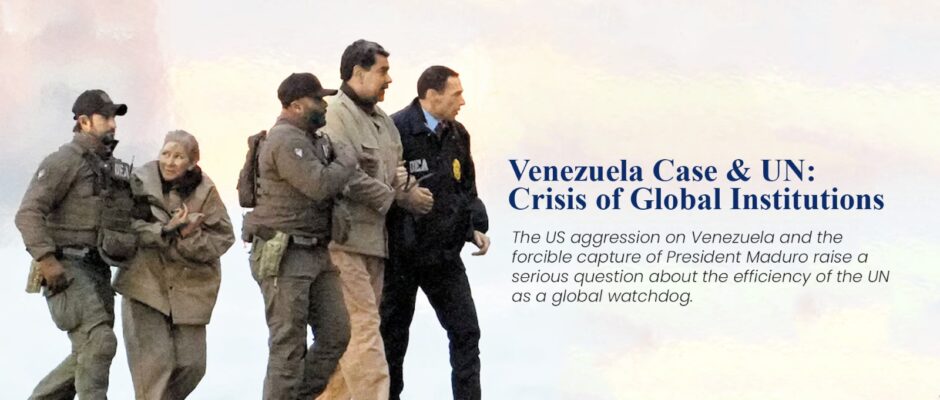
Venezuela Case & UN: Crisis of Global Institutions

The US aggression on Venezuela and the forcible capture of President Maduro raise a serious question about the efficiency of the UN as a global watchdog. It’s time to examine whether nations, which designed the post-1945 system, still regard themselves as committed to it, or treat the UN anchored treaty-based project as optional. Rahul Pawa On January 3, 2026, the U.S. forces launched a surprise strike inside Venezuela and forcibly removed President Nicolás Maduro and his wife, flying them to New York to face the U.S. charges. Reports described explosions in Caracas and the Maduro Government denounced an “imperialist attack” on national sovereignty. President Trump boasted on social media that the strike was carried out “in conjunction with U.S. law enforcement,” heralding Maduro’s capture as a triumph. The world responded with alarm. Venezuela’s interim Vice President, Delcy Rodríguez, demanded proof that the couple was alive. Russia and China voiced their strongest objections. Japan stressed the safety of its nationals, reaffirmed its commitment to “freedom, democracy, and the rule of law,” and indicated that it would work with G7 partners to help stabilise the region, while India expressed “deep concern” and reaffirmed support for the security of the Indian community and the people of Venezuela. Even within the United States, Secretary of State Marco Rubio acknowledged at a press briefing that Congress had not been consulted. These events raise stark legal questions. The core issues are jus ad bellum limits on the use of force, the prohibition on intervention and extraterritorial enforcement jurisdiction, the personal immunities of incumbent senior officials, and the consequences if the incursion triggered an international armed conflict. U.S. constitutional processes and the War Powers Resolution may constrain American decision-makers as a matter of domestic law, but they do not alter Venezuela’s rights under international law. Armed Assault or Law Enforcement Operation? Under the U.N. Charter, no state may unilaterally use military force against another except with Security Council approval or genuine self-defense. The US administration claims this was a cross-border “law enforcement” operation, but international law treats armed assaults like this as uses of force. As one expert summary notes, counter-narcotics or “illegitimacy” justifications cannot override Article 2(4)’s prohibition. Legal scholars agree that drug trafficking, even if a global scourge, is a criminal matter, not an armed conflict that justifies invasion. Customary international law adds another dimension: sitting heads of state have absolute immunity from arrest by foreign courts. Under the Arrest Warrant case and related practice, Maduro, as the incumbent Venezuelan President enjoys complete “inviolability” from forcible seizure. The U.S. might say it no longer recognises Maduro as legitimate, but international law does not allow one country to strip another’s leader of all protection while still holding it to its obligations. Even if Washington claims Noriega-like precedent, “unilateral kidnapping is unlawful regardless of recognition, and immunity questions aggravate, rather than cure, the illegality.”. Likewise, the principle of non-intervention is clear. “Cross-border apprehension” by force without the host state’s consent is an “unlawful exercise of enforcement power”. By sneaking in Marines or special ops to snatch Maduro, the U.S. bypassed all Venezuelan authorities and UN mechanisms. It also bypassed its own procedures by not informing Congress. As France’s foreign minister noted, the U.S., a Security Council member violated the principle of non-use of force and imposed an external solution, warning that “no sustainable political solution can be imposed from the outside” By employing bombs and missiles on Caracas, the operation arguably triggered an international armed conflict between two states. If so, the full body of international humanitarian law (IHL) applies. Every strike must meet IHL’s distinction and proportionality tests. For example, reported strikes that knocked out civilian power infrastructure would be illegal if the civilian harm outweighed any military gain. Moreover, once Maduro was captured, he became a protected person under the Geneva Conventions. He and his wife would be entitled to safe detention conditions and eventual release or trial, but under domestic law, not as prisoners of war. Importantly, even the abduction itself violates the duty to take “prisoners” only lawfully. In practical terms, neither side seems prepared to declare war, but the weapons used leave no doubt: the U.S. struck fixed targets with lethal force on foreign soil. Still, any escalation (for example armed skirmishes with Venezuelan forces) would immediately invoke full wartime protections. The Maduro abduction cannot be seen in isolation. In recent years, permanent members of the UN Security Council have repeatedly tested, stretched, or disregarded legal constraints: China has rejected the legal effect of the South China Sea arbitral award; Russia’s conduct in Ukraine has triggered sustained allegations of Charter breach; and the United States has its own history of unilateral uses of force, including the closely analogous 1989 intervention in Panama (Operation Just Cause). Each episode erodes confidence that treaties and the Charter’s restraints bind the most powerful as much as the rest. The United States is central to this story not only because it helped design the post-1945 order and was among the earliest to ratify the Charter, but also because its subsequent engagement with the UN’s treaty architecture has been selective. This is illustrated by continued non-ratification of major UN-linked instruments such as the Convention on the Rights of the Child (CRC), the Convention on the Elimination of All Forms of Discrimination against Women (CEDAW), and the United Nations Convention on the Law of the Sea (UNCLOS). Those choices do not reduce UN Charter obligations, but they sharpen doubts about commitment to the wider treaty-based project the UN Charter was designed to anchor. Unsurprisingly, the fiercest reaction came from Russia and China. After a China‑sponsored UNSC emergency session, several members condemned the raid as illegal, echoing concerns about a dangerous precedent. Russia’s Foreign Ministry condemned the raid online as “an act of armed aggression.” Intriguingly, France’s envoy reminded that any UN Security Council permanent member breaking the force ban would have “grave consequences for global security”. The cumulative message is clear: when the great powers act unilaterally, the

Read More

US Figures Big On Human Rights Violations

Republicans & Democrats that point to rights violation and abuse elsewhere turn a blind eye on their own dubious record Neha Dahiya & Rohan Giri New Delhi US has turned out to be the biggest hub for racism, discrimination by colour, lack of freedom to express and is the biggest violator of basic human rights. While successive democratic and republican administrations at White House have made it their prime business to talk about purported rights violation elsewhere, they chose to turn blind eye to grave crimes in its own territory. Though several global organizations have been located in US, the country has failed miserably to stop wrong doings, ensure pluralism find uphold basic rights of its citizens. US has also been charged with massive rights violations in other countries While these crimes go either unreported or US administration has allowed racist violence to happen, the political leadership is now in a binge given that facts have come to light. Centre for Democracy, Pluralism and Human Rights (CDPHR), an Indian organisation working on human rights and democracy released a report on Wednesday highlighting massive violation of these basic rights in US. The well documented report running into over 140 pages has come into public domain at a time when American organizations have levelled charges against foreign governments on not enabling safeguard of religious freedom and human rights. Case in point is the routine reports released by United States Commission on International Religious Freedom (USCIRF) that talk about human rights violations in other countries. These US organizations by design or connivance with the political leadership in Washington DC seem to have ignored wrongdoings back home that they seek to eradicate elsewhere. People in US seem to have been kept in dark on such violations with a purpose said CDPHR in its latest report by Prerna Malhotra (Faculty at University of Delhi) and Arvind Kumar (Civil Rights Activist and writer based in US). Restrictions on free expression & media, violence, threats of violence, and unjustified arrests are some of the grave crimes that go unreported in US, said the report. The report charges US with building structural racism as part of its Constitution itself. Three-fifth clauses in US constitution violate the principle of equality. Fugitive Slave clause does not permit people to escape slavery. Third clause of fourth article in US Constitution authorises the enslavers to seize enslaved people. No person held to service or labour in one state under the laws was allowed to escape to other states.  Unless discharged from such slavery, such labourers would be delivered back to the aggressors, as per US Constitutional provisions. Discrimination against those practicing non-Abrahamic faiths such as Hindus, Sikhs, Buddhists and Jain was on the rise in US. The holy symbols of Hindus, Sikhs, and Buddhists were desecrated or denigrated by politicians. For instance in January 2021, New York Senator Todd Kaminsky introduced a bill in New York Senate that proposed making it mandatory for schools in his state to teach ‘Swastika’, an auspicious and revered sign of Hindu Dharma, as an example of Hate. The Bill titled Senate Bill S2727 conflates the Dharmic Swastika with the Nazi sign of Hakenkreuz or Hooked Cross and mandates that the Swastika should be taught as an emblem of Nazi Germany. Therefore it should be taught as a Hate symbol from grade 6 through 12 in schools. The report points to normalization of gender discrimination and sexual violence in the USA. A study conducted on 1965 students in grade 7 – 12 revealed that 48 per cent students had faced some form of sexual harassment. Girls get sexually exploited by men in Power. Statistics show that nearly one in every five American women has been victims of rape or attempted rape. Big political names have figured in sexual exploitation, including the Presidents of the country. According to a study, one out of every five women has been raped at some point in their lives and nearly half of rape victims in the United States are raped by an acquaintance. In the workplace, women were discriminated in the United States that boasts of providing equal opportunities. The report revealed that 42 per cent of working women had experienced gender discrimination in the workplace, and 25 per cent paid fewer wages vis a vis their male counterparts for the same work. Children were also not spared in America. As per a report, in 2014, there were an estimated 42 million survivors of child abuse. It is rampant among government officials and politicians, but such cases are either covered up or the perpetrators are let off with light sentences. Racism against Black is always at a peak in the USA. Blacks were always used as pawns and puppets by the White supremacists, even the organisations of black were also controlled by whites. In America, poverty is higher among Blacks. They were routinely targeted with the intention to cull their population. Black women have the highest abortion rate in the country. Native Americans were also caged to poverty by the US Government. They were not allowed to manage their own lands since 1831, yet tribes were unable to make good their losses. Native Americans have their income 68 per cent below the national average, 20 per cent households earn less than $ 5000 annually as against 6 per cent national average, rape rate of wome n is 2.5 times higher and child abuse rate double. USA that talks big on humanitarian crises in the world may have to take responsibility for such crises in Afghanistan, Iraq, Syria and Ukraine. Over 241,000 people including 71,000 civilians were killed in the Afghan War initiated by the US in 2011on false pretext that it was in response to terror attacks against USA carried out on September 11, 2001. Taliban regime in Afghanistan itself was a creation of the US government. The takeover by the Taliban has precipitated another humanitarian crisis with 3.5 million Afghans internally displaced and another 2.2 million refugees with millions

Read More

Russia-Ukraine Crisis: India’s Foreign Policy Implications

Rahul Pawa / New Delhi On February 23, 2022, Russian President Vladimir Putin announced a “special military operation” in Ukraine. Russia has long opposed Ukraine joining the European Union (EU) and North Atlantic Treaty Organization (NATO), the West’s defensive military alliance. He accused NATO of threatening Russia’s “historic future as a nation” and announced Russia’s military operation in Ukraine. “The purpose of this operation is to protect people who, for eight years now, have been facing humiliation and genocide perpetrated by the Kyiv regime,” Putin added. Subsequently, several media outlets reported explosions in numerous locations and large-scale Russian military operations throughout Ukraine. Ever since Ukraine’s pro-Russian president, Viktor Yanukovych, was overthrown in 2014 after months of protests against his government, Russian President Vladimir Putin has regularly flagged Ukraine of being taken over by extremists. Russia responded by seizing Crimea’s southern region and sparking a revolution in the east, backing hardliners against Ukrainian soldiers in a war that has claimed 14,000 lives. Regardless, the current issue has its roots in the disintegration of the Soviet Union. Ukraine, a former Soviet republic, had the world’s third-largest nuclear arsenal when the Soviet Union disintegrated in the early 1990s. The US and Russia collaborated with Ukraine to de-nuclearise the country. In a series of diplomatic deals, Kyiv returned hundreds of nuclear warheads to Russia for security assurances against a possible Russian assault. However, the assurances did not stand; below, we examine the 2022 Russia-Ukraine Crisis and discuss India’s foreign policy implications in that context. Download Explainer – Russia Ukraine Crisis (Author is the Director for Research at Centre for Integrated and Holistic Studies)

Read More