
CIHS – Centre for Integrated and Holistic Studies

Date/Time:

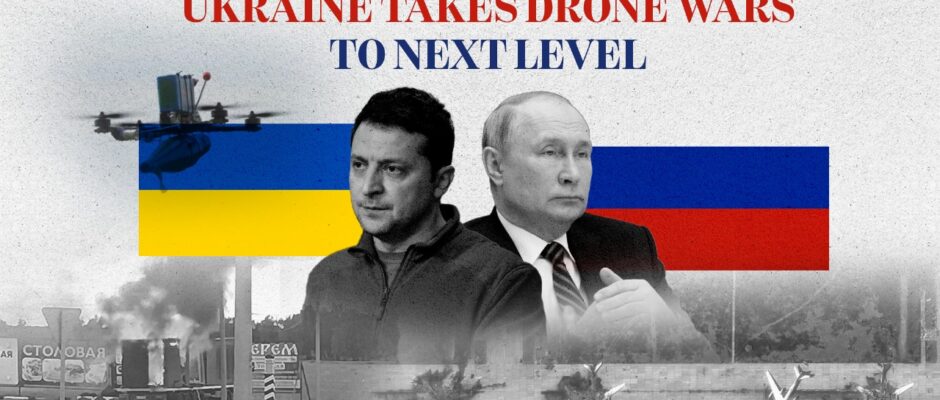
Ukraine Takes Drone Wars to Next Level

Ukraine Takes Drone Wars to Next Level

From Trojan Horse to pager bombs, Ukraine’s drones have rewritten war tactics while Russia puts up a red face. N. C. Bipindra Ukraine’s audacious drone attacks on airbases deep inside Russian territory are so brazen that such tactics have never been attempted before. The targeting of five Russian airbases — one of them over 4,500 km away from the Ukrainian border has reportedly destroyed over 40 military aircraft, including some long-distance bombers that were tormenting Ukrainians for nearly two years now. The use of cheap, off-the-shelf modified and armed drones is asymmetry in warfare taken to the next level. The drone strikes on June 1, 2025, are now being likened to Israeli Mossad pager bombs that took out a massive number of Hezbollah terror operatives inside Lebanon and the visit of unknown gunmen to wanted terrorists inside Pakistan in recent years. The drone attacks came after a long-drawn-out plan by Ukrainian military along with its intelligence units. The Ukrainians packed the armed drones onto cargo trucks and hid them with wooden planks under the truck roofs. Once the trucks reached too close to four airbases that were targeted —  Belaya in Siberia’s Irkutsk region, Olenya in Arctic Murmansk area, Ivanovo Severny near Ivanovo city, Dyagilevo in Ryazan and Ukrainka in Russia’s Far East the drones swarms were unleashed on Russian military aviation assets parked there. While the Belaya base in Irkutsk region was some 4,500 kilometers (2,800 miles) from Ukraine’s border with Russia, the Olenya base near Murmansk in the Arctic Circle was more than 2,000 kilometers (1,200 miles) from Ukraine’s border. The shortest distances covered by drone-carrying trucks were to Diaghilev airbase in Ryazan Oblast, some 520 kilometers (320 miles) from Ukraine and Ivanovo air base for Russian military transport aircraft was some 800 kilometers (500 miles) from the border. These visible distances notwithstanding, Ukraine’s daring drone attacks under Operation Spider Web targeted Ukrainka, the furthest airbase at over 8,000 km in Russia’s East, too far away from the war frontline. In Trojan-horse style attacks, Ukraine launched 117 drones concealed in container trucks, according to one Ukrainian account, striking with precision at airbases across Russia. Ukraine seems to have chosen this covert operation because the Western missiles supplied to it, such as the American ATACMS and European Storm Shadow, lacked the range to reach so deep inside Russia. Ukraine has been using drones against Russian targets, including Moscow, for last three years now. But majority of these drone attacks have been intercepted by Russians, essentially due to low speed of these unmanned aerial vehicles. Operation Spider Web’s audacity essentially played out due to Ukraine smuggling them into Russia and deploying them next to its target sites. Russia, obviously, was complacent with security of at least three of the five air bases, comfortable in the thought that it was too deep inside its territory for Ukrainians to even think of targeting them, a devastating mistake in defence preparedness, when military operations were prolonged beyond what was first envisaged when it began in February 2022. Moscow had presumed its airbases and military facilities deep inside its territory were safe, given their distance from Ukraine. Russia-Ukraine war, progressing for last three years now, has turned the warfare paradigm upside down. Till the Russia-Ukraine war began over Kyiv’s attempt to join the anti-Russia military bloc in the North Atlantic Treaty Organisation (NATO), military thought leadership was talking for nearly two decades about a short, swift and destructive warfare. Russia’s obvious military strength notwithstanding, its military operations did not result in quick surrender of a comparatively weaker Ukraine. The Russian neighbour a nation that was once part of the Soviet bloc held back the military onslaught for a while and by doing so, got the support of its friends in NATO. The US, Germany and other NATO nations sent billions of dollars’ worth arms and ammunition, battle tanks, air defence systems and fighter jets to Ukraine for its David vs Goliath moment. Satellite images, videos and photographs of the damage on these five airbases show Russia’s Tu-160, Tu-22 and Tu-95 nuke-carrying bombers key to their air power were hit badly with plumes of black smoke rising. Among destroyed air assets of Russia were Ilyushin Il-78 airborne refueling aircraft and advanced A-50 early warning and control aircraft a prized possession for airborne intelligence and radar warnings. Though Russia had tried to protect these assets with decoys, these measures failed miserably. Whether Western powers were involved in planning and execution of Operation Spider Web will be known later as more details of Ukraine’s attacks on Russia become public. But what could be worrying both Ukraine and NATO nations would be Russia’s response to Operation Spider Web. Ukraine and its friends in the West would be hoping that Ukraine’s drones circumventing Russian defenses and blowing up their military aviation assets would cause a major psychological blow to Russia’s air force. Truth be told, Operation Spider Web did lift Kyiv’s spirits and it is a dent to Moscow’s morale. But what they may have discounted is that Russia still holds air superiority overall against Ukraine and it may come back to deliver a crushing blow to Ukrainians at a place and time of its choosing, including an unequal nuclear response. If the nukes get involved in Russia’s war, then it could be game over for both Ukraine and NATO. The current Russia-Ukraine peace talks in Istanbul have already stalled, with Russian officials signaling no desire for compromise. The Ukrainian drone strike could mean the end of peace with Russia altogether. In response, Britain has announced a £350 million package to supply 100,000 drones to Ukraine by April 2026, reinforcing Kyiv’s growing drone warfare capabilities. In the second Armenia-Azerbaijan war for Nagorno-Karabakh region in 2020, Azerbaijani forces widespread use of drones was seen as crucial in determining the conflict’s outcome in their favour. Since then, drone warfare, particularly the asymmetric nature of advantage cheap, easily modifiable unmanned aerial systems bring to the table, has been a major focus

Read More

Strategic Autonomy, Balancing Powers

Indo-Russian summit strengthened special & privileged strategic partnership. India offers to play role of a peacenik in Ukraine conflict Dr. Punit Gaur Indian Prime Minister Narendra Modi’s two day visit to Russia has been watched keenly across world capitals. Especially so, given that it is the first bilateral engagement of Modi in his third term and it coincided with North Atlantic Treaty Organization (NATO) summit in Washington DC. Modi’s Russia visit to participate in the twenty second annual summit of India and Russia invited sharp reactions from Indian allies and foes alike. From US, European Union to Ukraine, there were comments on what Prime Minister Modi should be doing in Moscow. The Moscow summit is a first after President Vladimir Putin’s visit to New Delhi in 2021 and this engagement has come in the backdrop of ongoing conflict on East European front with Ukraine. Perhaps, global leaders expected serious talks between Modi and Putin that paved for a swift and organic end to the bloody conflict in Ukraine. To their great comfort, Prime Minister Modi did not let them down, Modi made serious attempts to counsel and convince President Putin that peace in the region was not possible with blood on hands. At the same time, Modi played a balancing act not to annoy his host in Moscow who spent most of the two days with Indian Prime Minister. On its part, Keiv expressed its disappointment on Modi’s visit to Moscow though President Zelensky is fully aware of Bharat’s position vis-à-vis Russia. Resilience in relations between the two partners who have evolved relations despite challenges may not have missed Zelensky while stating the obvious on Modi’s Moscow visit. Even White House and European Union may have known the inseparable strategic relations between Bharat and Russia. Several firsts marked Prime Minister Modi’s visit to Moscow. The milestones crossed during the visit underscore profound significance attached to this bilateral engagement. Russia’s highest state decoration, the Order of St Andrew was bestowed on Modi that may not go well with India bashers. This award signifies PM Modi’s efforts to cultivate bilateral relations between India and Russia. In 2000, India took the initiative to commence the cycle of annual summits between two countries at highest level. The tradition of having structured high-level discussions has been easily recognized by both sides as a way to take the bilateral relations to next level each time. India-Russia trade has seen an unprecedented surge to more than US $ 65 billion in 2022 owing to diverse products and services and there’s no denying the fact that energy constitute a big chunk of this bilateral transactions. India’s continued oil and gas dealings with Moscow have not gone well with the Western powers. US $ 100 billion bilateral trade targeted in six years during Modi’s visit is yet again a milestone that can be easily achieved. In recent years, Russia’s Far East and Arctic have drawn India’s attention as possible strategic investment sites. Though national currencies account for 60 per cent trade between India and Russia, the urgency for quicker and more real-time settlement of transactions is growing, especially in backdrop of Russia that got delinked from SWIFT ecosystem. Ignoring the unilateral sanctions on Russia and threats from US, India has not only maintained but strengthened its diplomatic and commercial ties with Moscow. These ties fraught with challenges and underscores the need for more diversified trade. Additionally, India has increased military collaboration with Russia announcing plans to work together on weapon manufacture, joint deployment of troops, vessels and fighter jets and access to military installations. India and Russia call on visa-free travel would significantly boost tourism and people-to-people connectivity. The move to allow students and visitors to use national currency, clearances for MiR cards in India and RuPay cards in Russia is again a significant first. The proposal to open two more consulates in Russia underlines the importance of economic and cultural ties and holds the potential for further economic growth.   Bharat’s decision to go ahead with ‘strategic autonomy’ on multilateral issues is what most allies have been trying to come to terms with. When Modi and Putin spoke at Uzbekistan in 2022 during Shanghai Cooperation Organisation (SCO) conference, he reportedly told the Russian president, “This is not the time for war.” This stance was reiterated during Modi’s Moscow visit while amplifying Bharat’s policy framework. India adopted an autonomous neutral stance regarding Ukraine and did not sign a joint communiqué at the Switzerland Summit last insisting on conditions for participation of all parties including Russia for lasting peace. Upholding UN Charter’s tenets, especially concerning value of preserving national sovereignty and territorial integrity was also insisted upon in Switzerland as well as Russia now. India firmly rejected the idea of using force to settle disputes. Peaceful negotiation and diplomacy are the most critical approaches for all disputes and this position reflected in Modi’s engagement with Russia. One significant development is Bharat’s willingness and commitment to offer a platform and play the role of a mediator for the peace process has again come to fore. At the same time, Bharat has emphasized that Russia should guarantee safety and repatriation of its citizens who are employed by Russian military ever since the conflict between Russia and Ukraine began. President Putin’s ready agreement on this request is a significant take away from Moscow. Russia seeks to create a multipolar world order and India vying for for a key role among Global South countries regard one another as crucial political allies. Russia continues to be an essential supplier of weapons, energy and space technology, all of which India views as necessary for its transition to become a major developed country by 2047.  Modi’s trip to Russia not only demonstrates New Delhi’s intention to grow ties with Russia but underscores the potential for significant mutual benefits and the importance of India’s strategic autonomy. (Author is a Research Fellow at Indian Council of World Affairs with focus on Eurasia)

Read More

‘India deserves a much higher, deeper, wider profile & global role’

Prime Minister Narendra Modi harps on ‘unprecedented trust’ as he emplanes to US for showcasing India’s smart and soft power prowess. By Rajesh Roy, Brendan Moran and Gordon Fairclough NEW DELHI—Indian Prime Minister Narendra Modi said ties between New Delhi and Washington are stronger and deeper than ever as India moves to secure what he sees as its rightful place on the world stage at a moment of geopolitical turmoil. “There is an unprecedented trust” between the leaders of the U.S. and India, Modi said in an interview ahead of his first official state visit to Washington after nine years in office. He hailed growing defense cooperation between the two countries as “an important pillar of our partnership,” which he said extends to trade, technology and energy. In Washington this week, Modi is expected to complete deals to manufacture jet-fighter engines in India to power advanced light combat aircraft, and to purchase high-altitude armed Predator drones from the U.S. in a multibillion-dollar agreement to boost surveillance efforts over the Indian Ocean and near its disputed border with China in the Himalayas. As the West squares off against Moscow and, increasingly, China, New Delhi stands to gain. Washington has courted India hoping that it will be a strategic counterweight to Beijing. The U.S. has moved to deepen defense ties even as New Delhi makes large purchases of Russian oil at discounted prices, providing financial support for Moscow as it wages war in Ukraine. Modi—who gives many speeches but fewer news conferences and interviews—spoke with The Wall Street Journal about India’s foreign policy, its efforts to build a more modern and sustainable economy and a range of other topics in a nearly hourlong interview in his office at his sprawling official residence in the heart of New Delhi. Overall, Modi’s message was that—from India’s role in global politics to its contributions to the world economy—the country’s time has come. He sought to portray New Delhi as the natural leader of the global South, in sync with and able to give voice to developing countries’ long-neglected aspirations. “India deserves a much higher, deeper and wider profile and a role,” said Modi, wearing a yellow kurta and light-brown jacket. Peacocks squawked in the garden outside. The 72-year-old leader called for changes to the United Nations and other international organizations to adapt them for an increasingly multipolar world order and to make them more broadly representative of the world’s less-affluent nations and their priorities, from the consequences of climate change to debt reduction. Unlike the vision of nonalignment advanced by Indian leader Jawaharlal Nehru in the early years of the Cold War, Modi’s foreign policy is one of multiple alignments, seeking to advance India’s interests in partnership with a range of global powers, including those in conflict with each other. Modi is one of India’s most popular prime ministers. He and his Bharatiya Janata Party won nationwide elections in 2014 and 2019 by comfortable margins. With national elections due next year, Modi’s approval rating is high. Political opponents and human-rights advocates have accused Modi’s party, which has roots in Hindu nationalism, of fostering religious polarization and democratic backsliding, pointing to issues such as restrictions on the press and removal of the special status of Indian-administered Kashmir to more closely integrate the Muslim-majority region into the country. Modi said that India not only tolerates but celebrates its diversity. “For thousands of years, India has been the land where people of all faiths and beliefs have found the freedom to coexist peacefully and prosper,” he said in a statement. “You will find people of every faith in the world living in harmony in India.” On the economic front, Modi has won praise for eliminating bureaucracy, relaxing rules and opening the way for more foreign direct investment. The country has surpassed China as the world’s most populous. What’s more, its population is young, promising a significant demographic dividend. The government has invested enormously in education and infrastructure, and it is poised to gain as multinationals look to diversify manufacturing and supply chains in an era of geopolitical tension. A new Apple store drew a crowd in Mumbai in April as the company expanded its investment in India. PHOTO: DHIRAJ SINGH/BLOOMBERG NEWS Apple is among the companies making significant new investments in southern India, with supplier Foxconn Technology Group planning new facilities in the states of Karnataka and Telangana and expanding iPhone production in the state of Tamil Nadu. “Let me be clear that we do not see India as supplanting any country. We see this process as India gaining its rightful position in the world,” Modi said. “The world today is more interconnected and interdependent than ever before. To create resilience, there should be more diversification in supply chains.” One thing India and the U.S. share are relationships with China that have grown increasingly fraught in recent years, marked by deepening military and economic rivalries. For India, that challenge is at its doorstep, with rising tensions centering around its decadeslong dispute with Beijing over the 2,000-mile border separating the two countries, known as the Line of Actual Control. The countries have been building infrastructure and deploying more troops in the region since a deadly 2020 clash in the Himalayas. Indian officials have blamed China for violating border agreements, and the two countries have held 18 rounds of military talks since 2020 aimed at preventing the dispute from spiraling into wider conflict. “For normal bilateral ties with China, peace and tranquility in the border areas is essential,” Modi said. “We have a core belief in respecting sovereignty and territorial integrity, observing the rule of law and peaceful resolution of differences and disputes. At the same time, India is fully prepared and committed to protect its sovereignty and dignity.” China’s Defense Ministry didn’t respond to a request for comment sent via the State Council Information Office. In drawing closer to Washington, the Indian government has had to overcome deep skepticism about the U.S. that dates back to the Cold War, when New Delhi became more closely aligned with Moscow after Washington declined to supply arms to India in 1965. The U.S. instead became a military backer

Read More

Window of opportunity

Russia’s decision to ban oil exports to G-7, EU& Australia, China battling the Covid 19, India enters the big boys ring with an ace! K.A.Badarinath It’s advantage India. Russian President Vladimir Putin’s decision to ban his country’s oil exports to G-7, European Union and Australia beginning February 1 for five months will open new window of opportunities for India in crude oil, refining, consumption and trade. President Putin’s decree was in response to $ 60 per barrel price cap slapped by these countries and groups as a counter to Russia’s campaign in Ukraine. India neither supported the Russian aggression in Ukraine nor has had aligned with Western forces in imposition of price cap on Russian oil. This equidistance and independent policy not only brought India to the centre of oil trade but also provided an opportunity to peddle peace between warring neighbours, Russia and Ukraine. Given that China has been overwhelmed by Covid 19 leading to economic downturn and thereby hitting its energy consumption, India has emerged the biggest energy partner for Russia. US allies, EU and Australia’s decision not only to impose a price cap on oil imports from Russia but bar their shippers, financiers and insurers from backing energy deals with the country has enraged President Putin. From Indian perspective, Russia has already emerged the biggest exporter of oil with over 1.7 million barrels per day during November 2022. Bloomberg has put this figure at 4 million barrels per day that Russia is supplying to India at ‘deep discount’.  Both Russia and India have been mum or refrained from making any comment on the price at which this oil trade is happening. These supplies are bound to increase over next six months given the huge un-utilized refining capacities and opening opportunities for exporting end-use hydrocarbons. Independent advisory Standard & Poor Global analysts estimate that two million barrels per day oil would be available from Russia that may be absorbed by India when Putin’s ban on exports to EU, G-7 and Australia kick in. Over 80 per cent of Indian imports from Russia during November 2022 are Urals grade that are currently traded at $ 54 per barrel, deeply discounted and benchmarked to Brent turning the $ 60 price cap a big mockery. Currently, spot market Brent has been traded at a whopping $ 82 per barrel. Two other Russian crude grades, ESOP and Sokol have been quoted at $ 71 and $ 76 per barrel respectively. For last five months, Indian oil imports from Russia have been on surge and constitute about 23 per cent of total import bill that New Delhi forks out. Ukraine conflict has not limited to changes in the geo-political realignments alone. It has extended big time to trade, investments and economic posturing of different countries that have taken a definitive stand on Russia’s unending campaign in Ukraine. India has consciously distanced itself from block-making against Russia. It cannot be construed as unhindered support to Russia in its aggression in Ukraine. Given its delicate relations with Ukraine, India had been on humanitarian aid drive in the war-torn country rummaged by Russian forces bombing and missile attacks. India also donned the role of a peacenik that was willing to make significant negotiations with both Russia and Ukraine to explore peace opportunities. This independent policy stance may not have appealed to US democratic White House led by President Joe Biden. India’s western partners may have to reconcile to the position that Indian policy formulation cannot be swayed by their own block formations. Apart from opportunity to source cost-effective crude and play peacenik role with Russia, India’s third window to open would be exploiting full potential for trade, investment and economic relations bilaterally. This seems to be the next phase in which India and Russian relations have entered. Given the present proclivities, India and Russia may go miles even as New Delhi repositions itself as the powerhouse to become $ 40 trillion economy by 2047. (Author is Director & Chief Executive, Centre for Integrated and Holistic Studies, a bipartisan think tank based in New Delhi)

Read More

Indian Students Evacuated Amidst War Torn Ukraine

Operation Ganga, largest evacuation exercise since world war two demonstrates the country’s strength, compassion and reach globally Rohan Giri / New Delhi Millions of students and professionals from different countries were stuck in Ukraine during special military operation launched by Russia two weeks back that included massive air raids, rolling out columns of tanks and firing of missiles. Most of these individuals and families were anxious to head back home to escape the Russian operations. But then, the Russian attack left them stranded with airspace is shut, trains suspended and borders sealed. Especially, students that form large chunk of foreign nationals in Ukraine were left with very few options to escape from the military action unleashed by Russia headed by President Vladimir Putin. Prior to the attack, several European, the US and Western countries embassies as well as High Commissions had issued advisories to their respective citizens to leave the conflict ridden country. On its part, Indian Embassy in Ukraine did the same. As the military conflict situation evolved, Indians mostly students studying medicine in several Ukrainian universities found it a daunting task to escape from their cities. While most countries left their citizens to fend for themselves, Indian government along with a host of voluntary and semi-government organizations launched ‘Operation Ganga’, code-named for the biggest evacuation campaign since World War II.  Apart from a small Indian Business community in Ukraine, more than 18000 Indian students study medicine and engineering in Ukrainian universities were to be pulled out of military conflict zones especially in Eastern region. Apart from issuing advisories from time to time, India asked its citizens whose stay was non-essential to move out to safe harbours. This was essentially viewed as a temporary measure as the conflict was expected to end in a couple of days. But, as the air raids intensified, bombing continued round the clock and tanks rolled into city after city, it became virtually impossible for Indians to stay back like other foreign nationals. This was the backdrop to launch ‘Operation Ganga’ with Prime Minister Narendra Modi leading from the front. Following the first advisory on February 15, Indian mission not only in Ukraine, but several other countries in Baltic region came in for coordinated efforts to get out the Indians.   Before the ‘Operation Ganga’ was launched, several measures were rolled out by Indian government as precursor to a difficult humanitarian operation that was conducted with dexterity and precision. Prime Minister Modi’s personal engagement with his counterparts in Russia and Ukraine worked wonders. A brief timeline of how events unfolded demonstrate the way things were planned to bring Indians back home with very little fuss. Here’s the Timeline: On February 16, Cap on passengers was removed under the Air bubble arrangement. On February 18, Air India flights were announced for evacuation on Feb 22, 24 and 26. On February 20, Air India was considering postponing flights due to no booking from Ukraine. The mission issued the second advisory strongly urging Indian Nationals to leave on the same day. On February 22, a third advisory was issued regarding additional flights. On February 24, the Airspace of Ukraine has been closed, and alternative arrangements are being made. On February 25, the Government of India and the Embassy of India are working to establish evacuation routes from Romania and Hungary. Advised to Print out the Indian flag and paste it prominently on vehicles and buses while travelling. On February 26, those staying in the Eastern area of Ukraine remain in their current places of residence until further instruction. On March 01, successfully facilitated the movement of more than 1400 students out of Zaporizhzhia, city in South-East Ukraine, westwards. On March 02, Urgent advisory to Indian students in Kharkiv for their safety and security must leave Kharkiv immediately. Operation Ganga As the crisis between Russia and Ukraine escalated, Ukraine closed its Airspace for civilian flights. More than 18,000 Indian expatriates, mostly students, were left stranded during the crisis. As students appealed for evacuation from the shelters, the Indian government launched a multi-pronged evacuation plan called ‘Operation Ganga’ to bring its citizens home. The Indian missions in Poland, Romania, Slovakia, and Hungary were made Arrangements under ‘Operation Ganga’ to bring back Indian citizens from Ukraine. Under ‘Operation Ganga’, Minister of Petroleum, Government of India, Hardeep Puri was sent to Hungary, Aviation Minister Jyotiraditya Scindia was sent to Romania and Moldova to bring back Indian citizens; Law Minister Kiren Rijiju in Slovakia and Minister of State for Civil Aviation in Poland VK Singh were sent. Major Evacuation Operations by Indian government The Indian diaspora is the most skilled in the world. In difficult times, the Government of India has started many operations to bring back its people. When the Covid-19 outbreak attacked the world, India’s government launched the “Vande Bharat Mission” to return Indian people who got stucked in foreign lands. As of April 30, 2021, around 60 lakh Indians had been returned through multiple phases of the operation. During the Covid-19 pandemic, Operation Samudra Setu was a naval operation that was part of a national attempt to bring back Indian citizens who had been abroad. It was able to return 3,992 Indian citizens to their motherland by sea. The Indian Naval ships Jalashwa (Landing Platform Dock) and Airavat, Shardul, and Magar (Landing Ship Tanks) took part in the 55-day operation, which covered more than 23,000 kilometers by sea. In March 2016, Terrorist attacks occurred at Brussels Airport in Zaventem and Maalbeek Metro station in central Brussels. A Jet Airways flight brought back 242 Indians, including 28 crew members. The Yemeni government and Houthi rebels were engaged in a conflict in 2015. Thousands of Indians were trapped, and Yemen was cut off from the rest of the world by Saudi Arabia’s declaration of a no-fly zone. India rescued almost 5,600 people from Yemen as part of Operation Raahat. In the wake of the 2015 Nepal earthquake, the Indian government and the Indian Armed Forces launched Operation Maitri, a cooperative relief

Read More

Russia-Ukraine Crisis: India’s Foreign Policy Implications

Rahul Pawa / New Delhi On February 23, 2022, Russian President Vladimir Putin announced a “special military operation” in Ukraine. Russia has long opposed Ukraine joining the European Union (EU) and North Atlantic Treaty Organization (NATO), the West’s defensive military alliance. He accused NATO of threatening Russia’s “historic future as a nation” and announced Russia’s military operation in Ukraine. “The purpose of this operation is to protect people who, for eight years now, have been facing humiliation and genocide perpetrated by the Kyiv regime,” Putin added. Subsequently, several media outlets reported explosions in numerous locations and large-scale Russian military operations throughout Ukraine. Ever since Ukraine’s pro-Russian president, Viktor Yanukovych, was overthrown in 2014 after months of protests against his government, Russian President Vladimir Putin has regularly flagged Ukraine of being taken over by extremists. Russia responded by seizing Crimea’s southern region and sparking a revolution in the east, backing hardliners against Ukrainian soldiers in a war that has claimed 14,000 lives. Regardless, the current issue has its roots in the disintegration of the Soviet Union. Ukraine, a former Soviet republic, had the world’s third-largest nuclear arsenal when the Soviet Union disintegrated in the early 1990s. The US and Russia collaborated with Ukraine to de-nuclearise the country. In a series of diplomatic deals, Kyiv returned hundreds of nuclear warheads to Russia for security assurances against a possible Russian assault. However, the assurances did not stand; below, we examine the 2022 Russia-Ukraine Crisis and discuss India’s foreign policy implications in that context. Download Explainer – Russia Ukraine Crisis (Author is the Director for Research at Centre for Integrated and Holistic Studies)

Read More

Human Cost Should Deter War!

India’s independent approach to Russian invasion on Ukraine balances its relations with NATO, European partners Amrit Pal Kaur / New Delhi Critics from either side of foreign policy matrix may have issues with India charting an independent and balanced course on Russia’s invasion of Ukraine as against NATO allies and European Union opposition to this intrusion. Pro-NATO and European think tanks have made out that India missed the bus in playing a decisive role in world affairs yet again by keeping off the conflict mostly unconcerned and untouched. Soviet era Russia’s backers have hailed India’s ‘sensible’ decision not to go whole hog with NATO alliance given her varied offensive and defensive interests. But then, Modi government hardly had many options in changing course of events leading to military aggression on Ukraine by Russia while both NATO and European Union went ahead with severely sanctioning Moscow. China that subtly supported Russian invasion chose to talk of winding down the violence though the two countries communist leadership has been led by oligarchs. Prime Minister Narendra Modi’s telephonic conversation with President Vladimir Putin is a milestone in long chain of events that led the present invasion. India’s appeals for peace and getting back to diplomatic dialogue on outstanding issues relating to Ukraine cannot be ignored by the world community. Russia’s ‘military operation’ in Ukraine has virtually sealed the possibility of rapprochement with Europe that continued to hang in balance during last 30 years.   India’s external affairs minister S. Jaishankar rightly mapped the genesis of Ukrainian issue that emanates from complexities of ‘Post Soviet Politics, expansion of NATO and relationship between Russia and Europe.’ In last three decades, Russia concluded numerous arms-reduction treaties with Western countries including 1997 Russia-NATO Act, Budapest Memorandum, Treaty on Conventional Armed Forces in Europe (1990), Intermediate Range Nuclear Forces Treaty (1987) and Open Skies Treaty that put an end to cold war in Europe and opened avenues for cooperation between Russia and Europe. Some genuinely believe that Russia did not reap benefit of the cooperation with Europe. Breaking point perhaps was granting NATO membership to Ukraine that brings Europe’s sphere of influence to Russia’s doorstep. President Putin’s statement that Russia wants demilitarization of Ukraine and it ‘does not intend to occupy’ the country implies that the conflict goes beyond their bilateral relations and points to involvement of greater Western powers. In this larger struggle for supremacy, one country which has been asked to pick sides is India. As an emerging market economy, credible and substantial international power, India has largely seen herself as a stabilizing factor that pushes seriously for peace and prosperity. Such is the case especially after India became an equivalent member of QUAD after shunning ‘hesitations of history’ that defined non-alignment. Indian position has come into greater focus due to its close relations with Russia, USA and European Union. Its membership and current chairmanship at UNSC has only accentuated India’s stake given that she been a longtime votary of independent foreign policy and pluri-lateral world order. Since India has had close civilizational links with both sides, it’s pragmatic and logical to abstain from voting on Ukraine issue at UNSC. India’s representative at UN Tirumurti spelt out India’s stand and asked countries to find peaceful, diplomatic solution through Minsk mechanism. It’s rather impractical to expect India to severe its relations with Russia that has been her single largest defense partner with 60 per cent share in defense inventory. On the other hand, India has also nursed progressive relations with US as well as Europe for over 20 years, since Vajpayee-Clinton era. India as a fast-developing country has its own pressing needs with over 1.4 billion to feed and enable spread of prosperity. Therefore, expectations on either side for India to align may not fit into the New Delhi’s scheme of things. Her compulsions to lift a vast majority out of poverty and put herself on growth mode are what drive India’s foreign policy. In fact, these very imperatives pushed India’s position striking a fine line between Russia and West at large. Instability on eastern flank of Europe brings home the acute need to develop in house inventory of defense mechanisms and systems without depending on imports. Self-reliance is the key to great power status. ‘Make in India’ initiative in the defense sector is a significant component of the policy choice made by the government. Russia’s invasion of Ukraine is bound to create ripple effects already being felt in India though New Delhi has stayed away from swinging either ways. Crude prices touching $ 105 per barrel in spot markets would translate to larger fuel import bill thereby upsetting budget numbers outlined by Finance Minister Nirmala Sitharaman. As Russia apart from OPEC has been large exporter of hydrocarbons in particular to Europe, the crisis will increase fuel prices and shortage in almost all of Europe. For instance, Finland imports most of its crude while Hungary gets 83 per cent, Austria – 62 per cent and Germany imports 46 per cent of its natural gas. Russia’s output had kept fuel prices competitive while curbing the Gulf dominance, its engagement otherwise will give space for the monopolies that’s bound to distort market prices, distribution as well as access. Precarious growth of world economy that’s bracing post-Covid will be badly hit. Most importantly, it will create crude induced inflationary pressures in countries like India where over 80 per cent fuel demand is met through imports. Recent World Bank report Global Economic Prospects argued that the world is walking towards global slowdown as the fiscal support in the wake of corona virus pandemic wanes, increase in debts and inequalities would kick in across the world. There is no denying that Europe and the world at large are treading choppy waters. Though the ongoing invasion may not go the cold war way, it will certainly wreak havoc on lives of innocent people caught in the crossfire. Human cost involved in the war should act as deterrence and the countries involved should

Read More