
CIHS – Centre for Integrated and Holistic Studies

Date/Time:

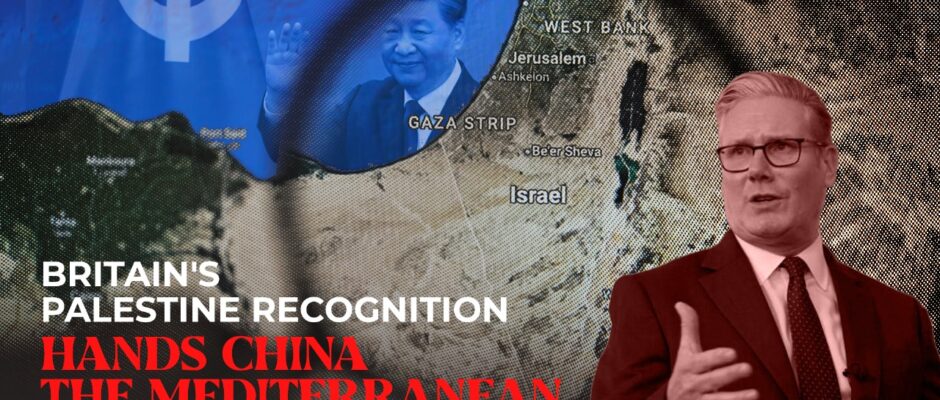
Britain's Palestine Recognition Hands China the Mediterranean

Britain’s Palestine Recognition Hands China the Mediterranean

CCP spent six decades cultivating Palestinian movements, embedding influence in Western activism and positioning itself as the indispensable power in a post-American WestAsia. Britain just made that job easier. Rahul Pawa On 21 September 2025, Prime Minister Keir Starmer broke with decades of U.K. policy formally recognising the state of Palestine. It was Britain’s most consequential West East move since the 1917 Balfour Declaration, made over explicit U.S. objections and Israeli fury. In London’s rush to show moral leadership, one reality was ignored: Beijing had spent six decades preparing for this moment. The CCP’s Palestinian project began in the 1960s. Between 1965 and 1970, Beijing sent small arms, mortars and anti-tank weapons to the Palestine Liberation Army and the Popular Front for the Liberation of Palestine. It trained cadres at the Whampoa Military Academy in Nanning and dispatched instructors to Syria and Algeria. In May 1966 Palestine Liberation Organization Chairman Ahmad al-Shuqairy thanked “Peking” for constant arms and training shipments. After the Six Day War in 1967, Israeli commanders displayed captured Chinese-made AK-47s, 81mm mortars and chemical decontamination gear seized in Gaza and Sinai. Alongside, Beijing also built a diplomatic bridge. In December 1995 it opened a foreign office in Gaza; a de facto embassy to the Palestinian Authority, decades before most Western states considered recognition. Its message to Palestinians was consistent: you can count on us when the West won’t. By Xi Jinping’s era the posture turned strategic. In 2017 the PLA opened its first overseas military base in Djibouti, a Red Sea hub housing thousands of Chinese troops. Beijing secured port stakes from Gwadar in Pakistan to Haifa in Israel, embedding itself along the arteries that supply Europe and the Gulf. A 25-year strategic agreement with Iran in 2021 locked in $400 billion in Chinese investments across oil, gas and transport corridors. CCP’s pattern is clear: first ports, then troops. Djibouti proved it, Hambantota confirmed it, Gaza may be next. Beijing has already demonstrated how commercial access becomes military power, and a recognised Palestine gives it the opening to repeat the same playbook on the Mediterranean. While Beijing built bricks abroad it built narratives at home. State-aligned Arabic media channels and TikTok streams pump out Gaza content at scale. A July 2025 Program on Extremism report mapped how the CCP’s influence runs through Western activism itself. That report details how Shanghai-based tech investor Neville Roy Singham, a onetime Huawei adviser, poured millions into U.S. and U.K. activist groups after Hamas’s October 7, 2023 attack. Groups like the People’s Forum, ANSWER Coalition and “Shut It Down for Palestine” became organising hubs for anti-Israel protests. BreakThrough News, their media arm, live-streamed marches while praising Xi Jinping Thought and Maoist revolution. Investigators concluded the effect was “to project the CCP as a defender of justice while undermining U.S. influence.” In December 2023 the People’s Forum hosted a “China75” event lauding Beijing’s governance model; by early 2024 its funding spiked from under $500,000 to $4.4 million as it expanded pro-Palestinian actions. The same network underwrote protests at Columbia University and in Whitehall, echoing CCP state rhetoric about “imperialist Zionism.” When Starmer spoke to recognise Palestine, Beijing didn’t improvise. Chinese State media instantly framed Britain’s recognition as vindication of the CCP’s “historic” support for Palestinian independence. Chinese diplomats in Ramallah pointed out they had welcomed Mahmoud Abbas to Beijing two years earlier and had pushed a ceasefire plan in 2023. They reminded Palestinian officials who had invested in them when no one else would. With London’s imprimatur, a Palestinian government now has every incentive to turn to CCP for reconstruction finance and infrastructure contracts. Beijing can bolt these onto its Belt and Road Initiative, locking in leverage over a new state at the heart of the Levant. U.S. influence, already eroded by drift and divided Congresses, will shrink further. China’s record speaks for itself. In Djibouti, commercial port access became a PLA base within three years. In Sri Lanka, Chinese loans turned into a 99-year lease at Hambantota. CCP has cultivated a pattern: ports, logistics, security co-operation and then military presence. If Palestine’s future leadership wants investment and security guarantees, CCP will deliver both. Even a small PLA signals unit or intelligence station would tilt the Eastern Mediterranean’s security balance. By presenting any facility as humanitarian or anti-piracy, Beijing can minimise Western backlash while gaining a front-row vantage on Israel, Egypt and NATO operations. Britain’s recognition may have been meant as a rebuke to Israel. However, in practice it is a strategic gift to Beijing. It signals to the Arab world that the West’s will is fractured and that China, not America, not Europe is the constant patron. It creates a diplomatic vacuum China is already moving to fill, from Gaza reconstruction bids to Palestinian security training. This is not hypothetical. Chinese firms dominated Iraq’s post-2003 oil fields; they built most of Africa’s new ports in the last decade. Palestine is a likely next. And unlike the United States or the U.K., the CCP fuses infrastructure with intelligence collection and military access as policy. Starmer’s Downing Street statement marks not the dawn of West Asia peace but a milestone in Beijing’s global ascent. The CCP spent six decades cultivating Palestinian movements, embedding influence in Western activism and positioning itself as the indispensable power in a post-American West Asia. Britain just made that job easier. (Rahul Pawa is director, research at New Delhi based think tank Centre for Integrated and Holistic Studies)

Read More

India’s Moon Mission Opens Up a Zillion Opportunities

Start-ups, small & medium firms to big enterprises will fuel India’s space foray and its economic contribution to $ 100 billion K.A.Badarinath When The New York Times scoffed at India a few years back to even try and send a lander with rover to Moon or attempt a Mars Mission, the publication may not have imagined that it would be real in a very short span. An offending cartoon of 2014 in NYT summed up the editorial board’s humiliation of India’s gumption to get into the ‘elitist space club’ to explore Mars and Moon. But then, the same cartoon made way to social media networks on Wednesday with suggestions that The New York Times make amends after India’s Chandraayan – 3 led to text book precision touch down of lander ‘Vikram’ and the rover, ‘Pragyan’ getting out to explore the moon’s south pole. Well, there were foreign media houses handles that did hail India’s feat. Some did so grudgingly while a few with ‘disbelief’. However, newspaper establishments or TV channels from Europe, US and UK in particular were not remorse about their stance vis-à-vis a purely scientific mission undertaken by a developing country like India with gusto. Some netizens pointed out that the cartoon drawn by Singapore based Heng Kim Song in NYT may have been ‘racist’ and ‘offensive’ in tone. On the other hand, ‘The Economist’ may not have been very happy with Prime Minister Modi for describing the feat as ‘victory of a new India’. What’s wrong with head of the nation sporting his country’s flag and India being victorious is not a crime. Its write up of August 23, 2023 on India’s moon mission was peppered with an acerbic claim that her rover was not as good as the one planned by America or the one owned by China. To show down the Indian achievement, ‘The Economist’ made The Economist leader did not forget to say that Indian lander touched 600 kilometres away from Moon’s ‘proper’ South Pole to apparently dispute the country’s version that it was ‘first’ to reach the place. Even gleeful ‘emojis’ and ‘jai hind’ (long live India) that flooded the internet after India’s moon feat seemed inconvenient for The Economist who could not fully appreciate the ‘aspirational and assertive India’s mind-set. Bloomberg’s Andy Mukherjee gave a political twist to India’s Chandrayaan-3 mission by buying into Congress charge of ISRO engineers that laid the infrastructure were not paid for 17 months. Mukherjee seem to have waded big into Indian political waters. Well, this jingo apart, India’s ‘historic moment’ after the moon landing opens a clutch of opportunities for humanity and major chunk of world’s population as pointed out by Prime Minister Narendra Modi from Johannesburg in South Africa where he’s huddled with BRICS leaders. What’s very significant about the ‘moon landing’ by Indian craft is that it opens space sector estimated at US $ 546 billion for home grown start-ups,  small, medium, micro enterprises apart from the big boys. Big spurt of over 15 per cent at Rs 13,000 crore in market capitalization of companies that contribute to space sector in one trading session on bourses manifests the potential that the sector holds for business growth and expansion. Sixteen space technology companies in India that took roots have also got first and second round of funding from angel investors and established fund houses globally. About 30-odd small ticket funding deals clinched in last couple of years has only added to excitement after the sector was opened to private and foreign partnerships. India may very well put its bets on space economy that is estimated to expand to $ 100 billion by 2025 and account for nine per cent global share from a measly two per cent now. If Prime Minister Modi’s proposal to float a space consortium by BRICS gets adopted, space economy’s contribution to developing countries progress and development will go up multi-fold. This is one level above the BRICS satellite constellation that’s being developed. Collaborative research, skills development, education and related technologies can be jointly harvested to create a common pool. Evolving Indian counterparts to large companies like SpaceX, Blue Origin, Virgin Galactic and Arianespace is what Bharat can look forward to as the country readies missions to Sun and Venus beginning next month. Going forward, creating space economy leaders of our own with the vision to realize India’s vast potential next 25-years is something we need to work on methodically. Creating separate funding buckets to bankroll technology intensive space ventures through equity and zero-rate debt is something that India will have to pursue to quickly realise for growth and expansion. Collaboration and finding right partners for each of the space missions may be the key for every country that’s exploring the universe. (Author is Director and Chief Executive, Centre for Integrated and Holistic Studies, New Delhi based non-partisan think tank)

Read More

Explainer: Weaponisation of social media against Hindus in UK

Leicester, the heartland of the Hindu community in the United Kingdom, is home to the second-largest Hindu populace in Europe. Widely known for its vibrant Hindu culture and stunningly beautiful Hindu festivities throughout the world. Since late August 2022 until September 2022, the city’s minority British Hindu community had been the target of deliberate, organised, and systematic acts of violence including vandalisation of a local Hindu temple by South-Asian origin Muslims in the UK. For nearly a month from late August until September 2022, Hindus were overwhelming victims of violent crimes like attempted stabbings, looting, organising to commit crimes, vandalism, and hate speech. Despite assurances of safety from the local authorities and Leicestershire police, British Hindu homes and business establishments in Leicester were targeted by organised, violent Islamist mobs. Extreme Islamist groups in the UK waged a systematic terror campaign against British Hindus while they were in Leicester, subjecting them to extreme threats, assaults, and trauma. A large-scale mobilisation of violent extremist Islamists and criminals to Leicester with the intention of damaging the city’s Hindu population was made possible by online hate campaigns that were planned both within and outside of the UK to incite hatred and spread misinformation against Hindus. This was reiterated by a recent research entitled “In a Cyber Social Swarming Precedes Real World Riots in Leicester: How Social Media Became a Weapon for Violence” released on November 17, 2022 by the National Contagion Research Institute (NCRI), a cyber threat intelligence organisation. In this explainer; we discuss its findings…. read more

Read More