CIHS – Centre for Integrated and Holistic Studies

Date/Time:

China’s Defence Ministry Releases Counter-drone Video as Shaheds Saturate West Asia

Beijing did not send troops to West Asia. It sent a marketing clip. Rahul PAWA | x – @imrahulpawa On 6 March 2026, as Iranian Shaheds continued to breach air defences across six Gulf Cooperation Council (GCC) states simultaneously, China’s Ministry of National Defence posted a 35-second clip on its official English-language website. With few sentences about detecting “low-altitude, low-speed, and small aerial targets such as drones.” The timing was surgical. The product was not. This is what Chinese defence marketing looks like in 2026: exploit a live war, insert an unproven system into a panic-driven procurement conversation, and bank on customers too frightened, too indebted, or too technically unsophisticated to ask the right questions. War That Created the Window On 28 February 2026, Israel and the United States struck Iran’s military infrastructure under Operation Roaring Lion and Operation Epic Fury. Tehran answered within hours. Operation True Promise IV sent ballistic missiles and UAS simultaneously into Bahrain, Qatar, Kuwait, Saudi Arabia, Iraq and the UAE. Within 36 hours, all six GCC states had been struck by Iran. No drill. No simulation. Nightmare Gulf war planners had war gamed for twenty years arrived at once. Iran’s UAS campaign did not relent. By 5 March, UAE alone had tracked 1,072 inbound UAS and 196 ballistic missiles. On that single day, 131 aerial threats were engaged over Emirati airspace. Iran’s Shahed variants, types 136, 107, and 238, constituted the bulk of confirmed rounds. The economics were catastrophic for defenders. Gulf interceptors ran between three million and twelve million dollars a shot. A Shahed costs hundreds. Iran could sustain the arithmetic indefinitely. Gulf capitals could not. Defence ministries across Asia, Africa, and the West Asia drew the same conclusion simultaneously: counter-UAS capability was no longer optional. They needed a system. They needed to procure one publicly. They needed it now. Beijing had been waiting for precisely this moment. What the Release Actually Says The MND release is worth reading with forensic care. The Radar-Video Fusion Platform, it states, “combines radar and video means” and is “capable of guiding the video system to conduct real-time tracking once targets are detected by radar.” It identifies “moving ground targets within the designated area” and “low-altitude, low-speed, and small aerial targets such as drones” as its detection targets. Strip the language and what remains is this: a fixed post, a radar that cues a camera, operating within a bounded area. The system detects and tracks. It does not intercept. It does not jam. It does not kill. No engagement range. No reaction time. No kill mechanism of any kind. This is the front end of a kill chain presented without the kill chain. Against 131 inbound Shaheds in a single operational day, a border camera that hands off to a video tracker is not a counter-UAS solution. It is a perimeter sensor with a marketing budget. PLA Combat Record That Should End the Conversation The question of whether Chinese military technology performs under fire is no longer theoretical. It has been answered, repeatedly, in the field, by China’s own export customers. Operation Sindoor, May 2025. Pakistan deployed its Chinese-supplied air defence grid against Indian Air Force strikes. Chinese-made HQ-9 and HQ-16 surface-to-air missile systems failed to intercept a single incoming missile. The YLC-8E anti-stealth radar at Chunian Air Base was destroyed. Wing Loong-II UAS were shot down by Indian air defences. Indian Rafale jets using SCALP precision missiles bypassed the Chinese-supplied grid entirely. PL-15 air-to-air missiles fired by Pakistani J-10C jets either missed or malfunctioned, with some reportedly landing in Indian territory. Pakistan’s defeat was total. Its arsenal was 81 percent Chinese-supplied. The pattern did not begin in 2025. Myanmar grounded the majority of its Chinese-supplied jets due to radar defects and unresolved structural faults years after delivery. Nigeria returned seven of nine Chengdu F-7 fighters to China for urgent repairs after a series of crashes, then abandoned the fleet entirely and purchased Italian M-346 aircraft instead. Pakistan’s F-22P frigates reported radar degradation, engine overheating, faulty Gimbal Assembly motors, and compromised missile guidance. Chinese manufacturers acknowledged the defects and declined to repair them on any workable timeline. Saudi Arabia acquired China’s SkyShield laser counter-drone system. In desert operational conditions it experienced significant performance degradation. A laser counter-drone platform that fails in desert heat is not a serious military proposition. This is not a pattern of isolated incidents. It is a pattern of systemic failure across platforms, across countries, across years. A Camera on a Stick China’s approach to military exports relies on perception management over battlefield performance. Advanced-looking systems. Orchestrated reveals. English-language portal releases timed to maximum global anxiety. The 6 March video is the template made visible: a border post dressed as a solution, a sensor dressed as a kill chain, published at the precise moment that counter-UAS procurement panic was highest in recorded history. Radar-Video Fusion Platform may perform adequately on a quiet frontier against a lone surveillance UAS in permissive conditions. That is what it was built for. It was not built to operate inside a Shahed saturation campaign. It cannot engage. It cannot degrade. It cannot stop a single inbound round. Against 131 aerial threats in a single day it can watch and record them arriving. In the Gulf war of 2026, that is not a military capability. It is a camera on a stick. The release was not written for engineers. Any competent defence engineer notes the absence of an engagement mechanism, reads “within the designated area,” and closes the browser. It was written for procurement officials in anxious capitals under political pressure to show populations that something is being acquired. In that market, Beijing is not selling a solution. It is selling the appearance of one. Based on the record from Islamabad to Lagos to Naypyidaw, the customers are still buying. They just keep finding out what they actually paid for. (The author is an international criminal lawyer and director of research at New Delhi based think tank Centre for Integrated

Read More

US Tech Stack That Took Out Khamenei and Why It Matters to India

The joint US-Israeli strike of February 28, 2026 that killed Khamenei was full-spectrum corporate warfighting; satellites, AI, cloud, autonomous swarms, and information dominance working as one lethal system. India watched. It must now evolve. Rahul PAWA | x – iamrahulpawa  In the predawn hours of Saturday, February 28, 2026, something extraordinary happened in the Shemiran district of northern Tehran. Khamenei, Iran’s Leader for 37 years, the man who had survived assassinations, wars, and decades of sanctions, was killed not primarily by a bomb, but by an algorithm. The operation, codenamed Epic Fury, was the first high-level decapitation strike in military history to be substantially driven by artificial intelligence across the kill chain. By the time Israeli aircraft and American munitions found their target, Palantir’s software had fused the intelligence, Anduril’s autonomous drone swarms had penetrated Iran’s air defences, Starlink had held communications together across a contested electromagnetic environment, and Claude’s Anthropic’s AI model, deployed on classified US defence networks had processed petabytes of intercepted Persian-language communications and generated targeting scenarios that human analysts would have taken weeks to produce. Ukraine had proved that Silicon Valley could hold a frontline. Venezuela had proved it could topple a government and secure an oil state. Iran was where both lessons converged into a single, decapitating strike. Invisible Architecture of a Visible Strike When news of Khamenei’s death broke, global attention fixed on the ordnance: 200 Israeli fighter jets in the largest military flyover in Israeli Air Force history, US bunker-busters, strikes across 24 Iranian provinces. What received less coverage was the invisible architecture that made it possible. Starlink was central long before the first missile launched. The Trump administration had covertly smuggled thousands of Starlink terminals into Iran in the months prior, sustaining a communications corridor for intelligence sources inside the country even as the Iranian regime drove national internet connectivity down to 4% of normal levels. When Iranian forces shut down Starlink networks, they were confiscating the same infrastructure that was feeding real-time intelligence upstream to US planners. Satellite connectivity was not a supporting element; it was the nervous system of the operation. Palantir provided the operational software layer; sensor fusion, targeting architecture, and the command-and-control framework that translated intelligence into actionable strike packages. Its Lattice system enabled autonomous drone swarms to communicate threat data laterally: when Iranian air-defence radar locked onto one drone, the entire swarm adapted, dispatching subgroups for electronic deception and anti-radiation strikes in real time. This is software-driven warfare weapons that are, as defence-tech investors now openly describe them, “code wrapped in aluminium shells.” Anduril’s YFQ-44A drones, operating through Hivemind AI pilots capable of executing complex missions without GPS, satellite communication, or human operators, demonstrated capabilities that rendered Iran’s hardware-centric air defences clumsy against algorithmic iteration. Shield AI’s autonomous systems operated in environments where traditional military drones would have been jammed and blinded. Amazon Web Services provided the cloud backbone, data continuity, logistics support, and the secure infrastructure that kept coalition planning intact against Iranian cyber-retaliation, which simultaneously targeted US military bases in Bahrain, Kuwait, Qatar, and the UAE. Anthropic’s Claude AI, which had already proven itself in Venezuela processing intelligence, mapping command chains, and generating scenario simulations that compressed weeks of human analysis into hours, ran the same playbook on Iran, this time trawling Persian communications and mapping fractures in the Revolutionary Guard’s targeting structure. Trump banned Anthropic the day before the strikes. US Central Command used Claude anyway, through Palantir and AWS, as bombs fell on Tehran. The corporate stack had become so load-bearing that a presidential order could not sever it mid-operation. It was not peripheral to American military power. It was the operation. From Sindoor to Stack For Indian strategic planners watching the war in West Asia unfold, the lesson is not comfortable. India has pieces of this architecture. It does not have the stack. India’s defence-industrial base is strongest where the old model still dominates: physical production. Native manufacturing capability is real, and Atmanirbhar Bharat has added momentum. But industrial production is the bottom layer of the stack US operation in West Asia demonstrated. Everything above it; connectivity, cloud, AI, autonomous systems, information operations is where India’s ambition is still catching up with requirement. India is building a commercial space sector, with domestic satellite launches accelerating and a small but growing constellation in development. It is not yet capable of blanketing a contested theatre with resilient satcom, let alone covertly sustaining intelligence networks inside an adversary state but the foundation is being laid. In operational software and autonomous systems, an iDEX-incubated startup ecosystem is producing native drones and ISR platforms,  promising early capability, not yet embedded in classified pipelines at wartime depth. In frontier AI, India has launched sovereign large language model initiatives and is developing government-facing AI infrastructure but the institutional pathway from commercial deployment to classified defence integration remains nascent. In the information domain, digital public infrastructure is maturing, though platform-level influence at global strategic scale remains beyond reach. Iran’s near-total internet blackout could not sever the intelligence flow because a commercial satellite alternative existed. India is working toward equivalent resilience. However, it is not there yet.  The operation that killed Khamenei was not a triumph of numbers. Iran was never going to match US and Israeli firepower. It was a triumph of the stack; satellites, AI, autonomous systems, cloud, and information dominance mobilised as one unified architecture. India already knows this, because it has lived it. Operation Sindoor 2025 was India’s own inflection point. AI fused multi-source battlefield data in real time. Native electronic intelligence software evolved mid-operation to pinpoint and rank threats. Over 600 drones were defeated in a single wave. Loitering munitions and FPV strike drones executed precision hits on high-value targets. The instinct was right. The native capability was real. But Sindoor also exposed the distance still to travel. The stack America deployed over Tehran was embedded in doctrine. India’s is battle-proven but not yet fully built. India need not replicate America’s model. But the underlying

Read More

VSHORADS Delivers India Its Own Aerial Firepower

Three flawless trials at Chandipur signal that India’s last line of aerial defence is no longer foreign. Rahul PAWA | x – iamrahulpawa On the evening of 27 February 2026, along the windswept test ranges of Chandipur on Odisha’s coastline, India wrote a new chapter in its quest for aerial self-reliance. The Defence Research and Development Organisation (DRDO) conducted three successive, flawless flight trials of the Very Short-Range Air Defence System or VSHORADS, a fourth-generation Man-Portable Air Defence System (MANPAD) that has been years in the making. The results were unambiguous: a 100% interception rate against fast-moving aerial targets that mimicked the full spectrum of modern aerial threats. What made these trials extraordinary was not simply the precision of the kills, but the conditions under which they were achieved. For the first time, the system was operated not by DRDO scientists in lab coats, but by soldiers who will one day carry this very weapon into India’s most hostile frontiers. Targets were engaged at varying speeds, ranges, and altitudes, including aerial vehicles engineered to simulate the low thermal signatures of the surveillance and kamikaze drones that have fundamentally altered modern warfare from Ukraine to the Middle East. Technology Inside the Tube To appreciate why VSHORADS matters, one must understand what sets it apart, not just from the Russian Igla-M systems it is designed to replace, but from the world’s most battle-proven MANPADs. The American FIM-92 Stinger, for all its combat pedigree from Afghanistan to Ukraine, requires a coolant gas cylinder to chill its seeker head before firing, adding weight, complexity, and critical seconds to the launch sequence. The British Starstreak, while blindingly fast at Mach 3+, demands a highly trained operator to guide it manually onto the target, making it unforgiving under battlefield stress. VSHORADS sidesteps both limitations. At its heart sits an uncooled Imaging Infrared (IIR) seeker that needs no gas kit and no operator hand-holding. It locks, it fires, it hunts. Where the Stinger and the Igla-M track a point of heat and can be fooled by a magnesium flare, the IIR seeker builds a high-resolution thermal picture of its target. A jet engine looks nothing like a burning flare in thermal resolution, and VSHORADS knows the difference. The system further incorporates a miniaturised Reaction Control System (RCS), using small directional thrusters rather than fins alone to change course mid-flight, granting it the agility to chase a drone executing a sudden corkscrew or a cruise missile hugging a valley floor. Combined with dual-thrust solid propulsion, it keeps pace with whatever the modern battlefield throws at it. Engineered for India’s Terrain Unlike Western or Russian systems designed primarily for European plains or desert theatres, VSHORADS has been engineered from the outset to function in India’s uniquely demanding environments. Himalayas present challenges that most military hardware simply was not designed to overcome: oxygen-thin air that degrades aerodynamic control, sub-zero temperatures that drain batteries and fog optical seekers, and rugged mountain passes where a soldier must carry everything on their back. DRDO has hardened the electronics, optimised the battery systems, and ensured the seeker functions without the coolant gas cylinders that legacy MANPADs require. In Ladakh, where a soldier cannot afford to carry extra weight, that elimination of the coolant bottle is a logistical blessing. The system can be shoulder-fired, tripod-mounted, or integrated onto vehicles, giving commanders tactical flexibility across mountainous, desert, and maritime environments. With an operational range of approximately six to seven kilometres, it comfortably outreaches the American FIM-92 Stinger and is competitive with the Igla-S, while offering superior guidance technology against modern threats. The Strategic Picture: Mission Sudarshan Chakra The February trials are the final milestone before full induction. Production has been assigned and the Indian Army placed an initial procurement order in June 2025. The Ministry of Defence has already issued a Request for Proposal for a next-generation VSHORADS-NG variant, signalling confidence that this platform will evolve with the threat landscape for decades to come. VSHORADS is a cornerstone of Mission Sudarshan Chakra. India’s ambitious roadmap to build native “Iron Dome” style, multi-layered air defence network by 2035. Named after the discus of Hindu deity Vishnu, the mission envisions an unbroken, spinning shield over Indian territory, from the highest Himalayan ridgelines to the coastal perimeter. Within this architecture, VSHORADS fills the most dangerous gap, the first 10,000 feet of airspace, where radar coverage is patchy, and response windows are measured in seconds. Alongside the Quick Reaction Surface to Air Missile (QRSAM) for mid-range threats and emerging laser-based directed energy weapons for close-in interception, VSHORADS forms the innermost and most mobile ring of the shield. The successful trials at Chandipur are proof of concept that Indian ambition, when given the time and resources to mature, can produce systems that stand at the global technological frontier. India’s skies, from the frozen passes of Ladakh to the mangrove coastlines of the Bay of Bengal, will soon be guarded by a weapon born entirely on Indian soil. When VSHORADS finally takes its place in the inventory, it will represent far more than a missile, it will be the outermost blade of the Sudarshan Chakra, finally spinning. (Rahul Pawa is an international public lawyer and Director of Research at the Centre for Integrated and Holistic Studies, New Delhi.)

Read More
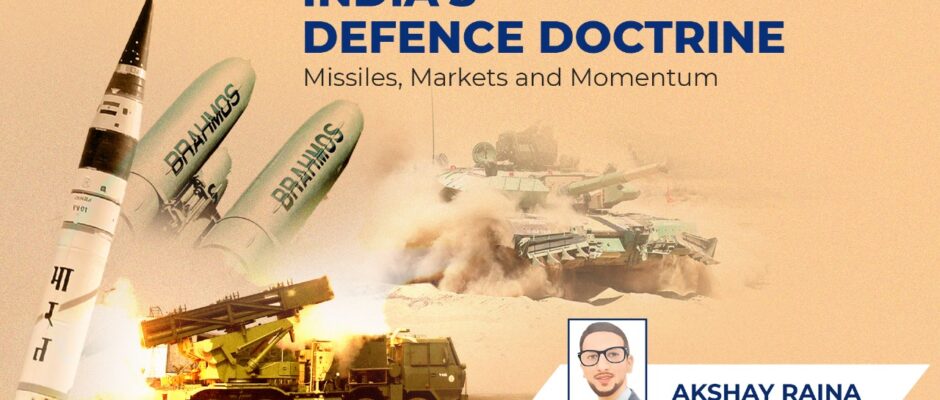
India's Defence Doctrine: Missiles, Markets, and Momentum

India’s Defence Doctrine: Missiles, Markets, and Momentum

India’s defence sector is undergoing a strategic renaissance evolving from self-reliance to global leadership as an exporter of cutting-edge, indigenous military technologies and a trusted partner in the international security architecture. Akshay Raina When it comes to national security, a country’s ability to rely on its own resources in times of conflict is crucial. For India, a rapidly growing global power with diverse security concerns, achieving self-reliance in defence production has become a top priority. This shift from dependency to self-sufficiency is no longer just a strategic aim; it’s a vital step toward safeguarding India’s defence needs while simultaneously strengthening its position in the global defence market. The country’s focus on enhancing indigenous defence production, through initiatives like Make in India, has completely transformed the landscape of defence manufacturing. In recent years, India has dramatically reduced its dependence on foreign imports, thanks to forward-thinking policies, increased collaboration between government agencies and private industries, and a strong emphasis on developing homegrown defence technologies. These efforts have also contributed to a significant rise in defence exports, signalling India’s emerging role as a major global defence producer and exporter. From Import Dependency to Self-Reliance India has historically been one of the world’s largest importers of defence equipment. However, this trend is rapidly changing. The introduction of the Defence Acquisition Procedure (DAP) 2020 by the Ministry of Defence was a pivotal move in this transformation. The DAP focuses on promoting the indigenization of defence production, strengthening India’s military capabilities and reducing the country’s reliance on foreign suppliers for key military hardware. A key aspect of this procedure has been the development of indigenization lists, alongside fostering innovation from domestic startups and MSMEs (Micro, Small, and Medium Enterprises), which are now integral to India’s defence ecosystem. The government’s investment in defence corridors and its efforts to promote collaboration between public sector undertakings (PSUs) and private entities have further accelerated this progress. Moreover, the relaxation of Foreign Direct Investment (FDI) limits in defence has encouraged global defence companies to establish manufacturing hubs in India, helping to fuel the growth of the domestic defence industry. Milestones in Indigenous Defence Production India’s move toward self-sufficiency in defence is marked by significant technological advancements and strategic achievements. India’s capabilities in defence manufacturing are no longer limited to just assembling products; the country is now designing and producing world-class technologies for its defence needs. Some of India’s notable indigenous defence products include: These products, alongside ongoing advancements in electronic warfare, radar technologies, and advanced fighter jets, exemplify India’s growing capability to design, develop and produce defence technologies to meet its strategic needs. With sustained investments in research and development, India is poised to reduce its dependence on foreign defence imports even further. India’s Expanding Defence Export Market India’s increasing self-reliance in defence is not only reducing the country’s dependence on imports but is also positioning India as a significant player in the global defence export market. Over 100 countries now purchase defence products from India, including helicopters, naval vessels, missiles, armored vehicles and aircraft. The rise in defence exports is largely attributed to the government’s focus on high-quality manufacturing, innovative technologies and streamlining the defence procurement process. Key achievements in India’s defence exports include: For instance, as per recent reports, India supplied over $250 million worth of Pinaka multi-barrel rocket launchers, anti-tank munitions and other ammunition to Armenia in 2022. India has also exported naval platforms and torpedoes to Mauritius, Myanmar, Sri Lanka and Vietnam and military trucks to Thailand. Additionally, Tata 8×8 LPTA trucks, based on the Tata 1623 platform, are being exported to the Royal Moroccan Army, marking another achievement in India’s defence exports. Future of India’s Defence Exports India’s defence exports are on an upward trajectory. As the country enhances its defence production capabilities, its growing export footprint positions India as a trusted supplier of affordable, high-quality defence products. The government’s ambitious target of reaching ₹50,000 crore in defence exports by 2029 reflects India’s determination to become a global leader in defence manufacturing. This rise in exports is not just about economics—it’s also about strengthening India’s strategic alliances globally. Deals with countries like the UAE, Armenia and Myanmar reflect India’s growing influence and the trust placed in its defence capabilities. By providing cutting-edge defence solutions at competitive prices, India is offering an alternative to traditional Western and Russian defence suppliers, which only further solidifies the country’s position in the global defence market. India’s Strategic Vision for Global Defence Leadership India’s defence sector has undergone a remarkable transformation over the past decade. Once one of the world’s largest importers of defence equipment, India is now rapidly becoming a top producer and exporter of world-class defence technologies. The government’s support for indigenous defence production, increased foreign investments and strategic initiatives like the Defence Acquisition Procedure (DAP) 2020 have paved the way for India to become self-reliant in defence production. India’s defence exports have surged significantly, from ₹686 crore in 2014-15 to ₹21,083 crore in 2023-24. With cutting-edge products like BrahMos, Pinaka and Tata 8×8 trucks, India is providing high-quality, reliable, and affordable defence solutions to the world. The country’s goal of achieving ₹50,000 crore in defence exports by 2029 is a clear indicator of India’s growing influence on the global defence stage. As the geopolitical landscape evolves, India’s role as a trusted defence partner and manufacturing leader will continue to grow, securing both its own defence needs and its position as a global strategic power. By prioritizing self-reliance, innovation and global partnerships, India is not just preparing for its future defence requirements but is also positioning itself as a leader in the global defence market. (Author is a seasoned media professional, content strategist and news analyst)

Read More

Technology Paradox!

Manipulation in technology becomes an effective tool with terrorists, fraudsters and dictates political conversations posing fresh challenges to humanity K.A.Badarinath Technology works weirdly. Human mind behind evolving technologies globally is all the more weird. When Prime Minister Narendra Modi gave a call to undertake research in areas of technology, innovation and development to further socio-economic progress, there were sneers and jeers especially the cynics. Reports appearing in media seek to underline significance of reorienting technology and scientific research to further Bharat’s development and economic prosperity. But, instances of technology manipulation have shaken Bharat’s conscience. Mahdev app is one of several fraudulent platforms that crept into the system and helped the crooks launder money, betting by vulnerable people, spread corrupt practices and bankroll political parties. About 22 such apps and websites were either restricted or banned completely by Bharat’s government this Sunday. Reports quoting Enforcement Directorate documents suggest that Rs 508 crore was paid to Chattisgarh chief minister Bhupesh Baghel as kickbacks for facilitating technology driven betting apparently managed and manipulated from Dubai. These funds were to support campaign of Indian National Congress fighting anti-incumbency in legislative assembly elections. Promoting corrupt practices through the instrument of technology is what has come to fore. Weird brains behind crafted technology platforms to further betting and entice vulnerable people with promise of big money may require closer scrutiny. Making conscious attempt to hoodwink law enforcement agencies by harvesting technology to ‘rob’ people of their hard earned money need to be recognized by ‘evolved societies’ that push for big technology foray. It’s not just technology driven software programmed betting apps that wreaked havoc on gullible people in Bharat as was the case with Mahadev App that was largely operated and managed from Dubai by its promoters and were hand in glove with Bhupesh Bhagel government’s bigwigs and ruling party bosses in the state. At a meeting of Thinkers Forum in Karnataka, Finance Minister Nirmala Sitharaman recently pointed to technology driven apps that were used by fraudsters and speculators to work up or pull down specifistocks, investment instruments apart from drumming up support as well as marketing Ponzi schemes. Genuine investors and savings of hard working people were bound to be lost to unscrupulous elements that manipulated technology to perpetuate financial crimes. Recent cash for questions scam being investigated by an ethics committee of Parliament also have a similar narrative. The accused Member of Parliament from opposition, Trinamool Congress Mahua Moitra apparently passed on her official mail login and passwords to corporate houses. Mail ID of this jet-setting MP were used and abused by corporate houses to steer Parliamentary discussions on issues that possibly relate to them. Dubai was the favourite destination for this MP from where her mail ID was logged in over 45 times by alleged handlers. A sweep of servers access and technology interface for this mail ID revealed the way she operated in conjunction with her corporate masters from whom she reportedly received expensive gifts and unlimited hospitality. Quick spread of artificial intelligence will not only disrupt Bharat’s society like any others, increase in financial crimes driven by technology is a foregone conclusion. Unprecedented advances in computer vision, languages processing, robotics have only complicated the world of money. Fraudsters are bound to have a hay day given issues relating to safety, accountability and transparency of technology driven, artificial intelligence propelled processes that govern the world of finance, banking, insurance, pension funds and markets. UK Prime Minister Rishi Sunak had recently compared dealing with artificial intelligence to emergence of internet or electricity several decades earlier. Rishi Sunak is right when he says that artificial intelligence brought with it fears that’s unparalleled in history of human evolution. Apart from large scale frauds, artificial intelligence and other cutting edge technologies have also brought fears of cyber-attacks, disinformation and it was an effective tool in hands of criminals and terrorists. Though the Bletchley declaration boasted of 29 countries including China and European Union being signatories to an alliance on artificial intelligence, there were enough naysayers especially the technology honchos of Meta and Tesla variety. From simple financial frauds to dictating political conversations, technology has emerged as the biggest threat in the hands of lumpen elements , terror mongers of every shade, variety & religious denomination apart from human disruptors. Moulding technology for human welfare, progress and development, spread of prosperity is the biggest challenge. (author is Director and Chief Executive of New Delhi based non-partisan think tank, Centre for Integrated and Holistic Studies)

Read More