CIHS – Centre for Integrated and Holistic Studies

Date/Time:

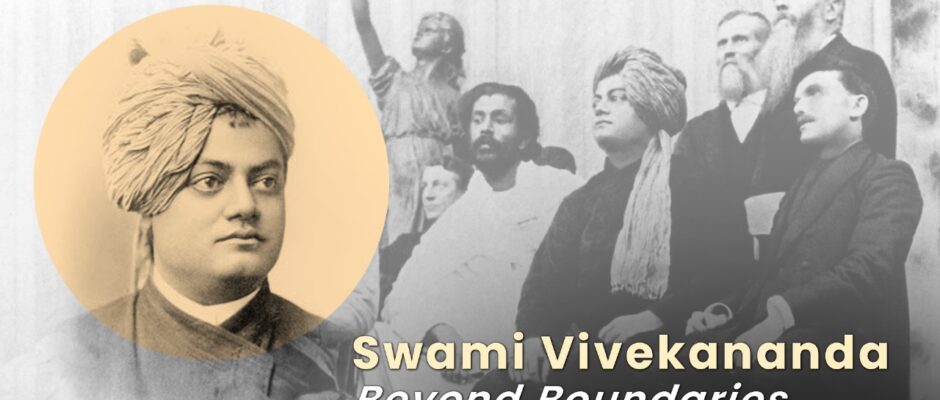
Vivekananda, Beyond Boundaries

Vivekananda, Beyond Boundaries

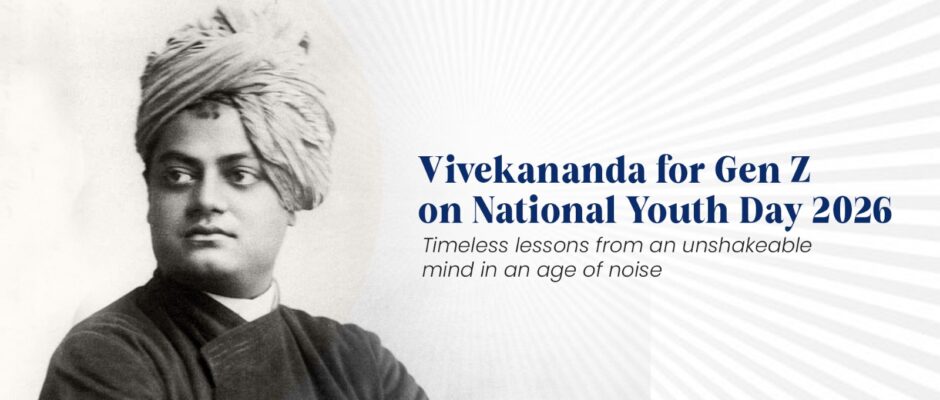
Swami Vivekananda’s holistic vision—where reason, faith, science, and philosophy converge—guides us today. His belief in the unity of existence inspires us to seek deeper truths beyond boundaries. Dr. Shailendra Kumar Pathak Swami Vivekananda, a luminary whose wisdom bridged epochs and disciplines, stands as a timeless exemplar of how ancient Bharatiya philosophy can illuminate the most advanced scientific inquiries. His epochal address at the 1893 World’s Parliament of Religions introduced Vedantic thought to the global stage, but this was merely a fraction of his intellectual legacy. Vivekananda’s profound grasp of Vedantic principles, combined with his reverence for scientific inquiry, inspired a generation of thinkers and continues to resonate in domains ranging from quantum physics to biotechnology. His vision was not a mere reconciliation of two seemingly divergent streams—spirituality and science—but a revelation of their shared foundation as pathways to universal truth. Vivekananda’s insights on the nature of reality anticipated many aspects of modern scientific discourse. His interpretation of Vedantic concepts such as Akasha (space or ether) and Prana (energy) aligns remarkably with contemporary explorations in quantum physics. During his conversations with Nikola Tesla, he explained how the Vedas described the fundamental unity of matter and energy. This dialogue inspired Tesla to explore these ideas in his experiments on energy transmission and wireless communication, underscoring the universality of Vivekananda’s thought. The Vedantic assertion that the universe is a manifestation of one underlying reality resonates with the principles of quantum mechanics, particularly the idea of quantum entanglement, which reveals the interconnectedness of particles regardless of spatial separation. The relevance of Vivekananda’s ideas extends beyond theoretical physics to the burgeoning field of biotechnology. His emphasis on the sanctity of life and the interconnectedness of all beings provides a philosophical framework for addressing the ethical dilemmas posed by advancements in genetic engineering, cloning, and artificial intelligence. Biotechnology, which often grapples with questions of purpose and responsibility, can draw inspiration from Vivekananda’s vision of a science guided by spiritual values. He believed that scientific progress should serve the greater good, aligning with the Vedantic principle of Lokasangraha—the welfare of the world. His call for integrating morality and science offers a crucial counterbalance to the unbridled pursuit of technological power. In the realm of neuroscience, Vivekananda’s insights into the nature of consciousness have found an uncanny echo in contemporary research. His assertion that the mind and body are interconnected systems aligns with modern understandings of neuroplasticity and the mind-body connection. The Vedantic idea of Chitta (consciousness) as a continuum that transcends individual experience mirrors the quest in neuroscience to comprehend the origins of consciousness and its universal aspects. As scientists explore meditation and mindfulness as tools for mental health and cognitive enhancement, Vivekananda’s teachings on the transformative power of concentrated thought and inner discipline gain renewed significance. Swami Vivekananda’s vision also anticipated the global shift toward interdisciplinary collaboration in research and innovation. He recognized that no single discipline could adequately address the complexities of human existence. His advocacy for blending the rigor of Western science with the depth of Bharatiya spirituality prefigured the integrative approaches now prevalent in fields such as bioethics, environmental science, and systems biology. His belief in the complementarity of external and internal exploration reflects the ethos of holistic science, which seeks to harmonize the empirical and the experiential. Moreover, Vivekananda’s philosophy has practical implications for contemporary education systems, particularly in fostering innovation and critical thinking. His call for self-reliance, Shraddha (faith in oneself), and the pursuit of knowledge as a sacred endeavor offers a compelling model for nurturing creativity and ethical responsibility in the next generation of scientists and technologists. In a world increasingly driven by artificial intelligence and machine learning, Vivekananda’s emphasis on the primacy of human values and the cultivation of wisdom over mere information remains profoundly relevant. The advancements in cosmology and astrophysics, too, bear an intriguing alignment with Vivekananda’s vision. The Vedantic view that the universe emerges from and dissolves into an infinite consciousness parallels theories of the cyclical nature of the cosmos, such as the Big Bang and the Big Crunch. Scientists probing the origins of the universe are increasingly acknowledging the limits of purely materialistic paradigms, opening the door to perspectives that transcend conventional boundaries. Vivekananda’s assertion that the universe is a dynamic interplay of energy and consciousness offers a metaphysical lens through which to interpret these discoveries. The impact of Vivekananda’s ideas is not confined to philosophical musings or theoretical sciences. It extends to applied sciences, such as renewable energy and sustainable development. His emphasis on simplicity, self-discipline, and respect for nature aligns with the principles of sustainable living, providing a moral compass for addressing the environmental crises of our time. In a world grappling with climate change and resource depletion, his teachings encourage the pursuit of technologies that harmonize with nature rather than exploit it. Vivekananda’s ability to see science and spirituality as mutually enriching pathways to understanding underscores his enduring relevance in a world increasingly shaped by technological advancements. His life and work serve as a reminder that the highest purpose of knowledge is not domination over nature but harmony with its deeper truths. As the boundaries of science expand into realms once deemed metaphysical—whether in exploring the multiverse or decoding the nature of consciousness—Vivekananda’s vision stands as a guiding light, urging humanity to balance the pursuit of knowledge with the cultivation of wisdom. In reflecting on Swami Vivekananda’s contributions, it becomes evident that his ideas transcend the limitations of time and place. He did not merely harmonize the East and the West or religion and science; he revealed their underlying unity. His vision of a science imbued with spiritual depth and a spirituality informed by scientific rigor offers a transformative paradigm for addressing the challenges of the modern age. As humanity stands on the cusp of unprecedented advancements in quantum computing, genetic engineering, and space exploration, the need for a moral and philosophical grounding becomes ever more critical. Vivekananda’s teachings provide that grounding, reminding us that true progress lies not in the

Read More

Swami Vivekananda Unpacked Dharma for Global Communities

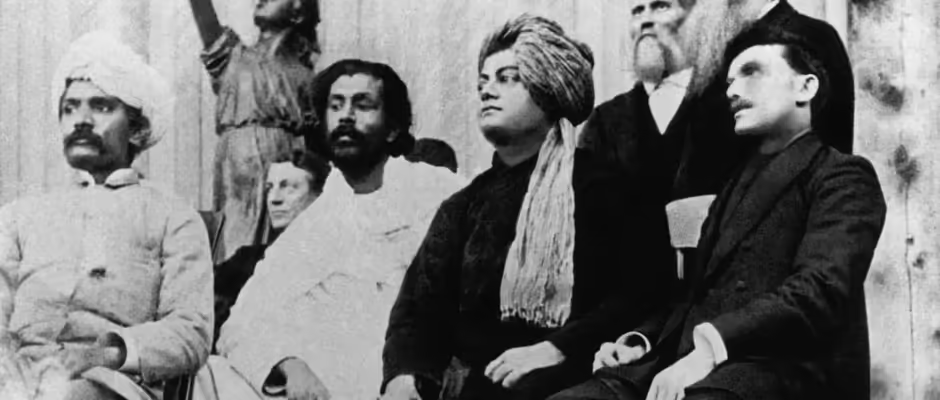
‘Us’ versus ‘them’ is passé. The great Bharatiya sage unveiled vedic vision of entire humanity being part of the wholesome ‘Supreme’. Dr Aniruddh Subhedar Very few people know that “Juggernaut” is derived from Sanskrit word “Jagannath,” most revered Hindu god literally meaning “Lord of the world”. In early 19th century, Christian missionaries spread malicious propaganda that during popular Rath Yatra of Bhagwan Jagannath, a huge chariot crushed devotees under its wheels. Many influential people in England including William Wilberforce who is admired in Western world for his advocacy to abolish slave trade demanded an end to the so-called devilish practices. Over the years, western world got enlightened about Jagannath Rath Yatra. But, even today, English word “Juggernaut” is seen as a destructive, unstoppable force serving as living testimony to the smear campaign against Bharat’s culture and Hindu dharma. Truth behind this one word illustrates the hostile world in which Swami Vivekananda had to work at a time when Hindus were considered savages, their philosophy and traditions viewed as devilish. Amidst these hostile forces, Swami Vivekananda hoisted the banner of Bharat’s spiritualism to Western world and emerged victorious. Throughout her history, Bharat produced great sages and scholars, each one greater than the other. But, in modern times, Swami Vivekananda is seen as harbinger of sanskritik (cultural) and adhyatmik (spiritual) revolution in India. He was the pioneering monk who understood the need to spread sublime and profound philosophy of Advaita Vedanta throughout the world. Global awakening to Yoga and Vedanta is fruition of Swamiji’s pioneering efforts. World’s Parliament of Religions World Parliament of Religions held in Chicago in September 1893 can be termed the first organized interfaith gathering internationally. Swami Vivekananda participated in this parliament which was held during September 11 – 27, 1893. From his first rendition on September 11 which opened with touching lines “Brothers and Sisters of America,” up to his address at the final session on September 27, Swamiji addressed the parliament six times. Each of these speeches focused on Bharatiya philosophy, universal brotherhood and need for global unity. Swamiji not only expounded on the philosophy of Vedanta but amplified teachings of Lord Buddha and their intricate relationship to Sanatan Dharma. While he criticized evangelical activities of Christian missionaries, he stressed the need for every individual to walk the path of self-realization. Quoting Lord Krishna’s words from Bhagavad Gita: “ये यथा मां प्रपद्यन्ते तांस्तथैव भजाम्यहम्। मम वर्त्मानुवर्तन्ते मनुष्या: पार्थ सर्वश:।।” (O Arjuna! In whatsoever form one seeks Me, I reach him in that form, for all mankind is but following the paths I laid down for them.) Swami Vivekananda told the world that the path to reach Supreme Being is not and cannot be monopolized by one religion. It is open to every honest seeker. Bharat’s Soul Unveiled Swamiji’s words were not just verbose discourse on philosophy for armchair intellectuals, nor were they a recounting of Bharat’s long-lost past. Rather, what Swamiji presented to the world was Bharat’s very soul. When Swamiji said, “I am proud to tell you that we have gathered in our bosom the purest remnant of the Israelites… I am proud to belong to the religion which has sheltered and is still fostering the remnant of the grand Zoroastrian nation,” he was not merely recounting Bharat’s glorious past but presenting reality of Bharat that was rooted in spirituality even during most testing times of colonial oppression. This legacy continues today when Iran, the original land of Zoroastrians is suffering religious fanaticism, riots and theocracy. Zoroastrianism continues to flourish in India. It is this soul of Bharat that prompted Indian Government to offer citizenship to persecuted religious minorities in its neighbouring countries through Citizenship (Amendment) Act, 2019. Arguments and conspiracy theories floated against the all-inclusive act was from those that did not realize Bharat’s Soul. Swami Vivekananda and World Peace Swami Vivekananda’s work had lasting impact not only on people of Bharat but global communities. His teachings led to setting up Vedanta societies across United States that continue to thrive even today. Vedanta Society of New York and that of Northern California, San Francisco were centres established by Swami Vivekananda. Today, the world going through conflicts and wars may have missed an enlightened soul like Vivekananda. We see racial crimes, bigotry, wars and persecution. Religious fanaticism is raising its head in the form of Khalistani terrorism. The land of Bengal (both Bangladesh and West Bengal) has descended into religious persecution and chaos as it has strayed from the path shown by Swami Vivekananda. At the World’s Parliament of Religions, Swami Vivekananda said: “Sectarianism, bigotry and its horrible descendant fanaticism, have long possessed this beautiful earth. They have filled the earth with violence, drenched it often and often with human blood, destroyed civilization and sent whole nations to despair. Had it not been for these horrible demons, human society would be far more advanced than it is now”. These words of Swamiji are more relevant today than ever. For long, organizations like United Nations have attempted at maintaining global peace. But, the world tends to lapse into chaos and violence periodically. Limited success is seen by UN as its efforts are mainly aimed at political level. What Swamiji preached was the path of emancipation of every soul where every individual strives for self-realization. September 11, when Swami Vivekananda delivered his speech at World’s Parliament of Religions, is commemorated by his disciples and admirers as ‘Vishwa Vijay Diwas’ (the day when he conquered the world). But this conquering is not a dystopian dream of military victory and subjugation; it is a victory through message of peace. For those harbouring malice, the “Lord of the World” (Jagannath) becomes a “destructive force.” But for noble minds nurtured by Swamiji, even “conquering” loses its bloodshed and becomes an exercise in love and mutual respect. To a world that knew only the logic of “us vs. them,” Swami Vivekananda introduced the idea of “आत्मवत् सर्वभूतेषु”. It signifies all living entities as part of one’s self. It’s time the world revisits

Read More