
CIHS – Centre for Integrated and Holistic Studies

Date/Time:

Pakistan's Vanishing Minorities: Maria Shahbaz Case

Pakistan’s Vanishing Minorities: Maria Shahbaz Case

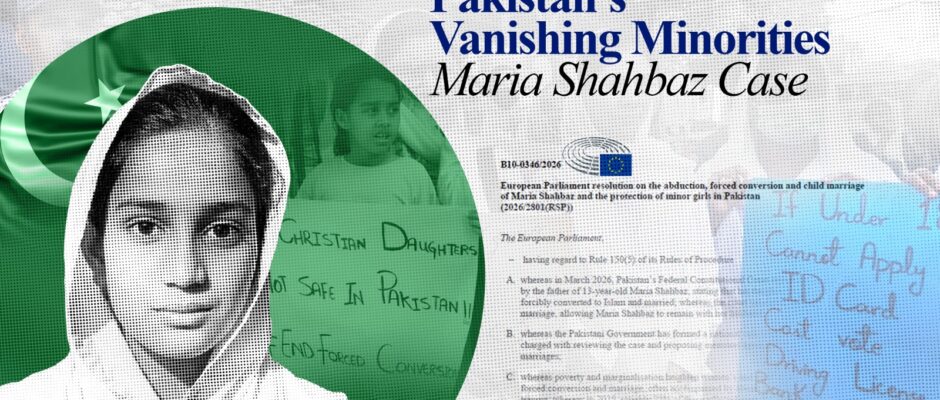
Rohan Giri In March 2026, a court in Pakistan closed the file on a thirteen-year-old girl from Lahore and, in doing so, opened a much older wound that the country has never quite managed to heal. Maria Shahbaz, a Christian by birth, had been abducted, coerced into converting to Islam, and married off to the man who took her. Her family brought documents to prove her age. They pointed to marriage papers that did not match the facts of her life. None of it moved the Federal Constitutional Court, which ruled that her later statements, given after weeks in the custody of her abductor, were enough to validate the marriage and send her back to him. It is the kind of verdict that, on paper, looks like the end of one girl’s story. In practice, it reads like the latest entry in a ledger that Pakistan’s minorities have been keeping, reluctantly and at great cost, for decades. The European Parliament noticed. On 8 July 2026, it adopted a joint resolution on the case, built from four separate drafts submitted by the European People’s Party (EPP), the Progressive Alliance of Socialists and Democrats (S&D), Renew Europe (Renew) and the European Conservatives and Reformists (ECR). What made the resolution worth reading closely was not simply its condemnation of a single court ruling, but the company that ruling was suddenly forced to keep. Buried in the recitals was a figure that ought to have made headlines of its own. In 2025 alone, roughly three-quarters of the documented victims of forced conversion and marriage in Pakistan were Hindu, a quarter were Christian, and nearly eighty percent of all such cases occurred in a single province, Sindh. A single ruling can be an aberration. A demographic skew repeated year after year, concentrated in one province, against the same two communities, is something else entirely. Anyone who has followed Sindh’s Hindu community for more than a news cycle will recognise the shape of this story before it is even told. In February 2012, a nineteen-year-old named Rinkle Kumari was taken at gunpoint from her home in Ghotki district. What followed was almost a template for everything that came after: a sudden disappearance, a claim of voluntary conversion, a court appearance in which the girl, by then weeks removed from her family and in the custody of the man accused of taking her, said what was required of her. Pakistan’s Supreme Court sent her back to her abductor. She told the court, in words that were reported at the time, that there was no justice for Hindus in Pakistan and that she would rather be killed there than returned to the shelter home. She was never seen by her family again. In the years since, the names have changed, Sunita Kumari, Neena Kumari, Lata Kumari, Reena and Raveena, but the sequence rarely does: abduction, a hurried conversion, a marriage certificate produced after the fact, and a court willing to accept a coerced confirmation as proof of consent. Independent research conducted by the NGO South Asia Partnership Pakistan, together with the Aurat Foundation, has estimated that at least a thousand girls, overwhelmingly Hindu, are forcibly converted in Pakistan every year. That is not the residue of an unfortunate exception. It is a functioning system. It is worth asking why this system has been allowed to function for so long, and the answer has as much to do with numbers as with law. Sindh remains home to the largest surviving Hindu population in Pakistan, a community that made up close to fourteen percent of the region’s population at the time of Partition and has since fallen to somewhere between three and four percent. That decline is usually explained away as the ordinary consequence of migration. But researchers who have studied the pattern closely, in India and elsewhere, argue that migration alone cannot account for a fall of that magnitude, and that a slow, decentralised mechanism of attrition, operating family by family through coerced conversion, has done at least as much to hollow out the community as any single wave of departures. No government needs to announce a policy of demographic erasure if its courts will quietly ratify the results of one anyway. There is a second thread in this story that the final joint resolution touched only lightly, though an earlier draft from the S&D group was willing to say it more plainly. That draft connected the pattern of forced conversions to the wider use of blasphemy laws, anti-terrorism statutes and cybercrime provisions against government critics, naming the convictions of Imaan Mazari, Hadi Ali Chattha, Mahrang Baloch and Sibghatullah Shahji, and the continued detention of Baloch and Pashtun rights figures including Ali Wazir. The final text softened this into a general call for judicial reform. But the connection, once drawn, is hard to unsee. A judiciary willing to accept a coerced statement from a frightened thirteen-year-old as evidence of free will is not a separate institution from the one that has, in parallel, been used to jail the lawyers, journalists and activists who try to speak for people like her. Both failures come from the same place: a legal system that treats the powerless, whether a minority child or a dissident adult, as someone whose stated wishes can be safely disregarded once the right procedural box has been ticked. The most telling part of the resolution, in the end, is not what it says about Pakistan’s judiciary but what it says about Europe’s own leverage. Pakistan has held Generalised Scheme of Preferences Plus (GSP+) status for years, a trade arrangement that grants its exports near-zero tariff access to European markets in return for implementing twenty-seven international conventions, among them the Convention on the Rights of the Child. The S&D’s original draft said, without much ambiguity, that continued failure to honour these commitments should result in the withdrawal of that status. By the time the four groups had merged their texts into one, that line had softened into a
Read More

Debt Bondage: Pakistan’s way of exploiting its minorities

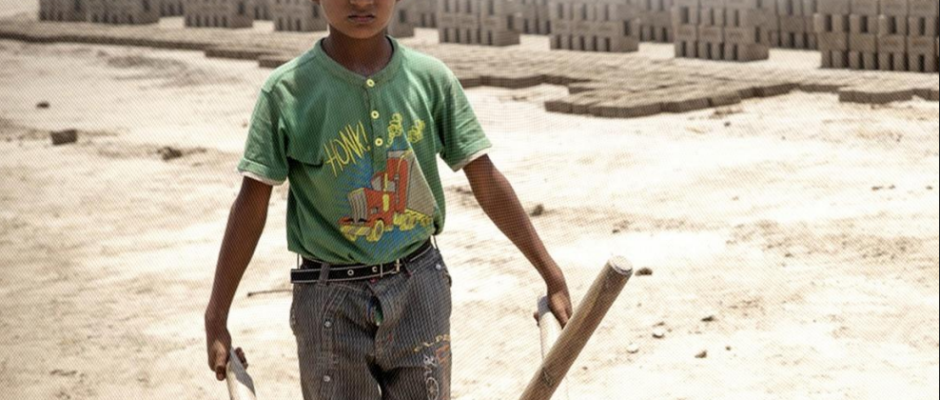
Forced labour, servile marriages, bonded inhuman labour, physical torture and abuses against women, children and the elderly have threatened Sindh’s minorities. I. Executive Summary Debt bondage in Sindh is systemic, inter-generational and structurally embedded. Legal prohibitions and international commitments notwithstanding, serious gaps in enforcement and socioeconomic inequalities sustain a cycle of exploitation. Without coordinated, evidence-based and politically accountable reform, millions of minorities, women and children remain at risk of continued slavery. Scale of Crisis Debt Bondage in Sindh High-Risk Districts & Sectors Impact on Minorities Child Labour Dimension Legal and Policy Gaps Structural Drivers Challenges in Rehabilitation & Reintegration Human Rights Relevance II. Context Debt bondage, a contemporary type of slavery wherein employees are obligated to their employers against unpaid advances and structural pressure, remains deeply ingrained in Sindh’s rural economy. It continues to be one of the most pervasive yet under-addressed human rights issues. Statutory prohibitions notwithstanding, international commitments and constitutional protections, exploitative practices continue unhindered due to systemic socioeconomic and governance failures, trapping millions of people in debt bondage, forced labour and coercive exploitation across important economic sectors. Minorities, especially low-caste Hindus, are disproportionately affected by cycles of inequality and exploitation perpetuated. Millions of people are still working in bonded labour in agricultural, brick kiln and informal sectors, according to extensive data and field reports. Minorities are disproportionately affected due to socio-cultural marginalisation. III. Background: Sindh, one of the world’s oldest centres of civilisation, is home to the Indus Valley and has historically served as a hub for ideas, trade and cultural development. The region’s multi-layered history, which includes Persian, Afghan, Mughal and eventually British colonial dominance, illustrates both cultural richness and repeated conquest from Mauryan, Kushan and Gupta rule to its significance as a centre of Islamic study and trade under Arab and Turkic rulers.    Sindh has struggled with persistent concerns about political centralisation, unequal resource distribution and influences on its linguistic and cultural identity ever since it joined Pakistan in 1947.Discussion about representation, economic justice and provincial autonomy is still essential for understanding current conflicts and the Sindhi movement’s desire for increased involvement in choices affecting the future of the area. Owing to mistreatment and mismanagement, there have been persistent demands for complete independence as a sovereign Sindh nation. As of 2023, Sindh, one of Pakistan’s four provinces, is home to an estimated 55 million people and occupies 140,914 square kilometres. In addition to serving as the provincial capital, Karachi is the biggest metropolis and centre of Pakistan’s economy. English is commonly used in government, administration and education, whereas Sindhi is the official provincial language and Urdu is the national language. Due to Sindh’s historically complex social fabric, majority of the province is Muslims (around 91 per cent) with Hindus making up the largest religious minority (about eight per cent). World Sindhi Congress (WSC), which represents Sindh abroad at Unrepresented Nations and Peoples Organisation (UNPO), promotes Sindhi political, cultural and human rights concerns on a global platform. Sindh has a long history of civilisation that dates back to ancient times. The ancient homeland of the Sindhu (Indus) River is known as Sindhudesh or Sindhu Kingdom in Mahabharata. Sindh’s longstanding status as a unique cultural and political entity in early South Asian history is reflected in the name. Sindhi people face increasing environmental, socioeconomic and human rights challenges that require immediate international attention. The targeting of ethnic Sindhis and religious minorities, together with reports of enforced disappearances, extrajudicial executions and dissent repression, highlights a very alarming accountability vacuum. Religious prejudice has escalated, making minority groups, especially Hindu girls, more susceptible to kidnapping and coerced conversion. Simultaneously, Sindh’s agrarian economy has been severely damaged by climate vulnerability, rising sea levels, soil salinity and frequent flooding.  Economic Corridor (CPEC) have accelerated ecological degradation, industrial pollution and displacement without sufficient local consultation. Sindh’s socioeconomic stability and cultural security have been undermined by these intertwined crises that have strengthened calls for greater political representation, minority rights protection, environmental protection and meaningful involvement in decisions that impact the region’s resources and future development. IV. Debt Bondage: A Silent Killer Debt bondage also known as bonded labour is contemporary form of slavery. It happens when someone is forced to pay back debt or advance payments (commonly referred to as peshgi) on terms that make it nearly difficult to comply due to exorbitant interest rates and pitifully low salaries. They are unable to refuse or flee exploitative labour which traps workers and their families. Forced labour, human trafficking, servile marriage and bonded labour are all considered forms of modern slavery and are included in the Global Slavery Index framework. On paper, millions of Sindhis in Pakistan enjoy freedom, but in practice, bondage rules their lives. Debt is a multigenerational trap designed to keep an indigenous community economically reliant, socially immobile, and politically silent in rural Sindh. It is not a short-term misery. Poverty is not the cause of this. It is a social order that was created. Districts where agriculture and kiln-based labour dominate local economies, such as Tharparkar, Umerkot, Sanghar, Mirpurkhas, Badin, Thatta and portions of Hyderabad division, are regularly designated as high-risk. V. Signature Patterns in Sindh In Sindh, bonded labour is still widely used, especially in brick kilns and agriculture, where unskilled labourers and landless peasants (haris) take advance loans from kiln owners or landowners and get caught in never-ending debt cycles that last for generations. Farmers are frequently forced to give up a disproportionate amount of their produce due to informal and opaque sharecropping arrangements, which increase their financial dependence and restrict any feasible route to repayment. Importantly, bonded labour is not limited to adult male workers; women and children are also ensnared in household debt commitments, making them more susceptible to abuse, exploitation and systematic denial of their basic rights. These obligations are: A Sindhi child is often born with debts that will never be paid off, including money the child never borrowed and working land he/she will never own. This isn’t labour but ‘hereditary imprisonment’. VI.

Read More