CIHS – Centre for Integrated and Holistic Studies

Date/Time:

It’s By Design and Agenda!

It’s By Design and Agenda!

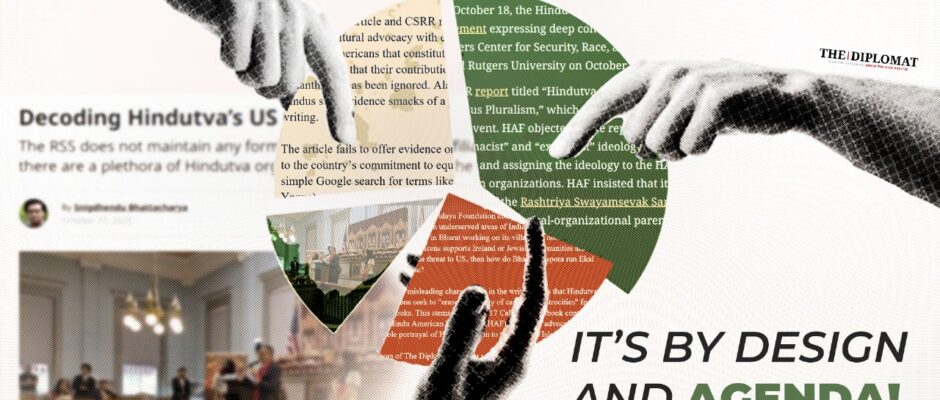
Write up in The Diplomat, CSRR report against Hindus, RSS & Bharat’s diaspora is factually incorrect, misleading & spreads fear! Madhusudhana Hebbar A write up in The Diplomat, titled “Decoding Hindutva’s US Operations,” published on October 27, 2025 attempts to unveil what it portrays as a network of Hindu nationalist organizations in United States, allegedly tied to India’s Rashtriya Swayamsevak Sangh (RSS) and purportedly pose a threat to American equality and religious pluralism. Drawing extensively from May 2025 report by Rutgers University’s Center for Security, Race, and Rights (CSRR), titled “Hindutva in America: A Threat to Equality and Religious Pluralism,” the piece labels Hindutva as a “supremacist” ideology comparable to fascism or white supremacy. But the article is marred by factual inaccuracies, logical inconsistencies; innuendos and a biased narrative that stigmatizes Hindu Americans. CSRR report itself has been questioned for its methodological flaws, including cherry-picking evidence, false equivalences and lack of community input. The report and the article wrongly portray cultural pride as supremacy while ignoring Hindutva’s roots in inclusivity and principles like vasudhaiva kutumbakam (the world is one family). A core inconsistency emerges in the article’s handling of RSS connections internationally. While the write up cites RSS website on not having any affiliates abroad, it still adventures to bracket Hindu Swayamsevak Sangh as RSS international wing. Factually, there are no formal linkages whatsoever between the two organizations barring the Bharat, Bharatiyata and Hindus link. RSS website said, “RSS works only in Bharat. But it is possible that we will be able to connect you to some like-minded organization in your country. No concrete evidence of formal ties (if any) is provided; instead, the article relies on vague “people trails”- personal associations which tantamount to guilt by association. This tactic echoes historic smears and overlooks that US-based organizations like HSS operate independently to promote cultural education, yoga, family values, community service and preserve Hindu heritage in multi-cultural America and not as an RSS extension. As against what has been claimed in the write up, HSS has 267 shakhas or basic chapters across seven regions in the United State in 33 states. The assertion that “primary focus of RSS activities in US is to unify the Hindu diaspora with an India-centric approach and to raise funds from them for projects in India” is baseless, as RSS does not operate in the US. The write up does not support its claims accusing RSS of mobilizing funds illicitly for and from organisations like Ekal Vidyalaya Foundation. In contrast, Ekal Vidyalaya Foundation complies with US laws and focus on education in underserved areas of India. Supporting organizations back in Bharat working on its villages is not a crime. When Irish Americans supports Ireland or Jewish communities aid to Israel do not pose threat to US, then how do Bharat diaspora run Ekal become an issue? Yet another misleading charge made in the write up was that Hindutva organizations seek to “erase the history of caste-based atrocities” from US textbooks. This stems from 2005-17 California textbook controversy where Hindu American Foundation (HAF) and others advocated for equitable portrayal of Hinduism, akin to treatment of Islam or Judaism. Authors of The Diplomat write up sought to correct inaccuracies, highlight positive contributions like yoga and philosophy and distinguish ancient varna / jati systems from modern caste discrimination without denying historical issues. HAF had requested taking on board Dalit Hindu spiritual traditions framing this as a push for fairness, not erasure. Opponents labeled it whitewashing, but the process involved public hearings and resulted in balanced revisions. The talk of Global Hindu Heritage Foundation in funding “reconversion” of Indian Christians to Hinduism is again far from truth. The article provides no link to RSS or other listed groups. From publicly available data, it appears that GHHF operates focusing on preserving Hindu temples and culture. These activities are not illegal in US and pale in comparison to centuries of Christian missionary efforts in India towards evangelism, funded by millions of dollars from outside India. Claims about figures like Saumitra Gokhale as RSS “pracharak” rely on affiliations, not proof of covert operations. His role in HSS and related groups involve open community work focused on the organisation’s mission and vision including yoga instruction, holding camps, seminars, talks, workshops etc. The Diplomat article and CSRR report perpetuate a narrative that conflates cultural advocacy with extremism, risking the marginalization of Hindu Americans that constitute over two per cent of US population. It’s by design that their contribution through technology, medicine, and philanthropy has been ignored. Alarmist smears against Indian American Hindus sans evidence smacks of a pre-designed and agenda-based writing. The article fails to offer evidence on threats posed by American Hindus to the country’s commitment to equality and religious pluralism. A simple Google search for terms like Yoga, SNY (Surya Namaskar Yagna) GuruVandana, Adopt a Highway, beach cleaning or SewaDiwali reveal a wealth of community service initiatives undertaken by HSS and like-minded organizations to benefit the areas they serve. The article fails to include perspectives of any individual or organization mentioned (beyond HAF) while writing based purely on CSRR report. It’s truly unfortunate that a respected outlet like The Diplomat would publish a piece that reads more like a promotional pamphlet or propaganda for the CSRR report itself. Online hate has intensified with White House Deepawali events triggering racist campaigns calling for deportations and denouncing Hindu immigrants’ contribution through taxes, technology and innovation. The timing is no coincidence. The write up claims division when Hindu advocacy groups push for recognition and protection against hate crimes that have doubled. Rather than countering this bigotry, pieces like the one Diplomat fuel flames, risk real world violence against a community threatened by prejudice. (Author is an IIT Graduate Engineer, living in the greater Los Angeles area. He is engaged in coaching youngsters interested in Hindu civilizational history, universal values, and their modern-day relevance.)

Read More
NPR’s Covert Operation to Market Fear on Hindus & RSS

NPR’s Covert Operation to Market Fear on Hindus & RSS

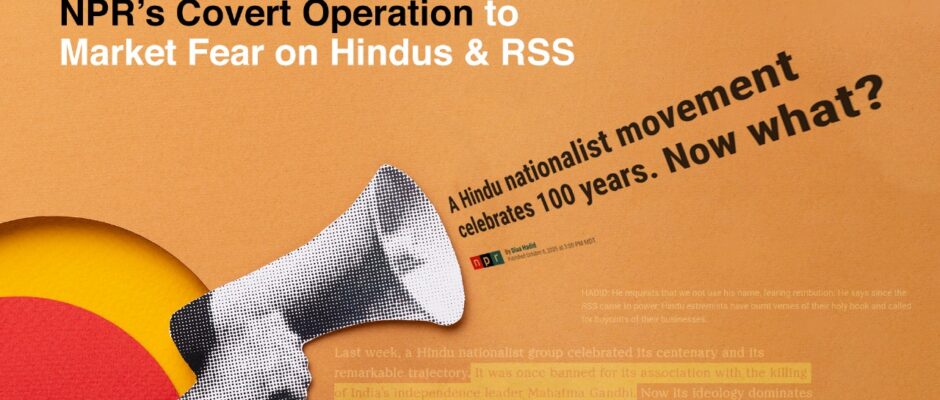
Dr Aniket Pingley / Nagpur Were someone to write a handbook on “Pandering to Prejudice while Pretending to Report,” they need look no further than Diaa Hadid’s National Public Radio (NPR) write-up and radio broadcast RSS. Hadid hides lack of diligence behind familiar imagery and attempts to flatter an audience expectation instead of testing them. Hollywood often turns social problems into entertainment. Crime, addiction and family breakdown appear again and again in films. These stories do not describe society as it is; they present a pattern that audiences already know. By recycling them, filmmakers sell a sense of realism itself. Sociologists have called this commodification of stereotypes where social anxieties are turned into products that people can consume. Hadid’s radio report for NPR titled “A Hindu nationalist movement celebrates 100 years. Now what?” follows the very pattern? The report attempts to present Bharat through a ready-made frame of danger and division. The listeners / readers are not invited to learn something new; they are prodded to recognize something familiar, a martial or fascist Hindu organisation, fearful Muslims and a society leaning toward intolerance. This works well for Western audience who have been mentally “incepted” for years by shoddy journalism to consume such stories as both alarm and entertainment. It becomes a reaffirmation that their liberal conscience remains intact. I have lived in the USA for more than a decade. I have listened to NPR on radio for years during my daily commute. Over time, I came to notice a pattern in its coverage of India. Their tone is rarely one of inquiry or balance; it is one of quiet moral certainty. Their general method is not to argue openly but to evoke unease through association, mood and selective recall. It is in this sense that Diaa Hadid’s report on the centenary of RSS fits perfectly within NPR’s broader narrative framework. I will expose anatomy of NPR’s covert style of building narrative. To this end, I will first explain the covert devices used by Hadid. Covert Devices Hadid’s piece works through three main covert devices: visual cues, selective use of authority and affective storytelling. a. Visual cues The report opens with the image of “more than 1,000 men in khaki pants, white shirts, black hats marched in step, bamboo canes at the ready.” This picture establishes the mood before any facts are given. The imagery evokes paramilitary spectacle; audience’s imagination supplies menace before any argument begins. It does not explain what the event represents; it signals threat. Once this image is fixed, every later detail reinforces it. b. Selective authority Hadid then attempts to construct credibility through Sangh baiters like Nilanjan Mukhopadhyay and Saba Naqvi. Their observations are not contextualised; the audience is not told that these voices represent one interpretive tradition among many. Their audio bytes are cherry-picked to deliver a uniform message: Hindu nationalism feeds resentment, controls institutions and endangers pluralism. This is nothing more than an echo-chamber. c. Affective storytelling A later section features an unnamed Muslim activist who “fears retribution.” No evidence or data is offered to support how widespread this fear is. The emotion itself is projected as the proof. The audience does not have to ask for data or context; feeling replaces verification. In short, where evidence should appear, emotion takes its place. Symbols and Stigma Reference to the film, The Kerala Story, is most telling rhetorical move. The film bears no institutional connection to RSS and belongs to the domain of popular cinema. Its presence in the report functions as symbolic contagion, i.e., by mentioning the movie immediately after discussing RSS “influence on Bollywood,” Hadid fuses disparate cultural artefacts into a single moral field. The RSS thus becomes responsible not only for political developments but also for cinematic representations of Muslims. For a Western audience already primed to associate “Hindu nationalism” with intolerance, such conflation produces instant engagement. To amplify stigma about RSS, Hadid retrieves the prevalent elements of Western archive on the RSS – (1) Mahatma Gandhi’s assassination and (2) Ram Janmabhoomi movement. There is no acknowledgment that RSS was exonerated after Gandhi’s death or that it operates legally within India’s constitutional framework, or that Ram temple was built via Supreme Court judgment after a long, patient waiting by the entire nation. Hadid repeats familiar falsehood that “Godse was once a follower of the RSS. Godse’s family insists he never left,” ignoring Godse’s own courtroom statement that he had left the RSS to join the Hindu Mahasabha. But then, fact-checking has never been a priority for those committed to manufacturing history and Hadid is neither the first nor the last to do so. Here, each reference functions to deliberately misguide or act as a cue that re-connects today’s audience to an existing moral verdict. The long and the short of it The anatomy of NPR’s false narrative building has the following parts: Exposing the institutional motive of NPR Hadid’s report exemplifies an institutional pattern within Western public media: to convert complex national phenomena into moral parables for liberal consumption. RSS becomes a semiotic device, a shorthand for all that is wrong with contemporary India. In this symbolic economy, factual depth is secondary to recognizability. Diaa Hadid’s NPR piece about RSS centenary does not break new ground. It follows Hollywood model of selling familiar anxieties. This is not an individual failure of journalism but a sign of how certain institutions continue to operate. They produce stories that confirm a shared moral outlook rather than test it. The result is not better understanding of Bharat or RSS, but another example of how complex realities can be reduced to simple and marketable fears. P.S. As for “Now what?” from the title — perhaps, now, some real journalism 😊 (Author is an accomplished computer scientist, educator, and holds expertise in media content strategy)

Read More

RSS at a Glance

Introducing “RSS at a Glance” a crisp infographic-ready snapshot of the Rashtriya Swayamsevak Sangh’s scale and momentum. It captures headline metrics you can cite at a glance: volunteers (swayamsevaks), daily shakhas, annual seva projects, educational initiatives and schools, disaster-relief deployments. A numerical backbone behind a century of volunteerism and nation-building.

Read More

An introduction to Rashtriya Swayamsevak Sangh (RSS)

As the Rashtriya Swayamsevak Sangh (RSS) enters its centennial year, we present “An introduction to Rashtriya Swayamsevak Sangh (RSS)” a primer on RSS’s origins, ethos, and impact. From daily shakhas and disciplined selfless volunteerism to nationwide seva initiatives in education, social harmony, environment, and disaster relief, this primer shows how character-building and community leadership translate into nation-building. Explore the milestones, the organisational cadence, and the living culture that has impacted social life across Bharat for a hundred years and continues to do so with purpose.

Read More
Sangh@100 with People’s Support

Sangh@100 with People’s Support

Dattatreya Hosabale The work of the Rashtriya Swayamsevak Sangh has now completed one hundred years. In this long journey, countless people have been companions, contributors, and well-wishers. This journey was full of hard work and challenges, but the unwavering support of ordinary citizens turned it into a fulfilling one. As we pause in the centenary year and look back, memories of many such moments and people come alive—those who devoted their everything to ensure the success of this mission. In the early years, young karyakartas set forth across the country like dedicated warriors, driven entirely by their love for the nation. Family man like Appaji Joshi or full-time pracharaks such as Dadarav Parmarth, Balasaheb and Bhaurao Deoras brothers, Yadavrao Joshi, Eknath Ranade—all of them, under the guidance of Dr. Hedgewar, took Sangh work as a sacred vow of lifelong service to the nation. The progress of the Sangh has always rested on society’s constant support. Because its work remained in tune with the spirit of the people, acceptance grew steadily over time. Once, Swami Vivekananda was asked during his foreign travels: “Most of your countrymen are uneducated, they don’t even know English, so how will they understand these profound things you talk about?” Swamiji had replied, “Just as ants do not need to learn English to find sugar, my people do not need foreign tongues to recognise a noble and spiritual cause. Their inner wisdom will guide them.” This statement turned out to be remarkably true. Similarly, despite the slow pace, society at large has continuously recognised and supported the Sangh’s sincere efforts. From the very beginning, Sangh Karyakartas received blessings, shelter, and encouragement from ordinary families. In fact, the households of swayamsevaks themselves became the foundational centres of the work. The contribution of mothers and sisters has been critical in giving completeness to this journey. Inspired figures like Dattopant Thengadi, Yashwantrao Kelkar, Balasaheb Deshpande, Eknath Ranade, Deendayal Upadhyaya, and Dadasaheb Apte drew strength from the Sangh and went on to build several organisations in different walks of social life. Today these organisations, with immense growth, have brought about constructive changes across many fields. Among women too, towering personalities like  Mausiji Kelkar and Pramila Tai Medhe, through the Rashtriya Sevika Samiti, have offered a motherly strength that has been central to this mission. Over the decades, the Sangh has raised several issues of national importance, always with society standing in support. At times even those publicly opposed have lent their voices for the larger Hindu cause. The Sangh consistently sought consensus and cooperation on matters of Hindu unity, national security, social harmony, democracy, and preservation of culture. Thousands of Swayamsevaks endured unimaginable hardships, and many laid down their lives. Through all this, society’s hand of support was always there. In 1981, when a few Hindus in Meenakshipuram, Tamil Nadu, were converted under misleading circumstances, a massive Hindu awakening movement followed. A conference attended by nearly half a million people was presided over by Dr. Karan Singh, then a senior Congress leader. In 1964, the Vishwa Hindu Parishad was founded with the active participation of renowned spiritual leaders like Swami Chinmayananda, Master Tara Singh, Jain muni Sushil Kumar, Buddhist bhikshu Kushok Bakula, and Namdhari Sikh Guru Jagjit Singh.  The initiative was inspired by Shri Guruji Golwalkar, with the purpose of reaffirming that untouchability had no place in Hindu scriptures. To uphold this principle a grand  World Hindu Conference was conveyed in Udupi where revered spiritual leaders, saints and mahants came together extending their blessings and support. The spirit voiced earlier at the Prayagraj conference—that Na Hindu patito bhavet (No Hindu can ever fall from grace) was echoed at this conference as Hindavah Sodara Sarve (All Hindus are brothers, children of Bharat Mata.)  From the campaign for cow protection, to the Ram Janmabhoomi movement, Sant-samaj (saintly fraternity) has always given blessings to the Sangh swayamsevaks. After Independence, when political reasons led to a ban on the Sangh’s activities, it was not only ordinary people but also highly respected figures who openly stood by it, giving courage in those difficult times. The same was experienced during the Emergency. That is why, despite so many obstacles, Sangh work has continued seamlessly and steadily. Through crises, it has often been the mothers and sisters who shouldered the responsibility of keeping Swayamsevaks and their work intact, becoming a constant source of inspiration. Looking ahead, in this centenary year, Sangh Swayamsevaks will make a special effort to reach every household—across big cities, remote villages, and among all sections of society—to invite wider cooperation and participation in the mission of national service. With the coordinated effort of all well-meaning forces of society, the next stage of our nation’s journey—towards holistic development—will certainly be smoother and more successful. (The writer is the Sarkaryavah of the Rashtriya Swayamsevak Sangh)Sangh@100 with People’s Support

Read More
Intellectual Laziness or Toolkit Operation!

Intellectual Laziness or Toolkit Operation!

The Economist’ stands exposed in its agenda driven write up on RSS, world’s largest voluntaristic Hindu centric movement. Dr Aniket Pingley The Economist, in its edition dated September 11, 2025, has published a leader write up on Rashtriya Swayamsevak Sangh (RSS), also known as Sangh. It postures as serious analysis. In reality, it is a flimsy collage of clichés, innuendo and context-stripped assertions. The author has not studied RSS; he or she has merely parroted decades-old propaganda, hoping that repetition will substitute for rigour. This is not journalism; it is intellectual laziness with an agenda. I have been trained in rigorous research within scientific disciplines which means I test every claim against data, logic, intention and approach. Unlike the author, I will not shoot and scoot with unverified slogans. I will hold up each statement, examine it under evidence and reasoning and expose whether it stands or collapses. Let’s begin. The overarching theme of this article is this – a mere lazy recycling of tropes. The author serves up familiar accusations as though they were fresh insight. In truth, it is the same stale dish of “paramilitary,” “fascist,” “second-class citizens,” and “paranoia” — merely reheated and presented as new. These labels have been thrown at the Sangh for past several decades, none have stood the test of law or fact and yet they are recycled here again. Instead of examining how RSS sustains 83,000 shakhas or runs 150,000 service projects (as stated by the author), the author prefers easier route of re-serving leftovers from decades past. Before we move ahead, let me unmask toolkit used by the author, like most other authors who are critical of the Sangh. The author uses eleven manipulative devices: This toolkit is not one of scholarship but one of manipulation. Let us now examine how this blunted toolkit is used to criticize the Sangh. For ease of reading, I have used a table for presentation. The list is not exhaustive; however, it should serve the purpose. Criticism in Article Toolkit Trick Used Facts Queries RSS wants Hindu-first India, minorities as second-class Stereotype recycling + loaded language Minorities hold top constitutional offices; Muslims vote, run businesses, thrive in arts and sport. Socio-economic progression of Muslims is an undeniable fact If minorities are “second-class,” by what metric? Where is the data? RSS ideology violates secular constitution One-dimensional framing RSS never sought a theocracy; it speaks of cultural nationalism. BJP once endorsed “positive secularism.” If RSS violated the Constitution, why has no court ever said so in 100 years? RSS has paramilitary/fascist roots Guilt by association + stereotype recycling No armed wing, no dictator, no fascist-style state control. Built around shakhas, service, volunteerism. If early rhetoric mattered, why is there no continuity of fascist traits today? RSS was banned thrice Cherry-picking 1948 ban lifted after courts did not find RSS’s role in Mahatma Gandhi’s assassination; 1975 was outright Emergency suppression; 1992 ban struck down by court. If truly dangerous, why revoke every ban? Why not ban permanently? Muslims as second-class Shoot-and-scoot Muslims enjoy constitutional equality, socio-economic welfare schemes, political representation at every level. What does “second-class” mean? Denied vote? Barred from office? Where is evidence? Babri demolition / Ayodhya Innuendo CBI court acquitted all accused; temple built via Supreme Court judgment after a long, patient waiting by the entire nation. Why omit the court verdict? Why keep innuendo alive after acquittal? Why omit that the nation celebrated the construction of the temple on a grand scale. RSS paranoia/obsession Loaded language 150,000+ service projects in education, health, relief; 83,000+ daily shakhas build discipline. Is this paranoia? Is community service equal to obsession? Where’s the proof? Authoritarian discipline = fascism Trope recycling RSS decisions by consensus; organizations inspired have disagreed on issues publicly. If authoritarian, why do these organisations openly disagree with BJP policies? Hindutva dominates all politics Fear projection + alarmism Opposition still governs major states; BJP loses elections; multiple visions compete. If Hindutva dominates, why do opposition parties win a significant chunk of votes across all states? I would like to highlight the author’s intellectual laziness furthermore by unmasking baselessness of his statements. Here are a few: Quote 1: “Senior members have distanced themselves from some of their predecessors’ rhetoric (not least the stuff about fascists).” Quote 2: “Earlier this year, Mr Bhagwat backed a popular call for India to carry out a caste census, even though the RSS… had long opposed this.” Quote 3: “The RSS is fuelled both by confidence and paranoia.” Each of these quotes, when stripped of their toolkit tricks, collapses into hollow rhetoric. Let me now educate the author about the Sangh. Unlike caricature offered, RSS is a cultural, civilizational project of institution-building and service. Here are some of its pillars that enabled 100-year long, thriving journey: This is the picture any serious analyst must confront. The Economist’s author chose instead to erase it entirely. One wonders as to why The Economist allows such a piece under its banner. Where was the editorial rigour? Why publish an article that recycles tropes, omits essential context and reduces complex realities to slogans? If these are the standards set for its writers by ‘The Economist’, the world’s largest volunteer organisation, then, RSS does not diminish. It is The Economist’s credibility. RSS has survived hostilities, slander and decades of unwarranted criticism done with an agenda. It continues to grow as it is rooted in Bharatiya society and not on borrowed clichés. The Economist’s article does not analyse the RSS. It exposes the intellectual bankruptcy of its editorial board and brings to closer scrutiny its rigour for writing. (Author is an accomplished computer scientist, educator, and holds expertise in media content strategy)

Read More
Without Enmity, Let’s Work for Welfare of All

Without Enmity, Let’s Work for Welfare of All

Taking inspiration from Bhagwan Ram, let’s pursue path of harmony, unity, progress and peace; reconstruction of Bharat and entire world. Dr Mohan Bhagwat The history of our Bharat is one of continuous struggle against invaders for around last one and a half thousand years. The aim of early invasions was to plunder and sometimes (like Alexander’s invasion) was for colonisation. But, attacks from West in the name of Islam only brought complete destruction and alienation of the society. To demoralise the nation, society, it was necessary to destroy their religious places, hence foreign invaders destroyed temples in India. They did this not once but multiple times. Their aim was to demoralise Bharatiya society so that they could rule over Bharat unhindered with a weakened society. The demolition of Shri Ram temple in Ayodhya was also done with same intention and for same purpose. This policy of invaders was not limited to just Ayodhya or any one temple, but was a war strategy for the entire world. Indian rulers never attacked anyone, but invaders of the world have done such misdeeds by being aggressive for expansion of their kingdom. But in Bharat, it did not have the desired results, not at least as per their expectations. On the contrary, in Bharat, the faith, commitment and morale of the society never diminished, the society did not bow down, their struggle of resistance continued. Therefore, repeated attempts were made to take control of Shri Ram’s birthplace and build a temple there. There were many wars, struggles and sacrifices for him. And, the issue of Ram Janmabhoomi ingrained in the minds of Hindus. In 1857, when war plans started being made against the foreign i.e. British rule, Hindus and Muslims together expressed their readiness to fight against them and then there was a mutual exchange of ideas between them. And, at that time, a situation evolved where there would be a reconciliation on issue of banning cow slaughter and liberation of Shri Ram Janmabhoomi . Bahadur Shah Zafar also guaranteed a ban on cow slaughter. As a result, entire society fought together. Bharatiya people showed bravery in that war but unfortunately this war of Independence failed. Then, Bharat did not get independence, British rule remained uninterrupted, but the struggle for Ram Temple did not stop. According to British policy of “Divide and Rule” towards Hindu-Muslims which was already in practice, gained even more prominence after 1857. To break the unity, British hanged the heroes of the struggle in Ayodhya and question of liberation of Ram Janmabhoomi remained unresolved. The struggle for Ram temple continued. After Independence in 1947, when Somnath temple was unanimously renovated, the discussion about such temples started. Similar consensus could have been considered regarding liberation of Ram Janmabhoomi, but the direction of politics changed. The selfish forms of politics such as discrimination and appeasement became prevalent and hence the question remained as it is. On this issue, governments did not even consider the wishes and sentiments of Hindu society. On the contrary, they tried to destroy initiative taken by the society. The legal battle related to this, which had been going on since pre-independence, continuously carried on. The mass movement for the liberation of Ram Janmabhoomi began in the 1980s and continued for thirty years. In 1949, the Murty of Bhagwan Shri Ramchandra appeared at the Ram Janmabhoomi. In 1986, the mandir was unlocked as per court order. In the coming period, the continuous struggle of Hindu society continued through many campaigns and kar seva. In 2010, a clear judgement of Allahabad High Court clearly came before the society. The efforts had to be sustained for final resolution of the issue at the earliest. On November 9, 2019, after 134 years of legal struggle, the Supreme Court gave a balanced decision after examining the truth and facts. The feelings and facts of both parties were also considered in this decision. This decision has been given after hearing the arguments of all parties in the court. According to this decision, a board of trustees was constituted for constructing the temple. Bhoomi pujan of the temple took place on August 5, 2020 and now, Paush Shukla Dwadashi Yugabd 5125, accordingly on January 22, 2024, installation and Pran Pratishtha ceremony of the Murty of Shri Ramlala has been organised. From Dharmic point of view, Shri Ram is the most worshipped deity of majority society and the life of Shri Ramchandra is still accepted as an ideal code of conduct by entire society. Hence, now the conflict that has arisen as for and against over the dispute should be ended. The bitterness that has arisen in the meantime should also end. Enlightened people of the society must see that the dispute ends completely. Ayodhya means a city ‘where there is no war ‘, ‘a place free from conflict’. On this occasion, in the entire country, reconstruction of Ayodhya in our mind is the need of the hour and also the duty of all of us. The occasion of construction of Shri Ram mandir in Ayodhya marks reawakening of national pride. This also signifies acceptance of the vision of life behind the character of Shri Ram by modern Bharatiya society. Lord Shri Ram is to be worshiped in the temple with rituals of ‘Patram, Pushpam, Phalam, Toyam’ (leaves, flowers, fruits and water) and at the same time, by establishing image of Shri Ram in our minds, in the light of the same inculcating ideal conduct, we have to worship Shri Ram. As “Shivo Bhootva Shivam Bhajet, Ramo Bhootva Ramam Bhajet” (to worship Shiva, Be Shiva, to worship Ram, be Ram) is called true worship. If we consider from this point of view, then according to the social nature of Bharatiya culture, we need to imbibe “Matravat Pardareshu , Pardravyeshu Loshtvat. Atmavat sarvabhuteshu , yah pasyati sah panditah” (He is a wise man who sees the wives of others as his mother, the wealth of others like clod of earth and all beings as his own

Read More
Trouble with ‘The Economist’

Trouble with ‘The Economist’

Write-up on RSS is steeped in distortions, prejudices, agenda driven narrative push rather than nuanced analysis that stands scrutiny. On December 19, 2024, as festive season approached, The Economist released its holiday double issue, featuring an unnamed article on Rashtriya Swayamsevak Sangh (RSS). The publication, owned by immensely wealthy Agnelli and Rothschild families, traces its origins to 1843, when it was founded to advocate for repeal of import tariffs. Yet, in its long history, The Economist has strayed little from its original mission of pushing selective agendas cloaked in garb of intellectual rigour. Over the years, it has subtly perfected the art of propaganda, blending curated narratives with psychological imprinting to advance the interests of its elite patrons. This Christmas edition is no exception. Beneath the veneer of incisive commentary lies a carefully orchestrated exercise in bias—shaping perceptions to align with the ruling class worldview that The Economist so loyally upholds. Whether degrading communities or offering justifications for wars, the magazine has long operated as a conduit for dangerous and radical global agendas. In this latest offering, the publication’s signature word crafting meets its predictable penchant for soft-pedaling propaganda, leaving readers with a polished but shallow narrative that serves its masters across oceans, rather than the truth it claims to champion. In its article titled “Inside the RSS: The World’s Most Powerful Group,” The Economist employs its arsenal of rhetoric to perpetuate a troubling narrative against what it perceives as a significant ideological opposition to its wealthy western ruling elite. The elite, seemingly vested in a global order conducive to its own interests, appears to view Rashtriya Swayamsevak Sangh (RSS) as a formidable challenge. The article alleges that RSS is a paramilitary organization culpable for persecution of India’s post-partition minorities —a claim that rests on foundation of conjecture rather than tangible evidence. In reality, Bharat boasts a thriving minority landscape, some of the world’s most robust legal protections and welfare schemes for minorities, unparalleled in their scope and inclusivity. At a time when Western corporations and elite amass fortunes from wars that devastate nations across the globe, Bharat’s ethos has consistently championed inclusivity, cultural oneness and wellness. The worldview embodied by the RSS—an organization that represents the world’s largest voluntary movement—is deeply rooted in this ancient Indian philosophy. Far from the aggression suggested by The Economist, the RSS reflects a commitment to harmony and resilience, offering a counterpoint to exploitative frameworks perpetuated by those who profit from division and conflict. By choosing to distort rather than understand this ethos, The Economist exhibits its own inability—or unwillingness—to engage with perspectives that challenge the interests of its benefactors. More so, in relentless pursuit of narrative control, The Economist once again attempts to link Nathuram Godse, the assassin of Mahatma Gandhi, to the RSS, describing him as an “ex-member” of the organization. This is a jaded agenda-based narrative that has had exposed RSS rivals. This very fixation not only underscores the publication’s penchant for propaganda but reveals a troubling reliance on conspiracy theories when they align with its agenda. Interestingly, The Economist spares no effort in crafting curated narratives about others while maintaining a conspicuous silence on controversies closer to its own sphere of influence. The Rothschilds, for instance—a family whose immense wealth and influence have been the subject of countless theories, from the Kennedy assassination to the Islamic State—remain untouched by the magazine’s purported investigative zeal. Similarly, the rumoured role of US government in assassination of Martin Luther King Jr. is conspicuously absent from its pages, despite widespread historic scrutiny. This selective focus speaks volumes about the publication’s biases and priorities. For those who can discern fact from fiction, The Economist’s approach serves as a reminder to distinguish credible media from outlets that prioritize agenda driven narratives over professional reportage. By choosing to amplify baseless charges against the RSS while ignoring deeper, systemic issues tied to its elite patrons, The Economist exposes its own limitations as a serious journalistic institution – which it tries to project itself. Ironically, The Economist expects its readers to believe that the RSS draws inspiration from Hitler’s Nazi Germany—a claim that is as baseless as it is sensational. The narrative point that lost its shelf life in last couple of decades, undoubtedly was reborn in champagne circles and elite echo chambers and it fails to hold up against the reality experienced by millions across India. From the youngest child to the eldest member of society, anyone who has encountered RSS firsthand can unequivocally attest to its true source of inspiration: the sacred Vedas, Upanishads and Sanatan Dharmic philosophy and outlook to Hindu way of life. Far from the twisted historical parallels The Economist seeks to draw, RSS is deeply rooted in timeless principles of Indian philosophy, centered on harmony, inclusivity, and selfless service. Such erroneous narratives find little resonance with the Indian population, who recognize them for what they are—attempts to vilify through misinformation. Instead, they gain traction in controlled settings where carefully curated echo chambers are created, often with backing of media outfits like The Economist. By perpetuating these flawed depictions, the magazine reveals not just its bias, but also its disconnect from ethos of a nation it claims to critique. In its relentless campaign against Bharat’s leadership, The Economist perpetuates baseless accusation that Prime Minister Narendra Modi bears responsibility for unfortunate Gujarat riots of 2002. This charge, however, crumbles under scrutiny, exposing not only its absurdity but also the Hinduphobic bias that underpins such narratives. What The Economist conveniently omits—and what must be highlighted—is the inhumane and brutal burning alive of 59 Hindu kar sevaks (volunteers) aboard Sabarmati Express at Godhra. This act of terror, meticulously planned and coordinated by Islamist extremists, sparked the violence that followed. Among those convicted for orchestrating this atrocity were Maulvi Umarji, Farooq Bhana and Imran Sheru—a stark reminder of premeditated nature of the attack. Yet, this foundational context finds no mention in The Economist’s coverage, which prefers to portray Hindus as aggressors while absolving the instigators of their

Read More
RSS and Spirit of Volunteerism

RSS and Spirit of Volunteerism

Sangh volunteers’ service projects have stumped the global communities & offer a unique template to serve humanity. Introduction Millions of selfless volunteers or Swayamsevaks working round the clock in Bharat and outside form flesh and blood of Rashtriya Swayamsevak Sangh (RSS), the largest Hindu-centric organization. Swayamsevak or volunteers driven movement run by RSS is easily bracketed as the biggest for social up-lift of vulnerable individuals, socially and economically deprived families and ensure ‘inclusive’ development and progress of Bharat.

Read More