CIHS – Centre for Integrated and Holistic Studies

Date/Time:

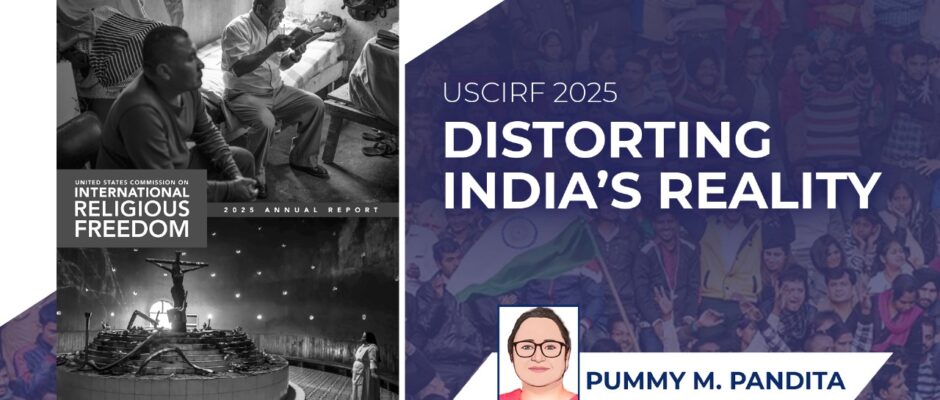
USCIRF 2025 - Distorting India’s Reality

USCIRF 2025: Distorting India’s Reality

The USCIRF time and again spins a one-sided tale cherry-picking facts, sidelining India’s constitutional pluralism, and pushing a loaded narrative that fits their playbook more than ground realities. Pummy M. Pandita The U.S. Commission on International Religious Freedom’s (USCIRF) 2025 India report has once again revealed the commission’s fundamentally flawed methodology, dependence on biased data sources & selection, lack of transparency in evaluating religious freedom, and a one-sided narrative that misrepresents India’s thriving democracy and plural society. By selectively choosing incidents, depending on questionable sources, and willfully avoiding India’s constitutional framework, USCIRF has created a report that is neither objective nor credible. In selectively pointing out incidents in a vacuum and ignoring the broader framework of India’s constitutional protections for all religions, USCIRF goes against its own credibility. Not only does this report misrepresent the situation on the ground, but it also unfairly defames a nation that enshrines the rights of all its citizens. USCIRF has repeatedly refused to provide its sources of data in a manner that meets rigorous journalistic or academic transparency standards. Much of the incidents quoted in the report rely on politically driven NGOs,  lobby groups, and reports from organisations that have a recorded history of ideological bias against India. Reports tend to be based on media reports instead of official government statistics, police records, or independent judicial evaluations. This selective information distorts the actual picture of religious freedom in India. Most of these sources have already been identified as previously misreporting or manipulating facts to fit a specific agenda. The lack of primary research, government interaction, or varied local opinions in the report questions its credibility. India is targeted for scrutiny, yet the USCIRF overlooks or disparages such incidents or worse in other democracies, showing a distinct double standard. The report ignores the emergence of religious extremism among some minority communities, such as instances where religious radicalization put national security at risk or affected communal harmony. It disregards the constitutional protection afforded to minorities in countries like India’s strong judicial protections, affirmative action measures, and full participation of minorities in public life. USCIRF selectively reports on local incidents without context, repeatedly leaving out legal proceedings, counter-reports, and government action taken to respond to grievances. USCIRF consistently misinterprets India’s legal structure, labeling good governance actions like anti-conversion laws and policies regarding citizenship as discriminatory, although they are founded on constitutional provisions. The report also underplays violent extremism, secessionist forces, and foreign interference in Indian internal affairs, selectively labeling state reactions as “persecution” without drawing attention to threats to national security. USCIRF’s record of going after India has followed a general geopolitics design wherein reports have been used to lever diplomatic engagements. The USCIRF has specifically targeted the Citizenship (Amendment) Act 2019 (“2019 CAA”) passed by the Indian Parliament in 2019 and its continued criticism since then reveals an inaccurate understanding of the genesis of the law and the disrespect towards sovereign Indian democratic institutions. CAA is designed to offer refuge to persecuted religious minorities—Hindus, Sikhs, Buddhists, Jains, Parsis, and Christians—from neighboring Islamic states like Pakistan, Afghanistan, and Bangladesh. These minorities have long faced systemic oppression in their home countries. CAA does not affect Indian Muslims, who are in no way disadvantaged by the law. Yet USCIRF frames it as a discriminatory tool, conveniently ignoring that it aims to address religious persecution in neighboring Islamic nations. For good order sake, United States too has a similar Citizenship Act in the form of the Lautenberg Amendment, led by US Senator Frank Lautenberg in 1989-90, which facilitates citizenship to recognized persecuted religious minorities in the former Soviet Union. Iran was added subsequently through the Specter Amendment, that provided refugee status and ultimately citizenship to a group of minorities from three nations.  Why is USCIRF silent on that and not condemned this act also? The commission has also been accused of disproportionately targeting on some nations and ignoring serious religious freedom abuses in many other nations, which puts its motives and geopolitical agendas in question. Its inability to speak out against growing cases of persecution of Hindus, Sikhs, Buddhists, and other minority groups in the neighboring countries where blasphemy laws and institutional discrimination are prevalent. This inconsistency erodes the credibility of the USCIRF and raises questions about whether its reports are motivated by facts or political goals. Suggesting India as a Country of Particular Concern (CPC) is not only factually wrong but also smells of a conscious effort to mislead about India’s religious scenario. India is still one of the most religiously plural and diverse countries, where individuals from all religions are involved in government, business, and public life. However, USCIRF’s failure to recognize this diversity and continued legal protections for religious communities reveals its biased agenda. The report also criticises India’s anti-conversion laws, which are in place to prevent coerced religious conversions, often under the guise of marriage or social coercion. These laws, intended to protect vulnerable individuals from exploitation, have become a focal point of controversy. USCIRF dismisses this as Hindu nationalist propaganda, sidestepping the genuine concerns that prompted these laws. By recommending punitive measures like sanctions and diplomatic pressure against India, USCIRF has gone beyond its mandate and attempts to intrude into the sovereign decisions of a democratic country. These suggestions are not only counterproductive but also demonstrate a basic misunderstanding of India’s democracy and devotion to pluralism. USCIRF Report 2025 is an extremely defective, ideologically charged document that fails objective scrutiny. Its selective ire, methodological shortcomings, and transparency deficiencies make it unsuitable for serious policy discussion. It is an instrument of geopolitical politics, not an objective evaluation of religious freedom. India’s commitment to religious freedom is classified in its Constitution and defended by its democratic institutions. It is essential that any honest evaluation of India is provided based on verifiable data, integrated analysis, and a recognition of India’s pluralistic fabric USCIRF 2025: Distorting India’s Realitysomething the USCIRF report utterly fails to accomplish. USCIRF’s biased reports are not an isolated phenomenon. They fit into a larger pattern

Read More

Biden’s Summit for Democracy and Human Rights around the World

Prachi Mishra / New Delhi The United States of America under the leadership of President Biden launched the first Summit for Democracy, held virtually on 9th and 10th of December 2021. This Summit lays the foundation for deliberation and discussion on the preservation of democracy and human rights in the coming decade. A week before the Summit, the Communist Party of China (CPC) and the People’s Republic of China (PRC) released a paper on total democracy under one party rule as a strong assertion to the Summit. In a white paper released by the CPC, titled, “China: Democracy That Works”, China stated that it is the ‘largest democracy’ in the world. This is the first time that both the PRC and the CPC have claimed that China’s governance structures and policies run on democratic principles. U.S. President Joe Biden’s Summit and CPC’s white paper provide a fitting context to this analysis on human rights in various forms of governance systems around the world.   In the last few years, there have been unprecedented challenges that have plagued most democracies. Be it the widening digital divide or the issue of gender-based crime, the nature of socio-economic challenges seemed to have weakened the democratic systems around the world. Similarly, over the course of the last decade, human rights violations around the world have also increased manifold. Non-democratic regimes, like China and Qatar, witness growing number of such cases but owing to their system of governance and media reportage, human rights violations in these countries are underreported or not reported at all. In this context, there is a pressing need to strengthen democratic systems and ensure that violation of people’s basic rights is addressed. In this brief, we draw a comparative analysis of human rights violations in different forms of governance systems. We present – Communist regimes, with a focus on China Theocratic regimes, with a focus on Pakistan Absolute monarchies, with a focus on Qatar Democracies, with a focus on India; and Totalitarian regimes, with a focus on North Korea The analysis is based on several indicators, viz., the nature of rights that are most often violated in a regime. These include women’s rights, rights to freedom of religion, children’s rights, freedom of expression and privacy, minority rights inter alia. Be it the suppression of Uyghur Muslims in China or the unlawful persecution of religious minorities in Pakistan’s Gilgit-Baltistan or the inequality faced by women in Qatar, human rights are violated in each of these regimes but are sparsely covered in the media. In totalitarian regimes, like North Korea, violations are seldom reported, and data is unavailable for most of these indicators. In a functioning democracy, reasonably India, where the four pillars of democracy work independent of each other, human rights violations are duly reported, and the judiciary has been playing a crucial role in providing justice to the aggrieved. The independence of media has led to greater reportage of violations which is often misconceived as failure of democratic systems. This calls for a balanced view of all governance systems and how reporting of violations are suppressed in many of them. Based on the interventions provided during the Summit, this brief lays down a few recommendations on upholding the human rights in democratic systems. Violations based on the nature of governance system Qatar Qatar’s political system is a de facto absolute monarchy, with the Emir of Qatar serving as the country’s head of state and administration. Qatari legislation is primarily based on Sharia law. According to the 2003 Qatari constitutional referendum, it was decided that the state of Qatar will be a constitutional monarchy with an elected legislature, yet elections were repeatedly postponed since 2013. Finally, in November 2020, Emir Tamim bin Hamad Al Thani announced that the elections will take place in October 2021. Following an announcement by the Emir of Qatar on August 22, 2021, general elections were held for the first time on October 2, 2021. Men and women over the age of 18 years were eligible to vote for thirty (30) of the fourty-five (45) seats in the Consultative Assembly, with the remaining fifteen (15) selected by the Emir. The thirty 30 seats were contested by two hundred eighty-four (284) individuals, including 29 women aspiring leaders. All candidates ran as independents as political parties are prohibited by constitution. No female candidates were elected and according to various non-governmental organisations, thousands of Qataris were denied the right to vote. Thereby, casting shadows on the Qatari constitutional monarchy claims. Freedom of Expression Qatar’s hereditary emir is in charge of all executive and legislative powers, as well as the judiciary. There are no political parties allowed, and while Qatari citizens are among the world’s wealthiest, the vast bulk of the population is made up of non-citizens who lack political rights, civil liberties, curtailed freedom of expression, freedom of religion and economic opportunities. In Qatar both print and broadcast media are influenced by powerful families and censored by the government. The international television network Al-Jazeera is showcased and branded to be exhibited as privately owned, however, the government is said to have compensated for its operating costs since 1996. In Qatar, all journalists practice some form of self-censorship and may risk jail time for defamation and other press violations. Access to the independent English-language website Doha News was restored in May 2020, after it had been prohibited in late 2016 due to a lack of an operating authorization. In 2017, and 2020, the outlet once more changed hands before resuming full operations. A change to the penal code in January 2020 makes spreading or publishing “fake news” punishable by up to five years in prison or a fine of 100,000 riyals ($27,500). The new ambiguously written rule that criminalises a wide variety of speech and publication activities threatens to severely curtail Qatar’s freedom of expression in Qatar. Religious Freedom Islam is the official religion in the State of Qatar. There is no constitutional protection for freedom of religion. However, the constitution

Read More