
CIHS – Centre for Integrated and Holistic Studies

Date/Time:

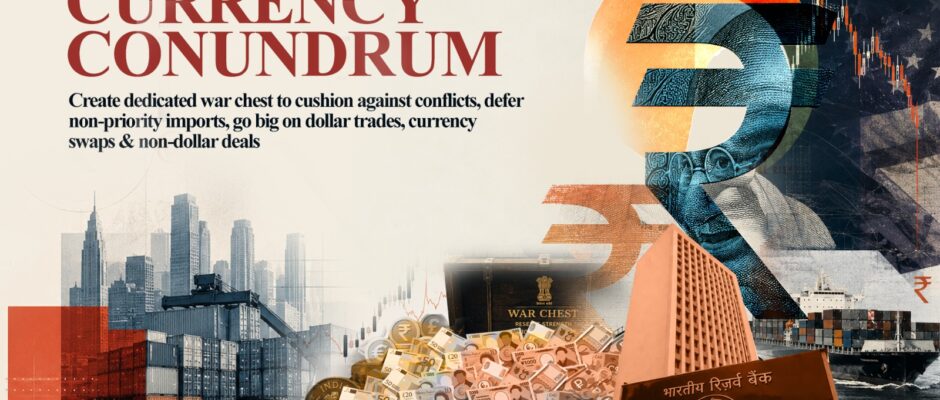
Currency Conundrum

Create dedicated war chest to cushion against conflicts, defer non-priority imports, go big on dollar trades, currency swaps & non-dollar deals. K.A.Badarinath Is Bharatiya Rupee under attack? Will conversion ratio cross the psychological barrier of Rs 100 per one US dollar? Would that mean Bharat’s economy gets more susceptible or vulnerable to external currency market churns? Or, will it be oil and war? How does one make sense of rupee valuations that fluctuate wild these days? There’s a vertical divergence in Bharat on Reserve Bank of India (RBI) strategy to stem continued slide in rupee. One big section led by sixteenth finance commission chairman Dr Arvind Panagariya argue that crossing Rs 100 mark against one US dollar should not be viewed too seriously. “It’s just a number” is what Dr Panagariya wrote in his column earlier this week pushing for free fall or depreciation of rupee. Owing to continued shortages in crude oil, forward market rate to dollar was pegged at Rs 100 a piece triggering a big debate on future of Bharatiya currency. Dr Panagariya advised RBI not to defend the rupee with its huge foreign currency reserves by intervening in markets. Oil shortages and higher inflation at retail level coupled with healthy interest rates were causing free fall of rupee that crossed 97 per dollar. There’s a significant group that recommended a more conservative approach to rupee valuation. Swadeshi Jagaran Manch, an RSS inspired organization has asked RBI not to allow rupee depreciation further and touch 100 per dollar. SJM’s argument is simple: imports for domestic industry and trading community would become expensive. Cost of products and services would move up swiftly thereby impacting consumption demand and eventually hit growth. Make in India for the world campaign with self-reliance or swadeshi as motto would be hampered if rupee depreciated beyond 100 per dollar. Further slide in rupee may not be tenable politically also given that in forward markets, US dollar is already being quoted beyond Rs 100. Soaring prices of crude oil in Bharat’s diversified energy basket also had its impact. For instance, crude oil prices surge of beyond 70 per cent during April 2025 and April 2026 is something which has seriously impacted Bharat’s energy import bill. Aggregate price of crude during the period was US $ 114.48 as against US $ 67.62 per barrel in previous year. Every dollar increase in crude oil per barrel translates to over US $ one billion in import bill for Bharat. Even an aggregate US $ 85 per barrel could put pressure on budget projections for 2026-27 given that fiscal deficit would expand, subsidy bill on fuel would spike and capital investments as well as development projects spending may have to be curtailed. This provides the logic, reasoning and rationale for Prime Minister’s call for belt tightening measures that have been rolled out over last two weeks. In this backdrop, liberalists led by likes of Dr Panagariya have opposed measures like floating dollar denominated government paper or mobilization through high cost NRI deposits in dollars to shore up the reserves. Deferring payments against currency value spikes or transferring currency gains to NRIs was not an option, they argued. Better option would be to attract long term investments, defer non-priority imports and make goods and services industry in Bharat attractive in terms of ‘ease of doing business’. During financial year ending March 2026, Bharat attracted gross foreign direct investments of US $ 95 billion. But, the net inflows which discounts investment outflows, profits repatriation, disinvestments etc and interest payments was pegged at a very modest US $ 7.7 billion. Quickly expanding net FDI inflows needs to be attempted. For starters, can we target net FDI inflows at US $ 25 billion this financial year? Secondly, currency swaps in medium to long term is an idea that bankers and policymakers cannot ignore. Leveraging volatility in the currencies market and taking positions is something that needs to be done in a calibrated way. Already, currency traders have reported that RBI booked healthy margins on sale of US dollars over last one year. Apart from swaps that spread currency risks, dollar trade is something that RBI and top Indian banks must continue to minimize the adverse impact of volatility in the markets. In last one year ending April 1, 2026, RBI sold US $ 53 billion to either defend rupee or book profits. As on date, Bharat’s foreign exchange reserves are reported at US $ 688.9 billion.  Expanding and diversifying Bharat’s foreign currency basket moving away from US green back is an option. President Donald J Trump may be averse to the idea of developing countries especially India ‘de-dollarizing’ its economy. But, settling trade deals in local currencies could be a big opportunity. Merchandise and services trade settlements in respective currencies can be considered beyond BRICS group. Deferring gold and silver imports by a year is not a bad option either. During 2025-26, gold import bill had crossed a whopping US $ 71.98 billion on 702 tonnes. A 24 per cent increase in gold import bill over 2024-25 is something that stares in the face. There’s no harm whatsoever for families to stagger out their gold and silver purchases given the big economic cost. Resetting or revisiting priority areas for foreign exchange deployment may be considered seriously. For instance, pharmaceutical sector is one big consumer of foreign exchange especially for ingredients to undertake production of end-use formulations. Here again, without restrictions, priority may be assigned to life saving drugs, those intermediates and formulations that are produced for re-export purposes. One big idea could be to create dedicated ‘war chest’ of currency reserves to tide over conflict situations. On lines of strategic oil reserves why not build conflict currency reserves? Only recently, during Prime Minister Modi’s brief stopover, an agreement was concluded to shore up strategic oil reserves by 36 million barrels. Each year, a chunk of RBI surpluses can be contributed to the war chest reserves. This is in addition to general foreign

Read More

New India’s Rupee Goes Global & Dematerialized!

Oil and gas deals, gold imports, small & medium ticket trade payments must be settled in rupees. Russia jumping on to the rupee bandwagon is a big breakthrough even as India readies to overtake Germany as third largest economy.   K.A.Badarinath Two significant developments this week have made the trajectory on Indian rupee very clear. One, Indian government’s fancy idea of taking the modest rupee global has taken wings. And, there’s definitive movement forward on digitizing the rupee after having rejected calls for legalizing private crypto currencies. Both these movements point to the ambition and forward looking policy stance of the Indian government and Reserve Bank of India if one were to gauge the implications. First things first, how does one make Indian rupee a global currency to reckon with after Chinese Yuan or Renminbi that has emerged as the fifth largest trading currency in last few years? Some baby steps seem to have been taken with regards to the rupee though naysayers think that it’s more of positioning the Indian currency by ultra-patriotic Narendra Modi government and Hindutva forces. Using Special Rupee Vostro (SRV) and bespoke accounts to expand international trade and settle export import deals on rupee terms is good beginning to internationalize the Indian currency. By-passing the dollar, euro, yuan or pound sterling denominated trades is no doubt the first step. The advantage in settling trade deals against rupee is many folds. Apart from internationalizing the rupee, Indian payment systems and gateways get popularized across trading and currency community. Secondly, volatility in global currencies that hitherto rummaged our trading community and foreign exchange traders catering to a large community of Indian students and travellers may now have limited impact once the deals are squared in rupees. Russia, a large energy and strategic partner for India, became the first large economy to open a special rupee vostro account to settle trade deals in rupees. Gazprombank of Russia has already opened a rupee denominated account with UCO Bank. Two largest banks, Sberbank and VTB Bank from Russia are also in the process of opening such accounts through their branches in Delhi. This will give a big push to non-dollar, euro or Yuan designated trade between India and Russia that’s facing issues as it has been cut off from the Swift payment system globally after its attack on Ukraine. Sri Lanka, Maldives, several South East Asian, African and Latin American countries may also follow suit given their inclination to pursue non-dollar trade deals concluded in Rupees.   Countries like Zimbabwe, Malawi, Djibouti, Ethiopia, Sudan, Madagascar, Kenya, Namibia and Bangladesh may also be willing to do rupee denominated trade deals. Current volumes and value of trade with these countries may be very insignificant. But, with big players like Russia joining the bandwagon, Indian rupee is bound to get the foothold it’s looking for in the global currency and trade markets. With over $ 800 billion merchandise trade clocked annually, there may be no reason why India should not have a say in determining payment terms. An equivalent value in services trade or more should add muscle to Indian negotiators seeking to make rupee settlements. While non-oil trade products and services deals may take a while to settle in rupees, oil and natural gas deals should be done in rupees. Given that Russia has emerged biggest supplier of oil after Iraq, Saudi Arabia, UAE and USA in that order, negotiation with Moscow on rupee denominated payment terms seems to have been concluded. Moreover, both India and Russia have long history of clinching oil deals in rupee – roubles during protracted cold war era. With Iraq, UAE and Saudi Arabia as well, there’s no limitation on India to settle oil and gas deals bypassing the US dollar or the euro. In the non-oil trade, small and medium ticket deals with a dozen countries can still be targeted.   Chinese President Xi Jingping may be more than willing to do a Yuan – rupee designated deals thereby disrupting virtual monopoly of US dollar and euro denominated deals. Given that India continued to be a big customer for China, non-dollar deals should be okay irrespective of the geo-political tensions and border disputes between the two countries. Gold imports are something that should move to rupee denominated settlements. With India being largest consumer of gold at about 1050 – 1200 tonnes annually valued at about $ 55 – 60 billion, New Delhi should begin rupee pitch on the bullion market. Gold is the second largest import item after oil and natural gas imports that range between $ 100 – 120 billion yearly. Second big development is modest rupee going digital on pilot basis that kicked off last few days beginning with Government securities. This is a definitive milestone in India’s banking history that goes beyond the British imperialist era. Rejection of cryptos as decentralized, speculative and block chain based currency in India was a difficult step but the right one. Having rejected private crypto currencies for commercial transactions, recognition as an asset and banks’ collateral, India’s foray into digital space through the rupee monitored and regulated by RBI marks a new beginning for the world’s fourth largest economy. As India prepares to surpass Germany and emerge third big economy internationally, phased roll out of e-rupee was the most desirable and sustainable option that Modi government and RBI has taken recourse to. This is in contrast with countries like Hong Kong that legalised crypto-currencies and El Salvador that set up a dedicated cryto-currency city. Central Bank Digital Currency (CBDC) or e-rupee has nothing to do or common with the private crypto-currencies. E-rupee is equivalent in value and acceptable to Indian government as much as the rupee in physical notes and coins. Even most advanced economies like US, UK and European geographies are grappling with the havoc unleashed by private crypto currencies that are speculative in values, not backed by an asset and mostly used for narcotic drug deals and laundering by terror groups internationally. It would

Read More