
CIHS – Centre for Integrated and Holistic Studies

Date/Time:

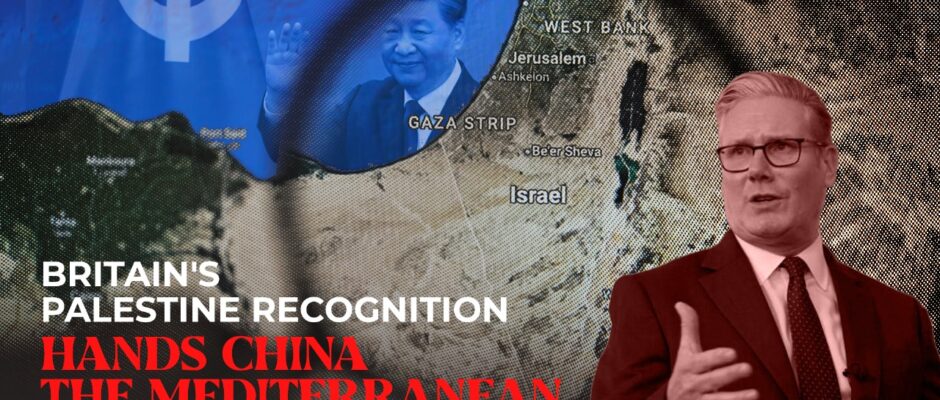
Britain's Palestine Recognition Hands China the Mediterranean

Britain’s Palestine Recognition Hands China the Mediterranean

CCP spent six decades cultivating Palestinian movements, embedding influence in Western activism and positioning itself as the indispensable power in a post-American WestAsia. Britain just made that job easier. Rahul Pawa On 21 September 2025, Prime Minister Keir Starmer broke with decades of U.K. policy formally recognising the state of Palestine. It was Britain’s most consequential West East move since the 1917 Balfour Declaration, made over explicit U.S. objections and Israeli fury. In London’s rush to show moral leadership, one reality was ignored: Beijing had spent six decades preparing for this moment. The CCP’s Palestinian project began in the 1960s. Between 1965 and 1970, Beijing sent small arms, mortars and anti-tank weapons to the Palestine Liberation Army and the Popular Front for the Liberation of Palestine. It trained cadres at the Whampoa Military Academy in Nanning and dispatched instructors to Syria and Algeria. In May 1966 Palestine Liberation Organization Chairman Ahmad al-Shuqairy thanked “Peking” for constant arms and training shipments. After the Six Day War in 1967, Israeli commanders displayed captured Chinese-made AK-47s, 81mm mortars and chemical decontamination gear seized in Gaza and Sinai. Alongside, Beijing also built a diplomatic bridge. In December 1995 it opened a foreign office in Gaza; a de facto embassy to the Palestinian Authority, decades before most Western states considered recognition. Its message to Palestinians was consistent: you can count on us when the West won’t. By Xi Jinping’s era the posture turned strategic. In 2017 the PLA opened its first overseas military base in Djibouti, a Red Sea hub housing thousands of Chinese troops. Beijing secured port stakes from Gwadar in Pakistan to Haifa in Israel, embedding itself along the arteries that supply Europe and the Gulf. A 25-year strategic agreement with Iran in 2021 locked in $400 billion in Chinese investments across oil, gas and transport corridors. CCP’s pattern is clear: first ports, then troops. Djibouti proved it, Hambantota confirmed it, Gaza may be next. Beijing has already demonstrated how commercial access becomes military power, and a recognised Palestine gives it the opening to repeat the same playbook on the Mediterranean. While Beijing built bricks abroad it built narratives at home. State-aligned Arabic media channels and TikTok streams pump out Gaza content at scale. A July 2025 Program on Extremism report mapped how the CCP’s influence runs through Western activism itself. That report details how Shanghai-based tech investor Neville Roy Singham, a onetime Huawei adviser, poured millions into U.S. and U.K. activist groups after Hamas’s October 7, 2023 attack. Groups like the People’s Forum, ANSWER Coalition and “Shut It Down for Palestine” became organising hubs for anti-Israel protests. BreakThrough News, their media arm, live-streamed marches while praising Xi Jinping Thought and Maoist revolution. Investigators concluded the effect was “to project the CCP as a defender of justice while undermining U.S. influence.” In December 2023 the People’s Forum hosted a “China75” event lauding Beijing’s governance model; by early 2024 its funding spiked from under $500,000 to $4.4 million as it expanded pro-Palestinian actions. The same network underwrote protests at Columbia University and in Whitehall, echoing CCP state rhetoric about “imperialist Zionism.” When Starmer spoke to recognise Palestine, Beijing didn’t improvise. Chinese State media instantly framed Britain’s recognition as vindication of the CCP’s “historic” support for Palestinian independence. Chinese diplomats in Ramallah pointed out they had welcomed Mahmoud Abbas to Beijing two years earlier and had pushed a ceasefire plan in 2023. They reminded Palestinian officials who had invested in them when no one else would. With London’s imprimatur, a Palestinian government now has every incentive to turn to CCP for reconstruction finance and infrastructure contracts. Beijing can bolt these onto its Belt and Road Initiative, locking in leverage over a new state at the heart of the Levant. U.S. influence, already eroded by drift and divided Congresses, will shrink further. China’s record speaks for itself. In Djibouti, commercial port access became a PLA base within three years. In Sri Lanka, Chinese loans turned into a 99-year lease at Hambantota. CCP has cultivated a pattern: ports, logistics, security co-operation and then military presence. If Palestine’s future leadership wants investment and security guarantees, CCP will deliver both. Even a small PLA signals unit or intelligence station would tilt the Eastern Mediterranean’s security balance. By presenting any facility as humanitarian or anti-piracy, Beijing can minimise Western backlash while gaining a front-row vantage on Israel, Egypt and NATO operations. Britain’s recognition may have been meant as a rebuke to Israel. However, in practice it is a strategic gift to Beijing. It signals to the Arab world that the West’s will is fractured and that China, not America, not Europe is the constant patron. It creates a diplomatic vacuum China is already moving to fill, from Gaza reconstruction bids to Palestinian security training. This is not hypothetical. Chinese firms dominated Iraq’s post-2003 oil fields; they built most of Africa’s new ports in the last decade. Palestine is a likely next. And unlike the United States or the U.K., the CCP fuses infrastructure with intelligence collection and military access as policy. Starmer’s Downing Street statement marks not the dawn of West Asia peace but a milestone in Beijing’s global ascent. The CCP spent six decades cultivating Palestinian movements, embedding influence in Western activism and positioning itself as the indispensable power in a post-American West Asia. Britain just made that job easier. (Rahul Pawa is director, research at New Delhi based think tank Centre for Integrated and Holistic Studies)

Read More

Sino-India Relations: Clashes and Dynamics

Rohan Giri The aggression by the Communist Party of China (CPC) through the People’s Liberation Army (PLA) along the Indian border has been a source of tension between India and China. The CPC’s activities encompass infrastructure development, PLA buildup, and territorial assertions. One particular area of contention in the ongoing border contentions between the China and India is the Pangong Tso glacial lake region, which stretches across eastern Ladakh and western Tibet. In the aftermath of the violent clash in the Galwan Valley in 2020, both nations have notably escalated their respective regional infrastructure development endeavours. In recent years, the CPC has actively pursued infrastructure projects along the Line of Actual Control (LAC), with a particular focus on the Pangong Tso glacial lake area. Notably, one significant development is the construction of a bridge that spans the glacial lake, linking the north and south banks. This bridge holds significant strategic value for the CPC, as it improves connectivity and enables the smooth movement of military assets. Moreover, the CPC has successfully completed the construction of a second bridge and is currently working on establishing road connectivity along the south bank leading to Shandong village. Moreover, the CPC is currently undertaking the construction of a 22 km-long tunnel along the G-0177 expressway in Yuli, which will serve as a crucial link to the G-216 highway in Tibet. These infrastructure projects clearly demonstrate the CPC’s unwavering commitment to strengthen its presence and enhance its military capabilities in the region. The aggressive development pursued by the CPC is consistent with its regional ambitions and the aim to extend its influence and control over strategically important areas along its boundaries with India. This approach enables the CPC to assert power and establish dominance in border regions, potentially curtailing India’s influence. Moreover, these developments reinforce China’s publicised  military capabilities and fortify border security, safeguarding its territorial claims and perceived national interests. However, India has also responded strongly to curtail China’s influence by actively engaging in infrastructure development initiatives in the Pangong Tso area. India has placed significant emphasis on enhancing road networks, establishing advanced landing grounds, and implementing other infrastructure projects. Construction work is currently underway to create an alternate axis to the crucial Darbuk-Skyok-Daulat Beg Oldie road, further improving connectivity and mobility in the region. The construction activities undertaken by the CPC have not only provoked India but have also necessitated the development of infrastructure in response. These infrastructure developments by both the China and India have resulted in a permanent alteration of the status quo in the Pangong Tso area. The construction of the bridge by the CPC and the black-topped road by India signify their respective efforts to consolidate their presence and enhance their military capabilities in the region. These infrastructure developments underscore the importance of constructive dialogue to prevent further escalation of tensions and uphold regional stability. The CPC is confronted with border tensions on multiple fronts as a result of its aggressive infrastructure development and encroachment policies. One notable area of contention is the South China Sea, where CPC’s territorial claims, represented by the nine-dash line, clash with the claims of neighbouring countries such as Vietnam, the Philippines, Malaysia, Brunei, and Taiwan. These conflicting claims have sparked maritime disputes, heightened tensions, and escalated military presence in the region. Furthermore, in the Taiwan Strait, CPC regards Taiwan as an integral part of its territory and has not ruled out the use of force to achieve assimilation. The Taiwan Strait remains a potential hotspot, with CPC intensifying military activities and conducting drills near the self-governing island. This situation has strained cross-strait relations and attracted the attention of regional and global powers. In the Himalayan region, the CPC has long-standing border disputes with neighbouring countries, including India, Bhutan, and Nepal. The Chinese shallow and illegal claims in border areas have been vehemently contested, leading to CPC’s frustration leading to standoffs in the region. In addition to the aforementioned disputes, the CPC and Japan have a territorial disagreement concerning the Senkaku/Diaoyu Islands in the East China Sea. Both nations assert sovereignty over these islands, which has resulted in frequent standoffs and heightened military presence in the region. The CPC’s claims and actions have raised substantial concerns among numerous countries. The construction of artificial islands, the militarisation of certain features, and assertive behaviour in disputed areas have prompted questions regarding the CPC’s intentions and its adherence to international norms. Thus, the CPC’s approach demonstrates a non-conformist mindset characterised by engaging in illegal infrastructure development, encroaching upon contested territories, and violating the sovereignty of other nations. An illustrative instance of this behaviour is observed in the South China Sea, which serves as a prominent example of a disputed territory. In this region, the CPC has undertaken the construction of artificial islands and the establishment of military installations in areas that are claimed by multiple countries. These actions have significantly heightened tensions and disputes with neighbouring nations, and have cast doubts on the CPC’s adherence to international laws and agreements, notably the United Nations Convention on the Law of the Sea (UNCLOS). Coming back to intricate dynamics of Sino-India relations, which are characterised by complexity and nuance. It is important to maintain realistic expectations regarding the stability of the relationship, considering the long-standing territorial disputes between the two nations. The CPC’s failure to adequately address these disputes contributes to the ongoing instability in their bilateral ties. Additionally, both the China and India hold significant regional power status, and their geopolitical and strategic interests often intersect, leading to competition and conflicting priorities. Both countries are experiencing rapid economic growth and play prominent roles in the global marketplace. This economic competition, particularly in sectors such as manufacturing and technology, can strain their bilateral relations. Issues such as trade imbalances, market access, and protection of intellectual property rights further contribute to the complexities and potential frictions between them. India’s impressive economic growth positions it as a potential future global powerhouse. With its dynamic and youthful workforce, expanding middle class,

Read More