
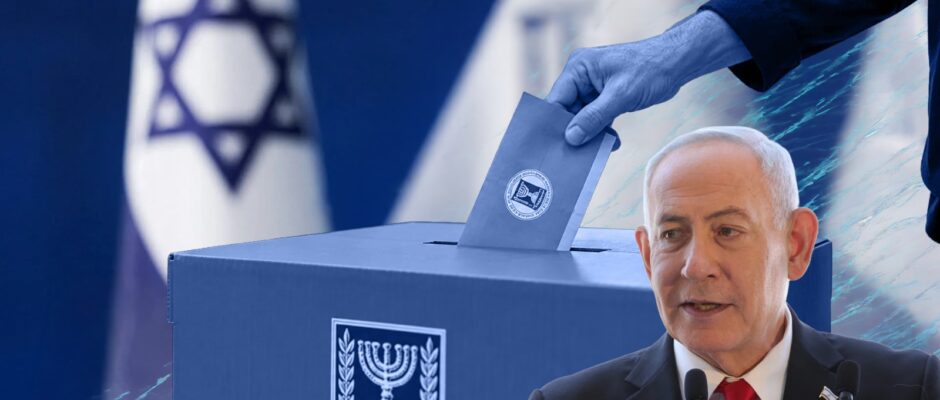
Israel’s 2026 Election and the Future of the Nation
Prof. Kedar Naik Israel’s 2026 election has produced a familiar result: an intensely engaged electorate, a divided parliament and no straightforward route to government. Beneath the negotiations over who becomes prime minister lies a harder question. Can Israel preserve its Jewish civilisational identity while maintaining common citizenship, shared obligations and institutions capable of governing? I approach that question as an Indian conservative, shaped by tradition, dharma, rashtra and the need for prudent change. A nation inherits memories and obligations that cannot be reduced to a contract among individual voters. But inheritance alone does not keep a state together. Its institutions must make room for disagreement, distribute burdens fairly and allow governments to act. When they reward communal bargaining at the expense of common responsibility, national solidarity begins to fray. The election of 27 October, with results formally approved on 4 November, followed years of strain: the dispute over judicial reform, the trauma of 7 October 2023, prolonged regional warfare and mounting anger over exemptions from military service. Turnout approached 78 per cent. That level of participation speaks to the vitality of Israeli democracy. The difficulty of turning those votes into a government speaks to its weaknesses. The arithmetic of a divided nation Netanyahu’s right and religious bloc won 53 seats in the 120-member Knesset, eight short of a majority. Likud remained the largest party with 27 seats. Shas and United Torah Judaism together secured 13, down from 18 in 2022, while Otzma Yehudit and Religious Zionism accounted for another 13. The Zionist opposition won 48 seats. Gadi Eisenkot’s Yashar took 21; Naftali Bennett and Yair Lapid’s Beyachad list won 12; the Democrats, bringing together Labour and Meretz, secured eight; and Avigdor Liberman’s Yisrael Beytenu won seven. Arab-led parties took the remaining 19 seats: 11 for the Joint List and eight for Mansour Abbas’s Ra’am. The opposition and Arab-led parties therefore possess 67 seats between them. Yet an arithmetical majority is not necessarily a workable political majority. Parties may agree that Netanyahu should leave office while disagreeing profoundly over the state they would govern together. For an Indian conservative, the distinction between Ra’am and the Joint List matters. Abbas has pursued a pragmatic strategy of working within Israel’s political order to secure policing, services and investment for Arab communities. The inclusion of Jewish former police commander Yoav Segalovitz on Ra’am’s list reinforces that approach. Its significance lies in the possibility of civic integration without requiring Arab citizens to abandon their identity. The Joint List brings together different traditions, including Hadash, Ta’al and Balad. Its opposition to Zionism, particularly Balad’s demand for a state of all its citizens, raises a different question for parties committed to Israel’s Jewish national character. External parliamentary support from such a list may make a minority government possible, but it leaves unresolved how far those parties can agree on security policy and the purposes of the state. There are three concerns here. The first is strategic freedom. A government dependent on outside support may struggle to sustain military operations or defence budgets if its indispensable supporters reject those policies. That danger is especially serious during war, when decisions cannot always wait for renewed coalition bargaining. It is a risk arising from political dependence, rather than an inevitable consequence of Arab participation. The second is trust. If leaders rule out reliance on a party during an election and then depend on it immediately afterwards, voters are entitled to ask what their promises meant. The experience of the Bennett–Lapid government showed how vulnerable a coalition can become when its members’ understandings of its legitimacy diverge. The third concern cuts in the other direction. A state cannot encourage Arab citizens to participate in elections and then treat their participation itself as suspect. Doing so alienates citizens who have chosen parliamentary politics and weakens those trying to build practical cooperation. A conservative defence of the nation should distinguish between legitimate disagreement, opposition to a government and rejection of the state’s continued existence. My standard would be constitutional integration: welcome parties prepared to accept the state’s permanence, reject terrorism and work within a fair arrangement of rights and duties. At the same time, take seriously the risks of making executive authority depend on factions with which there is no basic agreement about the national order. Neither blanket exclusion nor unqualified dependence offers a durable answer. When proportional seats produce disproportionate power Israel’s electoral system helps turn these divisions into recurrent crises of government. All 120 Knesset members are elected through nationwide party lists in a single constituency. A list must cross a threshold of 3.25 per cent to receive representation. Voters choose a party, rather than an individual representative for their town or district. The central problem is that proportionality in parliament can coexist with pronounced inequality in bargaining power. A small party whose votes are essential to a majority can demand concessions out of proportion to its electoral support. A much larger party may have little influence if nobody will govern with it. Giovanni Sartori’s distinction between a party’s “coalition potential” and “blackmail potential” is useful here. Parties matter through their ability to enter a government or change the behaviour of other parties. In a closely divided Knesset, the capacity to withhold a handful of votes can be more valuable than a broad but politically isolated mandate. This encourages parties to organise around tightly defined communities. Instead of negotiating broad compromises before the election, they can mobilise a committed constituency and bargain afterwards for budgets, ministries or exemptions. The national interest then emerges, if it emerges at all, from negotiations among parties whose first obligation is to their own supporters. Accountability suffers too. Junior partners can claim credit for what they obtain while blaming the prime minister, coalition rivals or courts for failures. Collective cabinet responsibility becomes difficult to enforce when a partner’s threat to leave can bring down the government. Meanwhile, voters in a border town have no territorially elected MK whom they can directly reward or remove for