
CIHS – Centre for Integrated and Holistic Studies

Date/Time:

Nepal Stares at Uncertainty!

Nepal Stares at Uncertainty!

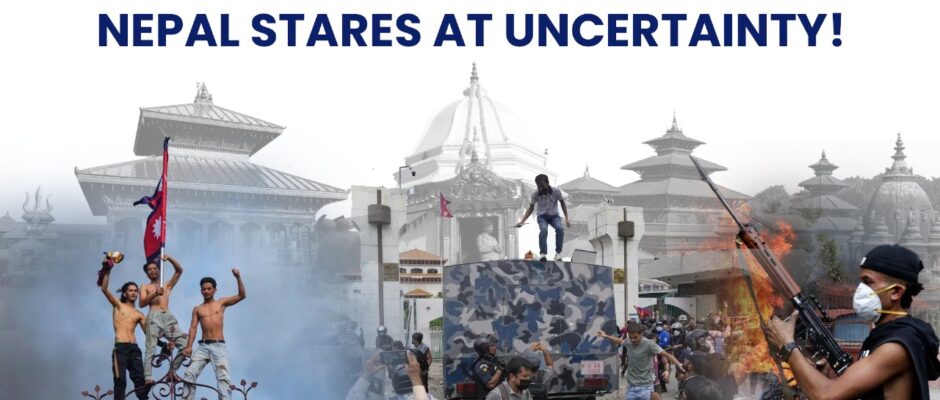
A stable, open, vibrant Himalayan nation retaining its Hindu core with cultural, civilizational and spiritual underpinning is most sustainable. K.A.Badarinath Peace and tranquillity, political stability and nursing the tiny Himalayan nation, Nepal to normalcy is pivotal to enduring growth and sustained development in South Asia. Bharat’s nearest and one of the most trusted partners, Nepal went through a lot in last couple of weeks. Disturbing and painful scenes of complete anarchy, loss of 19 young lives, scores injured, iconic Parliament, Supreme Court and other top-end buildings burning to ashes in part or completely painted a distressing picture of this picturesque country. There’s no place for corrupt, authoritarian or anti-people regimes that let down their own people. Be it Bangladesh, Nepal or Sri Lanka, zero tolerance to corruption is something that each will have to prioritize as basic tenant of a democratic polity. And, Nepali political leadership of all hues and shades have got thoroughly exposed after they failed to provide corrupt-free governance. Social media related policies were incidental and served as trigger for youngsters to hit the road. Eight major political formations with diverse ideologies and linkages like Nepali Congress, CPN-UML, Moist Centre, Jan Samajwadi Party, CPN – United Socialist, Loktantrik Samajbadi Party, Rashtriya Janmorcha that dominated the political arena today find themselves out of the system after K.P.Oli led coalition was forced out by the youngsters. Kathmandu Mayor Balen Shah and Sudan Gurung that apparently played a key role during the protests seem to have shifted behind the screen in their activities. While uncertainty stares in Nepal, an interim government headed by Prime Minister Sushila Karki and her three ministers do not fit into any of these political parties. And, they would find it difficult to find their in moving forward. Given that the young protesters did not have centralized leadership or entity that led the violent protests, the interim government will have to carve out its own socio-political space. Home Minister Om Prakash Aryal, Power Minister Kulman Ghising and finance Minister Rameshwar Khanal appointed by the first lady Prime Minister reportedly enjoy clean image and do not come with political baggage of any kind. Their work in respective areas stands out. All the four including Prime Minister Karki seem to have western orientation either due to their profession or outlook. Hence, their work in the government would be subjected to closer scrutiny by all stakeholders in Nepal. For the first time, overtly professional Nepal army had to play a semi-political role leading to dissolution of Parliament, formation of interim government that will lead the country into general elections in March 2026. To its credit, Nepal Army displayed exemplary professionalism by not taking reins of governance and backed the Karki regime to see through difficult transition next few months. Also, it is immensely possible that political parties that lost people’s confidence may realign to bounce back to centre stage seeking a second chance. After adoption of the new constitution ringing in democracy in 2008, fourteen governments were formed, dislodged with political alignments happening all through. None of these political formations were able to complete the mandated five-year term after an election. In these 18-years of political turbulence marked by twists, turns and realignments, India stood as beacon of strength to lend a helping hand in the Himalayan nation’s transition to democracy. Notwithstanding political ideologies of a government that ruled Kathmandu, India stood firmly with Nepal in its socio-economic development journey as a steadfast partner with no strings attached. If Prime Minister Narendra Modi and external affairs minister S.Jaishankar’s statements are any indication, India continues to be firmly behind Nepal. One also needs to watch out for cold play from Communist China and Republican US while Nepal struggles to end uncertainty and get back its rhythm. Hard part for Nepal would be to retain its basic Hindu character while diverse ideological formations and external forces come into play. There were wild guesses that the former monarchs were behind protests which were proved wrong. An open, vibrant and bustling Nepal retaining its Hindu core in terms of its cultural, civilizational and spiritual orientation is what would sustain itself as a sovereign nation. (Author is Director and Chief Executive of non-partisan New Delhi based think-tank, Centre for Integrated and Holistic Studies)
Read More
Nepal Falls to Dragon Debt Trap

Nepal Falls to Dragon Debt Trap

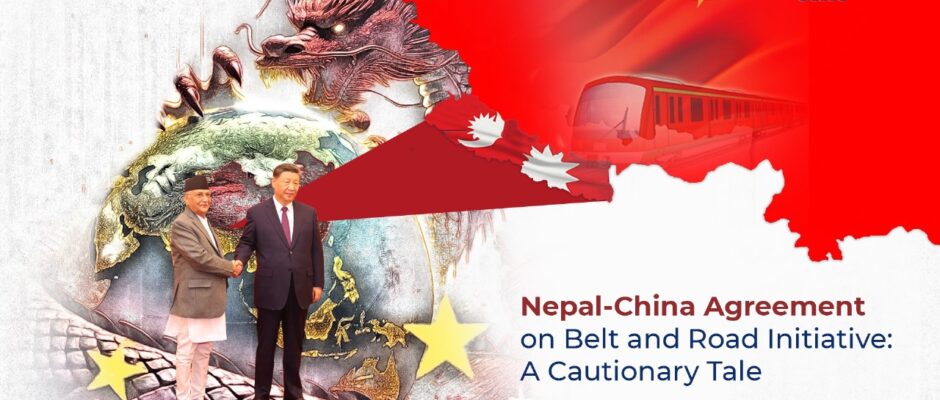
Nepal stares at huge economic costs built into BRI while President Xi pursues his expansionist geo-political interests in South Asia. Rohan Giri Earlier this month, Nepal’s communist regime sealed a deal with China to join ill-famed Belt and Road Initiative (BRI) that pushed several least developed and developing countries into the dragon debt trap. The dragon pact marks a key policy shift for Nepal moving it away from its millennial ally Bharat with civilizational links and signifies : closer alignment with Beijing. While the deal promises economic benefits especially through infrastructure development, it raises significant concerns about Nepal’s sovereignty, financial stability and regional security. More than a bilateral development project, BRI threatens to exacerbate Nepal’s internal challenges and entangle it in China’s geopolitical web. A Faustian Bargain Chinese President Xi Jingping’s signature project, Belt and Road Initiative, has been pushed aggressively as passage to economic growth for the developing nations where much-needed infrastructure would be in place, thereby enhancing trade connectivity and promoting economic growth. For Nepal, being a landlocked country on brink of economic revival, BRI seemed like just the ticket to lift isolation. Beneath the purported economic attraction lies a much darker reality — one of financial vulnerability, political dependency, and loss of sovereignty. The deal, while touted as a historic step by ruling Communist government, is nothing short of a Faustian bargain for Nepal. Prime Minister KP Sharma Oli deciding to go to China as his destination for the first foreign trip after assuming office and subsequently endorsing the BRI, marks a dramatic shift in Nepal’s foreign relations, which were traditionally close cultural and economic ties with India. But, with rising proximity to China — and its growing political and economic influence — comes an entirely new set of dangers that could be disastrous for Nepal. China’s Economic Mirage Behind the BRI lies a worrying financial model which has already ensnared several countries in crippling debt. BRI is mostly financed through huge loans from China usually on terms that put developing countries at risk of default. The countries that embraced the BRI such as Sri Lanka and Pakistan have been saddled with unsustainable debts. A case in point is how Sri Lanka was forced to lease Hambantota Port to a Chinese firm for 99 years following its failure to service the loans. Apprehension about Nepal getting into the vicious debt trap is very valid for this reason alone. Nepal, with a miniscule industrial base, having chronic fiscal deficit and depends on foreign aid, makes this over-leveraging risk extremely high. For one, BRI-sponsored Pokhara International Airport has already faced operational setbacks due to dearth of international flights that now faces the added headache of India’s airspace ban. The economic rationale for Nepal to continue pursuing Chinese loans is increasingly unclear especially when one considers the broader regional dynamics and Nepal’s precarious economic wherewithal. Communist Regime’s Illusory Promises The appeal of BRI to Nepal Communist government cannot be underestimated. Indeed, the ruling regime led by Nepal Communist Party (NCP) placed itself precariously between Chinese-style state-driven development and Nepal’s ambitions to evolve as a modern buzzing economy. Historic record of Communist regimes relying on foreign loans for ambitious infrastructure projects is far from encouraging. In countries like Sri Lanka and Venezuela, alignment with Chinese-funded initiatives has led not only to financial instability but also to political entanglements with Beijing, eroding the sovereignty of these nations. Nepal, too, risks losing control over its internal affairs if BRI’s promises fail to deliver as has happened in other nations under Chinese influence. The promises of job creation, improvements in infrastructure and growing economy from Communist regime would end up being hollow ones as this would lead to greater social inequality, political unrest and growing dependence on China. This could also manifest in a variety of ways: from suppression of political dissent in favour of Chinese interests to siphoning off of Nepal’s resources to meet Chinese repayment schedules. The people of Nepal already burdened by poverty may feel further alienated given their own government prioritizing Chinese loans. Strategic Dilemma and Geopolitical Tension Nepal’s entry into BRI, though framed as a development initiative, has far-reaching geopolitical implications as well. Nepal’s location, nestled between India and China has long made it a strategic focal point in South Asia. India with which Nepal shares not just a long border but also cultural, economic, and historical ties, has expressed some very strong reservations about BRI. China’s larger strategy to expand geo-politically via BRI has been well documented that throws up fresh security challenges in South Asia. India has reasons to worry about China’s activities. For instance, China-Pakistan Economic Corridor (CPEC) of BRI which passes through an illegally occupied region of Jammu and Kashmir is an example of how China’s infrastructure development works in tandem with its military strategic interests. To New Delhi, Nepal’s inroads with China is alarming for it will change the region’s delicate balance of power. The danger of alignment between Nepal with China is bound to provoke India given Kathmandu and New Delhi’s hitherto long-term relations. The risk is also that Nepal gets entangled in a wider strategic competition between China and India in which it has no particular leverage to speak of. A small yet significant nation becoming more and more dependent on China might lead to reduction in its own foreign policy independence as Nepal is increasingly drawn to align itself with wider strategic priorities of Beijing. Subtle Erosion of Sovereignty China’s influence in Nepal is not confined to economic aspects. While BRI may be portrayed as an innocuous development initiative, it also provides a tool for subtle control over political affairs. It is seen that China gets leverage on Kathmandu through finance of large-scale infrastructure projects as well as loan offers, not only from economic perspective but through political sway. This trend is witnessed in Sri Lanka and other countries under BRI, where dependency on debt leads to gradual loss of sovereignty. Thus, eagerness of Nepali Communist government to align with

Read More

Bumpy ride for Republican Nepal

Political parties, old and new, will have to measure up to expectations of Nepalese people for socio-economic development, prosperity Navita Srikant General Elections of November 2022 in Nepal saw emergence of alternate political parties besides the mainstream traditional players. Traditional democratic forces and communist ideologies were challenged by young and professional voices who advocated change. Terai Leaders continued their journey in fragments. The Elections also witnessed calls for return to Hindu Nation and Constitutional Monarchy as against the present multi-party system. “Raja aau Desh Bachau” (Oh King! Please come to save the country) was popular with youngsters. It has been eighteen months since 2022 elections and political uncertainty as well as chaos has become the new normal. If there be one line to sum up the mood amongst citizenry, it would be the desire to seek change from prevailing status quo. Youth continue to be a frustrated lot given that the education is redundant and does not land them in jobs.  Women struggle to make their voice heard and be represented in decision making within a regimental patriarchal society while businesses struggle to deal with liquidity crunch. They see little hope even in clearing public borrowings made during global pandemic Covid19. Entrepreneurship across Nepal is on the deathbed as there’s no supportive ecosystem. Amidst this social and economic unrest in Nepalese society, one had hoped for political stability to address these lingering issues. But, the mainstream parties as well as new political formations could barely sustain the momentum of growth and development. Instead, they got pre-occupied with power sharing permutations and combinations. In the meanwhile, forex reserves swelled only due to increased remittances. But, increasing conflict and war situations around the world exposed vulnerability of remittances-based economies like Nepal and amplified the need for more stable policy frameworks. On domestic front, Nepal was hit by high profile policy related corruption that seriously dented the image of political parties. Bhutanese Fake Refugee Scam of transnational nature incriminated high ranking politicians, former ministers and bureaucrats. Policy linked corruption in cases as Giri Bandhu Tea Estate, Lalita Niwas Land scam and Cooperative sector irregularities are classic cases of amending rules, regulations to enable non-state actors from taking advantage to benefit chosen private entities at the cost of the Exchequer. Similarly, Maoist Cantonment scam is another case to use state coffers to pay the parties’ supporters. It wouldn’t be an exaggeration to state that the strongest and only nation state in South Asia that was never colonized is being plundered and looted by its own political leadership and more so under the new three-tier federal system. In the recently released, sixty first annual report of the Office of Auditor General of Nepal, it is stated that 171 local level units under Local Government have spent Nepali Rs 9.15 crores in salaries for appointment of personal secretaries and advisors for which there is no provision in provincial laws. Additionally, the report pointed out irregularities in procurement and implementation in projects managed by Nepali Police and Security Forces. Nepali Army’s name was embroiled in cases of procurement irregularities in Kathmandu Terai Fast Track Project (KTFT Project). In a recent case, there was an uproar in arrest of Kailash Sirohiya, the chairman of Kantipur Media Group (KMG) over his citizenship credentials. In brief, the citizenship number allotted to Sirohiya was previously set aside to one Shivaji Sahu Teli. Sirohiya had obtained citizenship by descent in 1979 and renewed his citizenship card in 2000. The confusion with citizenship numbers and two persons being allotted the same number appears to be an issue of institutional capacity at local administrative units. What was surprising that local authorities jumped the gun and arrived at his offices to arrest in broad daylight instead of serving show cause notice to Sirohiya for explanation and in parallel conducting their own review of files and archives? KMG is one of the leading Media Groups in Nepal. Recent news stories in KMG on irregularities and unlawful gains reportedly made through four cooperatives by Rabi Lamichhane, Deputy Prime Minister and Minister of Home Affairs may have served as immediate provocation to question Sirohiya’s citizenship. Developments leading to arrest and thereafter national uproar, calls for solidarity with KMG’s Sirohiya and demands to end pressure tactics to prevent free press and freedom of expression hogged headlines. Leading opposition party, Nepali Congress including some of the leaders of the existing coalition condemned use of undue force and pressure by the Government for what seemed like a procedural inquiry and could have followed its due course without having to flex muscle. Coalition Government leaders remained mum to save the government from a free fall. Prime Minister Pushpa Kamal Dahal ‘Prachanda’ recently stood for his fourth ‘Vote of Confidence’ in just18 months, three times by swapping coalition partners and once due to break-up in Janata Socialist Party (JSP), the coalition partner in the third time government. Rather than rainbow colours of sectoral development, growth plans and progress, Nepal’s canvas on domestic affairs reflect predominance in dark colors of coalition politics, corruption and vendetta politics, financial irregularities surpassing past numbers due to three-tier political administrative structure. Investment Board of Nepal put in huge efforts to organise a high-level Nepal Investment Summit with over 800 foreign delegates and 2500 domestic leaders. The summit rightly created positive buzz and provided a platform for networking and collaborations. Summit participants were rather unanimous that ‘Emerging Nepal’ is ready for foreign investment. But, one silently noticed that a shiver went down the halls of the Summit in desperate search for domestic political leadership with spine. It is now imperative that the shiver doesn’t end looking for a foreign spine with attractive offers and hidden caveats in between the lines that can end up ruining the economy. Nepal is still sitting with exposure of Chinese defunct aircrafts (which were rejected by Bangladesh but bought by Nepal) and Pokhara Airport Loan. While Chinese leadership stated Pokhara Airport to be part of BRI Project, then Nepali Government clearly stated that

Read More

Akhand Bharat is underlying reality in the mural

Indo-Nepalese linkages have depth to handle contentious border issues, illicit drug deals, jihadist madrasas springing up big time! Vinod Kumar Shukla Traces of Indian culture and civilization go beyond Afghanistan in the west and Indonesia in South East Asia. More facts and revelations have been collated over time due to concerted research about length, breadth and its longevity. But myopic Indian media has the tendency of making an issue out of nothing and question anything and everything that glorifies Indian civilization. It’s all done not to scrutinize facts but put Indian government in the dock. Interestingly enough, self-proclaimed holier than thou Indian media failed to see Sengol as being integral to India’s millennium old cultural voyage and its handing over to Jawahar Lal Nehru in 1947 was termed fake history. Select Indian and global media outlets get divine and display false intellect in interpreting 2300-year-old depiction in a mural that’s part of the newly opened Parliament. This has given enough cannon fodder to China and Pakistan. India’s External Affairs Ministry spokesperson Arindam Bagchi was straight when he described the mural as an artwork that depicted the spread of Ashokan Empire. Bagchi took the position, “The mural in question depicts the spread of Ashokan Empire and the idea of responsible and people-oriented governance that he [Ashoka] adopted and propagated.” Bagchi rejected conjectures that the issue figured in bilateral talks between Prime Minister Narendra Modi and his Nepalese counterpart Pushpa Kamal Dahal popularly known as ‘Prachanda’ who was on a bilateral visit to New Delhi last week. But, India’s western and northern neighbours seized upon the opportunity to make mountain out of a molehill. Nepal’s opposition parties, some of them aligned with Chinese think tanks and Chinese Communist Party made every effort to cause mayhem on phone screens, social media handles and hijack the conversation away from Indo-Nepal issues. Apparent objections were on depiction of Lumbini, Uttarapath, Purushpur and Taxila on the mural in question as part of India’s Akhand Bharat plan. Social media was flooded with messages that opposition leaders asked the visiting Prime Minister ‘Prachanda’ to take up the issue with India to get the mural removed from Parliament. But, India insisted that the issue did not figure in bilateral discussion. Big question however remains. Is it not true that India and Pakistan were part of Indus (Sindhu) Water Treaty depicted in the mural reflecting India’s civilizational identity as Bharat? Can Indian forget Takshshila where Vishnugupta (Chanakya) was a teacher and assisted Chandragupta, Ashoka’s grandfather in uniting India? Lumbini where Gautam Buddha was born is Sakya Muni for many in India emphasising his Sakya lineage. And, this region formed one of the ten republics of [Akhand] Bharat during sixth century BC. No political boundary whatsoever was strong enough to restrict Akhand Bharat that had unique lifestyle and behaviour of every civilizational Indian. Reference to Uttarapath is as old as Panini’s Ashtadhyayi where he listed the kingdoms along ‘Uttarapathenahritam’. Pakistan can ignore these facts and consider its history to have begun with 1947 and remain in denial mode for cultural links with India. Pakistan’s tilt towards Arabic nations may not help as the latter view Islamabad with deep disdain. On the parallel, handful of Nepalese leaders denying this cultural unity is not only strange but unfortunate as its cultural connects with India is inseparable and alienated. When Indian Prime Minister Modi visited Lumbini on May 16 last year on birth anniversary of Mahatma Buddha, he inaugurated Kushinagar International Airport. It was meant to bring to focus cultural integration.  Kushinagar airport would help tourists and pilgrims to get easy access to Lumbini contrary to misinformation campaign that India is on some imaginary expansionist mission. Lumbini and Kushinagar are the places where Mahatma Budhdha took birth and died respectively. Further, four-lane Ram Janaki path is being built from Ayodhya to Janakpur. A Buddhist circuit is drawn connecting Gaya, Sarnath, Kushinagar and Lumbini. Modi’s Lok Sabha constituency Varanasi has been an important seat of pilgrimage for Lord Shiva’s devotees. Also,  Kashi has been the seat of learning and place of worship for successive Prime Ministers and Nepal’s royals. They were also associated with Guru Gorakhnath in Gorakhpur bordering Nepal. Ram Van Gaman Path Marg too has Nepal and Sri Lankan linkages while Krishna corridor would connect many cities. Cultural connect transcends political boundaries as former Maoist Guerrilla Prachanda appears to have overcome the dichotomy of his faith and political ideology when he performed Rudrabhishek at Mahakaleshwar Temple in Ujjain. He gifted loads of Rudraksha beads to the temple. What binds India and Nepal is their Hindu identity, so each other’s security concerns are of paramount importance. Therefore, National Security Advisor Ajit Doval’s meeting with the Nepalese Prime Minister was certainly not a courtesy call. Issues like mushrooming Madarsas along Indo-Nepalese border, contraband trade, outlaws committing crime and escaping into Nepal apart from ISI operatives making a foothold on Nepalese soil have reportedly figured in the discussions. There is no denying that border issues continue to be in contention especially Kalapani, Lipulekh and Limpiyadhura areas that Nepal claims to be part of its territory. Both sides seem to agree that there’s enough depth in their relationships to handle these issues. But, one cannot ignore the Chinese Communist Party’s continued needling in Indo-Nepalese affairs. After mishandling1989 blockade aggravated minor differences between the two countries into distrust, China played an iniquitous role. Further, comprehensive Peace Accord in 2006 leading to end of monarchy and general elections, the Constituent Assembly declared Nepal a Federal Democratic Republic that had Chinese footprint all over. On the other hand, what went wrong for India was the erstwhile Manmohan Singh government outsourcing its Nepal policy to Communist Party of India – Marxist that had its allegiance to China. Whenever India and Nepal attempted at ironing out differences, China worked at torpedoing plans to expand its influence in South Asia. Fanning Pahadi versus Madheshi divide in Nepal was its favourite game plan. China supplied oil and arms during 1988-89 to disturb the delicate

Read More

Maoist guerrilla turned Hindu protagonist?

Prachanda’s puja at Mahakaleshwar is more tactical transformation to mollify India; political success and survival back home Yubaraj Ghimire On May 31 evening, Nepal’s Prime Minister Pushpa Kamal Dahal (“Prachanda”) raised his hands in welcome and signalled Manjeev Singh Puri, asking the former Indian Ambassador to Nepal to approach him at a reception held in his honour at the country’s embassy in New Delhi. “I have not forgotten… you asked me several times when will I wear Daura-Suruwal. Look, I have done it.” Prime Minister Dahal donned Nepal’s official and traditional dress for the first time during a trip abroad. Dahal and his party – the Communist Party of Nepal (Maoist-Centre) – have consciously avoided wearing traditional attire to maintain the radical and revolutionary image. That image was sacrificed on his trip to India. On third day of his trip, Dahal not only visited Indore but performed an elaborate puja at Mahakaleshwar temple in Ujjain. He offered the deity 108-rudraksha bead thread, clad in distinctly religious attire. Dahal was a “revolutionary” whose insurgency saw many incidents of temples being vandalised and those observing rituals (even death rituals) being killed. He has avoided visiting any temple including Pashupatinath temple in Nepal till now. His religiosity in India, then, may well be taken as a tactical transformation to address the Modi factor – a factor which may be crucial to his political success and survival. Many, then, believe that he has not “transformed” – he has simply been tamed by hostile circumstances and politics. His visit to India five months after he assumed office as PM for the third time was for political management. Just an hour before his departure, he managed to get President Ram Chandra Poudel to approve the Citizenship Bill that erstwhile President Bidhya Devi Bhandari had declined. Dahal bypassed parliament by getting the cabinet to go for a shortcut. This was done to mollify New Delhi. India has still not welcomed Nepal’s constitution, promulgated in 2015. Dahal and K P Oli (who was then waiting to take over as PM) turned down India’s suggestion to delay the promulgation till demands of some Tarai-based parties which included the citizenship issue were sorted out. The result was a 134-day-long economic blockade, which led to a sweeping anti-India sentiment in Nepal. Modi also lost a lot of his considerable popularity in the country. The Citizenship Bill, among other things, provides instant citizenship with all the political and property rights to foreign women married to Nepali men. While the Bill does not address many of the more radical demands, like citizenship to men married to Nepali women, Dahal’s pushing it through likely earns him some trustworthiness in the eyes of Indian establishment. It can be interpreted as a realisation on his part that not listening to India earlier was a mistake. Dahal had his own reasons to stoop, hoping he will ultimately conquer. Sixteen years ago, the decade-long insurgency – which led to 17,000 deaths – ended in a peace accord following a deal that India brokered between the Maoists and Nepal’s pro-democracy parties. Modi, who came to power in Delhi eight years after the deal, hailed the accord in his first address from the ramparts of Red Fort as a “triumph of the ballot over bullet”. But now, at 71, Dahal faces the prospect of that triumph being bungled. Not only his detractors, but ex-guerrillas and political allies want the gross human rights violations probed and the guilty punished, as pledged in the peace accord signed in November 2006. Dahal has been trying hard to grant general amnesty to the guilty but as the accord was witnessed by the international community, including the UN, his best option was to reach out to India to bail him out and, if necessary, intercede with Western countries. Indian authorities appear convinced that the Maoist leader’s offer to side with India in containing China in Nepal and even to put Chinese investments at bay, is genuine. Delhi seems to believe that Dahal continuing as PM would be in India’s interest. Amazingly, he also reportedly assured the BJP that he was no less Hindu than the former King Gyanendra Shah, whose efforts at making a political comeback are getting a huge public response in Nepal. His visit to Mahakaleshwar was evidence of that. For now, Dahal got what he wanted from Delhi. The two sides signed deals to have Indian Public Sector Undertakings — National Hydro-Power Corporation and Satluj Jal Nigam — to develop the 679 MW Lower Arun and 480 MW Phukot (Karnali) — with India promising to enhance multi-fold the current purchase level (400 MW) of Nepal-generated power. Delhi asserted that no power generated by Nepal companies with Chinese investment will be purchased. This is a clear message that Chinese investment in all major sectors will be discouraged. Dahal did not quite raise the border dispute – this would have spoilt the positive atmosphere he was trying to create. But this is likely to be seen as a “surrender”, and create a backlash at home. His Delhi visit will be debated, polarising people and parties in Nepal. And that will cost Prachanda the image his “revolutionary past” bestowed on him. In that avatar, the problems with an “expansionist India” used to be a political and diplomatic mantra. (author is a senior journalist based in Kathmandu. This write up was first published in Indian Express)

Read More

Stability or chaos, What next in Nepal?

Rohan Giri Amid political uncertainty and bleak future, Himalayan former Hindu Kingdom, Nepal elected its new President in 78-year-old Ram Chandra Paudel. Paudel is a senior Nepali Congress leader and defeated Nepal Communist Party (United Marxist Leninist) backed Subas Chandra Nembang. In the 52,628 weightage-based votes, Paudel secured 33,802 and was anointed Nepal’s President while Nembang polled 15,518 votes.   After Nepal Pratinidhi Sabha or House of Representative was in session for 64-days with 275 members, Nepal Communist Party (United Marxist Leninist) broke away from the ruling coalition alliance and the government. The break up in ruling coalition was triggered by reported disagreement on the presidential candidate. As per Nepal Parliament’s current status, a party or an alliance will have to muster the support of at least138 members to gain majority and continue in governance. Nepal Communist Party (United Marxist Leninist), the second-largest party in the coalition government with 79 members has recently deserted the ruling alliance. The alliance, however, does not appear to have suffered significant losses since the Nepali Congress Party has 89 members, Nepal Communist Party (Maoist Center) – 32 members, and Rashtriya Swatantra Party has 20 members. These three parties command a comfortable majority with no threat to the government as of now. Desertion of CPN (UML) is widely being attributed to Prime Minister, Pushpa Kamal Dahal, “Prachanda” violation of December 25, 2022 agreement put together to assume power by the coalition. As a consequence, eight CPN (UML) ministers including Deputy Prime Minister in the Prachanda-led incumbent government resigned en masse thereby creating a flutter. Previously, in 2017, the alliance between China’s front-man Khadga Prasad Sharma Oli and Maoist guerrilla Pushpa Kumar Dahal fell apart. The churn in political coalitions demonstrates the potential for future uncertainties in Nepal. In an earlier report, it was predicted that the coalition would be difficult to survive as the co-existence of Maoists and Marxists influenced by China has seen about ten swearings-in and then thrown out of power in the last few years. To deal with such a situation, “under Clause 2 of Article 100 of the Constitution of Nepal, a prime minister would be required to seek a vote of confidence again if a coalition partner or political ally broke away or withdrew support from the government. In such a situation, Prime Minister will have to secure a fresh vote of confidence in 30 days. If the prime minister failed secure confidence vote by March 26 in the present context, Prachanda will lose office. Given the present numbers and assuming there would be no further cross overs or desertions, Prime Minister Prachanda is expected to sail through in the Parliament. Nepal, which established democracy in 2008 by ending the monarchical system of about 240 years, was successful in establishing democracy. However, with the change in the design, have they left behind their values as well? Nepal, a Hindu nation, has fallen into China’s trap. As a result, China’s debt has grown in the name of the country’s development, the leaders have become China’s puppets, and the path to instability is being taken in the name of disagreement. This mountain kingdom was different from that. The way to increase Nepal’s development and reduce instability will come from the nation’s own values, which are the Hindu values of a Hindu nation. Looking back ten to fifteen years, the contradiction between Hindu majority India and Nepal, which were very close, has grown. The Nepali leadership’s increasing closeness to the dragon is the only reason for this. So the actual cause for breaking the alliance is different from what we see on the information mediums; in reality, Beijing’s representative, KP Sharma Oli, wanted to take all the important political, economic, and strategic calls internally and externally but failed to do so. The following trust vote will decide who will lead Nepal and the next strategy. If the situation as it is now seen remains the same, then the current coalition can stay in power even further. (Rohan is a journalism graduate from Indian Institute of Mass Communication (IIMC) New Delhi, and Manager Operations at CIHS.)

Read More

India, a natural Nepal pal

Hands off New Delhi policy towards Kathmandu vis-à-vis expansionist China will work wonders for Prachanda’s regime K.A.Badarinath Nepal is on tumult. As expected, a big chunk of China inspired Maoists and Marxists that failed to co-exist previously have got back to rule the mountain kingdom that have seen about ten swearings-in and out in as many years. Maoist guerrilla Pushpa Kumar Dahal seems to have not learnt bitter lessons  of 2017 when he aligned and broke off from Communist Party of Nepal (Marxist – Leninist) led by Khadga Prasad Sharma Oli. Thanks to opportunistic political saga unfolding in Nepal, Dahal who’s popularly known as ‘Prachanda’ ditched his latest ally Nepali Congress and returned to CPN – ML for forming a government primarily to assume Prime Ministerial position on Monday. In fact, Dahal represents the oft quoted saying that politics is an art of possibilities played very bold. Dahal seems to have made most of these possibilities to ascend for the third time to become Prime Minister of Nepal in last few years. His key lieutenants led by Deputy General Secretary from the Communist Party of Nepal – Maoist Barsha Man Pun had headed for Beijing even as counting of votes after November 20 elections threw up the possibility of a hung Parliament. While avowed reason was Pun’s ‘illness’, his political engagements with Communist Party of China (CPC) seem to have reportedly led to the breakup of pre-electoral alliance of Nepali Congress – CPN Maoist Centre. It was quickly followed by forging of a new alliance of comrades from all shades and denominations pushed aggressively by CPC. CPN – ML leader K.P.Sharma Oli’s inroads and linkages with CPC leadership also seem to have worked well in pushing the Nepali Congress into opposition space notwithstanding the latter being single largest party with 89 members in 275-strong Parliament. Big question in the melee is whether Dahal aka ‘Prachanda’ have his way to run Nepal’s affairs without being a lacky to China? Dice are cast given that Beijing’s proxy K.P.Sharma Oli would like to take all important political, economic and strategic calls relating to China and India. This uneasy alliance between Prachanda and Oli forged by forces in Beijing may find it difficult to find a working relationship given the bad blood that flew in the earlier government and in run up to the campaign. From India’s perspective, Nepali Congress being out of power may be a big disappointment. But, it will have to find ways to work out a nuanced relationship with the new dispensation that’s bound to assert the China way. In fact, Prachanda with his independent views that are equidistant from both China and India may be the biggest bet. Prime Minister Narendra Modi was the first global leader to congratulate Prachanda on his appointment as his Nepalese counterpart through a twitter post. Secondly, a hands-off approach towards Nepal which has been the centre of India’s engagement with Kathmandu till date, should continue to guide the civilizational partners. Continuing with the time tested 1925 Indo-Nepal pact in ‘spirit and content’ without interference from third party will be the biggest challenge. Thirdly, India being trusted economic and development partner, should continue to engage with the new Nepali government irrespective of machinations attempted by K.P.Sharma Oli for his masters in Beijing. Fourthly, political uncertainty is bound to continue given the multiple partners in the coalition and the aspirations that they bring to the table rather than the value, ideas and content to the new government. Keeping close tabs on political developments, interest groups and policy matrix will work well for India. Fifthly, Beijing is bound to push itself hard this time round to edge out India and attempt a ‘virtual occupation’ through Belt and Roads Initiative apart from taking control of the country’s hydroelectric power generation assets. More than all that forced DNA sampling of Nepali population is likely to be done ala what is being Tibet as part of its strategic and expansionist thrust. Sixthly, India will have to work overtime to keep even-keeled relations with Nepal that’s been its partner from milk, vegetables to oil needs. More than all that, the two countries’ ‘Sanatan dharmic linkages’ will have to be celebrated and embellished thereby reinforcing the unalienable nature of the two people’s relationships. Chinese foreign minister Wang Yi is to be believed, Beijing proposes to work with India for steady and sound growth in bilateral relations. In this backdrop, not meddling with India’s civilizational partners like Nepal could work as the starting point. Nepal’s political leadership from across the spectrum will have realize that its interests were intertwined with that of India as an all-weather friend that can work wonders in South Asia. (Author is Director & Chief Executive, Centre for Integrated and Holistic Studies, a bipartisan think tank based in New Delhi)

Read More

China braces to play dirty in Nepal

Delicate political applecart has the potential to throw up a storm given multiple coalition partners, communists &Maoists may go Beijing way! Rohan Giri Himalayan Kingdom Nepal is going through trying times as no single party would enjoy even simple majority in the Parliament following the November 20 elections. Having said this, the five-party alliance led by Nepali Congress Sher Bahadaur Deuba is set to form the next government in the 275 member Nepali House as the five coalition partners began their power sharing formula in the new dispensation. For a stable government to be sustainable, the alliance will have to get 138 of their candidates elected as members. This seems to be within the reach for the coalition in this Hindu majority state – Kingdom. The results and trends indicate that Nepali Congress has emerged as front runner while the Communist Party of Nepal (Unified Marxist-Leninist) is at second place. Nepal Communist Party (Maoist Centre) follows it at third position and Nepal Communist Party (Unified Socialist) would have fourth largest block of elected members. There are currently two significant coalitions in the election, one led by Nepali Congress (NC) and the other by the Nepal Communist Party (United Marxist-Leninist). Apart from this, the National Independent Party entered the fray for first time with its own set of candidates. Nepal Communist Party (United Marxist Leninist) made Nepal’s territorial integrity as its campaign call. Its supremo K.P.Oli took upon himself to withstand pressure from purported India pressure. On the other hand, Nepali Congress party included the country’s territorial conflict with China as its rallying point. International concerns on Belt and Road Initiative (BRI) and the Millennium Challenge Corporation (MCC) were brought to national debate. After a decade-long deadly Maoist insurgency followed by 10 years of political instability, Nepal adopted new constitution in 2015. This election is the second federal and provincial election in Nepal after the enactment of its constitution in September 2015. Last five years of government have been in turmoil and instability owing to bickering and coups of a different variety. Internal power struggles and flipping sides by political leaders defined the instability in Nepal while the country evolved as an exciting full democracy in South Asia with its own unique character. China’s aggression in Nepal through its wolf diplomats and direct involvement in the political overturns bring to fore its expansionist streak. Case in point is the Chinese Foreign Minister Wang Yi’s state visit to Kathmandu, transfer of the Chinese Ambassador to Nepal, and other high-level interactions in the midst of electoral process. This is typical to the Oligarchs driven Chinese Community Party and its general secretary Xi Jinping. During O.P. Sharma’s term as Prime Minister in 2015-16 and 2019-21, Nepal’s engagement with China was elevated to one of strategic partnership. Chinese scholars believed that since the Nepali Congress took reins, the country progressively drifted away from China. Due to United States presence in Nepal and India being natural ally of the Himalayan Kingdom, Chinese strategists have been working overtime to gain full control on the country as was the case with Pakistan. From Indian perspective, Nepali Congress led by Deuba may be the best bet as of now. New Delhi has been a benevolent partner in Nepal’s progress under the monarchy as well as the new democratic state. India’s concern may accentuate in case communist elements within the majority coalition and maoist extremists driven opposition look at realignment to carve out a pro-China political formation and edge out Nepali Congress even after having emerged the largest party. It is undeniable that during KP Oli’s leadership, relations between Nepal and India deteriorated over a number of issues, including the modification of the map of Limpiyadhura, Lipulekh, and Kalapani. The roti-beti culture of India and Nepal makes their relationship unique, and the open borders between the two countries provides the facility for citizens to move and manage trade and relationships, especially the Madhesis. During KP Oli’s tenure, he turned to China for supplies, signing a trade and transit treaty that led to the Chinese invasion of Nepali territory. Oli not only attempted to position himself against India to please China but willingly ignored China’s encroachment Nepal territory. India believes in neighbor first policy and Nepal is the immediate neighbor. India has been Nepal’s “firm partner” on the path to peace, progress, and development. This election is important for both Nepal and India to sustain the bilateral ties, cultural and civilizational relations, and geopolitical situation. In this backdrop, China’s mobilization of Nepal’s communist parties may put India’s long-standing relations in a bind. An unholy alliance between Deuba and Oli is being attempted as a way for China to have foothold in the new power structure. Chinese encroachment in the Himalayan state is a challenge for New Delhi as well. Although Nepal elections outcomes are expected to benefit India, it entails strengthening interpersonal links and structurally incorporating Kathmandu into connectivity projects focused on sub-regional trade with India. One would keep fingers crossed as the political slugfest in Nepal unfolds and Chinese dragon breaths down the Himalayan Kingdom’s neck. (Rohan is a journalism graduate from Indian Institute of Mass Communication (IIMC) New Delhi, and Manager Operations at CIHS.)

Read More