
CIHS – Centre for Integrated and Holistic Studies

Date/Time:

Reforms Should Go Beyond Economy, Touch Every Facet of Life

Let’s leverage strengths for global good, meet aspirations of Bharat’s citizens as we progress to become a developed country by 2047 Narendra Modi The biggest festival of democracy, the 2024 Lok Sabha Elections, is concluding today in our nation, the Mother of Democracy. After a three-day spiritual journey in Kanniyakumari, I have just boarded the plane for Delhi. Through the day, Kashi and numerous other seats have been in the midst of voting. My mind is filled with so many experiences and emotions… I feel a boundless flow of energy within myself. The 2024 Lok Sabha elections are the first in the Amrit Kaal. I began my campaign a few months ago from Meerut, the land of the First War of Independence of 1857. Since then, I have traversed ac-ross the length and breadth of our great nation. The final rally of these elections took me to Hoshiarpur in Punjab, the land of the great Gurus and a land associated with Sant Ravidas Ji. After that, I came to Kanniyakumari, at the feet of Maa Bharti. It is natural that the fervour of the elections was echoing in my heart and mind. The multitude of faces seen in rallies and road shows came in front of my eyes. The blessings from our Nari Shakti… the trust, the affection, all of this was a very humbling experience. My eyes were getting moist… I entered into a ‘sadhana’ (meditative state). And then, the heated political debates, the attacks and counter-attacks, the voices and words of accusations which are so characteristic of an election… they all vanished into a void. A sense of detachment came to grow within me… my mind became completely detached from the external world. Meditation becomes challenging amidst such huge responsibilities, but the land of Kanniya Kumari and the inspiration of Swami Vivekananda made it effortless. As a candidate myself, I left my campaign in the hands of my beloved people of Kashi and came here. I am also grateful to God for instilling in me these values from birth, which I have cherished and tried to live up to. I was also thinking about what Swami Vivekananda must have experienced during his meditation at this very place in Kanniyakumari! A part of my meditation was spent in a similar stream of thoughts. Amidst this detachment, amidst the peace and silence, my mind was constantly thinking about the bright future of Bharat, the goals of Bharat. The rising sun at Kanniyakumari gave new heights to my thoughts, the vastness of the ocean expanded my ideas, and the expanse of the horizon continuously made me realise the unity, the Oneness, embedded in the depths of the universe. It seemed as if the observations and experiences undertaken in the lap of the Himalayas decades ago were being revived. Kanniyakumari has always been very close to my heart. The Vivekananda Rock Memorial in Kanniyakumari was built under the leadership of Shri Eknath Ranade ji. I had the opportunity to travel extensively with Eknath ji. During the construction of this memorial, I had the opportunity to spend some time in Kanniyakumari as well. From Kashmir to Kanniyakumari… this is a common identity that is deeply ingrained in the heart of every citizen of the country. This is the ‘Shakti Peeth’ (seat of Shakti) where Maa Shakti incarnated as Kanya Kumari. At this southern tip, Maa Shakti performed penance and waited for Bhagwan Shiva, who was residing in the Himalayas at the northernmost parts of Bharat. Kanniyakumari is the land of confluences. The sacred rivers of our country flow into different seas, and here, those very seas converge. And here, we witness another great confluence – the ideological confluence of Bharat! Here, we find the Vivekananda Rock Memorial, a grand statue of Saint Thiruvalluvar, Gandhi Mandapam, and Kamarajar Mani Mandapam. These streams of thought from these stalwarts converge here to form a confluence of national thought. This gives rise to great inspirations for nation-building. This land of Kanniyakumari gives an indelible message of unity, especially to any person who doubts Bharat’s nationhood and the sense of unity. The grand statue of Saint Thiruvalluvar in Kanniyakumari seems to be looking at the expanse of Maa Bharti from the sea. His work Thirukkural is one of the crown jewels of the beautiful Tamil language. It covers every aspect of life, inspiring us to give our best for ourselves and for the nation. It was my great fortune to pay my respects to such a great figure. Swami Vivekananda once said, “Every nation has a message to deliver, a mission to fulfil, a destiny to reach.” For thousands of years, Bharat has been moving forward with this sense of meaningful purpose. Bharat has been a cradle of ideas for thousands of years. We have never considered what we have acquired as our personal wealth or measured it purely by economic or material parameters. Therefore, ‘Idam-na-mama’ (this is not mine) has become an inherent and natural part of the character of Bharat. Bharat’s welfare benefits our planet’s journey to progress as well. Take the freedom movement as an example. Bharat gained independence on Aug 15, 1947. At that time, many countries around the world were under colonial rule. Bharat’s independence journey inspired and empowered many of those countries to achieve their own freedom. That same spirit was seen decades later when the world came face to face with the once in a century Covid-19 pandemic. When concerns were raised about the poor and developing countries, Bharat’s successful efforts provided courage and assistance to many nations. Today, Bharat’s governance model has become an example for many countries around the world. Empowering 25 crore people to rise above poverty in just 10 years is unprecedented. Innovative practices such as Pro-People Good Governance, aspirational districts, and aspirational blocks are being discussed globally today. Our efforts, from empowering the poor to last-mile delivery, have inspired the world by prioritising individuals standing at the last rung of society. Bharat’s Digital India campaign is now an example for the entire
Read More

‘Bharat to be a developed nation by 2047’

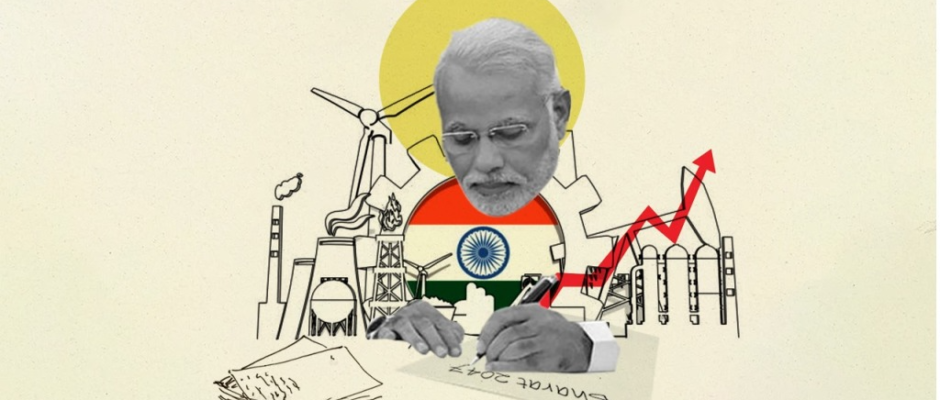
25-year roadmap to get there may be unveiled even as BJP-led Narendra Modi juggernaut gets ready to rollout seeking a third term K.A.Badarinath Twenty five years roadmap for turning Bharat into a modern, independent and developed economy with a large say in global affairs is the common theme that runs through both Presidential address at the start of Parliament’s budget session and economic survey for 2022-23. Both President Draupadi Murmu and Finance Minister Nirmala Sitharaman did the honours in the colonial era Parliament building as they reflected Prime Minister Narendra Modi’s resolve to roll out firm plans for Bharat in ‘Amrit Kaal’ spread over to 2047. Evolving a fully self-reliant country sans poverty, prosperous middle class with youth and women at forefront have been envisaged by the Modi government that will allow fulfilling all humanitarian obligations globally. Focus on ‘unity in diversity’ in Presidential address also marks yet another assertion from the government that Bharat will continue to cherish, embellish and groom all minorities by faith, worship and sections of a larger Hindu society. This may perhaps be intended at demolishing a false narrative being constructed by few global outlets that minorities in Bharat are being hounded out or subjected to genocide. The roadmap to achieve the ‘golden future’ may draw inspiration from Bharat’s glorious past, freedom struggle and 1.4 billion people’s resolve. This is the line pursued by Modi government as it readies to draw curtains on ‘amrit mahotsav’ that marks 75-years of Bharat’s independence after having pushed back colonial occupiers. Presidential address and economic survey fine print that outlines the blue print for a ‘developed country’ is nothing short of a grand stand vision for Bharat joining the big boys globally as a developed nation. Both the documents proudly declare Bharat as fifth largest economy that would expand to $ 3.5 trillion in two months. The federal budget to be presented on Wednesday by Nirmala Sitharaman may provide more clues or offer different specs to attaining the exulted status of a developed economy. Economic survey has already talked about achieving 10 – 12 nominal GDP growth in medium term as a commitment and objective to taking India big on world map as second or third largest economic powerhouse. Both Presidential address and the survey simultaneously articulated the nine years report card of Narendra Modi government’s performance across sectors. Given that BJP-led ruling alliance will have to face the electorate in May – June 2024 seeking a third term, this report card serves as a ready reckoner of what has been done during last nine odd years. Similarity does not end here. Presidential address lists out the government’s achievements in socio-economic sectors thereby improving people’s lives. Concomitantly, the survey provides a lengthy list of economic reforms and fundamental change in structural governance brought in by the Modi government. Bringing transparency and openness into public life may be yet another theme point apart from weeding out corruption at different levels. Corruption is the big plank on which BJP-led Hindu centric formation assumed power with complete majority for first time in 2014. On the reforms front, both President Murmu and Finance Minister Sitharaman have listed Goods and Services Tax (GST) as a big success story in tax reforms. While the states still have issues on GST, revenue sharing formula and several hurdles in ending the fake bills, the reform is definitely a game changer given that multitude of taxes have been phased out. Economic survey for the first time introduced a complete assessment of how peoples live changed owing to improvement in social sector indices. On the other hand, President Murmu reeled out figures to reflect the on-ground change brought about. For instance, in digitized economy, Bharat has reported Rs three lakh crore worth transactions on the e-market place. Similarly, over Rs 27 lakh crore have got transferred into bank accounts of the beneficiaries in 300-odd schemes through direct benefit transfers. Over 50 crore people have been treated under Ayushman Bharat scheme and accessed affordable medicines from 9000 jan aushadi kendras.This led to saving of over Rs 80,000 crore that could have been forked out by people on health treatment.  Over 7.5 crore households have got access to tap water. Under what started as an anti-Covid 19 drive over Rs 3.5 lakh crore worth food grains were provided to the poor and needy. Rs 2.25 lakh crore distributed as support to farmers. Out of this, Rs 50,000 crore has gone to women farmers alone.Over 36,000 hamlets of tribals have virtually been adopted under a PM’s scheme. 500 blocks seem to have got a facelift as ‘aspirational’ campaigns. Over nine crore women have benefited through self help groups while 70 per cent of small borrowers from banks were women. President’s address provided another 100 such data points to support the Modi government’s articulation on bringing about ‘transformational shift’ in people’s lives.  This also makes us believe that quietly, Modi government is getting into election mode especially after the two days national executive committee meetings of BJP held in New Delhi. On the global front, Modi government may speak on two issues prominently as a sovereign outfit and as president of G-20 as well as SCO. A peek into tomorrow’s budget may provide more clues to Modi’s big vision statement.

Read More

Panch tatva philosophy to guide India’s G-20 Presidency

Push for partnerships, hope, harmony and healing. Decisive leadership voices policy against war, conflicts and confrontation Narendra Modi Today, India commences its G20 Presidency. The previous 17 Presidencies of the G20 delivered significant results — for ensuring macro-economic stability, rationalising international taxation, relieving debt-burden on countries, among many other outcomes. We will benefit from these achievements, and build further upon them. However, as India assumes this important mantle, I ask myself — can the G20 go further still? Can we catalyse a fundamental mindset shift, to benefit humanity as a whole? I believe we can. Our mind sets are shaped by our circumstances. Through all of history, humanity lived in scarcity. We fought for limited resources, because our survival depended on denying them to others. Confrontation and competition — between ideas, ideologies and identities — became the norm. Unfortunately, we remain trapped in the same zero-sum mindset even today. We see it when countries fight over territory or resources. We see it when supplies of essential goods are weaponised. We see it when vaccines are hoarded by a few, even as billions remain vulnerable. Some may argue that confrontation and greed are just human nature. I disagree. If humans were inherently selfish, what would explain the lasting appeal of so many spiritual traditions that advocate the fundamental one-ness of us all? One such tradition, popular in India, sees all living beings, and even inanimate things, as composed of the same five basic elements — the panch tatva of earth, water, fire, air and space. Harmony among these elements — within us and between us — is essential for our physical, social and environmental well-being. India’s G20 Presidency will work to promote this universal sense of one-ness. Hence our theme — “One Earth, One Family, One Future”. This is not just a slogan. It takes into account recent changes in human circumstances, which we have collectively failed to appreciate. Today, we have the means to produce enough to meet the basic needs of all people in the world. Today, we do not need to fight for our survival — our era need not be one of war. Indeed, it must not be one! Today, the greatest challenges we face — climate change, terrorism, and pandemics — can be solved not by fighting each other, but only by acting together. Fortunately, today’s technology also gives us the means to address problems on a humanity-wide scale. The massive virtual worlds that we inhabit today demonstrate the scalability of digital technologies. Housing one-sixth of humanity, and with its immense diversity of languages, religions, customs and beliefs, India is a microcosm of the world. With the oldest-known traditions of collective decision-making, India contributes to the foundational DNA of democracy. As the mother of democracy, India’s national consensus is forged not by diktat, but by blending millions of free voices into one harmonious melody. Today, India is the fastest growing large economy. Our citizen-centric governance model takes care of even our most marginalised citizens, while nurturing the creative genius of our talented youth. We have tried to make national development not an exercise in top-down governance, but rather a citizen-led “people’s movement”. We have leveraged technology to create digital public goods that are open, inclusive and interoperable. These have delivered revolutionary progress in fields as varied as social protection, financial inclusion, and electronic payments. For all these reasons, India’s experiences can provide insights for possible global solutions. During our G20 Presidency, we shall present India’s experiences, learnings and models as possible templates for others, particularly the developing world. Our G20 priorities will be shaped in consultation with not just our G20 partners, but also our fellow-travellers in the Global South, whose voice often goes unheard. Our priorities will focus on healing our “One Earth”, creating harmony within our “One Family” and giving hope for our “One Future”. For healing our planet, we will encourage sustainable and environment-friendly lifestyles, based on India’s tradition of trusteeship towards nature. For promoting harmony within the human family, we will seek to depoliticise the global supply of food, fertilisers and medical products, so that geopolitical tensions do not lead to humanitarian crises. As in our own families, those whose needs are the greatest must always be our first concern. For imbuing hope in our future generations, we will encourage an honest conversation among the most powerful countries — on mitigating risks posed by weapons of mass destruction and enhancing global security. India’s G20 agenda will be inclusive, ambitious, action-oriented, and decisive. Let us join together to make India’s G20 Presidency a presidency of healing, harmony and hope. Let us work together to shape a new paradigm — of human-centric globalisation. (author is India’s Prime Minister and the write up coincides with India taking over presidency of G-20) 

Read More

PM Modi at G20 in Bali, Indonesia

Prachi Mishra / New Delhi Indian Prime Minister, Narendra Modi, in his speech at the first working session on Food and Energy Security of the G20 Summit in Bali, called for all the world leaders to strive for peace, security, and harmony. Deriving from the lessons learnt during the wars of yesteryears, he urged for a path to ceasefire and diplomacy in conflict-ridden Ukraine. Basing on the ethos of vasudhaiva kutumbakam, he stated that the time is ripe for all nations to collectively resolve the ongoing conflict between Russia and Ukraine. This statement holds much gravitas as India enters its year-long G20 presidency on December 1st. He said that the G20’s presidency in the land of Buddha and Mahatma Gandhi will send a strong message of peace to the entire world. In a world which is gripped with many issues, India is bound to play a key role in shaping the course of global development in the coming year. He asserted that in the post-pandemic world, where climate change, COVID-19, and the Ukraine conflict have wreaked havoc on global supply chains and disrupted systems as were known earlier, the onus of setting the new world order now lay entirely on multilateral groupings like the G20. He stressed that the relevance of G20 has increased insurmountably in the present times, especially when age-old institutions like the UN have been unsuccessful in resolving pressing global challenges. On the issue of food security, he stated that during the pandemic, India ensured that each and every of its citizens had access to and availability of food grains. In fact, India also lent a helping hand to many other countries by not only providing them with medical aid, vaccines, and equipment but by also providing them with food grains. He also brought to focus the issue of fertiliser shortage. Since fertilisers are directly linked to food grain production, their global shortage should ring a bell for the world leaders to address this paucity. Moving forward, he recommended a mutually agreed instrument that can be developed to facilitate supply of both fertilisers and food grains. He also laid stress on promoting organic farming and that many Indian states have revolutionised and re-popularised natural farming and have been promoting traditional food grains like millets to ensure sustainability. In fact, the revival of these grains has been given a strong thrust by the Indian government in the last few years to eradicate malnutrition, ensure food security, improve the livelihood of marginalised farmers, and make farming more climate friendly. Moving on to the next major point of consideration, he stressed that India’s energy security is crucial for growth globally and that vehemently opposed restrictions imposed on the supply of energy. Apropos of this, he stated that stability of the energy market must be ensured. Since there has been a clear opposition from many nation states to purchase Russian oil and gas, this tilt away from the global crude oil leader can create an astronomical imbalance in the oil and gas trade, eventually leading to energy instability. Imposing restrictions of such nature can have catastrophic consequences on global supply chains, manufacturing, and industrial production in many countries. In fact, to balance the supply scale, India increased its imports of Russian crude oil from 0.2 percent (as of March, 2022) to 22 percent (as of October, 2022). He also affirmed India’s commitments to Sustainable Development Goals and asserted that by 2030, half of Indian power needs will be met by renewable energy sources. At a time when the energy crisis has been looming in many parts of the world, India is well placed to boost its renewable energy sector. India is the founding member of the International Solar Alliance and is on the cusp of transitioning towards green energy. He also spoke about more inclusivity in technology transfer and financing so that developing countries are also able to ensure a smooth energy transition. Prime Minister Modi met and greeted other leaders of the G20 and is expected to engage with them on the sidelines of the Summit. These bilateral interactions will not only pave the way for the Indian presidency of the Summit but also bring everyone together on India’s G20 priorities. (Prachi is a research consultant at Centre for Integrated and Holistic Studies.)

Read More