
CIHS – Centre for Integrated and Holistic Studies

Date/Time:

Hindus are Safe in Bangladesh, Really?

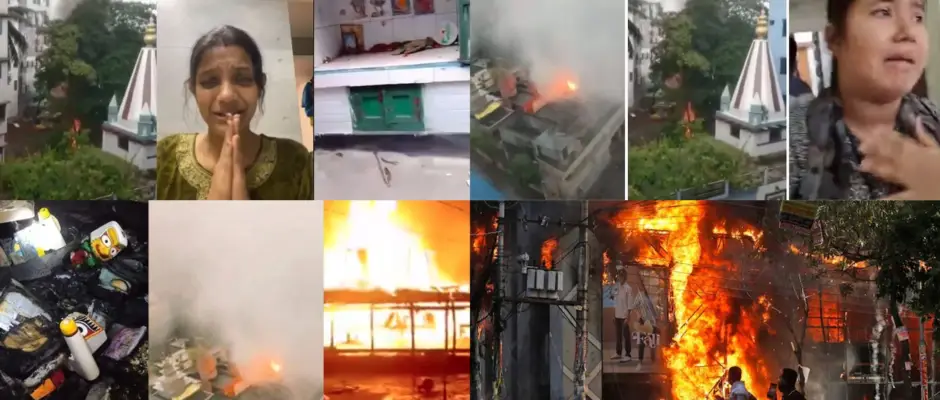
Zafar Sobhan, ���The Print’ made false, tall claims about fair treatment to Hindus. Bangladesh President Yunus came close to stating the truth, Are Hindus really not under threat from jihadists in Bangladesh? Are they safer than Muslims and other minorities in India? Well, Zafar Sobhan in a write up has made vague but determined attempt to whitewash continued atrocities against Hindus with no letup in the genocidal campaign. But, Sobhan falsely claimed that Hindus were safe in turbulent, unsettling and violence ridden Bangladesh ignoring the publicly available data, case studies and unhindered persecution. ‘The Print’ provided its columns to Zafar Sobhan for spreading these falsehoods like agenda-based international media organizations like Al Jazeera etc.   This response will methodically debunk Zafar’s fallacies and provide a true picture of minority conditions in Bangladesh. From rapes, violent attacks, forced resignation of Hindu officials to loot and occupation of their properties has become the norm while the likes of Zafar look the other way. As per Bangladesh Bureau of Statistics, Hindu population in the country has dropped drastically to 8.5 per cent in 2011and down further in last 13 years from 13.5 per cent in 1974. This demographic shift is not merely result of migration for economic opportunities but deeply intertwined with systemic discrimination, land dispossession through Vested Property Act and constant incidents of targeted attacks on Hindu society. By design and intent, Zafar seems to have downplayed incidences of violence against minorities in Bangladesh, implying that such incidents were isolated and do not reflect greater societal issues. Centre for Integrated and Holistic Studies investigations uncover that Hindu temples, businesses and houses are frequently and widely attacked particularly during times of recent political turmoil. These occurrences are not random acts of violence; they are frequently coordinated by extremist groups aiming to impose control or exploit political instability. Data for June – August 2024 indicate an organized attempt to intimidate, harm and ultimately wipe out Hindu population in Bangladesh. The attacks were carried out in several areas, targeting vulnerable individuals and religious sites. Temples in Moulvi bazar, Chittagong and Sitakunda are a few known cases of desecration that highlighted coordinated campaign of genocide and eradication. Zafar offered to paint the violent political movement that resulted in Sheikh Hasina’s departure as ‘democratic uprising free of Islamist influence’. This portrayal is inaccurate and ignores the complex realities of Bangladesh’s political scene. Islamist Influence and Extremism Emergence of extreme Islamist outfits such as Jamaat-e-Islami and Hefazat-e-Islam in Bangladesh’s political setting cannot be ignored. These organizations have documented history of campaigning for policies that oppress minorities and undermine the concept of secularism. Zafar’s denial of Islamist involvement in contemporary political movements is not supported by facts which demonstrates that these outfits have used political turmoil to promote their interests at the cost of minority oppression. Political Transitions’ Impact on Minorities In Bangladesh, it is a trend for minorities to become the targets of violent attacks during any political movements. An example of the kind of widespread violence that can result in deaths, serious injuries, significant property destruction, and vandalism of temples, was in 2021 during Durga Puja. These events demonstrate how vulnerable minorities are during times of political instability, contradicting Zafar’s assertion that minorities are safer in Bangladesh. Over years, persecution and intentional attacks against the Hindu community in Bangladesh have had a profound and long-lasting effect. For instance, massive violence against Hindus erupted in 2013 when Jamaat-e-Islami leader Delwar Hossain Sayeedi was found convicted. Around 50 temples were attacked and more than 1,500 Hindu homes were demolished. This incident fits into a larger pattern in which elections and political upheaval are followed by violent attacks against Hindus. Numerous instances occurred between 2013 and 2020, one of which was looting and demolition of 500 Hindu homes in Gopalpur village alone during the 2014 post-election riots. These acts demonstrate how this religious minority in Bangladesh is subjected to systematic and ongoing persecution. Historical Background, Persecution and Displacement It is critical to comprehend the historical background in order to evaluate current state of minority affairs in Bangladesh. The long-term patterns that have influenced lives of minorities in Bangladesh have not been sufficiently taken into account by Zafar Sobhan. Periods of severe persecution are a defining feature of the history of minorities in Bangladesh, especially during and after the 1971 Bangladesh Liberation War. Deliberate persecution of Hindus throughout the conflict and ensuing appropriation of land under the Vested Property Act have left a lasting impact on the community, leading to their uprooting and economic marginalization. During the time of struggle for Bangladesh Liberation, on March 25, 1971, the Pakistani military launched a horrific operation of genocide against Bengalis, notably on the Hindu community. Around three million individuals were killed in systematic atrocities during this genocide, which lasted until Bangladesh gained independence on December 16, 1971. At least 200,000 women were raped, and some estimates put the figure as high as 400,000. Brutality such as the Burunga massacre of May 26, 1971, when 94 Hindus were brutally killed by the Pakistani military at Burunga High School, marked the darkest height of the genocide. Over 10 million Bengalis, mostly Hindus, were forced to flee to India as a result of extensive atrocities committed by the Pakistani army, which saw no distinction between Hindu, Bengali, and Indian identities. In the blunt repercussions of the Babri structure demolition in India, Islamist groups in Bangladesh began a violent massacre against Bengali Hindus on December 7, 1992. The earliest target was the Dhakeshwari Temple in Dhaka, which was attacked and set on fire. Further targets were the Bholanath Giri Ashram, which was robbed, and the Hindu-owned jewelry stores in old Dhaka, which were destroyed. The following days saw more bloodshed when Islamist attackers in Cox’s Bazar District set fire to fourteen Hindu temples and demolished 51 Hindu houses in Ali Akbar Dale. Five temples suffered significant damage, and villages in Chittagong District such as Fatikchari and Mireswari were nearly completely destroyed by fire. By the time the

Read More

Refusal to Reform

Self-defeating journey that Pakistan embarked upon with Jihadist mindset has rendered Shimla agreement ineffective & unworkable. Rohan Giri Fifty two years back, Shimla accord inked on July 2, 1972 by then Bharat’s Prime Minister Indira Gandhi and Pakistan’s President Zulfiqar Ali Bhutto, bears testimony to Islamabad’s refusal to learn its lessons. It’s also a missed timeframe for Pakistan for evolving as a well-meaning, affable and socio-economic development partner on western borders that Bharat was looking for. Partition of Bharat in 1947 by imperialist British forces on withdrawal mode inflicted a huge injury that cannot be easily forgotten. Instead of metamorphosing as a well-meaning society based on true Islamic values, it resorted to genocide of Bengali Hindus in East Pakistan in most inhuman way in 1971. Pakistan had to eat a humble pie after getting defeated at the hands of Indian army and consequent liberation of Bangladesh. Shimla agreement concluded in Barnes Court christened as Raj Bhavan today was intended at bringing about lasting peace in South Asia, especially Bharat and Pakistan. But, that did not happen as predicted even before ink on the Shimla agreement dried. Things did not work out as Sunni extreme leadership refused to acknowledge magnanimity of Bharat in returning their 93,000 war prisoners without a word. Questions were raised on intent of Smt Indira Gandhi who returned all major territories of Pakistan that came under Bharat fold in aftermath of the war. Intentions and goals articulated in Shimla Agreement were magnificent on paper but hollow in reality. Commitment to a direct, bilateral approach to problem solving, emphasis on face-to-face interactions, were laudable. Pakistan that had long history of deception and flopped promises saw the accord as a strategic pause rather than genuine peace initiative. Among Shimla Agreement’s six important clauses, pledge to observe Jammu and Kashmir’s Line of Control (LoC) was most significant. This was one commitment that Pakistan gravely breached very frequently. Disagreements were to be settled amicably and that no government would unilaterally change the status. This again was violated. The rogue state that it evolved to be, Pakistan, continued to fuel fires of turmoil, culminating in Kargil War in 1999. This blatant crossing of Line of Control served as vivid reminder that Pakistan had never genuinely embraced principles of the Shimla Agreement. The accord had highlighted mutual respect for one another’s geographical integrity and political independence. Pakistan, with its malicious intent and plan on Kashmir made attempts on several occasions to intervene in India’s domestic affairs, breaking the very foundation of the accord. The pledge to desist from hostile propaganda was a scam, as Pakistan’s official machinery continued to spew anti-India rhetoric, stoking hatred and division. Despite the Shimla Agreement, Pakistan’s conduct over the decades demonstrated its deceit. The Kargil conflict, in which Pakistani soldiers penetrated Indian territory along the LoC, was a clear act of aggression that shattered the already fragile agreement. This fight, which lasted for more than 60 days, exposed Pakistan’s true character, reinforcing its reputation as an untrustworthy neighbor. Indira Gandhi, acclaimed as a competent leader, was heavily criticized for signing the Shimla Agreement without achieving a resolution to the Kashmir conflict. The pact was viewed as a strategic failure, a concession that failed to capitalize on India’s resounding victory in the 1971 war. Pakistan’s claim to Kashmir, combined with its repeated efforts to internationalize the issue, have rendered the Shimla Agreement ineffective and meaningless. The Shimla Agreement’s history is one of unfulfilled promises and broken expectations. It underscored the futility of trusting a country that has repeatedly proven its propensity to destabilize peace for geographical advantage. Pakistan’s repeated betrayal, from the Kargil conflict to its current backing for cross-border terrorism, demonstrates that it never intended to comply with the Shimla Agreement. The agreement, while ostensibly a plan for peace, was a strategic failure that failed to address the two countries’ core challenges. It allowed Pakistan to recover and rearm, which eventually led to other instances of conflict. India’s generous gesture of returning POWs and territory was met with Pakistan’s unwavering enmity, demonstrating once more that Pakistan’s word could not be trusted. Finally, the Shimla Agreement, which was offered as a historic step toward peace and stability. Pakistan’s reluctance to respect its pledges, as well as its ongoing efforts to destabilize the region, have demonstrated that any agreement with such a nation is worthless. The Shimla Agreement serves as a clear reminder of the drawbacks of naive diplomacy as well as the importance of taking a hard stance when dealing with a fraudulent neighbor like Pakistan. (Author is a doctoral fellow at Amity University in Gwalior, content manager at Centre for Integrated and Holistic Studies)

Read More

Fuelling Discontent Dishonestly

Ziya Us Salam’s propagandist anti-Hindu book, “Being Muslim in Hindu India” promoted by habitual offender The New York Times Dr Shailendra Kumar Pathak The book, “Being Muslim in Hindu India,” by Ziya Us Salam, an author infamous for his agenda driven writings has sparked controversy and debate, particularly due to its propagation of what many perceive as a narrative steeped in victimhood and misinformation. A recent article in The New York Times edition of May 18, 2024, titled ‘Strangers in Their Own Land: Being Muslim in Modi’s India’ by Mujib Mashal and Hari Kumar seems to be an attempt at amplifying this very min-information.  Assertions made in the book that are one-sided may have suited anti-Hindu and anti-Bharat agenda of The New York Times.  Media outlets like ABC News, AFP News from US also echoed the packaged mis-information peddled by Ziya Us Islam. On closer scrutiny, it becomes evident that claims made in the book and related articles are riddled with inaccuracies and lack substantive evidence. A few media outlets had to cut a sorry figure as US State Department debunked their claims on lack of religious freedom in Bharat. On May 20, US foreign ministry spokesperson Matthew Miller said that the state rejects such reports outright. “We are deeply committed to promoting and protecting universal respect for the right to freedom of religion or belief worldwide. We have engaged many countries including India on the importance of equal treatment for members of all religious communities,” Miller said at a briefing. In this write up, claims made by Ziya Us Islam in his book and related foreign media reports are being closely scrutinised to expose the fallacies and distortions that underpin them. Salam’s book propagates false victimhood narrative suggesting that Muslims in Bharat are constantly oppressed and marginalized due to their religious identity. This portrayal ignores the socio-political realities of Bharat where Muslims have held significant positions in government, businesses, academia and arts. Dharmic ethos has led Bharat to accommodating diverse religious communities and faiths including Muslims over the millennia. It may not be an exaggeration to say that Bharat is the only country that’s home to most sects and sub-sects of Muslims.  Overplay by foreign media sporadic localised incidents involving minorities in Bharat are absurd. Prime Minister’s Economic Advisory Council said in a report that from 1950 to 2015, muslim population in Bharat increased by 43.15 per cent. On the contrary, a decline of 7.82 per cent has been reported for Hindus during the same period. If muslims faced atrocities or were under attack as Ziya Us Islam and his media friends claim, will the absolute number of muslims surge? The research found that Christian, Sikh and Buddhist numbers increased while Jain and Parsi populations fell. Is there, any country across the world where any community faced discrimination and wrath of majority but its number grew consistently over 65-year time frame? Propagandist book alleges systemic discrimination by Indian state against Muslim citizens. On the contrary, Bharat’s Constitution guarantees equal rights and opportunities to all its citizens, irrespective of religion. Government policies and initiatives aim to uplift marginalized communities including Muslims, through affirmative action and welfare schemes. Accusations of state-sponsored discrimination lack evidence and serve only to fuel divisive agendas. One glaring flaw in Salam’s book is his selective interpretation of history. He conveniently ignores instances where Hindu-Muslim harmony prevailed and exaggerates isolated incidents of conflict to paint a grim picture of interfaith relations in Bharat. In reality, Bharat’s cultural tapestry is woven with threads of coexistence and mutual respect, exemplified by centuries-old syncretic traditions and shared cultural practices. Salam’s work ventures to perpetuate stereotypes about Hinduism, portraying it as inherently hostile towards Muslims. This misrepresentation not only undermines the rich tapestry of Hindu philosophy and spirituality but reinforces divisive narratives that fuel communal tensions. Hinduism encompasses diverse beliefs and practices embodied by principles of tolerance, compassion and pluralism. Salam’s lies hit the roof when he claims that ancestors of Bhagwan Ram were Muslims. It has been proved with scientific research that Ram existed more than 3000 years before Islam took birth on this earth. The book sensationalizes Hindu – Muslim relations by highlighting isolated incidents of communal violence while ignoring the vast majority of harmonious interactions between two communities. Bharat’s cultural fabric is woven with threads of diversity and tolerance where Hindus and Muslims coexisted peacefully celebrating each other’s festivals and sharing social bonds. Instances of communal harmony far outweigh sporadic conflicts, a fact conveniently overlooked in the propaganda narrative. Salam illustrates some incidents where those accused in murder of Muslims were given heroic welcome. The author deliberately keeps silent on targeted killing, rape and sexual abuse of Hindu girls and women perpetuated by Muslims through predesigned means and campaigns. Salam appears very upset towards laws against ‘love jehad’ encouraged by Muslim families through fake identity. His conscience does not stir when reports appear each day on rapes, murders, discords, divorce, abuse of Hindu girls. By singularly portraying Muslims as victims of purported Hindu oppression, Salam overlooks the agency and resilience of the Muslim community in Bharat. Despite facing challenges, Muslims have made significant contributions to Bharat’s cultural, economic and social fabric. From art and literature to science and technology, Muslims have excelled in various fields enriching the nation’s diversity and heritage. Attributing violence to Hindu extremism oversimplifies complex socio-political dynamics. Like any other country Bharat also grapples with various forms of violence including caste-based and intra-religious conflicts. Blaming Hindu nationalism for all instances of violence undermines efforts to address broader issues of social justice and communal harmony. Salam’s book risks exacerbating sectarian tensions by essentializing Hindu-Muslim identities and reinforcing a binary narrative of “us versus them.” Such divisive rhetoric not only undermines Bharat’s secular ethos but plays into the hands of extremists on both sides who seek to sow discord and hatred. Instead of fostering unity and understanding, Salam’s work could fuel polarization and mistrust. The propaganda propagated in Ziya Us Salam’s book, “Being Muslim in Hindu

Read More

Half-Truths Presented to Debunk Hard Reality of Jihad

Jain, S., Alavi, M., & Sharma, S. (2024). Love Jihad and Other Fictions: Simple facts to counter viral falsehoods (1st ed.). Aleph. Dr Amritpal Kaur American novelist Colson Whitehead had said, ‘what isn’t said is as important as what is said’. The Book Love Jihad and Other Fictions is an apt example of what is left out of the narrative. To begin with, the book deals with the phenomenon of Love Jihad and several other forms of Jihad that its authors believe as works of fiction. To them there is no solid ground to base the argument of Love Jihad. Broadly, the book attempts to debunk three forms of Jihad namely, Love Jihad, Population Jihad and conversion of people from Hinduism to Christianity. It argues that these ‘jihad’ or Muslim holy wars (by means of Marriage and progeny) are works of fiction. On the contrary it seeks to find ground reality to set the record straight. As the reader goes through the analysis, it is glaring that the said “facts” are rather subjective interpretations of individuals and often one-sided. In fact, it’s precisely the reason for not being able to convince the reader about the realities. To begin with, in the chapter on Love Jihad, the book sites Kerala’s very first Love Jihad case in the country where luring of a woman in the name of love and marriage led to her marriage and eventual conversion to Islam. The chapter discusses in detail about the thoughts and feelings of the man involved. However, we do not hear about the side of the Girl or her parents primarily as to why she left the man, Shahan Sha. It is important to acknowledge that in a huge majority of inter-faith marriages, it is the Hindu woman who has to convert to Islam. It seldom happens, if at all that the Muslim man converts to Hinduism. There are a number of cases where girls have reported physical and sexual abuse after initial courting period to forcefully convert to Islam. In many cases it has led to their untimely and often violent deaths.  In subsequent analysis on Love Jihad, the book emphatically deals primarily with English media as the ‘next best source’ for information. However, neutrality of Media and objectivity of facts is questionable. It would be anybody’s guess as to if the analysis is mainly based on media reports and not the unbiased information, it would be coloured by political leanings of the author and media house concerned. On population jihad, the book tries to debunk the idea that higher muslim birth rate has led to larger size of muslims population, The ‘facts and comparisons it gives are rather mind-boggling. For example, it argues that fertility rate of Muslims in South India is lower than that Hindus in the North India. Polygamy is not cited as one of the reasons for such spurt in Muslims numbers crossed 210 million in recent years. Comparative analysis of fertility levels should have been based on samples from the same region rather than mixing up data by design and intention.  Same spin on facts has been given in the case of Muslims in Assam. The book argues that muslims fertility rates in Assam is higher than that of Hindus but is not much different from national average. Can there be a true comparison when the question they seek to answer is higher population growth of Muslims in the state? The true comparison would have been between Hindus and Muslims numbers, growth rates and percentages in the same north-eastern state of Assam. That would have shown shift in population composition. By bringing the variable on aggregate Indian growth rate, the book attempts to muddy waters in favour of one individual group. Third issue dealt with is conversion of Hindus primarily into Christianity. The book argues that threat of conversion into Christianity is unreal. The case cited to elucidate the point is that of Lavanya, a teenage girl who committed suicide due to psychological pressure put on her to change her religion. The book sees the suicide as ‘complex phenomenon’ based on the family life of the girl without giving categorical ‘facts’ to either prove that Lavanya died due to conversion pressure or otherwise. Since Lavanya died due to complex issues it cannot be attributed to Christian warden of her hostel. What saves this analysis otherwise is the fact that the case is being heard by the courts. By questioning integrity and attachment of her family it sought to discard the forceful conversion of a bubbly teenage girl as main reason for her death. Ironically, had it been the case otherwise, the authors would have been a wee bit harsh in the name, calling a spade a spade. Similar courtesy has not been extended in this case as the girl is a Hindu. It is important to realize and acknowledge that muddled facts can be misleading too, views from different sources were to be heard from all the sides to derive a value neutral and objective assessment. However, the book presents one-sided analysis and by placing only convenient bits of information with wrong comparative set narratives, it paints a wrong picture. It undermines the concerns of those who have suffered at hands of such propaganda. Scores of girls’ families that died at hands of vengeful and violent suiters who pressure them to convert to Islam would vastly disagree with the book’s analysis. In fact, it is a classic case of how facts can be used to lie. (Author is Assistant Professor in Political Sciences, Dayal Singh College, Delhi University, New Delhi)   

Read More

Jinnah’s Fallacy Commemorated as Pakistan’s National Day!

The Lahore Resolution, aka Pakistan Resolution, written by Sher-e-Bangla A.K. Fazlul Huq, said that Muslims in India were a separate country with their own social, religious, and cultural identities. It called for the creation of independent states in areas where Muslims predominated. Despite the resolution’s own lack of mention of the term “Pakistan,” it planted the seeds for its ultimate establishment. Millions of Muslims’ hopes for their political future were brought to life and given a tangible vision by the Lahore Resolution. Intellectuals like Allama Iqbal, who emphasised the political, social, and cultural distinctions between Muslims and Hindus, were instrumental in developing the idea of a distinct Muslim state. The concept gained more popularity after Choudhary Rahmat Ali’s 1933 pamphlet “Now or Never”, which suggested calling the hypothetical state “Pakistan”, was published. Pakistan is an odd outlier in the vast fabric of geopolitical history, a nation that appeared out of thin air and lacks a tangible locus. Its establishment in 1947, during the mayhem of British decolonization in the Indian subcontinent, was not a product of historical or cultural evolution, but rather of political expediency. Ever since its establishment, Pakistan has faced difficulties in defining its identity and navigating issues related to legitimacy, governance, and identity beyond its arbitrary borders. Pakistan was created by political plotting motivated by the demands of sectarian politics and colonial legacies, not by a natural process based on nationalism. Pakistan was created by the division of British India. Pakistan’s ideological foundation came from the Two-Nation Theory, which maintained that Muslims and Hindus were two distinct nations that could not cohabit in a single state. Nevertheless, this notion oversimplified the complex sociocultural context of the Indian subcontinent and ignored the diversity within Muslim communities. Pakistan’s identity gets more complex by its large geographical region. Divided by over a thousand miles of Indian territory, East and West Pakistan (now Bangladesh and Pakistan, respectively) had little in common except their shared religious beliefs. This physical separation further undermined the legitimacy of the Pakistani state, escalating racial tensions and ultimately leading to the bloody battle and Bangladesh’s secession in 1971. Two-Nation Theory of Muhammad Ali Jinnah was weak and unimpressive. It was hollow on an intellectual level and disconnected from reality. Muslims were everywhere throughout India and all of them would not have been able to have had their own homeland without a massive population swap. Although Ambedkar and Jinnah discussed it in passing but both must have understood how unrealistic it was. Yet, Jinnah was able to stir up fleeting feelings and sway Muslim sentiment in his favour. The day India was divided proved its falsehood. Just slightly more than half of the 100 million Muslims migrated to Pakistan. The remainder chose to remain in India.[1] Jinnah, leader of the All-India Muslim League, fiercely advocated Muslims’ rights in British India. He believed that the Muslims of the subcontinent were a distinct people and that they ought to have their own nation where they could openly practice their religion and have their rights to politics and culture protected. This idea served as the cornerstone of his political campaign to establish Pakistan. A fundamental element of Jinnah’s scheme and subsequent partition of the Indian subcontinent was the Two-Nation Theory. The argument that Muslims and Hindus in British India were two different nations with irreconcilable differences was used by Jinnah and his Muslim League to support the demand for a separate Muslim state.[2] With support from Muslim League, Jinnah formulated the Two-Nation Theory for the purpose of defending their political, cultural, and religious rights, contented that Muslims needed their own state.  This increased tensions between communities and prepared the ground for the terrible violence and uprooting that precipitated division in 1947. In fact, the split itself continues to rank among the most horrific events in the history of the region, causing extensive killings, large-scale migrations, and lingering hostilities. There is no denying that Jinnah’s Two-Nation Theory still has an impact on South Asia’s political climate today. The contentious relations between India and Pakistan and the continuous discussions in the region about nationalism, identity, and religious plurality are all affected by the legacy of partition. Dismissing the Myth That Hindus and Muslims Cannot Coexist With a population of over a billion, India is home to both one of the biggest Muslim populations in the world and a majority Hindu population, dispelling the idea that the two religions cannot live in harmony. Most Muslims and Hindus in India live in harmony, sharing homes, workplaces, and cultural activities.  This coexistence is a result of centuries of shared history and respect for one another, not just an oddity. Rhetoric that asserts Muslims and Hindus cannot live in harmony has reappeared in recent years. The long history of tranquilly and cohabitation between these two cultures in the Indian subcontinent is undermined by this dividing narrative, which is frequently supported by political agendas and sectarian interests. The belief that Muslims and Hindus cannot live together exaggerates complex social realities and ignores millennia of shared cultural history and respect. Many religious sects have historically called India home, contributing to the country’s rich cultural diversity. First of all, these claims are contradicted by India’s own history. For centuries, Muslims and Hindus have coexisted in the same social and cultural context, sometimes amicably and other times tensely. The blending of these two major religions is attested to by the nation’s syncretic traditions, which are seen in its literature, festivals, and architectural design. From ancient times India has been a melting pot of several religions, where mutual respect and understanding have often prevailed. During the Indian Independence movement, Muslims and Hindus fought side by side against British colonial rule. Visionaries like Mahatma Gandhi and Maulana Abul Kalam Azad, who highlighted that all Indians, regardless of their creed, share a common destiny, advocated religious harmony and cooperation. There are countless examples of Hindus and Muslims living side by side in harmony and peace throughout India. The reality on the ground belies the

Read More

French culture, core values under threat!

Entire Western Europe face challenges in integrating refugees & immigrants that are mostly Muslims, forging diverse & united society Rahul Pawa In the wake of tragic police shooting of Nahel M., a seventeen-year-old teenager of Algerian-Moroccan heritage in the Parisian suburb of Nanterre on Tuesday, June 27, 2023, French Republic finds itself engulfed in a tempestuous storm of violent protests, as impassioned demonstrations, riots, and looting cascade through its streets. Against backdrop of persistent allegations of entrenched discrimination, this surge of violent events has cast a stark light on disconcerting societal fissures that run deep within French Republic. More-so, the untimely demise of teen delivery driver Nahel during a routine traffic stop, serves as a poignant reminder of the profoundly intricate and multifaceted predicament that now grips the nation. Evoking disquieting parallels to haunting events of three-week-long 2005 French riots, during which police actions resulted in the tragic deaths of two immigrant teenagers who sought refuge in an electrical substation, tensions surged again. Discrimination and police harassment in impoverished immigrant residential areas resurfaced as pressing concerns, casting a shadow over societal harmony. Meanwhile, President Emanuel Macron’s sudden departure from critical discussions within European Union (EU) regarding Russia -Ukraine conflict, coupled with his government’s contemplation of a potential declaration of emergency, leaves France teetering on the precipice of uncertainty. Gravity of the situation cannot be overstated: France, along with several other Western European nations, is facing an ongoing crisis in terms of integrating immigrants and refugees. This crisis is exacerbated by a significant loss of trust within society, intensifying an already unstable situation and sparking tensions with far-reaching consequences. Recent discourse on demise of the teen delivery driver Nahel has centered around French immigration and refugee protection and return elucidating a wide spectrum of perspectives on crucial themes of discrimination, integration and cohabitation. France, renowned for its opulent cultural heritage spanning the realms of art, literature, music, fashion, cuisine, and philosophy, occupies an eminent position on the global cultural stage. Nevertheless, the nation has faced challenges in effectively assimilating diverse populations and nurturing a sense of unity. A study commissioned by France’s national statistics agency, INSEE, has revealed that immigrants comprised approximately 10.3% of the population in 2021, amounting to nearly seven million individuals. This figure signifies an increase when compared to 6.5% of foreign-born residents in 1968. Migration has played momentous role in shaping the multifaceted tapestry of the country with approximately a third of the citizenry having a connection to immigration across three generations. In recent years, immigrants from former French colonies in North Africa, sub-Saharan Africa, and Asia have constituted a significant contingent within the immigrant community. Significantly, a substantial portion of immigrants in France hail from Algeria, accounting for over 12% of the immigrant population. Similarly, around 12% of immigrants come from Morocco, while approximately 4% originate from Tunisia. Additionally, there is a notable influx of immigrants from Portugal, comprising over 8% of the total, followed by Italy at 4%, Turkey at more than 3%, and Spain at approximately 3%. Interestingly, women make up the majority of these immigrant communities. It is worth noting that many immigrants have chosen to settle in major urban centres including capital Paris, where nearly one-fifth of the population embraces their immigrant heritage. Despite this significant presence, it is intriguing that France’s immigration rates remain lower than the European average, lagging behind countries like Germany and Spain. The rise in immigration can also be attributed to challenges faced by the European Union (EU) during the refugee crisis that began in 2015. As part of the EU’s collective response to the crisis, member states, including France, agreed to accept a specific number of refugees based on a quota system. These quotas are determined collectively, considering factors such as the country’s population size, GDP, and capacity to integrate and support refugees. Based on available data and estimates, it is reported that as of December 31, 2020, the French Office for the Protection of Refugees and Stateless Persons (OFPRA) identified 455,295 refugees and individuals under other forms of international protection in France. The complexities surrounding immigrant integration extend beyond mere numbers and require a concerted effort to foster inclusivity, provide adequate support systems, and ensure equal opportunities for all members of society. Although France has made progress in addressing these challenges, there is still much work to be done to bridge the gaps and create a cohesive society that embraces diversity while upholding the principles and values that define French culture. Within this landscape, divergent viewpoints emerge, with some advocating for strict assimilation, emphasizing French national identity and values, while others champion a more pluralistic approach, extolling the worth of cultural diversity and the recognition of different identities. These contrasting perspectives reflect broader conversations about finding equilibrium between preserving French cultural heritage and embracing the multicultural reality of a globalised world. The concept of “coexistence” remains nuanced and ever-evolving within French society, requiring sustained dialogue, understanding, and efforts to bridge divisions and foster an inclusive and harmonious environment for all. Nevertheless, France has faced a multitude of contentious issues throughout its recent history, encompassing critical matters such as cultural identity, religious expression, and social integration. These conflicts arise from cultural disparities and conflicting ideologies. Samuel Huntington’s theory of a ‘clash of civilisations’  suggests that divergent cultural and religious beliefs among civilisation’s could lead to strife and disharmony. In the French context, this clash has taken various forms, particularly concerning the integration of Muslim immigrants. Over the years, the French society has been subject to intense debates regarding religious practices, secularism, democracy and the role of Islam within French society. One key point of contention revolves around the delicate balance between the Islamic way of life and French liberal ethos. Incidents of alleged discriminatory practices targeting racial and religious minorities, including unjust arrests, harassment, and excessive use of force, have eroded trust among immigrant communities and perpetuated a perception of discrimination and inequality in French society. While French legislation, such as the 2004 law prohibiting

Read More

OIC selective amnesia, attempts to interfere in India’s affairs

Undermining Indian values may not help Muslim outfit, especially when it falls in line to support terror modules, their handlers Since its inception, Organisation of Islamic Cooperation (OIC) has made serious moves to interfere in India’s affairs periodically to constructed inaccurate, selective and misleading narrative that contravenes facts. During the recent violence heaped on peaceful Ram Navami processions last week, OIC came into the ring denouncing one side and following a set pattern. In the statement, OIC general secretariat said, “It has followed with deep concern the acts of violence and vandalism targeting the Muslim community in several states in India during the Ram Navami processions, including the burning of a madrasa and its library by an extremist Hindu mob in Bihar Sharif on March 31, 2023.” It continued, “The OIC General Secretary denounces such provocative acts of violence and vandalism, which are a vivid manifestation of mounting Islamophobia and systemic targeting of the Muslim community in India. The OIC General Secretary calls upon the Indian authorities to take firm actions against the instigators and perpetrators of such acts and to ensure the safety, security, rights and dignity of the Muslim community in the country.” In a befitting reply to these unwarranted one sided comments, official spokesperson of Ministry of External Affairs, Arindam Bagchi, said on April 4, 2023, “We strongly condemn the statement issued by OIC secretariat today regarding India. This is one more example of their communal mind set and anti-India agenda. OIC does its reputation damage by being constantly manipulated by anti-India forces”. Facts were contrary to what OIC said in its press statement. Across states like Bihar, West Bengal, Maharastra and Jharkhand, islamists had targeted peaceful Ram navami processions when they passed through muslim majority areas provoking reaction from the faithful Hindus in a couple of places. On March 30, 2023, Ram Navami procession near Panjrigar mohalla in the Vadodara district of Gujarat was attacked by Islamists who pelted stones at the procession. In Uttar Pradesh, an incident of stone-pelting on a Ram Navami procession passing in front of a mosque was reported in the state’s capital Lucknow. In Maharashtra, Hindu processions were attacked in Chhatrapati Sambhajinagar, Jalgaon, and Mumbai. A Ram Navami procession in the Malvai region of Mumbai’s Malad suburb was attacked by an Islamist mob as it passed by a Masjid near gate no. 7 area. In West Bengal, clashes broke out between two communities during a Ram Navami procession in the Dalkhola area of Islampur town of North Dinajpur. One person was killed and 5-6 policemen were injured in clashes in a Muslim-dominated area. Failure of the muslim religious and political leadership to rein in the rioters and violence perpetrators from their side seems to be root cause of violence, arson and friction. One key question is why does violence always happen during Hindu festivals that denote tolerance, bonhomie and boisterous with bhajans, singing and dance? Why’s it that violence invariably happens in Muslim majority areas? And, why’s it that Muslim leadership maintains a deafening silence on violence by jihadists and islamists of every hue and colour? This is not the first time OIC made attempts to interfere in India’s internal affairs violating global norms of diplomacy, decency and engagement in sane manner. Previously OIC had come up with a dubious statement on purported ban on Muslim female students from wearing hijab in the state of Karnataka. The statement had read, ‘the continued attacks targeting Muslims and their places of worship, the recent trend of anti-Muslim legislations in different states and rising incidents of violence against Muslims on flimsy pretexts are indicative of the growing trend of Islamophobia.’ Here again, the issue was misrepresented. Karnataka state government had only asked all students including female Muslims to adhere to uniform code set for colleges and schools. The issue was blown out of proportion after about half a dozen girls made hijab an issue as activists of banned organization, Popular Front of India (PFI). OIC also seems least bothered about partial or complete ban on hijab imposed by some of top Islamic countries. Chad, Egypt, Cameroon, Morocco, Algeria, Iraq, Kazakhstan, Kyrgyzstan, Tajikistan, Tunisia, Uzbekistan, and Gabon are some of the prominent Islamic countries that are members of OIC that have not made wearing of hijab mandatory. Prior to that, the notorious organisation trumpeted its concern on reported Haridwar hate speech describing that as a public call for genocide of Muslims by Hindu followers. Muslims genocide has never ever happened in India’s history of millennia. In fact, it was the other way round. In Kashmir, thousands of Hindus had to migrate out over last three decades owing to constant attacks, humiliation, loot, rapes and abuse at the hands of muslim terror outfits fanned, funded and indoctrinated by Pakistani ISI. OIC, in its meeting on the side lines of 76th U.N General Assembly, pressed India to reverse its decision to remove Jammu and Kashmir’s special status. In fact, abrogation of article 370 of Indian Constitution was an internal administrative decision of the duly elected sovereign government through a due process of law enacted by Parliament, the highest democratic institution in the country. In 2020, Delhi riots, OIC selectively said that riots had caused arson and vandalism of Muslim-owned properties. On the contrary, facts have come to fore where Hindus lost lives, properties and got severely abused at the hands of gun trotting Muslim terrorists.  Way back in 1969, Muslim world collaborated to form its own international organisation to act as collective voice of Muslim world named the Organisation of the Islamic Conference, later renamed as Organisation of the Islamic Cooperation (OIC) in 2011. After United Nations, OIC is the world’s second-largest international body with 57 member countries, all of which are Islamic nations or countries with Muslim majority. India, despite being home to second-largest Muslim population country in the world with over 210 million muslims is not a part of the OIC. OIC is managed by Saudi Arabia, although Pakistan, as the only Islamic country

Read More

Depressed Subgroups Under Notified Indian Minorities

 Rohan Giri / New Delhi Muslims, Christians, Sikhs, Jains, and Zoroastrians (Parsis) are among the five religious groups or sects that are granted minority religion status under the Indian Constitution. These designated Indian minorities do, however, contain depressed subgroups that experience prejudice on a daily basis from their own community members. This report reflects on the state of affairs of such depressed minorities under notified Indian minorities. (Rohan is a journalism graduate from Indian Institute of Mass Communication (IIMC) New Delhi, and Manager Operations at CIHS.)

Read More

Listless Anti-India Propaganda Exposed!

Self-proclaimed intelligentsia attempt to eulogize terror, terrorists & their handlers do not hold water. It’s against basic grain of democracy! Neha Dahiya / New Delhi On April 19, self-claimed intellectual Arundhati Roy spoke on “Religious Nationalism, Dissent and the Battle between myth and history” in University of Texas at Austin. Laced with false propaganda, inherent extreme bias, intellectual bankruptcy, hatred and many factual errors, Arundhati Roy seems particularly rattled by the current government’s firm stand on putting an end to decades-old nexus of anti-India forces, NGOs and terror groups. In her speech, she relentlessly picked out the word, BJP, RSS and Prime Minister Narendra Modi depicting her obsession and self-constructed fear for the current Indian government. Claims versus facts on RSS Contrary to claims made by Arundhati Roy, whose links with terror outfits is well documented, RSS is neither fascist nor racist. RSS is the largest voluntary organisation that’s service oriented, inculcates patriotic spirit amongst the Hindus globally and pushes for sustainable development agenda for humanity rooted in ‘Sanatan dharma’, Indian civilizational values. From providing education opportunities to millions of under-privileged kids to empowering girl children and women, RSS has been at forefront in bringing about fundamental shift in Indian society that got emancipated from the long British imperialist rule. RSS human service during natural disasters either in India, US or Europe has been widely reported. From saving lives to providing succour, RSS volunteers had shown exemplary idealism especially during earthquakes, floods epidemics or hurricanes. Completely ignoring RSS long track record of humanitarian approach to peoples’ problems, Arundhati making desperate attempt to label the organization ‘fascist’ has no basis. In fact, Arundhati and her Leftist hooligans are the intolerant fascists that unleashed terror on patriotic RSS volunteers in states like Kerala and West Bengal. In these states, Marxist cadres supported and promoted by Arundhati Roy have murdered scores of RSS volunteers till date. Yet another substantiated charge made by Arundhati Roy was that RSS is setting fire to the country and attacking both Christians and Muslims in Kashmir. Militant cadres inspired by Mao Tse Tung including Arundhati Roy have played with fire and have blood on their hands in India. Arundhati Roy and her political principals are known to have provided weapons to innocent tribals in Jharkhand, Chattisgarh and Andhra Pradesh to create unrest and disturb peace in these states. Self-proclaimed intellectuals like Arundhati Roy were known to have provided shelter to Left wing extremists as well as anti-India terror groups with a subversive agenda. Arundhati says that RSS centennial celebrations in 2025 will be a watershed moment in Indian history. She’s right in a way. Rise of Hindutva inspired Indian society and people are bound to play a larger role on global stage. Be it environment, human rights to women’s empowerment, RSS and Hindus will make their mark internationally with classical civilizational values like ‘Vasudhaiva Kutumbatam’ being the war cry. Turning the entire humanity into a larger family is what the likes of Arundhati Roy seem serious frightened about. What’s wrong in exposing the opponents of RSS that came into being in 1925? One hundred years of eventful, non-profit work of RSS stands out through a bouquet of its organizations dedicated to prosperity and wellbeing of the humanity. RSS rose like a phoenix after having been banned four times, thrice by the successive intolerant Congress regimes in India and once by the British rulers. These restrictions on a democratic, open and norms based organization, did not adversely impact the pace, progress and growth of RSS. Manipulated data on Hindu festivals What flummoxed most Hindus is Arundhati Roy’s concocted charges that they wielded swords and sticks against Muslims during the sacred festivals, Ram Navami and Hanuman Jayanti. Each year, both Ram Navami and Muslim festival, Ramzan are celebrated more or less during same days leading to heightened tempers. Her ranting that Hindus were the first to provoke and attack muslims in eleven cities during the Ram Navami and Hanuman Jayanti processions is not based on based facts but figment of fertile imagination. In fact, on the ground in all eleven cities, it’s the peace-loving Hindus that were at the receiving end. Terror-linked Islamists urged and encouraged by the likes of Arundhati Roy attacked Hindus. On April 16, 2022, Islamist miscreants attacked Hindus in Delhi from all sides, pelted stones, beat up both the devotees of Ram & Hanuman as well as security personnel. Seven Islamists that were apprehended by the Delhi Police have past record of gambling and murder related crimes. In fact the attackers seriously injured eight police personnel manning law and order apart from one civilian. Three firearms and five swords recovered from the accused debunk claims of those supporting the arsonists. On April 11, 2022, in Khargone and Barwani of Madhya Pradesh, Islamists threw petrol bombs and stones on the procession and set many vehicles on fire. This incident has been given a different colour to suit the anti-Hindu and anti-India narrative peddled by Arundhati Roy and her comrades in arms. On April 11, 2022, in Himmatnagar of Indian western state Gujarat, Islamist arsonists attacked Hindu devotees that were peacefully singing bhajans in praise of Lord Ram during Ram Navami procession. Islamists hurled stones at them. In yet another incident at khambat of Gujarat, Islamists set ablaze eight Hindu shops and pelted stones on the devotees procession. At Lohardaga in Jharkhand, Islamists set ten bikes and one van belonging to Hindus on fire. In this violent attack that was perpetrated on April 10, 2022, one Hindu lost his life. Was this even taken cognisance of by Arundhati Roy and her proclaimed intellectuals gang working round the clock to push the wrong envelope? On April 10, 2022, in Howrah, West Bengal, Islamists attacked around twenty Hindus including three policemen who were in a procession. Two days prior to this, Islamists cut the power supply by design to attack and pelt stones on the Hindus. They set two cars and a bike on fire as well. In north-western state, Rajasthan’s

Read More