CIHS – Centre for Integrated and Holistic Studies

Date/Time:

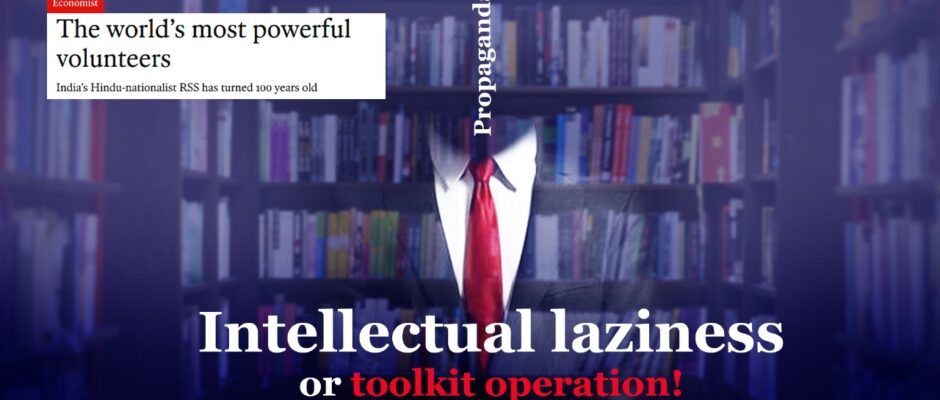
Intellectual Laziness or Toolkit Operation!

Intellectual Laziness or Toolkit Operation!

The Economist’ stands exposed in its agenda driven write up on RSS, world’s largest voluntaristic Hindu centric movement. Dr Aniket Pingley The Economist, in its edition dated September 11, 2025, has published a leader write up on Rashtriya Swayamsevak Sangh (RSS), also known as Sangh. It postures as serious analysis. In reality, it is a flimsy collage of clichés, innuendo and context-stripped assertions. The author has not studied RSS; he or she has merely parroted decades-old propaganda, hoping that repetition will substitute for rigour. This is not journalism; it is intellectual laziness with an agenda. I have been trained in rigorous research within scientific disciplines which means I test every claim against data, logic, intention and approach. Unlike the author, I will not shoot and scoot with unverified slogans. I will hold up each statement, examine it under evidence and reasoning and expose whether it stands or collapses. Let’s begin. The overarching theme of this article is this – a mere lazy recycling of tropes. The author serves up familiar accusations as though they were fresh insight. In truth, it is the same stale dish of “paramilitary,” “fascist,” “second-class citizens,” and “paranoia” — merely reheated and presented as new. These labels have been thrown at the Sangh for past several decades, none have stood the test of law or fact and yet they are recycled here again. Instead of examining how RSS sustains 83,000 shakhas or runs 150,000 service projects (as stated by the author), the author prefers easier route of re-serving leftovers from decades past. Before we move ahead, let me unmask toolkit used by the author, like most other authors who are critical of the Sangh. The author uses eleven manipulative devices: This toolkit is not one of scholarship but one of manipulation. Let us now examine how this blunted toolkit is used to criticize the Sangh. For ease of reading, I have used a table for presentation. The list is not exhaustive; however, it should serve the purpose. Criticism in Article Toolkit Trick Used Facts Queries RSS wants Hindu-first India, minorities as second-class Stereotype recycling + loaded language Minorities hold top constitutional offices; Muslims vote, run businesses, thrive in arts and sport. Socio-economic progression of Muslims is an undeniable fact If minorities are “second-class,” by what metric? Where is the data? RSS ideology violates secular constitution One-dimensional framing RSS never sought a theocracy; it speaks of cultural nationalism. BJP once endorsed “positive secularism.” If RSS violated the Constitution, why has no court ever said so in 100 years? RSS has paramilitary/fascist roots Guilt by association + stereotype recycling No armed wing, no dictator, no fascist-style state control. Built around shakhas, service, volunteerism. If early rhetoric mattered, why is there no continuity of fascist traits today? RSS was banned thrice Cherry-picking 1948 ban lifted after courts did not find RSS’s role in Mahatma Gandhi’s assassination; 1975 was outright Emergency suppression; 1992 ban struck down by court. If truly dangerous, why revoke every ban? Why not ban permanently? Muslims as second-class Shoot-and-scoot Muslims enjoy constitutional equality, socio-economic welfare schemes, political representation at every level. What does “second-class” mean? Denied vote? Barred from office? Where is evidence? Babri demolition / Ayodhya Innuendo CBI court acquitted all accused; temple built via Supreme Court judgment after a long, patient waiting by the entire nation. Why omit the court verdict? Why keep innuendo alive after acquittal? Why omit that the nation celebrated the construction of the temple on a grand scale. RSS paranoia/obsession Loaded language 150,000+ service projects in education, health, relief; 83,000+ daily shakhas build discipline. Is this paranoia? Is community service equal to obsession? Where’s the proof? Authoritarian discipline = fascism Trope recycling RSS decisions by consensus; organizations inspired have disagreed on issues publicly. If authoritarian, why do these organisations openly disagree with BJP policies? Hindutva dominates all politics Fear projection + alarmism Opposition still governs major states; BJP loses elections; multiple visions compete. If Hindutva dominates, why do opposition parties win a significant chunk of votes across all states? I would like to highlight the author’s intellectual laziness furthermore by unmasking baselessness of his statements. Here are a few: Quote 1: “Senior members have distanced themselves from some of their predecessors’ rhetoric (not least the stuff about fascists).” Quote 2: “Earlier this year, Mr Bhagwat backed a popular call for India to carry out a caste census, even though the RSS… had long opposed this.” Quote 3: “The RSS is fuelled both by confidence and paranoia.” Each of these quotes, when stripped of their toolkit tricks, collapses into hollow rhetoric. Let me now educate the author about the Sangh. Unlike caricature offered, RSS is a cultural, civilizational project of institution-building and service. Here are some of its pillars that enabled 100-year long, thriving journey: This is the picture any serious analyst must confront. The Economist’s author chose instead to erase it entirely. One wonders as to why The Economist allows such a piece under its banner. Where was the editorial rigour? Why publish an article that recycles tropes, omits essential context and reduces complex realities to slogans? If these are the standards set for its writers by ‘The Economist’, the world’s largest volunteer organisation, then, RSS does not diminish. It is The Economist’s credibility. RSS has survived hostilities, slander and decades of unwarranted criticism done with an agenda. It continues to grow as it is rooted in Bharatiya society and not on borrowed clichés. The Economist’s article does not analyse the RSS. It exposes the intellectual bankruptcy of its editorial board and brings to closer scrutiny its rigour for writing. (Author is an accomplished computer scientist, educator, and holds expertise in media content strategy)

Read More
Open-source intelligence (OSINT) reveals that the Savera coalition and the groups that countersigned its 10 July 2025 letter are not a loose assortment of concerned New Yorkers; they constitute a disciplined advocacy network that fuses three streams of ideologies: 1. U.S.–based Muslim-Brotherhood-adjacent infrastructure led by CAIR-NY and the Indian American Muslim Council (IAMC); 2. A newly-minted “progressive-Hindu” and anti-caste façade (Hindus for Human Rights, Ambedkar King Study Circle, Dalit Solidarity Forum) that supplies anti-Hindu normalisation; 3. Legacy left-wing, church and labour partners (e.g. The Riverside Church, Rabbis for Ceasefire, ASAAL, DRUM) that amplify messaging inside “legacy left wing circles” circles. These entities repeatedly collaborate under banners such as Reclaiming India and the Alliance for Justice & Accountability, run coordinated social-media campaigns, and target three policy nodes in Washington: Congress, USCIRF and the State Department. Their operational goal is to brand Indian government positions, and increasingly mainstream Hindu events in America, as “supremacist”, thereby normalising an equivalence between Hindutva and violent extremism. While most are registered 501(c) organisations, multiple red-flag indicators emerge: historic Hamas-related designations (CAIR), documented Jamaat-e-Islami overlaps (IAMC), Soros-funded BDS-style campaigning now redirected from Israel to India (HfHR), opaque fiscal disclosures, and revolving-door leadership across the network. The pattern warrants Treasury, DOJ and IRS scrutiny for potential FARA non-compliance, foreign in-kind support and grant-making that masquerades as purely humanitarian work.

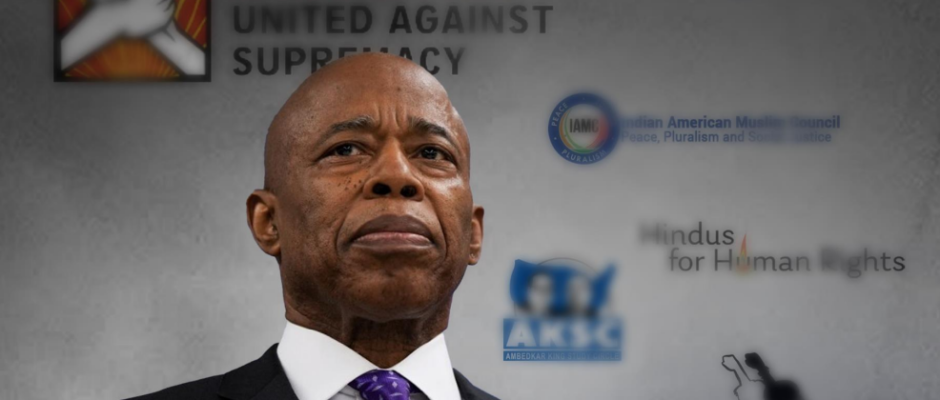
Understanding Savera, 31 co-signatories that petitioned Mayor Eric Adams

Open-source intelligence (OSINT) reveals that the Savera coalition and the groups that countersigned its 10 July 2025 letter are not a loose assortment of concerned New Yorkers; they constitute a disciplined advocacy network that fuses three streams of ideologies: These entities repeatedly collaborate under banners such as Reclaiming India and the Alliance for Justice & Accountability, run coordinated social-media campaigns, and target three policy nodes in Washington: Congress, USCIRF and the State Department. Their operational goal is to brand Indian government positions, and increasingly mainstream Hindu events in America, as “supremacist”, thereby normalising an equivalence between Hindutva and violent extremism. While most are registered 501(c) organisations, multiple red-flag indicators emerge: historic Hamas-related designations (CAIR), documented Jamaat-e-Islami overlaps (IAMC), Soros-funded BDS-style campaigning now redirected from Israel to India (HfHR), opaque fiscal disclosures, and revolving-door leadership across the network. The pattern warrants Treasury, DOJ and IRS scrutiny for potential FARA non-compliance, foreign in-kind support and grant-making that masquerades as purely humanitarian work.

Read More
Washington Post Does It Again!

Washington Post Does It Again!

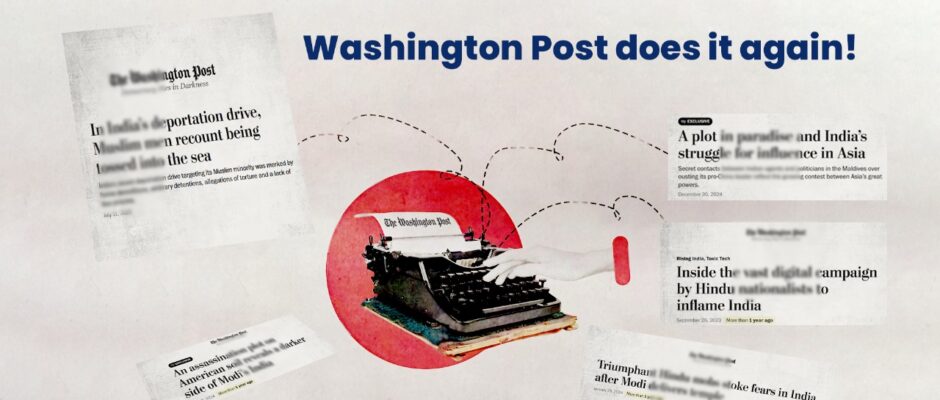
Agenda based biased reportage from Bharat seems to never end. Latest story is with regards to illegal infiltrators from Bangladesh. CIHS Several global media representatives operating out of India or those descending in New Delhi on behalf of organizations like Washington Post seem to have been adequately briefed on their agenda. And, these uncouth operators who carry press cards may have in reality been sold out to ‘anti-Bharat’ lobbies globally. Otherwise, there’s no reason why Washington Post does time and again only seek to debunk the India story through its editorial and news columns. Latest in a series of ‘anti-India’ despatches appeared in July 11, 2025 edition of Washington Post under the headline, “In India’s deportation drive, Muslim men recount being tossed into sea” put together by Pranshu Verma, Tanbirul Miraj Ripon and Sahal Qureshi. Their claim through the write up is simple from the word ‘go’. They claimed with obviously little or no-evidence that Indian Muslims with valid documents were either thrown into the sea or pushed across Bangladesh borders. Detentions, demolitions and torture purportedly perpetuated by Indian security personnel have been written about. Even a cursory online search puts the number of illegal migrants and Bangladeshi infiltrators as more than 20 million turning India into being the country with largest number of illegal migrants in the world. As per Ministry of Home Affairs, Bharat, Delhi and Mumbai, apart from coastal states like Gujarat and Goa have become centres of illegal migrants especially from Bangladesh and Pakistan. These numbers in no way bother Washington Post reporters with an ‘agenda’ to paint Bharat black and dirty as it expands its growth story, spreads prosperity and remains open, largest and a bustling democracy. Washington Post management decision to run an anti-India tirade through its editorial and news pages may not surprise many. In recent past, WP published two anti-India stories that turned out to be blatantly false if one were to go by Indian government. One WP report made a sensational claim that India made serious attempts to impeach Maldivian President Mohamed Muizzu. Second big claim made by WP was that Indian agents attempted to eliminate certain terror elements in Pakistan. Well, both reports were denied by Indian government and bracketed them as ‘compulsively hostile’ in nature, spirit and content. In fact, Washington Post had to publicly apologise for mocking at Bharat’s mars mission with ‘frugal budgets’ and turning it blatantly racist. Well, WP management, under owner Jeff Bezos of Amazon who purchased the media house through Nash Holdings in 2013 for reported US $ 250 million, may have overstepped in its editorial and news policy towards India. Otherwise, there’s no reason why Washington Post goes hammer and tongs against Bharat, her interests and her ethos. Leave alone the factthat Bangladeshis form largest chunk of illegal immigrants, WP does not consider significant enough that India is home to over 205 million Muslims as per Pew Research. And, this number would only grow in multiples to become largest Muslim population in the world by 2050. Now, these projections are in contradiction to WP claims of Muslims being targeted or framed by India. Deportation of infiltrators or illegal immigrants from India may not be an outright crime. But then, for Washington Post, it’s a human rights issue. Will Washington Post come up with screaming headline when illegal migrants to America are sent back to their countries of origin? In the deportation of infiltrators, where do Hindu groups figure? What’s their crime? Why portray Hindus as the aggressors? In the process, Washington Post has lost the plot and pursuit to objective reporting of events, developments and ‘news worthy’ issues. If India were to demonize her own Muslim citizens as claimed by Washington Post, how does one explain their socio-economic progression in last two decades in particular? In a campaign against illegal occupation of public spaces also, Washington Post sees a sinister design to dismember Muslims in India.

Read More
‘Mis-Reporting on War Against Terror’

‘Mis-Reporting on War Against Terror’

India faced serious issues when a few top international media outlets shred objectivity in their reportage on terror, terrorist organizations, their handlers and financiers. Rohan Giri In the dense fog of war against terror unleashed by India after dastardly killing of 26 tourists in Pahalgam, several international media outlets rushed not to inform, but to build slanted opinion in sync with their agenda-based narratives. From manipulated assumptions to selective outrage, recent reportage by outlets like The Independent, Al Jazeera, British Broadcasting Corporation (BBC), The Guardian, The Washington Post and The New York Times raises serious questions not just about journalistic standards but the intent behind this slanted coverage of war on terror. Even global news agency like Reuters fell to prey to such narratives. Between May 7 – 11, India’s Ministry of External Affairs (MEA) and Ministry of Defence (MoD) jointly released evidence and detailed press briefings were held showing how India’s calibrated military actions were in direct response to a spate of cross-border terror attacks traced to Pakistan-based jihadi networks. Indian government provided satellite Intelligence, precision strike data and official press briefings were held. But, the international media houses chose to bury facts, ignore or sidestep India’s security concerns, campaign against terror and gave platform to unverifiable Pakistani military propaganda. One big question was the possible agenda these media houses peddled during the conflict? London-based The Independent carried articles in series on terror attacks, military retaliation by India and the two full days of conflict. One piece suggested that Pakistan shot down three Indian Rafale fighter jets. Reuters went a step further and put the number of fighter jets lost by India at five.  The New York Times even claimed that it had evidence. But then, what’s the basis for these dispatches? Well, an old hand at international news agencies averred that the story was blurted  out by American security establishment sleuths that reportedly kept a watch on India’s precision strikes that led to destruction of nine terrorist sites in Pakistan occupied Jammu Kashmir and deep within Pakistan where over 100 terrorists were neutralised. Another version was that Chinese Communist Party apparatus swung into action. Its agenda that apparently was pushed big time. As per these media analysts, China was keen to portray that its military aircraft and missiles in Pakistani armour shot down the Rafale fighter jets. Beijing’s possible intent was to establish its superiority in tactical and technological superiority in a complex war theatre. The word around was that China was simultaneously looking at testing its fighters capabilities and missiles power as against French Dassault built Rafales and Indian missiles. Well, one wonders on ethical part of media ecosystem that comes under close scrutiny in trying war situation. But then, lobbies with geo-political interests and corporates pushing their defence ware also played out. Unverified claims made by Pakistani military as part of its psychological offensive was taken as ‘fact based’ news copy without third-party verification or forensic satellite imagery. Interestingly enough, the big unanswered question was why several international media outlets failed to pass muster by for not juxtaposing India’s official version or basic checks done with South Block that houses defence ministry on Raisina Hill. A story on similar lines filed by The New York Times team in South Asia with screaming headlines that India lost jets. This is contrary to Indian army version that all aircraft returned safely to their base. If Pakistan had such decisive victories shooting down as many as five Indian jets and global media networks reported this as the ‘absolute truth’ where’s the evidence? Did Pakistan present wreckage or pilot log information? Was evidence sought either from US security establishment, Chinese peddlers or Pakistani machinery? Is this objective ‘war reporting’ or part of the larger misinformation campaign launched by Islamabad, its backers and cahoots? Another write up by Independent claimed that India used Israeli-origin Harop drones against Pakistan in a provocative act insinuating recklessness. Again, no proof was offered, no drone telemetry was shown and no assessment was provided of the Harop’s actual precision capabilities. Were these articles meant to inform the reader—or feed into a broader narrative that paints India as a trigger-happy aggressor, irrespective of facts? Al Jazeera went a step further. It aired emotional testimonies from locals in Muridke who disputed India’s intelligence that a mosque in the town had doubled up as a terror training camp. Civilians deserve to be heard in a war situation. But, why was it that these newsmen with huge track record failed to piece together Muridke’s well-documented history as headquarters of Lashkar-e-Taiba. This is not classified information—it is part of the 26/11 Mumbai terror ATF reports and independent research. Why suppress this reality? Who benefits from painting that Muridke was a “victim”? Moving to the next peddler, The Guardian published a humanizing profile of Pakistan Army Chief General Asim Munir, portraying him as a composed and stabilizing force. What got omitted in the process was Munir’s leadership of Pakistani military that intensified support to jihadist proxies under the guise of “strategic depth”—a doctrine responsible for decades of regional instability. Why romanticize military leadership in a country where elected civilian voices are repeatedly silenced and the army retained unchecked power? Why does The Guardian avoid similar puff pieces for India’s civilian leadership during crisis management? In another article, The Guardian casually reported India’s accusations that Pakistani drones had attacked Indian civilian and military sites. It framed this as part of a “tit-for-tat” cycle—effectively equating defensive action with terrorist provocation. But how can a country’s retaliation after civilian deaths be presented as escalation? Is there no difference between attacking civilians and targeting terror camps based on intelligence? Meanwhile, The Washington Post centered its story on the theme of “misinformation”—but blurred the lines between Pakistan’s unverifiable claims and India’s official statements backed by data and press briefings. Does Washington Post really believe a constitutional democracy’s formal briefings are on par with WhatsApp forwards and anonymous leaks pushed by a military-intelligence complex with a known

Read More
Demolishing the Dawn’s Deception

Demolishing Dawn’s Deception

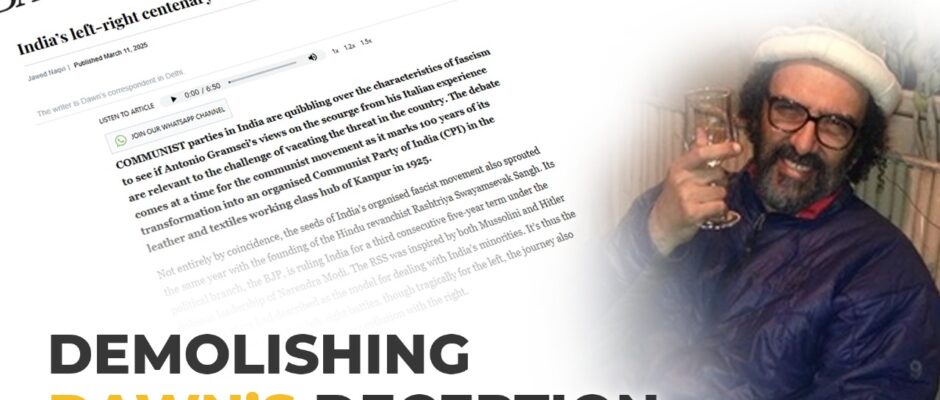
Rohan Giri Dawn.com, the Pakistani news outlet that hosts Naqvi’s fabrications, has a long history of anti-Indian prejudice, regularly publishing articles that undermine Indian sovereignty and national interests. While it claims to support democracy, it rarely, if ever, scrutinizes Pakistan’s establishment with the same zeal as it does India. The hypocrisy is apparent. It is a journal that thrives on manufactured frustration with India while deliberately avoiding the dictatorial reality of its country. Jawed Naqvi’s most recent piece in The Dawn, “India’s left-right centenary,” is another example of selective indignation and intellectual dishonesty. It is deliberately written to support the myth that Rashtriya Swayamsevak Sangh (RSS) is the face of fascism in India. In his distinctive manner, Naqvi weaves together hypocritical historical allusions, ideological prejudices, and plain lies to create a story that has been disproven time and time again but is still promoted by those who are unwilling to confront except facts. In addition to criticizing RSS, his piece highlights the larger intellectual squalor that plagues segments of the Indian left and its supporters abroad. Exposing his distortions is not only necessary but also morally required since, if allowed unchecked, lying takes on the appearance of reality. Naqvi’s argument’s basic tenet is a sloppy and false analogy between RSS and European fascism. It reveals a basic misinterpretation—possibly deliberate—of fascism as well as the intellectual and historical foundations of RSS. RSS has never aspired to be an authoritarian entity, in contrast to Hitler’s racial superiority or Mussolini’s corporatist state. It continued to be a sociocultural movement dedicated to self-reliance, national cohesion, and a continuation of civilization. The alleged similarities to European fascism are merely rhetorical instruments employed by people who wish to discredit the movement without actually participating in its activities. The irrationality of this accusation is further demonstrated by the fact that RSS has never supported racial supremacy, a one-party system, or a dictatorship—all of which are fundamental elements of fascism. Decentralization of authority, community-driven governance, and cultural revival—values that are directly in conflict with the core of fascist ideology—have, if anything, always been at the heart of RSS’s priorities. Naqvi’s assertion that Hitler and Mussolini were the inspiration for RSS is a well-worn fallacy that has been repeatedly disproved but is still brought up by individuals with political frustrations. The accusations are the result of selectively misinterpreting words made by specific people while disregarding the broader context. Distorting historical facts to suit a convenient political narrative is the height of intellectual dishonesty. Unlike the Communist parties, which notoriously followed the Soviet line even at the expense of national interests, the RSS has no history of working with colonial or imperialist regimes. In 1942, the Communists fiercely opposed the Quit India Movement, calling it “subversive,” at the direction of their bosses in Beijing and Moscow. They weakened the quest for independence, whereas RSS struggled diligently at the grassroots level to foster cultural awareness and a sense of pride in the country. If the study of treachery is the goal, then the Communist parties—not RSS—need to be examined. Communists teaching about nationalism is blatantly ironic. Communists were involved in violent uprisings, such as the Telangana Rebellion, which aimed to impose a Soviet-style revolution in India, while the RSS was working to unite the nation. Naqvi romanticizes this uprising as a noble peasant battle, but in reality, it was a violent and terrifying war. Under the guise of “revolution,” the Communist objective has always been to sow disarray, erode democratic institutions, and open the door for authoritarian control. It should come as no surprise that democracy has always suffered the most when Communists have taken control, whether in North Korea, the USSR, or Maoist China. The people’s rejection of their outdated, foreign-imposed ideology is what is causing their electoral downfall in India, not any alleged “fascist” repression. Naqvi’s attempts to demonize the RSS and cover up the wrongdoings of Indian Communists are blatant examples of selective amnesia. The CPI’s record is marked by obvious blemishes, including its ideological subservience to foreign powers, its unwillingness to support the 1962 war effort against China, and its vacillations on important national challenges. On the other hand, RSS has supported Indian army in needs, increased disaster relief, and supported national defense. These are not theoretical claims; they are demonstrable realities. Naqvi, however, avoids them out of convenience since they contradict his rhetoric. It is a flagrant fabrication to say that RSS and its inspired individuals were “apologists for colonialism.” The Communist leadership frequently undermined nationalist initiatives and remained ambivalent about India’s independence. While RSS karyakartas were actively involved in opposing British rule. The goal of the RSS was to create a robust, independent society that could fend off colonial domination on all fronts—politically, culturally, and economically. The Communist concern with quick and frequently violent upheavals was always in conflict with these long-term objectives. If we look at Jawed Naqvi explicitly, his history of anti-Hindu and anti-Indian hatred is well known. His publications frequently echo the talking points of Pakistan’s official narratives, raising doubts about his integrity, ethics and journalism. His previous pieces, such as “Hindutva Terrorism: Another View” and “The Crooked Timber of Modi’s India,” all follow the same formula: they show Muslims as unforgiving victims, Hindus as aggressors, and India as a country on the verge of collapse. The outrage is blatantly selective. He highlights every perceived or actual weakness in India’s democracy, but he says nothing about Pakistan’s deep state, its persecution of minorities, or its decline into political and economic catastrophe. Naqvi’s most recent article is not a rare occurrence; rather, it is a component of a larger trend—a network of authors and journals that want to discredit India’s revival of civilization by calling it “fascist.” A typical example of projection is this one. Extremist Islamism and Communism, I call that Islamo-leftist, the exact ideologies Naqvi espouses, have committed some of the most horrific crimes in recorded history. More than 100 million people have died as a result of communism worldwide, and extremist Islamist beliefs have sunk entire

Read More
Grooming Gangs, Forced Conversions, and Sexual Jihad - Truth That The Quint Ignores

Grooming Gangs, Forced Conversions, and Sexual Jihad: Truth That The Quint Ignores

Rohan Giri The article published by The Quint under the title “‘Zalim Hindu’ Porn: How AI is Mass Producing Pornographic Images of Muslim Women” is a classic example of selective outrage, deliberate victimhood, and an attempt to whitewash an issue that has been a global concern: the systematic targeting, abuse, and exploitation of non-Muslim women by Islamist networks. The piece, while raising concerns about AI-generated images, fails to acknowledge the far more sinister, real-world atrocities committed under the guise of religious supremacy, sexual jihad, and the systematic grooming of women across the world. Furthermore, The Quint’s report ignores the mindset that underpins these systemic abuses in addition to misrepresenting the extent of the problem. It reveals an underlying bias by focusing on Muslim women as the main targets of digital manipulation while neglecting the real, physical, and pervasive crimes against non-Muslim women. Those who have actually suffered under theocratic despotism and radical Islamist exploitation are marginalized by this selective reporting, which feeds a false perception. The article diverts attention from the deeply rooted issues within radicalized portions of society rather than addressing the real offenders. If journalism’s purpose is to reveal injustice and defend the victims, The Quint’s strategy is dreadfully inadequate. Rather than advocating for responsibility and significant change, it feeds a false narrative that downplays the pain of thousands of women around the globe. Whether it is through love jihad or forced conversions in South Asia, institutionalized oppression in Islamist-dominated nations, or grooming gangs in the UK, the very real and systematic targeting of non-Muslim women must be included in any meaningful conversation about gender-based violence. Failing to do so not only makes such journalism less credible, but it also gives the very forces that support these abuses more power. Global Patterns of Exploitation: 1. Love Jihad in India and South Asia 2. Grooming Gangs in the UK and Europe 3. Sexual Harassment and Assault by Islamists Selective Outrage: Ignoring the Real Perpetrators The article focuses on AI-generated images as the ‘real’ attack on Muslim women while ignoring: Instead of addressing these grave violations, the article cherry-picks instances that align with its victimhood narrative, conveniently sidestepping the global reality of Islamist sexual exploitation. Hypocrisy on Women’s Rights The article’s attempt to paint Muslim women as ‘targets’ is ironic considering that: Weaponizing Victimhood to Mask Real Aggression The article deliberately ignores the well-documented Islamist strategy of using sexual exploitation as a form of religious and demographic warfare. Rather, it erases the pervasive atrocities experienced by non-Muslim women while selectively highlighting a specific internet concern. Media Complicity and Suppression of Truth Western and Indian mainstream media often remain silent on these crimes due to fears of offending Islamist groups or being labeled ‘Islamophobic.’ Erasing Non-Muslim Women’s Trauma for Political Gains While the article condemns the supposed fetishization of Muslim women in AI-generated images, it ignores the rampant objectification, abuse, and sexual slavery of non-Muslim women by Islamist radicals. The trauma of thousands of Hindu, Sikh, Yazidi, and Christian women is dismissed in favor of manufactured outrage over online content. Addressing the Real Issue If there is to be a discussion on sexual violence, it must include the very real, ongoing atrocities committed under Islamist doctrines worldwide. To focus solely on AI images while ignoring mass rapes, forced conversions, and systematic abuse of non-Muslim women is not just hypocritical—it is complicit in enabling the true perpetrators. Women’s safety is a global issue, and it is high time that the world confronts the well-documented, systematic targeting of non-Muslim women instead of peddling selective outrage to divert attention from real-world crimes. This is not about any phobia, as propagandists might claim; it is about recognizing and combating a dangerous ideology that continues to wreak havoc on innocent women across the globe. Until these harsh realities are acknowledged, any conversation on gender-based violence remains incomplete, biased, and morally bankrupt. (Author: Rohan Giri is a journalism graduate from Indian Institute of Mass Communication (IIMC) New Delhi, and Manager Operations at CIHS.) References

Read More
The Polis Project Exposed - A Web of Bias, Misinformation, and Deception

The Polis Project Exposed: A Web of Bias, Misinformation, and Deception

Rohan Giri The Polis Project bills itself as a journalism and research group, but its activities betray a much darker purpose. Instead of being an impartial organisation dedicated to the truth, it routinely targets Hindu organisations and India, spreading misleading information while omitting the realities of religious persecution and intricate geopolitics. Under its cover of human rights, it serves as a platform for anti-India propaganda, twisting the truth and influencing opinions around the world to support its political agenda. Another illustration of The Polis Project’s continuous effort to discredit Hindu organisations and harm India’s reputation abroad is the recent propaganda report it released titled “Transnational Funding in Hindu Supremacist Movements”. This purported report is a politically driven attempt to paint Hindu institutions as extremist fronts rather than an unbiased analysis of financial networks.  With an aim to provide the impression that there is an organised supremacist movement, where none actually exists, the paper has selectively omitted important information, using inflammatory language, and cherry-picking statistics. It vilifies organisations involved in humanitarian, educational, and cultural preservation efforts while willfully ignoring the actual threats posed by radical groups operating in South Asia and abroad. There is a certain pattern to the Polis Project’s operations. While ignoring grave human rights abuses in other regions of the world, it unfairly criticises India. Its obsession to depict the current Indian government as authoritarian, using hyperbolic phrases like “genocide” and “fascism”, is to stir up indignation and sway global opinion. By creating a biased narrative that ignores the complexity of religious conflicts and communal tensions in India, their reporting on sociopolitical events distorts reality. While ignoring the persecution of Hindus in Bangladesh, Pakistan, and Kashmir, it creates the impression that India is an oppressive state by publicising certain occurrences and interpreting them with a preconceived ideological framework. Deep state funding, particularly those supported by George Soros, is the source of the Polis Project rather than an independent organisation. Its creator, Suchitra Vijayan, has a history of endorsing radical groups while posing as an activist. A cursory glance at her social media activity shows that she publicly supports people who have been charged with inciting violence, such as Umar Khalid, who was detained for his role in the Delhi riots. She also offered assistance to Irfan Mehraj, a “journalist,” who was detained in connection with a terror financing investigation in 2023. Mehraj was identified by the National Investigation Agency (NIA) as a close associate of Khurram Parvez, a well-known anti-Indian activist and a prominent member of the Jammu and Kashmir Coalition of Civil Societies (JKCCS), a group connected to dubious financial dealings that aid separatist elements. The Polis Project’s operating structure further demonstrates foreign influence over it. As per Disinfo Lab’s claim, the administrator of its Facebook page is headquartered in Pakistan, which raises severe questions regarding its legitimacy and motivation. Although its propaganda efforts are focused on India, its digital presence indicates external management, raising the prospect of planned influence tactics aimed against India’s stability. This aligns with broader international efforts to amplify divisive narratives against the country. Even outside of its digital activities, The Polis Project has close connections to groups that have openly supported separatist and Islamist causes. The Indian American Muslim Council (IAMC), an organisation well-known for advocating against India on global forums, regularly features in its events. Despite IAMC’s acknowledged affiliations with extremist organisations, The Polis Project finds common ground with them, confirming that it is far from being an unbiased research organisation. Its unclear funding structure is another issue. The Polis Project says it is transparent, although it hasn’t given a detailed account of where its funding comes from. Its closed financial sources raise serious concerns, and as a nonprofit organisation with headquarters in the United States, it is nevertheless vulnerable to outside interference. Who provides the funding for it? What outside parties gain from its persistent anti-Indian propaganda campaign? The ambiguity surrounding these issues suggests a conscious attempt to hide the foreign entities that might be controlling its operations. Besides targeting Hindus in India, The Polis Project has also reached out to the Hindu diaspora around the world. It attempts to damage the standing of charitable endeavours carried out by Hindu communities around the world by unjustly associating Hindu cultural organisations and charities with a purported supremacist purpose. Claims that organisations like Sewa International, Ekal Vidyalaya Foundation, and Hindu Swayamsevak Sangh are political fronts are unfounded, despite the fact that they have played important roles in social service, education, and disaster relief. Discrediting the Hindu diaspora and stifling its contributions to social advancement are deliberate goals. The Polis Project’s utter silence over the religious persecution of Hindus is another example of its duplicity. It vigorously promotes stories of state-led persecution of minorities in India, but it ignores the violent attacks on Hindu communities around the world, the systematic discrimination and persecution of Hindus in Bangladesh and Pakistan, and ethnic cleansing in Kashmir. Its selective activism reveals its lack of sincere support for human rights and demonstrates that its goals are not to promote justice but to pursue a political agenda. India’s sovereignty is being undermined globally by The Polis Project, who continuously depicts India as an authoritarian state. It is in line with larger efforts to destabilise India as it presents internal policies as dictatorial, supports separatist language, and purposefully leaves out important background information. This cannot merely be the result of a journalistic error, but a well calculated move to damage India’s reputation internationally. In an effort to undermine India’s position as a rising global force and sow internal strife, it manipulates narratives for the benefit of outside interests. With a blatant ideological agenda, the Polis Project is not an impartial monitor. Its biased narratives, foreign affiliations, selective activism, and untransparent funding make it clear that it is an anti-India propaganda tool. It is crucial to refute its misinformation with factual arguments and stop its lies from becoming widely accepted in global discourse. Organisations with a stake in dividing

Read More