
CIHS – Centre for Integrated and Holistic Studies

Date/Time:

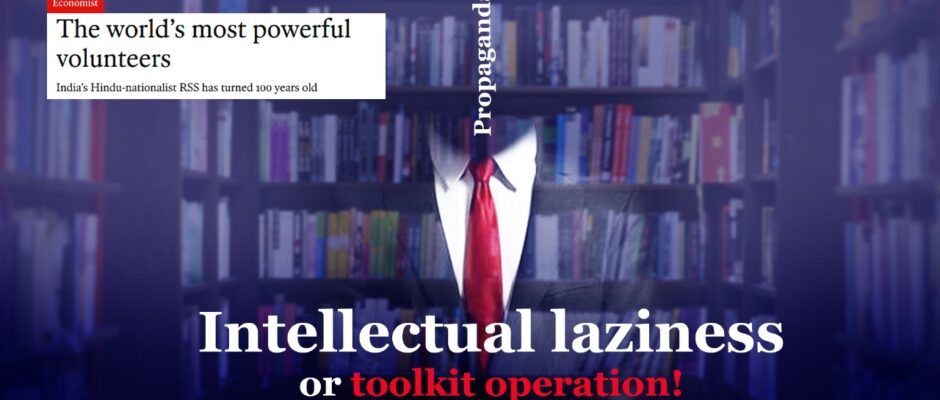
Intellectual Laziness or Toolkit Operation!

Intellectual Laziness or Toolkit Operation!

The Economist’ stands exposed in its agenda driven write up on RSS, world’s largest voluntaristic Hindu centric movement. Dr Aniket Pingley The Economist, in its edition dated September 11, 2025, has published a leader write up on Rashtriya Swayamsevak Sangh (RSS), also known as Sangh. It postures as serious analysis. In reality, it is a flimsy collage of clichés, innuendo and context-stripped assertions. The author has not studied RSS; he or she has merely parroted decades-old propaganda, hoping that repetition will substitute for rigour. This is not journalism; it is intellectual laziness with an agenda. I have been trained in rigorous research within scientific disciplines which means I test every claim against data, logic, intention and approach. Unlike the author, I will not shoot and scoot with unverified slogans. I will hold up each statement, examine it under evidence and reasoning and expose whether it stands or collapses. Let’s begin. The overarching theme of this article is this – a mere lazy recycling of tropes. The author serves up familiar accusations as though they were fresh insight. In truth, it is the same stale dish of “paramilitary,” “fascist,” “second-class citizens,” and “paranoia” — merely reheated and presented as new. These labels have been thrown at the Sangh for past several decades, none have stood the test of law or fact and yet they are recycled here again. Instead of examining how RSS sustains 83,000 shakhas or runs 150,000 service projects (as stated by the author), the author prefers easier route of re-serving leftovers from decades past. Before we move ahead, let me unmask toolkit used by the author, like most other authors who are critical of the Sangh. The author uses eleven manipulative devices: This toolkit is not one of scholarship but one of manipulation. Let us now examine how this blunted toolkit is used to criticize the Sangh. For ease of reading, I have used a table for presentation. The list is not exhaustive; however, it should serve the purpose. Criticism in Article Toolkit Trick Used Facts Queries RSS wants Hindu-first India, minorities as second-class Stereotype recycling + loaded language Minorities hold top constitutional offices; Muslims vote, run businesses, thrive in arts and sport. Socio-economic progression of Muslims is an undeniable fact If minorities are “second-class,” by what metric? Where is the data? RSS ideology violates secular constitution One-dimensional framing RSS never sought a theocracy; it speaks of cultural nationalism. BJP once endorsed “positive secularism.” If RSS violated the Constitution, why has no court ever said so in 100 years? RSS has paramilitary/fascist roots Guilt by association + stereotype recycling No armed wing, no dictator, no fascist-style state control. Built around shakhas, service, volunteerism. If early rhetoric mattered, why is there no continuity of fascist traits today? RSS was banned thrice Cherry-picking 1948 ban lifted after courts did not find RSS’s role in Mahatma Gandhi’s assassination; 1975 was outright Emergency suppression; 1992 ban struck down by court. If truly dangerous, why revoke every ban? Why not ban permanently? Muslims as second-class Shoot-and-scoot Muslims enjoy constitutional equality, socio-economic welfare schemes, political representation at every level. What does “second-class” mean? Denied vote? Barred from office? Where is evidence? Babri demolition / Ayodhya Innuendo CBI court acquitted all accused; temple built via Supreme Court judgment after a long, patient waiting by the entire nation. Why omit the court verdict? Why keep innuendo alive after acquittal? Why omit that the nation celebrated the construction of the temple on a grand scale. RSS paranoia/obsession Loaded language 150,000+ service projects in education, health, relief; 83,000+ daily shakhas build discipline. Is this paranoia? Is community service equal to obsession? Where’s the proof? Authoritarian discipline = fascism Trope recycling RSS decisions by consensus; organizations inspired have disagreed on issues publicly. If authoritarian, why do these organisations openly disagree with BJP policies? Hindutva dominates all politics Fear projection + alarmism Opposition still governs major states; BJP loses elections; multiple visions compete. If Hindutva dominates, why do opposition parties win a significant chunk of votes across all states? I would like to highlight the author’s intellectual laziness furthermore by unmasking baselessness of his statements. Here are a few: Quote 1: “Senior members have distanced themselves from some of their predecessors’ rhetoric (not least the stuff about fascists).” Quote 2: “Earlier this year, Mr Bhagwat backed a popular call for India to carry out a caste census, even though the RSS… had long opposed this.” Quote 3: “The RSS is fuelled both by confidence and paranoia.” Each of these quotes, when stripped of their toolkit tricks, collapses into hollow rhetoric. Let me now educate the author about the Sangh. Unlike caricature offered, RSS is a cultural, civilizational project of institution-building and service. Here are some of its pillars that enabled 100-year long, thriving journey: This is the picture any serious analyst must confront. The Economist’s author chose instead to erase it entirely. One wonders as to why The Economist allows such a piece under its banner. Where was the editorial rigour? Why publish an article that recycles tropes, omits essential context and reduces complex realities to slogans? If these are the standards set for its writers by ‘The Economist’, the world’s largest volunteer organisation, then, RSS does not diminish. It is The Economist’s credibility. RSS has survived hostilities, slander and decades of unwarranted criticism done with an agenda. It continues to grow as it is rooted in Bharatiya society and not on borrowed clichés. The Economist’s article does not analyse the RSS. It exposes the intellectual bankruptcy of its editorial board and brings to closer scrutiny its rigour for writing. (Author is an accomplished computer scientist, educator, and holds expertise in media content strategy)

Read More

Lies & Propaganda!

Los Angeles Times article falls flat on basics relating to RSS, Hindus & Bharat By Neha Dahiya In an op-ed write up headlined “As a Hindu, I can’t stay silent about injustices in India” that appeared in Los Angeles Times edition of August 15, 2022, the author Akhila L Ananth seem to have made a desperate attempt to falsify Hindus image and turned her arguments propagandist and away from ground realities in India. The writer seems to have been either a victim of misguided anti-Hindu and anti-Indian propaganda. Or, she may have a willing and active participant of such negative campaign rather than making an objective analysis of developments within and outside India. Contrary to the assumption that Hindu nationalists have brutalized different communities, India with over 1.3 billion people has millennial history of religious, caste and faith linked diversity. Hindus that believe in sanatan dharma have lived in harmony with Buddhists, Jains and the Sikhs that have had close civilizational links with the majority people. Barring a few sporadic incidents in a country of the size of European Union, Muslims and Christians that were either born in India or most that made India their home have freely practiced their religious faith without much of a hassle. To compartmentalize Indians and charge that Prime Minister Narendra Modi waged a political war against the poor people, farmers, indigenous and caste based groups has very little or no basis whatsoever. If that were true, would Modi’s party secure thumping majority in two successive Lok Sabha elections of 2014 and 2019. Is it not a fact that the right wing party was holding reins in 17 states and three others where it’s a coalition partner? Politics aside, India’s civilizational values do not have any room for attack on equality and plurality. In fact, there very values are cherished and embellished by RSS and the Hindutva forces. India proudly celebrates its diversity. Not only is it proud of its ethnic and religious diversity, all are equal before Indian laws that stood scrutiny for 75-years post-imperial rule. There’s hardly room for discrimination based on caste, region, religion, ethnicity or faith even in governance. In fact, India has over the decades designed projects, schemes and entertained ideas that gave better opportunities to communities and religious minorities in education, socio-economic progression. For example, minorities especially the Muslims, Christians and others like Sikhs have been big beneficiaries of such schemes and projects. Be it tribal, backward community, forest people or those living in hilly terrain or coastal areas, they are core of Hindu society and to say brutalize has no basis. To state that semi-sovereign status of Indian union territory of Jammu & Kashmir, Ladakh has been abrogated speaks poorly on scholarship and understanding the intricate nuances of the issue. Even before the 2019 amendment of Article 370 of the Indian Constitution is examined, it is important to note that no single person makes decisions in a vibrant democracy like India. The amendment was outcome of a protracted legal and political process. In the first place, it’s incorrect to refer to “Kashmir” as “semi-sovereign” as Kashmir has been a division of the former state of Jammu and Kashmir (J&K) and J&K had no vestige of sovereignty outside of the Indian Constitution and its own constitution was subordinate to the Indian Constitution. To propagate that Kashmir was a “territory trapped between Indian and Pakistani military rule” reflects shallowness and understanding of the Kashmir Valley. For over 5000 years, Kashmir is a story in continuum and its history firmly aligns with the idea, identity, and culture of ancient Bharat. Hundreds of magnificent ancient Santan temples (Hindu Temples) like the Martan Sun Temple in Anantnag or Narayan Nag temple complex in Ganderbal district of the Kashmir Valley, thousands of Sanskrit scriptures like the Nilimat Puran and Rajtarangi are testament to Kashmir’s continuous relation, connection and basis of oneness with the rest of India. In contemporary times, two months after British India was partitioned, in an effort to take control of the Kashmir Valley by force, the then newly formed Pakistani Army launched “Operation Gulmarg” on October 22, 1947. The operation involved both regular Pakistani Army forces and tribal raiders assembled with the war cry, “Islam is in danger”. Simultaneously, the then lawful ruler of the then princely state of Jammu and Kashmir, Maharaja Hari Singh reiterated his desire to accede his kingdom to the Dominion of India by signing an Instrument of Accession in accordance with the Indian Independence Act of 1947. Louis Mountbatten, who was British India’s governor general at the time, approved the accession on October 27, 1947. Indian soldiers launched a counterattack. By November 8, the Indian Army had taken control of Srinagar, the princely state’s capital. Up until mid-November, when scope of the war was reduced, the pushback persisted. Up until end of 1948, the war lasted longer but was less intense. In January 1949, the cease-fire agreement was officially signed wherein Pakistan remained to hold large parts of territory under its occupation. The area occupied by Pakistan is referred to as Azad Jammu and Kashmir by India’s neighbour. In 1963, Pakistan ceded some of its occupied territories of Baltistan, the Shaksgam Valley, Hunza-Gilgit, and Raksam to China.  Therefore, the only areas trapped as a result are those of Jammu and Kashmir that are occupied by Pakistan and Chinese military as opposed to a vibrant, democratic and developing  Indian Union Territory of Jammu and Kashmir. Contrary to claims made in Los Angeles Times, women of Islamic faith freely wear the Hijab across India including the southern state of Karnataka. Hijab row in Udipi was hatched and orchestrated by radical Islamist outfit Popular Front of India’s (PFI) student wing Campus Front of India (CFI) to create fear psychosis within Muslim minorities painting a dystopian picture about current state of affairs and drive oft-repeated myth that the state was against Muslims. Aliya Assadi, Ayesha Hajeera Almas, Ayesha, and Muskaan Zainab, the four initially stated victims of Hijab issue

Read More