CIHS – Centre for Integrated and Holistic Studies

Date/Time:

Lions, Shadows & Silk Roads

Lions, Shadows & Silk Roads

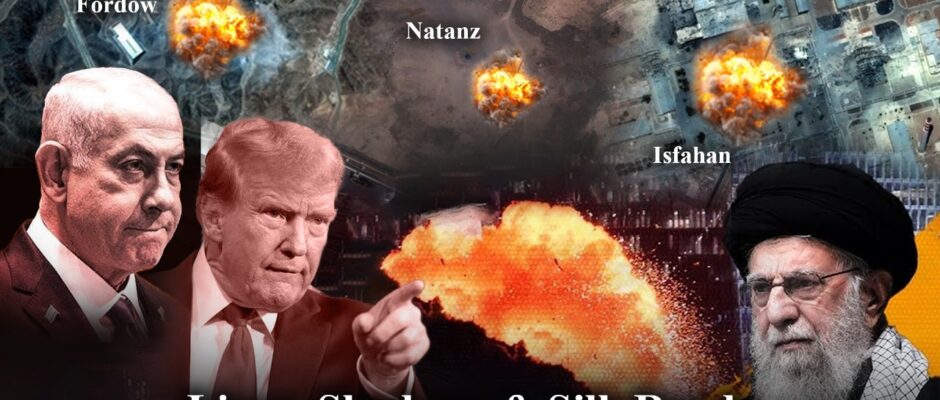
Israel-Iran clash reshaped West Asia’s strategic chessboard with US getting in. India will have to display maturity, dexterity, openness and exercise its strategic autonomy. N. C. Bipindra The Middle East was thrust into dramatic escalation of hostilities as Israel launched “Operation Rising Lion,” a comprehensive preemptive military campaign against Iranian targets, taking out military and nuclear facilities, on June 13, 2025. The operation, which included airstrikes, cyber-attacks and targeted assassinations was Israel’s most extensive cross-border military endeavour in recent years. In response, Iran activated proxy militias, launched missile attacks via Islamic Revolutionary Guard Corps (IRGC) and escalated its hybrid warfare tactics across the region. After calling for asking Iran to surrender, US President Donald Trump approved American air strikes completely obliterating three key Iranian nuclear facilities at Natanz, Fordow and Isfahan, yet noting “now is the time for peace.” This confrontation has far-reaching implications for regional stability, global oil markets, US foreign policy and emerging trade corridors like India-Middle East-Europe Economic Corridor (IMEC) and India-Isreal-UAE-USA (I2U2) group. For India, which has been investing heavily in regional diplomacy and infrastructure partnerships such as IMEC and I2U2, the conflict raises urgent questions about risk, resilience and realignment in its West Asia strategy. Operation Rising Lion, Israel’s Gambit Israel’s Operation Rising Lion was triggered by a surge in Iranian backed attacks on Israeli diplomatic and economic interests in northern Iraq, Syria and transfer of precision-guided missiles to Hezbollah in Lebanon apart from repeated calls for use of nukes to annihilate Israelis. The operation marked a shift in Israel’s longstanding “campaign between the wars” doctrine into an open and assertive military campaign targeting Iranian infrastructure, weapons convoys and senior commanders in multiple theatres. Key components of the operation included coordinated airstrikes on IRGC installations, targeted killing of senior operatives, military leadership and taking out nuclear facilities. The operation included cyber strikes and group covert attacks that disrupted Iranian air defence networks, missile stations and fuel supply chains. Anticipating a counterstrike from Iran, Israel deployed its new laser-based missile defence system which had been tested successfully against Iranian cruise missile barrages. Most of the Iranian attacks were intercepted though some have penetrated the air defence system to hit Israeli cities and towns including a hospital complex. Israel declared the operation a strategic necessity to “decapitate Iran’s regional encirclement architecture” and pre-empt future multi-front attacks including the nukes. While tactically effective, it has risked triggering a full-scale war with Iran and its axis of resistance apart from getting US and Russia-China involved in the war. Iran’s Proxy Retaliation, Strategic Posturing Iran’s counter-response blended military retaliation, strategic ambiguity, and proxy warfare. Apart from direct state-to-state confrontation with Israel — still a risky escalation — Iran relied heavily on asymmetric tactics. Iran fired hundreds of drones and rockets into Israel, overwhelming Iron Dome systems despite Israeli air superiority. The Houthis, an Iranian proxy in Yemen, have dubbed the US strikes on Iran as a “declaration of war” and have fired several missiles at Israel. Iran’s missile strike on Israel marked the first direct hit from Iranian territory since the April 2024 skirmish, indicating a new threshold of confrontation. Though Iran is trying to avoid full-scale war, its response is carefully calibrated to bleed Israel politically and militarily, while also testing the resolve of US deterrence commitments in the region. US Strategic Overstretch? The US was quickly pulled into the maelstrom, just over a week into the launch of military hostilities. Though Trump only issued warnings for a week, providing intelligence support to Israel and deploying at least two aircraft carriers to the region, his administration seems to have decided that enough is enough. Washington now faces accusations of strategic inconsistency. While it pushed for de-escalation publicly, on the parallel it supported Israeli operational aims covertly. This dualism will further strain US ties with Gulf States like Oman and Kuwait who fear further regional de-stabilisation. Furthermore, as tensions peaked, Trump administration’s G7 engagement was interrupted, which complicates America’s long-term global balancing act. Disruptions, Opportunity for India India has deep economic, energy and strategic stakes in West Asia. Operation Rising Lion and its aftermath present both direct threats and unexpected opportunities for New Delhi. IMEC Corridor in Jeopardy: The IMEC, announced at the 2023 G20 Summit, depends on regional stability across UAE, Saudi Arabia, Israel, and Jordan. The Israel-Iran conflict has disrupted port operations in Haifa and Eilat, key to IMEC’s Mediterranean leg. It has jeopardised land connectivity across Jordan due to increased Israeli military mobilisation. The insurance premiums on Red Sea maritime routes are expected to spike by about 35 per cent hurting Indian exporters. While not dead, IMEC’s viability is now under serious question until a ceasefire or détente is re-established. I2U2 Faces Diplomatic Strain: The I2U2 grouping aimed at high-tech cooperation, food security and infrastructure investment now faces political turbulence. UAE, a key I2U2 pillar, is deeply wary of regional conflict spilling over and has called for restraint putting it at odds with Israel’s aggressive posture. India is caught between maintaining its longstanding ties with Israel and its desire to deepen linkages with Iran, UAE and the Arab world, especially after recent Chabahar Port developments. India’s diplomatic tightrope is getting narrower. Energy Security and Diaspora Risks: Iran’s retaliation threatens commercial shipping in the Strait of Hormuz if India is seen backing Israel. While largely rhetorical, these threats would increase Brent crude prices beyond current rates, putting India’s inflation control at risk. There is heightened concern on nine million-strong Indian diaspora in the Gulf, as militias near Kuwait and Bahrain showed signs of mobilisation. India has had to yet again evacuate her citizens from Iran, Israel and the spill over of the conflict to other States in the region would compound the evacuation tasks on hand. Strategic Recommendations for India In navigating the evolving West Asian crisis, India must pursue a multi-vector strategy. It must reinvigorate strategic neutrality. India must avoid taking sides publicly while conducting quiet shuttle diplomacy between Israel, Iran and Gulf countries. A role in

Read More

Dichotomy, Fault Lines & Lies

Muslim women globally seek to free from hijab and burka. In India, its other way, radical religious fanatics push for regressive dress code Neha Dahiya Why’s it that there’s so much furore on the headgear, face cover or someone covering his or her body partially or in full? Incidents reported in last few weeks on Hijab in particular across the world seem lot more disturbing from humanity and civilizational perspective. Big question that continues to taunt the Islamic world was how a 22-year old Mahsa Amini from Sagrez in Iran was murdered by Iranian police on September 13 for allegedly not covering her head in full. And, there after the repression unleashed by Iranian government that made wane attempts to justify the broad daylight murder of Mahsa Amini is rather appalling and inhuman. Iranian President Sayyid Ebrahim Raisolsadati otherwise known as Ebrahim Raisi seems to have gone overboard to justify the brutal murder of Mahsa Amini. The claim from the Iranian administration seems to be that Hijab was mandated by Islam and there’s no way anyone can be free from the Islamic tradition of covering the head from top to toe with Hijab and a burkha. While the extremist islamist – jihadists came to claim the link between hijab and islam, women and girls have made attempts to free women from this barbaric tradition. Otherwise, how would one explain several nations mostly run by muslim leadership discarding the black robe and hijab that suffocated the women and girls over ages? Mahsa Amini was on a trip to Tehran with her brother Kairash when the morality police hitherto known as Gasht-e-Ershad  abducted her on Shahid Haghini expressway. As per reports Mahsa Amini was brutally beaten in the van and later on Vozara Avenue. As per reports, outside the detention centre, Kairash witnessed women taken inside that screamed for their lives. Mahsa Amini collapsed and slipped into coma and succumbed to beatings three days later. Under Iran’s sharia (Islamic) law, imposed since Ayatollah Khomeini took reins in 1979, women were bound to cover their hair and wear long, loose-fitting clothes to disguise their body. Even slightest signs of disobedience led to severe punishments and physical torture in detention centres commonly known as‘re-education’ run by the ruthless morality police. Muslim women world over including Iran have periodically campaigned against Hijab that has nothing to do with Islam in the strict sense. Women reportedly first took to streets against Hijab in Iran weeks after Khomeini’s arrival decades ago. India was no exception to such Anti-Hijab protests till December 2021 when six girls ebbed by the jihadists entered the Udupi government-run pre-university college in the Indian southern state of Karnataka swearing hijab to classes Most interesting is their indoctrination that claimed hijab was part of their religious practice. When they were turned out of the classrooms for not complying with the college uniform rules they argued for freedom to practice their religion and attire associated with it. Unlike many of their counterparts in dozens of countries, these girls wanted to wear a Burqa and Niqab covering their full body and a face veil concealing the uniform and identity of the student. The girls went to the Karnataka high court demanding to wear hijab on the campus premises. There is no law in Indian constitution mandating a code of conduct for women as in the case of Iranian theocracy. Instead, protected by the “Right to Live with Human Dignity” under Article 21 of the Indian Constitution, there are absolutely no legal restrictions on Muslim women in India wearing the hijab or even the burqa in public. One needs to acknowledge that an institution has the power to impose a dress code on its premises. The freedom of a woman to wear whatever she pleases does not supersede an institution’s authority to decide a dress code for its registrants. The rule was applicable to any public or private office space, not just colleges. It also applied to hotels, dining establishments, places of worship, and other similar establishments. Arguments that wearing hijab was essential practice in Islam may not hold water. Hijab has roots in Persian and known as ḥajaba or the veil in Arabic. In Quran, hijab is termed as ‘Khimar’ which means curtain or partition in literal or metaphorical sense. Khimar originated from trilateral verb ‘khamara’ which again means ‘ghatta’, to conceal, hide, or cover something. Quran Surah al-Ahzab, verse-53 said, “Let them wear their Khimar over their juyub” referring to their chest. Allah instructed the believing women to bring the fabric to their front by drawing Khimar over their chests, as a covering. Khumurihina (plural of Khimar) used in this Quran verse refers to scarves that females wore on the Arabian Peninsula at the time. Given the clear distinction, justifiably one wonders as to why Hijab is used while Quran refers to as scarf or Khimar. Subsequently, verse 30 in chapter 24 and verse 54 in Chapter 33, Holy Quran asked both men and women to act with “decency” and “integrity,” both physically and morally. The Quran did not mandate a strictly religious “uniform,” and the first spiritual message did not mean to impose strict or “fixed” dress rules once and for all as propagated by Islamist fanatics but rather to “recommend” an “attitude” or “ethic” towards the body and soul. Khimar versus hijab is not one of Islam’s pillars but rather relate to moral principles, behaviour and relational ethics. Only when religious faith is exercised freely can it meaning something. As a result, discussing Islamic obligation to wear a hijab or Khimar is spiritually and technically incorrect as the Quran states, “No compulsion in religion.” (256 of Al-Baqara). Karnataka High court had ruled that hijab was not essential to religious practice of Islam and upheld the state government order on adhering to uniforms in educational institutions. The recent Supreme Court split verdict on Hijab and its reference to a larger bench has made the debate all the more intense. Six- Muslim girls that

Read More