
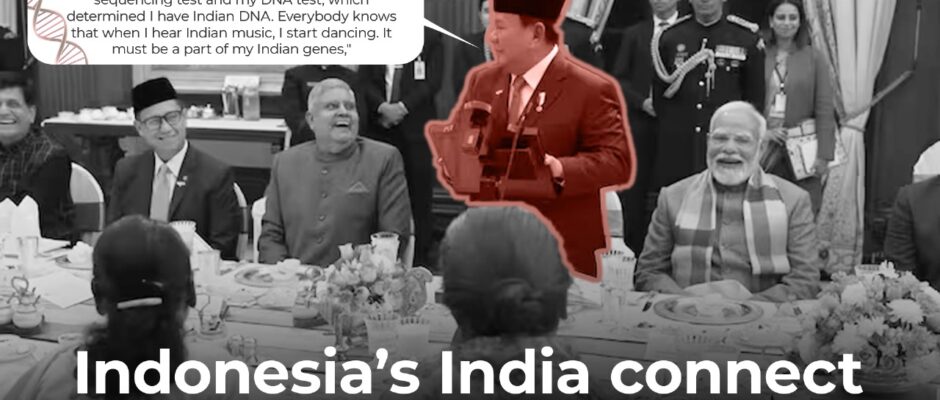
Indonesia’s India Connect
President Prabowo’s remark of having Indian DNA reignited intimate debate on the two countries centuries’ old linkages. Dr Gautam Kumar Jha Indonesian President remarked at a post-Republic Day banquet hosted by Indian President Droupadi Murmu, “I have Indian DNA”. This one-liner by chief guest of seventy sixth Indian Republic Day has reignited debate on deep-rooted historical and cultural connections between India and Indonesia. This statement is not just symbolic but reflects centuries of shared heritage, mutual influence and ongoing collaboration that continue to shape relationship between these two vibrant nations. Bonds between India and Indonesia date back over 1600 years marked by spread of Hinduness and Buddhism through trade, migration and cultural exchange. King Samaratungga of Sailendra dynasty that ruled Mataram Kingdom and Srivijaya in eighth and ninth centuries exemplifies this connection. An archaeologist Devendra Nath Thakur, in his study, “Sanskrit Inscriptions of Indonesia” highlighted significance of Karangtengah inscription (824 CE). This inscription underscores foundational role of dharma (righteousness, duty or moral law) in society emphasizing its pervasiveness, purification and role in alleviating human suffering. The inscription articulates how benevolent kings like Samaratungga leveraged dharma to legitimize their rule and foster societal harmony. By promoting dharma, these rulers not only reinforced their authority but ensured ethical governance, contributing to longevity and prosperity of their kingdoms. This historical perspective underscores the enduring relevance of dharma in governance and societal well-being, laying a strong foundation for intimate cultural exchanges that followed. From early centuries, Hindu and Buddhist kings governed large parts of present-day Indonesia spreading Bharatiya (Indian) knowledge and traditions. This long span of exchanges left an indelible mark on Indonesian society, evident in education curriculum where 70 per cent of history taught in high secondary schools focuses on Hindu -Buddhist period and its profound influence. Such deep cultural integration makes Indonesian President’s remark on having Indian DNA both a testament to historic ties and reflection of shared heritage. Assertion by Indonesian President Prabowo Subianto that he has Indian lineage is not an isolated off the cuff remark. It underscores deep historical and cultural entanglements between India and Southeast Asia. This is not just the case in Indonesia, though; genetic, cultural and migratory facts have all clearly demonstrated the universal resonance of Indian DNA throughout Europe and Western world. The Roma, who have roots in northwest India, are an acknowledged example. The Roma migrated from India about 1500 years ago, as determined by genetic research including studies published by Nature and Cell. They carry unique markers associated with their Indian ancestry. This link is further supported by linguistic and cultural continuity between Indian and Roma traditions. Genetic and intellectual exchanges between Indian and European civilizations were made straightforward by Indo-Greek experiences, especially those that occurred during Alexander’s invasion of Indian subcontinent (4th century BCE) and Greco-Bactrian and Kushan empires that followed. Archaeological proof includes combination of Indian and Greek iconography in Gandharan art. Beyond traditional migration accounts, more recent genetic research discoveries by Harvard geneticist David Reich show that Indian ancestry has made substantial contribution to global populations. These examples demonstrate how Indian DNA influenced by historical, economic and geopolitical factors has had long-lasting impact on the world highlighting importance of Subianto’s statement in a larger historical and scientific context. During his campaign, President Prabowo emphasized India’s development model, signalling a keen interest in deeper collaboration. This aligns perfectly with eagerness of both Indian and Indonesian stakeholders to elevate bilateral ties. Trade between India and Indonesia has surged beyond US $ 30 billion, reflecting robust economic engagement. In the defence sector, significant progress include negotiations for BrahMos missile system, joint military exercises and plans for joint manufacturing and maintenance of advanced fighter jets like Rafales. Strategic areas such as maritime security and training of Indonesian military personnel are also being prioritized. President Prabowo announced that high-profile Indonesian armed forces personnel will visit India in coming weeks to implement these agreements. This move not only signifies trust but measures that both nations are taking to enhance strategic partnership. Focus on traditional medicine is something to write home about. Integration of Ayurveda with Indonesia’s traditional practices, Jamu, represents a fusion of ancient wisdom and modern healthcare. The meeting on Saturday established a trusted platform for both countries to collaborate for mutual benefit, highlighting importance of preserving and promoting traditional knowledge systems in contemporary settings. India and Indonesia share a rich socio-cultural heritage with many common social traits still evident today. Indonesians are renowned for their humility and politeness, qualities that complement India’s vibrant and diverse culture. While India has made significant advancements in higher education, technology, defence, healthcare, and IT, Indonesia excels in the services sector, agro-products and natural resources, including marine biodiversity. There is substantial potential for collaboration in special research funding focused on shared heritage which can further strengthen bilateral ties. By leveraging each other’s strengths, both countries can address gaps and create a symbiotic relationship. Additionally, Indonesia’s inclusion in BIMSTEC (Bay of Bengal Initiative for Multi-Sectoral Technical and Economic Cooperation) will help establish a familial platform, fostering deeper cooperation and integration within the region. Historical interactions between India and Indonesia have fostered unique blend of cultural and traditional practices. Institutions like National Medicinal Plant Board (NMPB) in India, established in 2000 under Ministry of Ayush play pivotal role in promoting medicinal plant conservation and sustainable use. Collaboration between Indian and Indonesian institutions can enhance the preservation and cultivation of medicinal plants, supporting both traditional medicine systems. Post-Covid-19, demand for herbal products has risen globally, driven by concerns about antibiotic resistance and safety of synthetic drugs. Both India and Indonesia are poised to capitalize on this trend by promoting traditional medicine through structured frameworks and bilateral agreements. Initiatives like India-Indonesia Bio-Resource Consortium (IIBC) focus on foundational development, advanced research and drug development, integrating traditional knowledge with modern scientific advancements. Indonesian President’s remark on his Indian DNA,” encapsulates centuries of intertwined histories. From reign of King Samaratungga to contemporary strategic partnerships, relationship between these two nations is characterized by mutual respect, cultural affinity