CIHS – Centre for Integrated and Holistic Studies

Date/Time:

100 Years’ Journey of RSS: New Horizons

100 Years’ Journey of RSS: New Horizons

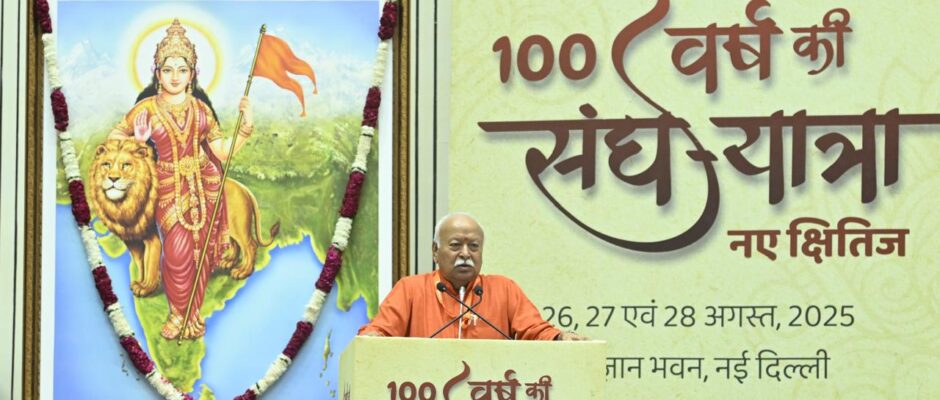
As the Rashtriya Swayamsevak Sangh enters its Centenary Year, a special 3-day lecture and interaction series of “100 Years’ Journey of RSS: New Horizons” was organised at Vigyan Bhawan, New Delhi, from 26–28 August 2025. The event, marked by thoughtful deliberations and inspiring addresses, brought together swayamsevaks, intellectuals, foreign dignitaries from more than 20 countries viz., US, UK, Russia, China, Germany, Japan, Australia, Nepal, Sri Lanka, Argentina, Malaysia, Indonesia, New Zealand, Uzbekistan, ⁠Kazakistan, Denmark, ⁠ Isreal, (to name a few), foreign media viz., BBC, AFP, DW, Sputnik, Reuters, NYT, WSJ, Kyodo News and many others, to look back and see the future. Sarsanghchalak, Dr. Mohan Bhagwat Ji, in his keynote address presented a deep insight into the Sangh’s journey since 1925. He brought before the gathering the fact that the Sangh had not been born due to some passing cause, but due to a timeless civilisational requirement, to cultivate character, cohesion, and service in society. He noted that whereas Sangh’s first one hundred years have been committed to establishing a robust infrastructure and national consciousness, the coming century will require newer models of involvement in the areas of education, technology, nature, culture, and international discoursed. During the three days, there were thematic sessions discussing crucial aspects of the Sangh’s contribution: Nation First and Social Harmony, Civilisational Continuity in a Changing World, and Empowering Communities for Self-Reliant Bharat. Representatives from various walks of life deliberated on how the Sangh’s quiet and consistent efforts in villages, towns, and cities have brought up a generation with sanskars and with the confidence to tackle contemporary issues. The exchanges brought out one shared spirit: that the 100-year RSS pilgrimage is not so much a history of expansion, but a living witness to the dynamism of selfless service and cultural consciousness. As Sangh embarks on its second century, the challenge is to widen horizons, adopting inclusiveness, innovativeness, and greater social connect, yet staying rooted in the fundamental vision of ekatmata, sewa, aur rashtra-nirman (unity, service, and nation-building). Three day event at Vigyan Bhawan ended with a fresh commitment, that the Centenary of RSS will not only marks a glorious past but also plant the seeds of a brighter, harmonious, and self-assured Bharat for the future generations. “Sanghachhadhwam, Samvadadhwam, Sam Vo Manamsi Janatam” (Let us move together, let us speak together, let our minds be in harmony.) — Rig Veda

Read More
Bali Jatra Reflects Bharat’s Maritime Prowess

Bali Jatra Reflects Bharat’s Maritime Prowess

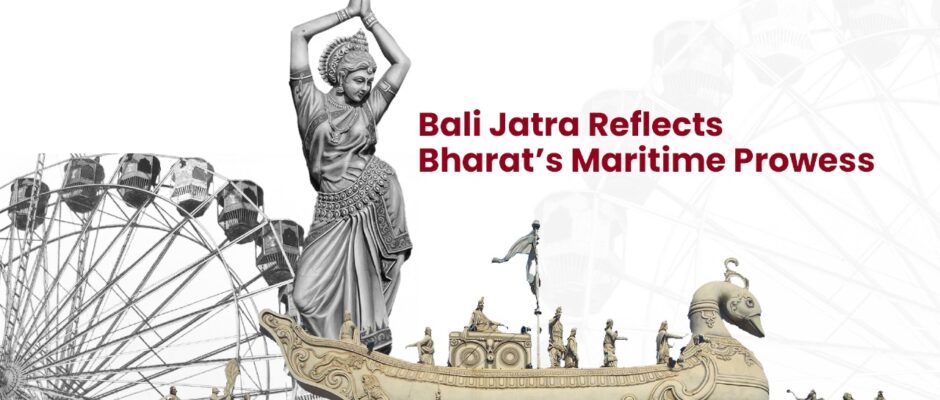
India and Southeast Asia share civilizational connect, maritime and cultural heritage that’s now dubbed as Global South. Dr Aniket Pingley Connections between India and Southeast Asia go back more than two thousand years, shaped by vast waters of Indian Ocean. These seas were not barriers but bridges, linking ports of ancient India with the islands and coastal regions of what we now call Southeast Asia. Merchants, monks, artisans and travelers carried more than goods; they carried stories, languages, faiths and practices. Over time, these exchanges left enduring marks on societies from Sumatra to the Malay Peninsula and beyond. In many ways, Southeast Asia became a mirror that reflected civilizational outreach of Bharat. Trade was the most visible layer of this relationship. India exported textiles, spices, beads and ivory while importing gold, tin, camphor and exotic wood from Southeast Asia. These exchanges were never limited to commerce alone. Maritime routes were also pathways for ideas. Ramayana and the Mahabharata were retold in local languages; Sanskrit and later Pali shaped courts and religious practices and Indian temple architecture inspired monuments from Angkor in Cambodia to Borobudur in Indonesia. The very names of places such as Yogyakarta, Ayutthaya and Srivijaya testify to these cultural flows. These interactions reveal how India’s influence went beyond its borders helping to form cosmopolitan societies in Southeast Asia that were both rooted in local traditions and open to outside influences. Diplomatic and political exchanges played an important role. Rulers in Java, Bali and Sumatra often drew on Indian ideas of kingship, legitimizing their authority through symbols and rituals derived from the subcontinent. The legend of King Airlangga of Java, for example, shows how Indian epics and models of governance were woven into local traditions [5]. Similarly, in Malay Peninsula, early polities combined maritime trade with cultural borrowing from India, laying the foundations for the region’s lasting connections with the subcontinent [7]. These layers of connection commercial, cultural, religious and political formed a civilizational network that is now increasingly referred to as “Global South.” India’s historic outreach demonstrated how societies of South could link with each other, exchange resources, and build hybrid cultures without external domination. This perspective is particularly important today as countries of Asia, Africa, and Latin America seek greater cooperation outside the traditional frameworks of the West [7]. Bali Jatra: Memory of the Ocean Voyages Odisha, known as Kalinga in ancient times, was a formidable maritime power. Its strategic location along Bharat’s eastern coast made it a hub for trade and cultural exchange. Major ports like Tamralipti, Palur and Manikapatna were bustling centres of commerce, facilitating movement of goods and ideas between India and Southeast Asia. It is in this context that festival of Bali Jatra (Baliyatra), celebrated in Cuttack, Odisha, hold such significance. Literally meaning “voyage to Bali,” the festival commemorates the journeys once undertaken by Sadhabas or Odia merchants, who sailed across the Bay of Bengal to trade with Java, Bali, Sumatra and other parts of Southeast Asia [1][2]. During full moon of Kartik Purnima every year, families in Odisha still set afloat small boats made of banana bark, paper, or cork, symbolizing vessels that once braved seas. The Balinese celebration of Nyepi, Hindu New Year, bears similarities to rituals of Kartik Purnima in Odisha. Both festivals involve offerings to the gods, prayers for prosperity and rituals closely tied to agricultural and maritime cycles. The practice is more than a regional ritual; it is a living archive of India’s maritime past. Bali Jatra reminds us that Indian Ocean trade was not incidental but central to Bharat’s engagement with Southeast Asia. At its height, these voyages established a dense web of relationships that enriched both sides. For Southeast Asia, Indian traders brought goods and technologies that supported local economies. For India, the voyages opened access to new markets, resources and cultural influences. The festival, therefore, is not only about nostalgia but also about acknowledging an interconnected past. Today, Bali Jatra has grown into one of the largest open-air fairs in Asia, attracting millions of visitors [3]. It showcases not just Odisha’s heritage but wider story of India’s role in maritime Asia. The festival includes cultural performances, food, handicrafts, and exhibitions that highlight the living traditions of seafaring communities. It also increasingly serves as a site of cultural diplomacy, inviting participation from Southeast Asian countries whose histories are tied to these voyages. Contemporary Relevance & Policy Play The significance of Bali Jatra does not end with heritage. It has clear implications for policy and diplomacy in the present. India and ASEAN today are strategic partners, cooperating in trade, security and cultural exchange. Yet for these partnerships to deepen, they need narratives that bind them beyond statistics. Bali Jatra provides one such narrative, rooted in shared history and civilizational connect. For Bharat’s policymakers, the festival is an example of India’s civilizational diplomacy. The presence of diplomats and foreign representatives at recent Bali Jatra celebrations shows growing recognition of its potential [3]. By inviting Southeast Asian leaders, academics, and artists to participate in the event, India can use the festival to create dialogues that are both cultural and strategic. Such engagements could align with forums like the Delhi Dialogue and ASEAN–India summits [8], making cultural heritage an integral part of foreign policy. For Southeast Asian nations, acknowledging festivals like Bali Jatra opens space to emphasize shared heritage while respecting national diversity. Countries such as Indonesia and Malaysia, where Indian cultural imprints remain visible, can view these connections not as relics of the past but as foundations for renewed cooperation. Policy research papers from think tanks such as Institute of Strategic and International Studies Malaysia already suggest that cultural diplomacy can strengthen the Comprehensive Strategic Partnership between India and Malaysia [6]. Similarly, Indonesian scholars point to the shared legacy of figures like King Airlangga as a reminder of intertweaved histories [4]. For the academic community, Bali Jatra offers a platform for dialogue on the meaning of the Global South. As scholars note, the Global South is not only

Read More
Tiananmen Square: Silenced Memory, Bloody Mirror to CCP Legacy

Tiananmen Square: Silenced Memory, Bloody Mirror to CCP Legacy

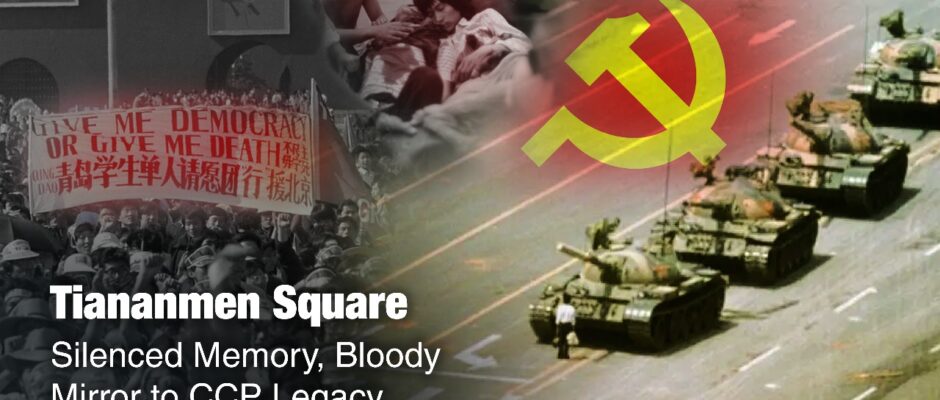
History, if buried, becomes a tool of tyranny. Memory, if preserved, becomes a weapon of liberty. The ghosts of Tiananmen still march in silence.  It is up to the world to give them voice. Pummy Pandita On June 3rd and early morning of June 4th, 1989, Chinese Communist Party (CCP) showed its draconian fangs and massacred the country’s youth and workers at Tiananmen Square. Thousands of unarmed workers and students protesting for democratic reforms and freedom from corruption were confronted with tanks, bullets and ferocity. Thirty-six years on, the Chinese dictatorship continues to erase, censor and sanitize that blood-soaked chapter from national psyche. But for the world at large, Tiananmen is still a beacon of defiance and a cautionary tale of enduring authoritarian rule. Although the death toll is veiled by censorship, estimates vary from hundreds to several thousand. What is undeniable is that CCP directed People’s Liberation Army (PLA) to suppress peaceful protests with iron fists and running the tanks over protestors. The iconic image of “Tank Man”, a solitary protester facing a line of tanks, was not mere momentary bravery. It was condemnation of a ruthless regime that perceived students waving placards as a danger to state security. Now, Chinese internet censors even suppress digits “64” and “1989.” Victims’ families, Tiananmen Mothers are subjected to surveillance, harassment and house arrests each anniversary. The attempt by state to rewrite history is a testament to its own fear: that memory is revolutionary and truth is subversive. Tiananmen was not an aberration; it was harbinger of CCP’s authoritarianism that changed but did not disappear. The censorship technologies, surveillance knowhow and suppression tactics that spawned in the wake of 1989 have since metastasized into contemporary surveillance state we witness in Xinjiang, Hong Kong, Tibet and increasingly within mainland China. The party that ran over students in Beijing constructed virtual concentration camps in Xinjiang in the name of “counter-terrorism.” And, the regime that shook at placards in 1989 now shakes at hashtags, virtual dissent and international scrutiny. Tiananmen was the bloody blueprint. Refinement, not remorse, followed. The world witnessed Tiananmen with horror in 1989. But it wasn’t long before trade interests and geopolitical convenience swept the outrage away. Within a few years, China was mainstreamed into global economy. In 2001, it was admitted to the WTO. Western firms poured in, drawn by cheap labour and state-forced exploitation, even as dissidents went missing and Nobel Peace laureates like Liu Xiaobo died in detention. This ideological bankruptcy, where democratic nations get friendly with the totalitarian ones in the interests of immediate gain, has only encouraged Beijing. West’s dependency on Chinese markets has made it an accessory to muffling Tiananmen’s memory. Why recall Tiananmen today? Because China’s political system, techno-authoritarian one-party rule with economic influence, is being shipped out; Chinese young people are coming off age in a state that not only revises the past but eliminates it and the struggle over narrative sovereignty is a battleground in the greater war for liberty in 21st century. Remembering Tiananmen is not about nostalgia. It is about marking the line in red between authoritarianism and civilization. It is about remembering that CCP’s “rise” rests upon coffins of protestors, bones of those it muzzled. The tanks are no longer rolling down Chang’an Avenue, but the infrastructure of fear, censorship and ideological control remains. For a world in which China’s economic influence and digital footprint become increasingly dominant, remembering Tiananmen is not merely historical amnesia—it is geopolitical suicide. It is imperative that governments, civil societies and international institutions not only to remember but act to raise voices that Beijing wants to suppress, to respond to Beijing’s international narrative warfare with unyielding truth and to see to it that those who stood in Tiananmen Square – armed with nothing but ideals and signs – did not die for nothing. (Author is head of operations at Centre for Integrated and Holistic Studies, a non-partisan think tank based in New Delhi)

Read More
Japan & Bharat: Friends for Eternity

Japan & Bharat: Friends for Eternity

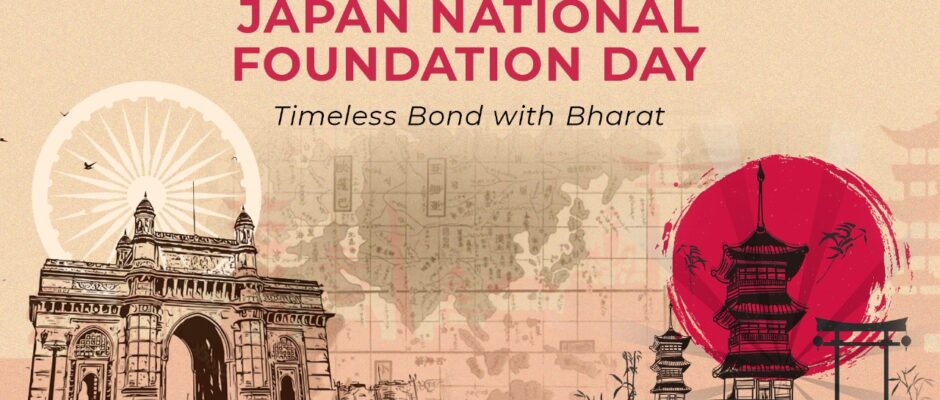
As Japan rings in its national foundation day, Bharat is on the curve joining this momentous occasion in shared values & principles of righteousness based on ‘dharma’. Rahul Pawa Across vast expanse of time and geography, few relationships between nations carry the depth and grace of one shared by Bharat (India) and Japan. Rooted in shared values, spiritual kinship and mutual admiration, this bond transcends transactional nature of alliances. Instead, it thrives on profound cultural, philosophical and historical ties that unite these two ancient civilizations. It is a connection that reflects the very essence of human harmony, a quiet testament to enduring power of shared ideals and aspirations. In rich history of human civilization, where threads of culture, faith and tradition intertwine, relationship between Bharat and Japan stand out as a masterpiece of enduring harmony and shared aspirations. This bond, etched into hearts of both nations, is not merely a product of modern diplomacy but connection spanning millennia. As Japan commemorates its National Foundation Day on February 11, celebrating ascension of Emperor Jimmu in 660 BCE and founding of the nation, it is an opportune moment to reflect upon rich and layered bond between these two great civilizations. In intricate cartography of Edo period, Japan placed India at centre of the world. Not out of geographical ignorance, but as a conscious act of reverence. Bharat—Tenjiku, as they called it—was more than a distant land; it was a spiritual homeland, birthplace of a philosophy that shaped Japan’s moral compass. For a nation that revered teachings of Buddha, India was not a foreign country but sacred extension of its identity. Long before ink of modern diplomacy touched parchment, flow of ideas between these two ancient civilizations had begun. When Indian monk Bodhisena arrived in Japan during eighth century, it was not a fleeting encounter but a moment of profound resonance. Invited to preside over consecration of the Great Buddha at Todai-ji Temple, he embodied the living bridge between two people united by in search for enlightenment. The ceremony, performed with sacred intent, symbolized more than the completion of a statue—it was consecration of a bond, a promise that these two cultures would remain intertwined. Maps of Edo period tell another story, quiet but potent. They show an India shaped not by geography but by imagination—a land of myths, wisdom and cosmic order. For Japan, steeped in Buddhist cosmology, India was not merely a place but metaphor for spiritual awakening. These maps, with their sprawling ovoid depictions of Tenjiku held India as axis of a world harmonized by Dharma. Such reverence is rare, even in annals of history. It speaks of a relationship not driven by conquest or commerce but by shared ideals and mutual awe. As tides of time shifted, threads of this bond remained unbroken. The rise of Zen Buddhism in Japan was deeply inspired by Indian Mahayana traditions transforming not just religious practice but essence of Japanese culture. The simplicity of Zen gardens, quiet grace of tea ceremony and meditative depth of haiku—all bear faint yet indelible imprint of India’s spiritual heritage. In turn, Japan’s refinement of these traditions added new dimensions to them, demonstrating unique capacity to absorb and elevate what it embraced. Culinary exchanges between Bharat and Japan are yet another testament to this quiet partnership. The artful simplicity of Japanese sushi finds an echo in intricate preparation of Indian thalis. The reverence for natural flavours in Japanese cuisine resonates with vegetarian traditions of India born from principles of ahimsa. Every shared meal, every borrowed recipe, is a silent acknowledgment of the kinship that transcends borders. The 20th century, with all its upheavals, tested this ancient bond but never weakened it. During India’s struggle for independence, figures like Fujii Guruji, founder of the Nippozan Myohoji Buddhist Order, stood in solidarity with India. His belief that the land of Buddha must be free to realize its spiritual destiny reflects depth of understanding between the two nations. Even as Japan pursued its own path of modernization, the connection to India remained alive, quietly influencing its worldview and aspirations. Today, the relationship between Bharat and Japan has evolved into a partnership of equals.  “Special Strategic and Global Partnership” is not a mere diplomatic phrase but continuation of an ancient dialogue. It is a collaboration born out of trust and shared values, manifesting in initiatives like Mumbai – Ahmedabad High – Speed Rail and Quad Alliance. These are not just projects or policies—they are modern expressions of an enduring friendship that began in monasteries and temples. Yet, essence of this bond lies not in its politics but in its people. Japanese tourists bow in reverence at Bodh Gaya, site of Buddha’s enlightenment, while Indian students embrace precision and innovation of Japanese education. The principle of Vasudhaiva Kutumbakam—the world as one family—and Kizuna—bonds of friendship—find living expression in these interactions. They remind us that this is not a relationship of convenience but one of conviction. As Japan celebrates its National Foundation Day, it is a moment to reflect on the legacy of this bond. February 11, marking ascension of Emperor Jimmu, symbolizes beginning of a journey, not just for Japan but for a relationship that has stood test of time. It is a day to honour ideals that have united Bharat and Japan: pursuit of harmony, reverence for tradition, and unyielding belief in a better tomorrow. This is not just a tale of two nations—it is a story of two spirits, kindred and enduring. As the cherry blossoms bloom in Japan and sacred rivers flow in Bharat, they carry with them whispers of an ancient friendship, timeless and unbroken. (Author is Research Director at Centre for Integrated and Holistic Studies, New Delhi based non-partisan think-tank)

Read More

Refusal to Reform

Self-defeating journey that Pakistan embarked upon with Jihadist mindset has rendered Shimla agreement ineffective & unworkable. Rohan Giri Fifty two years back, Shimla accord inked on July 2, 1972 by then Bharat’s Prime Minister Indira Gandhi and Pakistan’s President Zulfiqar Ali Bhutto, bears testimony to Islamabad’s refusal to learn its lessons. It’s also a missed timeframe for Pakistan for evolving as a well-meaning, affable and socio-economic development partner on western borders that Bharat was looking for. Partition of Bharat in 1947 by imperialist British forces on withdrawal mode inflicted a huge injury that cannot be easily forgotten. Instead of metamorphosing as a well-meaning society based on true Islamic values, it resorted to genocide of Bengali Hindus in East Pakistan in most inhuman way in 1971. Pakistan had to eat a humble pie after getting defeated at the hands of Indian army and consequent liberation of Bangladesh. Shimla agreement concluded in Barnes Court christened as Raj Bhavan today was intended at bringing about lasting peace in South Asia, especially Bharat and Pakistan. But, that did not happen as predicted even before ink on the Shimla agreement dried. Things did not work out as Sunni extreme leadership refused to acknowledge magnanimity of Bharat in returning their 93,000 war prisoners without a word. Questions were raised on intent of Smt Indira Gandhi who returned all major territories of Pakistan that came under Bharat fold in aftermath of the war. Intentions and goals articulated in Shimla Agreement were magnificent on paper but hollow in reality. Commitment to a direct, bilateral approach to problem solving, emphasis on face-to-face interactions, were laudable. Pakistan that had long history of deception and flopped promises saw the accord as a strategic pause rather than genuine peace initiative. Among Shimla Agreement’s six important clauses, pledge to observe Jammu and Kashmir’s Line of Control (LoC) was most significant. This was one commitment that Pakistan gravely breached very frequently. Disagreements were to be settled amicably and that no government would unilaterally change the status. This again was violated. The rogue state that it evolved to be, Pakistan, continued to fuel fires of turmoil, culminating in Kargil War in 1999. This blatant crossing of Line of Control served as vivid reminder that Pakistan had never genuinely embraced principles of the Shimla Agreement. The accord had highlighted mutual respect for one another’s geographical integrity and political independence. Pakistan, with its malicious intent and plan on Kashmir made attempts on several occasions to intervene in India’s domestic affairs, breaking the very foundation of the accord. The pledge to desist from hostile propaganda was a scam, as Pakistan’s official machinery continued to spew anti-India rhetoric, stoking hatred and division. Despite the Shimla Agreement, Pakistan’s conduct over the decades demonstrated its deceit. The Kargil conflict, in which Pakistani soldiers penetrated Indian territory along the LoC, was a clear act of aggression that shattered the already fragile agreement. This fight, which lasted for more than 60 days, exposed Pakistan’s true character, reinforcing its reputation as an untrustworthy neighbor. Indira Gandhi, acclaimed as a competent leader, was heavily criticized for signing the Shimla Agreement without achieving a resolution to the Kashmir conflict. The pact was viewed as a strategic failure, a concession that failed to capitalize on India’s resounding victory in the 1971 war. Pakistan’s claim to Kashmir, combined with its repeated efforts to internationalize the issue, have rendered the Shimla Agreement ineffective and meaningless. The Shimla Agreement’s history is one of unfulfilled promises and broken expectations. It underscored the futility of trusting a country that has repeatedly proven its propensity to destabilize peace for geographical advantage. Pakistan’s repeated betrayal, from the Kargil conflict to its current backing for cross-border terrorism, demonstrates that it never intended to comply with the Shimla Agreement. The agreement, while ostensibly a plan for peace, was a strategic failure that failed to address the two countries’ core challenges. It allowed Pakistan to recover and rearm, which eventually led to other instances of conflict. India’s generous gesture of returning POWs and territory was met with Pakistan’s unwavering enmity, demonstrating once more that Pakistan’s word could not be trusted. Finally, the Shimla Agreement, which was offered as a historic step toward peace and stability. Pakistan’s reluctance to respect its pledges, as well as its ongoing efforts to destabilize the region, have demonstrated that any agreement with such a nation is worthless. The Shimla Agreement serves as a clear reminder of the drawbacks of naive diplomacy as well as the importance of taking a hard stance when dealing with a fraudulent neighbor like Pakistan. (Author is a doctoral fellow at Amity University in Gwalior, content manager at Centre for Integrated and Holistic Studies)

Read More

THE BHOJSHALA

Located within the Dhar district of Madhya Pradesh, India, Bhojshala stands as an ancient Hindu institution devoted to Devi Vagdevi (Saraswati). In recent times, it has become the center of heated debate, with the Archaeological Survey of India conducting a thorough scientific survey of the site. Bhojshala’s significance lies in its multitude of layers, which encompass historical, theological, and cultural dimensions. It stands as a profound exemplar, showcasing the intricate intersections between historical legacy and Bharat’s contemporary faith-based and nationalistic foundations. Introduction Bhojshala stands as a poignant symbol of India’s rich tapestry of religious and cultural heritage. Established in the 11th century by the renowned Raja Bhoja of the Paramara dynasty, it was envisioned as a bastion of Sanskrit learning and Vedic wisdom, epitomising the intellectual zenith of medieval India. However, in the 13th century, the arrival of the Delhi Sultanate, led by the Islamic invader Alauddin Khilji, marked a dark chapter in Bhojshala’s history. The esteemed center of knowledge underwent significant destruction, partly transforming into the Kamal Maula Mosque, an Islamic structure. This event profoundly shaped the religious and cultural landscape of the region. Today, Bhojshala finds itself embroiled in a contentious altercation between Hindu and Muslim communities, each vying for religious rights and laying claim to the site’s historical significance. The annual Hindu festival of Basant Panchami often becomes a flashpoint, with tensions escalating as Muslim groups assert their right to worship at the revered location. Particularly volatile situations arise when Basant Panchami coincides with a Friday, frequently resulting in clashes. Amidst this turmoil, the Archaeological Survey of India, which is currently conducting a comprehensive survey of this heritage site. Yet, as Bhojshala remains a focal point of debate, it represents the broader dynamics of demolition of cultural heritage in India. Historical Background Bhojshala offers a captivating glimpse into India’s opulent medieval era, epitomised by the reign of Raja Bhoja, a luminary among the educated monarchs of the Paramara dynasty. Celebrated for his patronage of the arts, literature, and architecture, Raja Bhoja established Bhojshala as a prestigious center of learning, dedicated to the goddess of wisdom, Saraswati. It flourished as a vibrant hub where scholars and students from diverse backgrounds converged to delve into the study of Sanskrit and the Vedas, leaving an indelible mark on the intellectual and social fabric of the time.  However, Bhojshala underwent a significant transformation with the advent of Islamic invaders in the region. During the 13th century, Alauddin Khilji’s expansion into the Indian subcontinent precipitated a notable decline in Bhojshala’s prominence and identity. Once revered for its educational and religious significance, the site was partially repurposed into a mosque, known as the Kamal Maula Mosque. This era marked the onset of a complex stratification of cultural and religious identities, as reflected in the alteration of Bhojshala’s architecture and spiritual essence.  The architectural remnants of Bhojshala today bear witness to its storied past. Its design elements echo the Hindu architectural styles of its inception, while Islamic motifs were incorporated during its conversion into a mosque. This amalgamation serves as a poignant symbol of the enduring and far-reaching impact of history and culture on the Indian subcontinent.  Bhojshala’s historical significance as a center of learning and religious devotion serves as a poignant testament to Bharat’s cultural richness and the enduring legacy of its ancient civilisation. The ongoing struggle over worship rights at Bhojshala underscores the complex interplay between contemporary religious identities and historical legacies, providing a compelling illustration of the intricate dynamics between history, religion, and politics in shaping the destiny of cultural treasures. Hindu Struggle for Bhojshala The battle to reclaim and safeguard Bhojshala stands as a testament to the indomitable spirit of Hindus, a struggle ignited in 1305 when the Islamic invader Alauddin Khilji besieged Malwa in present-day Madhya Pradesh. This brutal onslaught ravaged numerous revered Hindu institutions, including Bhojshala. Yet, in the face of adversity, the courageous acharyas (educators) and students stood unwavering, engaging in fierce combat. When 1200 esteemed scholars were presented with the dire ultimatum of conversion or death, their steadfast refusal to abandon their Sanatan Dharma in favour of Islam led to their brutal massacre, their bodies desecrated within the sacred precincts of Bhojshala. The aggression did not cease there. In 1401, under the guise of empire-building, Dilawar Khaw Ghori audaciously attempted to convert Vijay Mandir (Surya Martand Temple), now known as Lat Masjid, and sections of Saraswati Mandir Bhojshala into Islamic structures. This sacrilegious endeavour was further pursued in 1514 by Mehmud Shah Khilji II, who sought to obliterate Bhojshala and eradicate its Hindu legacy by transforming it into a mosque. The tomb of Kamal Maulana (who died in 1310) was erected 204 years posthumously as part of a sinister plot to usurp the Saraswati Temple Bhojshala.Even the British colonialists played a role in this cultural plunder. In 1902, Lord Curzon dispatched the revered statue of Maa Vagdevi to England, a priceless relic of our heritage now confined to the London Museum. In the modern era, the state administration not only turned a deaf ear to cries for justice but actively opposed efforts to liberate Bhojshala and restore the statue of Mata Vagdevi. In a blatant act of suppression, 273 activists were detained in 1996. In May 1997, then-Chief Minister Digvijay Singh controversially issued a decree permitting the performance of Namaz within Bhojshala’s sacred precincts every Friday, sparking widespread democratic protests and demonstrations by the Hindu community. This served as a testament to their unwavering resolve to defend their cultural and religious sanctity. The struggle for Bhojshala transcends mere territorial disputes; it embodies a fervent crusade to revive an ancient bastion of knowledge, science, art, culture, and spirituality. It symbolises the broader battle to reclaim countless Indian and Hindu institutions still unlawfully encroached upon. This is a clarion call to resist cultural erasure and stand steadfast against forces seeking to diminish our rich heritage. Government and Legal Interventions In 1904, recognising the rich historical legacy and illustrious past of Bhojshala, the imperialist British administration granted it

Read More

West’s Supremacist, Colonial Mindset Gets Exposed

Bharat does not require dictates in democratic principles from US, Germany or other European powers. West’s misguided, outdated and conceited assumptions must be abandoned outright. Rahul Pawa April and May 2024 will be etched as ‘decisive months’ in Bharat’s modern history as the country prepares for yet another dance of democracy, a five-yearly feature. It also unfolds the grand electoral exercise when an estimated 970 million voters would exercise their franchise to elect a new government. Bharat’s citizens spanning geographic landscape from the mighty Himalayas in the north to vast Indian Ocean in the south and from Thar Desert in the west to the Mishmi Hills in the east would queue up to vote and elect the new government for next five years. As per Election Commission of India, the electorate this year includes 20 million young first-time voters and 14.1 million newly registered female voters amongst 1.4 billion population, indicating a significant uptick in youth and female participation in Bharat’s democratic process. Hosting the world’s most expansive, inclusive and resilient proven democratic exercise may not have been fully appreciated by Western powers. And, Bharat finds itself as the target of unsolicited interventions by her Western counterparts like United States Commission on International Religious Freedom (USCIRF), German Foreign Office, US State Department and United Nations (UN). These actions portray an arrogant presumption, a misplaced sense of superiority and a lingering colonial mindset that presupposes Western democratic models as the pinnacle of governance, undermining the sovereignty and integrity of Bharat’s electoral, legislative and constitutional workings.   West have had often cited Athens as cradle of democracy, a system born from the union of the Greek terms ‘demos’ (people) and ‘kratos’ (power). This narrative positions Athenian model established under Cleisthenes in the fifth century BCE as the archetype of people-powered governance. Yet, this Eurocentric perspective overlooks profound democratic ethos embedded within the ancient civilization of Bharat, predating Greek democracy by centuries. Bharat’s engagement with democratic principles is not a borrowed concept but a homegrown tradition that finds its roots in the Rig Veda, estimated to be composed around 1500 BCE. This ancient text reveals a society where governance was not the dominion of a singular ruler but a collaborative effort involving the collective wisdom of the Sabha (assembly) and Samiti (council), indicative of an evolved and sophisticated understanding of democratic governance far before emergence of Greek Athenian model. Vedic texts including both the Rig and Atharva vedas, detail existence of assemblies where decisions were deliberated in the presence of kings, ministers and scholars. Such gatherings were characterized by inclusive discussions and integration of diverse viewpoints embodying the essence of democratic dialogue. Approval of these assemblies led to electing or identifying a leader or ‘rajan’ unlike in the west. The very concept of a leader or ‘Rajan’ was neither divine, absolute nor hereditary. Systemic checks and balances resonate with current democratic ideals.  The invocation of ‘Samjnana’ in the Rig Veda symbolizing collective consciousness furthers intrinsic democratic spirit of ancient Bharat. This term, representing unity of thought and purpose among the people, was foundational to Vedic concept of governance where decisions were made through consensus reflecting a commitment to communal harmony and mutual respect. Moreover, historical records of Mahabharata and governance models described in Kautilya’s Arthashastra reveal a continuum of democratic practices through various epochs including republican systems of Licchavi and Vaishali where leaders were elected rather than born into power. Such examples affirmed that principles of democracy—participation, deliberation and representation—are not new to Bharat but are woven into the fabric of its society. Considering this wealth of historical evidence, the notion that Bharat requires dictates in democratic principles from a Western standpoint is not only misguided but perpetuates an outdated and conceited assumption that ought to be abandoned without delay.  Bharat’s democratic and judicial frameworks are subjected to proliferated patterns of interference from international organizations necessitating a detailed examination of the motives and potential impacts of such foreign meddling. United States Commission on International Religious Freedom (USCIRF) established by Christian missionary groups concerned with the alleged persecution of Christian missionaries worldwide has positioned itself as a self-appointed global arbiter of religious freedom. Over years, it has regularly vocalized, often misleadingly, about Bharat’s society and governance. Since 2013-14, USCIRF’s stance towards Bharat has been significantly influenced by its interactions with Indian American Muslim Council (IAMC), an organization linked to the Islamic Circle of North America (ICNA), an offshoot of Jamaat-e-Islami (Pakistan), particularly regarding Citizenship Amendment Act. This relationship, uncovered by independent research from an Open Source Intelligence (OSINT) firm indicates a strategic campaign to influence US policy and public opinion against Bharat highlighting a complex network of influences that questions USCIRF and other such US based entities and their impartiality in evaluations concerning Bharat. Recent machinations to portray Bharat in a negative context magnify apprehensions regarding international discourse surrounding Bharat’s internal matters. Germany’s criticism of lawful arrest of Indian politician Arvind Kejriwal and remarks by UN Secretary-General Antonio Guterres questioning integrity of its electoral process not only encroach upon the principles of sovereign equality and non-interference but also reveal a pattern of biased and agenda-driven scrutiny. Strikingly, Germany’s observations, juxtaposed against its role in hosting Nuremberg trials which aspired to set global legal precedents and ensure legal accountability at the highest levels of governance particularly stand out. United Nations bound by its charter to respect the sovereignty of its member states, seems increasingly influenced by growing financial contributions of Communist Party of China (CPC) indicating a shift in the dynamics of international power play. These developments do not merely affect the mechanisms of global governance but hint at complex strategic maneuvers, acknowledging resurgent Bharat as a principal contender in this global maze. Bharat advances towards electing her representatives to 18th Lok Sabha which is essentially a celebration of democracy that is unparalleled in scale and tradition, Unwarranted overreach by West into Bharat’s sovereign affairs and internal matters casts a long shadow over their intent and interest. This external curiosity cloaked in the guise of

Read More

Bangladeshi Hindus Face Religious Persecution

The book brings to fore sexual assault, rapes, extreme inhuman discrimination perpetuated by Muslim vandals on minority Hindus. Prakhar Sharma “Being Hindu In Bangladesh” is documentation of a narrative often sidelined in mainstream discourse. Authored by Deep Halder, an esteemed editor and Avishek Biswas, a seasoned professor, this publication offers first-hand account of the lives of Hindus in Bangladesh, transcending mere secondary research to provide a grassroots perspective. The book cover serves as a powerful prelude to the content within. Adorned with stark red blood sign, it commands attention and sets tone for the narrative. This imagery resonates deeply evoking visceral responses and hinting at harsh realities faced by Hindus in Bangladesh. It captures author’s experiences in Dhaka. Within the pages of this tome lie two prevailing sentiments that encapsulate plight of Hindus in Bangladesh. Firstly, there is the pervasive fear that under the rule of opposition Bangladesh Nationalist Party (BNP), the already precarious situation of Hindus would deteriorate further with murderous mobs threatening their very existence. Secondly, even under governance of the Awami League, Hindus continue to harbour concerns about their future, uncertain about what awaits them beyond the tenure of Sheikh Hasina. Halder and Biswas meticulously unravel these beliefs, presenting a harrowing portrait of challenges faced by Hindus in a predominantly Muslim nation. They delve into grim reality of unprovoked violence, where Hindus routinely lose not only their land and livelihoods but their homes and daughters to marauding mobs. These incidents, occurring year-round and predominantly in rural areas, remain obscured from journalistic scrutiny, compelling the authors to undertake a journalistic odyssey akin to war reporting. In “Being Hindu In Bangladesh,” Halder and Biswas have not only shed light on a marginalized narrative but have provided a platform for voices that often go unheard. Their work stands as a testament to resilience of a community grappling with adversity, urging readers to confront uncomfortable truths and advocate for change. “Dalit – Muslim Unity is a false Narrative” Yes, you have read it correctly. Deep Halder, the book’s author, ventured to Mandal’s house in Bangladesh, gathering evidence and first-hand information for his narrative. The book meticulously unravels the story behind “Jai Bhim – Jai Mem,” a narrative that has been romanticized over decades. Halder skilfully captures life of Jogendranath Mandal, Pakistan’s first Law Minister and a towering figure in pre-partition dalit leadership. Mandal, who opted for Pakistan over India, envisioned harmonious coexistence between dalits and muslims in newly-formed nation. However, as communal tensions escalated, Hindus began fleeing East Pakistan for India in large numbers with Mandal eventually following suit. Few in Mandal’s lower-middle-class neighbourhood now recall that this very house was host to the eminent leader during his twilight years. Mandal, disillusioned and broken, spent his final years here, perhaps reflecting on his shattered dream of Hindu-Muslim unity in East Pakistan. He passed away in obscurity in Bongaon, North 24 Parganas, West Bengal, in 1968. The house, adorned with blue windows and nondescript outer walls, is owned by Bharat Chandra Adhikary. Adhikary extended refuge to Mandal upon his return to India in 1950, offering solace to a man who had resigned from the Pakistani cabinet in despair. In his resignation letter to Pakistan’s Prime Minister Liaquat Ali Khan, dated October 8, 1950, Mandal expressed his belief that economic interests of Muslims and Scheduled Castes in Bengal were aligned. However, disillusionment with Muslim League and scepticism towards Indian National Congress and Hindu Mahasabha eventually led him to accept unpopularity of his decision to support Pakistan. Halder’s exploration of Mandal’s life and choices offers readers a nuanced understanding of complexities surrounding identity, politics, and communalism in tumultuous era of partition. Through meticulous research and poignant storytelling, Halder brings to light the untold story of a man whose ideals and aspirations were ultimately overshadowed by harsh realities of history. “Noakhali Horror” In a poignant interview reminiscent of haunting tales depicted in “Pather Panchali,” Deep Halder met with Smritikana Biswas, a 90-year-old witness to horrors of Hindu – Muslim riots in Noakhali in 1946 and subsequent atrocities in 2021 which included attacks on Hindu temples and homes. Biswas recounted a chilling memory of her father’s desperate attempt to save her sister during the 1946 pogrom, where violence threatened their village located hours away from Dhaka. It was a haunting decision but the only means to safeguard the girl. Even now, the trauma of witnessing mutilated bodies and stench of blood still lingers, as Biswas confessed to Halder, reflecting on tragic events that have left an indelible mark on her life. Each time I revisited this chapter, I found myself recoiling in horror. Through first-hand account of Purnima Rani Shil, detailed in “Horror In The Countryside,” the grim reality of plight faced by Bangladesh’s Hindu population came into stark focus. Shil’s harrowing experience on the night of October 8, 2001 where she was brutally assaulted and violated until losing consciousness, serves as a reminder of unfathomable brutality endured by countless individuals. Even worse, the perpetrators and their associates continue to torment her with incessant harassment. Why This Book is ‘Different’? What sets “Being Hindu In Bangladesh” apart from other contemporary literature is its distinctive focus on a narrative often overlooked in discussions of war and history. While numerous books delve into broader themes of conflict and violence, this publication stands out by addressing a significant gap in partition literature which has predominantly been shaped by a selective narrative favoured by left historians. Moreover, Partition of Bengal and its aftermath remain underexplored topics, lacking the attention it rightfully deserves. Authors Deep Halder and Abhishek Biswas seize the opportunity to rectify this oversight. They embark on a unique journey into lives of Hindus in Bangladesh, traversing the country to document their experiences, challenges, and broader socio-political landscape. By shining a spotlight on this overlooked aspect of history, the authors offer readers a more comprehensive understanding of complexities inherent in post-partition societies. Hindu American Foundation’s report revealing that 11.3 million Hindus have fled Bangladesh due to religious persecution

Read More

Jinnah’s Fallacy Commemorated as Pakistan’s National Day!

The Lahore Resolution, aka Pakistan Resolution, written by Sher-e-Bangla A.K. Fazlul Huq, said that Muslims in India were a separate country with their own social, religious, and cultural identities. It called for the creation of independent states in areas where Muslims predominated. Despite the resolution’s own lack of mention of the term “Pakistan,” it planted the seeds for its ultimate establishment. Millions of Muslims’ hopes for their political future were brought to life and given a tangible vision by the Lahore Resolution. Intellectuals like Allama Iqbal, who emphasised the political, social, and cultural distinctions between Muslims and Hindus, were instrumental in developing the idea of a distinct Muslim state. The concept gained more popularity after Choudhary Rahmat Ali’s 1933 pamphlet “Now or Never”, which suggested calling the hypothetical state “Pakistan”, was published. Pakistan is an odd outlier in the vast fabric of geopolitical history, a nation that appeared out of thin air and lacks a tangible locus. Its establishment in 1947, during the mayhem of British decolonization in the Indian subcontinent, was not a product of historical or cultural evolution, but rather of political expediency. Ever since its establishment, Pakistan has faced difficulties in defining its identity and navigating issues related to legitimacy, governance, and identity beyond its arbitrary borders. Pakistan was created by political plotting motivated by the demands of sectarian politics and colonial legacies, not by a natural process based on nationalism. Pakistan was created by the division of British India. Pakistan’s ideological foundation came from the Two-Nation Theory, which maintained that Muslims and Hindus were two distinct nations that could not cohabit in a single state. Nevertheless, this notion oversimplified the complex sociocultural context of the Indian subcontinent and ignored the diversity within Muslim communities. Pakistan’s identity gets more complex by its large geographical region. Divided by over a thousand miles of Indian territory, East and West Pakistan (now Bangladesh and Pakistan, respectively) had little in common except their shared religious beliefs. This physical separation further undermined the legitimacy of the Pakistani state, escalating racial tensions and ultimately leading to the bloody battle and Bangladesh’s secession in 1971. Two-Nation Theory of Muhammad Ali Jinnah was weak and unimpressive. It was hollow on an intellectual level and disconnected from reality. Muslims were everywhere throughout India and all of them would not have been able to have had their own homeland without a massive population swap. Although Ambedkar and Jinnah discussed it in passing but both must have understood how unrealistic it was. Yet, Jinnah was able to stir up fleeting feelings and sway Muslim sentiment in his favour. The day India was divided proved its falsehood. Just slightly more than half of the 100 million Muslims migrated to Pakistan. The remainder chose to remain in India.[1] Jinnah, leader of the All-India Muslim League, fiercely advocated Muslims’ rights in British India. He believed that the Muslims of the subcontinent were a distinct people and that they ought to have their own nation where they could openly practice their religion and have their rights to politics and culture protected. This idea served as the cornerstone of his political campaign to establish Pakistan. A fundamental element of Jinnah’s scheme and subsequent partition of the Indian subcontinent was the Two-Nation Theory. The argument that Muslims and Hindus in British India were two different nations with irreconcilable differences was used by Jinnah and his Muslim League to support the demand for a separate Muslim state.[2] With support from Muslim League, Jinnah formulated the Two-Nation Theory for the purpose of defending their political, cultural, and religious rights, contented that Muslims needed their own state.  This increased tensions between communities and prepared the ground for the terrible violence and uprooting that precipitated division in 1947. In fact, the split itself continues to rank among the most horrific events in the history of the region, causing extensive killings, large-scale migrations, and lingering hostilities. There is no denying that Jinnah’s Two-Nation Theory still has an impact on South Asia’s political climate today. The contentious relations between India and Pakistan and the continuous discussions in the region about nationalism, identity, and religious plurality are all affected by the legacy of partition. Dismissing the Myth That Hindus and Muslims Cannot Coexist With a population of over a billion, India is home to both one of the biggest Muslim populations in the world and a majority Hindu population, dispelling the idea that the two religions cannot live in harmony. Most Muslims and Hindus in India live in harmony, sharing homes, workplaces, and cultural activities.  This coexistence is a result of centuries of shared history and respect for one another, not just an oddity. Rhetoric that asserts Muslims and Hindus cannot live in harmony has reappeared in recent years. The long history of tranquilly and cohabitation between these two cultures in the Indian subcontinent is undermined by this dividing narrative, which is frequently supported by political agendas and sectarian interests. The belief that Muslims and Hindus cannot live together exaggerates complex social realities and ignores millennia of shared cultural history and respect. Many religious sects have historically called India home, contributing to the country’s rich cultural diversity. First of all, these claims are contradicted by India’s own history. For centuries, Muslims and Hindus have coexisted in the same social and cultural context, sometimes amicably and other times tensely. The blending of these two major religions is attested to by the nation’s syncretic traditions, which are seen in its literature, festivals, and architectural design. From ancient times India has been a melting pot of several religions, where mutual respect and understanding have often prevailed. During the Indian Independence movement, Muslims and Hindus fought side by side against British colonial rule. Visionaries like Mahatma Gandhi and Maulana Abul Kalam Azad, who highlighted that all Indians, regardless of their creed, share a common destiny, advocated religious harmony and cooperation. There are countless examples of Hindus and Muslims living side by side in harmony and peace throughout India. The reality on the ground belies the

Read More

Yoga uniting nations, cultures and communities through wellness

Rohan Giri / New Delhi Indian Prime Minister Narendra Modi is on a three-day state visit to the United States of America where he will lead International Yoga Day congregation at United Nations headquarters in New York. Introduction of Yoga to America can be traced to late nineteenth and early twentieth centuries when Indian philosophers and spiritual leaders like Swami Vivekananda and Paramahansa Yogananda visited the country. They shared teachings of Yoga, philosophy, and meditation, igniting curiosity among a small group of intellectuals and seekers. However, during countercultural movement in1960s and 1970s, Yoga gained significant attention. Yoga has its origins in India as a science of physical, mental, and spiritual well-being. United Nations designated June 21 as International Yoga Day in 2015 in recognition of its potent contribution to humanity in present days of conflict, suffering, pain and economic instability. Now, Yoga practitioners can be found across the world. This year, on the day, Indian Prime Minister Narendra Modi will lead the yoga practitioners globally with his participation from the United States where he’s on a state visit. In last eight years, growing tribe of yoga practitioners across geographies demonstrate the impact and transforming potential of cultural interchange and diplomacy. Cultural Bridge Presence of Narendra Modi at the helm of the International Yoga Day celebrations in the US also reflects the growing importance of Yoga as a cultural bridge between the two countries. It represented the acceptance of Yoga as a universal practice that crosses borders, faiths, and ideologies. Inclusive nature of Yoga, creating unity, harmony, and mutual respect among many cultures and communities is a message this centuries old practice has signaled. Health & Well-being Of late, the world has witnessed renewed focus on health and well-being as lives got trickier and heal care costs surged getting beyond reach. The two-year long fight against COVID-19 pandemic also highlighted the importance of maintaining physical and mental wellness. With its holistic approach, Yoga offered many benefits including stress reduction, enhanced flexibility, improved posture, robust immune system and a calmer mind. Narendra Modi’s leadership on Yoga Day 2023 in the US also serves as a timely powerful reminder of global significance attached to Yoga. Yoga Diplomacy: In the present day context, Yoga has also evolved as a powerful tool of smart and soft power projecting India’s cultural influence and values to the world. The positive image of Yoga has become bedrock several public diplomacy events internationally in respective countries bid to resolve knotty issues. For India, Yoga is a medium showcase her cultural heritage, emphasizing peace, unity, and holistic well-being. This form of public diplomacy strengthens a nation’s soft power and creates avenues for dialogue, cooperation, and mutual understanding among nations. India’s thrust on Yoga is also due to its belief in the age old practice’s potential to contribute positively for the humanity that needs a soothing balm. Diplomacy which has usually been connected with political talks and agreements has found a new expression in the practice of Yoga. Owing to Prime Minister Modi’s participation in the Yoga event, it has to lead to improvement in India’s cultural diplomacy and deepened ties with the United States. Strengthening people-to-people contacts, increased understanding, and setting up friendship bridges between the two countries is something Yoga has done and is likely to achieve for communities internationally. Legacy of Yoga Yoga has a rich legacy. Practitioners have handed over the beliefs and practices through generations carrying profound wisdom and teachings. Emphasizing Yoga’s past and reinforcing its eternal relevance in a rapidly changing world is something that annual Yoga events are bound to reinforce. Indian diaspora in America played a vital role in promoting, preserving and evolving Yoga as a cultural and spiritual practice. They have shared their cultural heritage with the broader American society through passion, knowledge, and dedication. Yoga has also turned into a powerful tool connecting the Indian diaspora to their roots while providing a means for personal growth, community-building, and cultural exchange. As the Indian diaspora continues to shape the narrative of Yoga in America, their contributions bridge cultural divides, celebrate diversity, and cultivate a deeper understanding of Indian and American identities. Narendra Modi’s leadership of the International Yoga Day celebrations in United States this year is a milestone in global adoption of Yoga. It symbolized the power of Yoga to transcend cultural boundaries. (Author is operations manager at Centre for Integrated and Holistic Studies, non-partisan think tank based in New Delhi)

Read More