CIHS – Centre for Integrated and Holistic Studies

Date/Time:

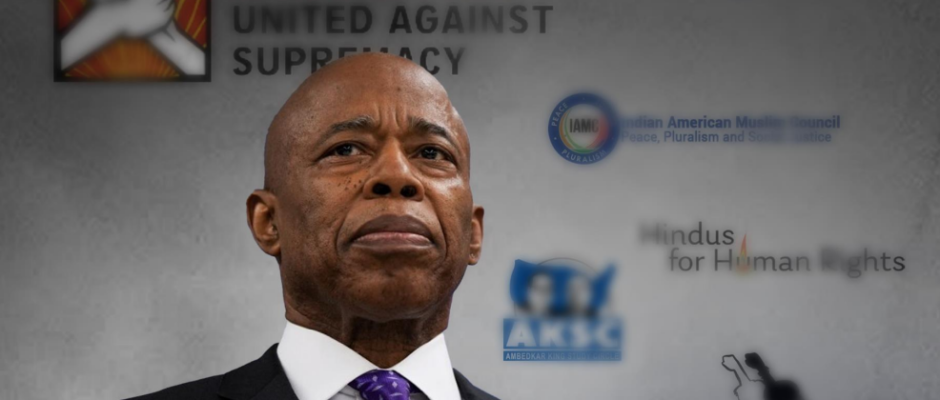
Open-source intelligence (OSINT) reveals that the Savera coalition and the groups that countersigned its 10 July 2025 letter are not a loose assortment of concerned New Yorkers; they constitute a disciplined advocacy network that fuses three streams of ideologies: 1. U.S.–based Muslim-Brotherhood-adjacent infrastructure led by CAIR-NY and the Indian American Muslim Council (IAMC); 2. A newly-minted “progressive-Hindu” and anti-caste façade (Hindus for Human Rights, Ambedkar King Study Circle, Dalit Solidarity Forum) that supplies anti-Hindu normalisation; 3. Legacy left-wing, church and labour partners (e.g. The Riverside Church, Rabbis for Ceasefire, ASAAL, DRUM) that amplify messaging inside “legacy left wing circles” circles. These entities repeatedly collaborate under banners such as Reclaiming India and the Alliance for Justice & Accountability, run coordinated social-media campaigns, and target three policy nodes in Washington: Congress, USCIRF and the State Department. Their operational goal is to brand Indian government positions, and increasingly mainstream Hindu events in America, as “supremacist”, thereby normalising an equivalence between Hindutva and violent extremism. While most are registered 501(c) organisations, multiple red-flag indicators emerge: historic Hamas-related designations (CAIR), documented Jamaat-e-Islami overlaps (IAMC), Soros-funded BDS-style campaigning now redirected from Israel to India (HfHR), opaque fiscal disclosures, and revolving-door leadership across the network. The pattern warrants Treasury, DOJ and IRS scrutiny for potential FARA non-compliance, foreign in-kind support and grant-making that masquerades as purely humanitarian work.

Understanding Savera, 31 co-signatories that petitioned Mayor Eric Adams

Open-source intelligence (OSINT) reveals that the Savera coalition and the groups that countersigned its 10 July 2025 letter are not a loose assortment of concerned New Yorkers; they constitute a disciplined advocacy network that fuses three streams of ideologies: These entities repeatedly collaborate under banners such as Reclaiming India and the Alliance for Justice & Accountability, run coordinated social-media campaigns, and target three policy nodes in Washington: Congress, USCIRF and the State Department. Their operational goal is to brand Indian government positions, and increasingly mainstream Hindu events in America, as “supremacist”, thereby normalising an equivalence between Hindutva and violent extremism. While most are registered 501(c) organisations, multiple red-flag indicators emerge: historic Hamas-related designations (CAIR), documented Jamaat-e-Islami overlaps (IAMC), Soros-funded BDS-style campaigning now redirected from Israel to India (HfHR), opaque fiscal disclosures, and revolving-door leadership across the network. The pattern warrants Treasury, DOJ and IRS scrutiny for potential FARA non-compliance, foreign in-kind support and grant-making that masquerades as purely humanitarian work.

Read More

‘Drip-Drip Genocide’ of Religious Minorities in Pakistan

Arun Anand The movement for the creation of Pakistan out of the larger landmass of India was based on the (in)famous ‘two-nation theory’ that positioned Hindu and Muslim as two irreconcilable identities, and therefore, deserving separate homelands. Muhammad Ali Jinnah, the leader of the struggle for Pakistan, envisaged it as a Muslim-majority homeland but one that housed and treated equally other minorities as well. However, since the early days of the establishment of the new country, the tone was set when it declared itself as the Islamic Republic of Pakistan under the 1956 constitution, barring non-Muslims from becoming President or Prime Minister. The partition of the Indian subcontinent had wreaked grotesquely inhuman carnage, killing between 1 million to 2 million people and uprooting around 15 million people on both sides of the border. Ever since then the religious minorities in Pakistan such as Hindus, Christians, and Sikhs continued to face existential threats, shrinking demographically and politically. The onslaught confronted by religious minorities in Pakistan is reflected in the distressingly marginal increase in their population since the country conducted its first census in 1951. Religious minorities, which constituted only 3.12% of West Pakistan’s total population in 1951, could only grow to 3.72% by 1998. This 1998 census put the Hindu population in Pakistan at around 2 million, however, it was shown to increase to only 3.5 million in the 2017 census, that is, in almost 20 years. In fact, a comparison between the 2017 and 2023 census figures reveals that the Hindu share of the total population declined from 1.73% to 1.60%. The Christian population in the same period was also shown to have marginally risen from 1.27% to 1.59%. The Sikhs, despite their relentless demands, are not given a separate column for documentation, and are clubbed under the category of ‘others’. Nonetheless, the NADRA (National Database and Registration Authority) shows only 6,146 registered Sikhs in 2021, a gigantic downgrade from their numbers before the partition. In contrast, in India, Muslims, who are the largest minority group, registered a 4.4% increase, from 9.8% of the total population in 1951 to 14.2% in 2011. There are multiple reasons behind Pakistan’s pathetic demographic statistics. However, they can mostly be summed up in two factors- institutional discrimination and blatant impunity or even encouragement to radicalized social elements. Over the years, increased space to radical Islamist parties for political expediency or regional geopolitics has meant that the ‘Islam is in danger’ narrative that was employed to demand Pakistan has been sharpened to vilify ethnic, sectarian, and religious minorities. Attacks on minority places of worship have become routine, amid frequent reports of abductions, forced conversions, lynchings, and open calls for genocide. Among the nearly 4 million Hindus in Pakistan, around 90% live in the Sindh province. According to a report, it is estimated that around 1,000 Pakistani women and girls from religious minority groups between the ages of 12 and 25 are abducted, forcefully converted to Islam, and married to their abductors every year. This criminal practice, called a ‘human-rights catastrophe’ by the report, is most acute in the Sindh province, and although girls from all religious minorities are subjected to this brutality, it is most commonly enacted on Hindu girls. Around 20-25 Hindu girls are estimated to be kidnapped and converted in Sindh every month, which means that their already limited access to education, healthcare, and other public facilities is even more curtailed due to a prevalent fear of abduction. The police and judiciary often exempt the perpetrators who many times enjoy social influence and support for ‘scoring’ a conversion to Islam. Another major weapon that has been widely deployed in Pakistan to persecute minority groups has been the notorious blasphemy law. The blasphemy law, although in existence since colonial times when its purpose was to avert inter-religious conflict, was given an extremely harsh form under the military regime of General Zia-ul-Haq who is known for institutionalizing Islamization in Pakistan. The law has been weaponized to frivolously accuse persons from minority groups, most prominently Christians, spawning a culture of vigilantism, lynchings, glorification of perpetrators, and expulsion of persecuted people from the country. Prominent political figures such as the former governor of Punjab Salman Taseer and former Federal Minister for Minorites Shahbaz Bhatti have been assassinated for opposing the law, and judges who either convict vigilantes or acquit the falsely accused have to flee the country to save their lives. The pervasive misuse of the law is illustrated by the fact that since the 1920s till 1986, only 14 cases of blasphemy had been reported under the law, whereas at least 1,472 people have been charged under the same between 1987 and 2016. Even more disturbingly, at least 70 people have been reportedly murdered over blasphemy accusations since 1990, including the Sri Lankan Christian worker Priyantha Kumara. In addition to this, attacks on minority places of worship are frequent, however, those have never been tried under the blasphemy law in Pakistan. In August 2023, the fundamentalist group Tehreek-e-Labbaik reportedly led attacks in the Jaranwala area of Faisalabad in Punjab and ended up burning 21 churches and hundreds of Christian houses, over an allegation of blasphemy. A month prior to that, the 150-year-old Mari Mata temple of Karachi was destroyed and 2 days later, dacoits attacked a Sindh temple with rocket launchers. The Pakistani state has subjected its religious minorities to structural discrimination in every sphere. From vilifying them in school textbooks, underrepresenting or tokenizing them in government bodies, to systematically promoting their persecution through fundamentalist proxies, it has forced many people from the minorities to seek refuge out of the country. In the words of Pakistan’s former minister and media advisor to the President, Farahnaz Ispahani, the state has been enacting ‘drip-drip genocide’- a form of slow genocide- against its minorities, as it seeks to ‘purify’ Pakistan which literally translates to ‘the land of the pure’. (Author is a senior journalist & columnist. He has authored more than a dozen books)

Read More

‘Hatred against Hindus does not shock people’

Treated as ‘oppressors’, British Hindus face bullying, hatred, bigotry & slurs. Teaching on Hinduism with prejudice & colonial mind set Charlotte Littlewood Research I conducted last year for the Henry Jackson Society study found a 173 per cent increase in anti-semitic incidents in UK schools over the past five years. With the more general rise in anti-semitism a regular headline, what was almost more shocking than the research was just how little it shocked people. This year, we have looked into the experiences of Hindu pupils and found that 51 per cent of Hindu parents surveyed said their child had faced anti-Hindu hate in schools. Where are the protesters against this intolerance? Why is it that in an age of supposed anti-racism, attacks on both the longest standing victims of race hate and a people held under British colonial rule for hundreds of years draw so little concern? David Baddiel’s thesis rings true: Jews don’t count because they are not the right kind of victim. Contemporary anti-semitism draws on centuries-old bigotry that depicts them as “too rich” and “too powerful”. Now it seems this idea has barred another group of victims from victimhood: Hindus. For sections of the left, the world is divided into the “oppressor” and “oppressed”. Should you fall into the oppressor class you are everything that should be opposed and can never be a victim? Jews are viewed as white and powerful, imperialist and establishment, therefore deemed not able by definition to face racism and incapable of being victims. Hindus, it seems, have joined them. Last summer, more than 600 people took to the streets of Leicester in violent protest against alleged “Hindutva”, a term unfamiliar to many. To some it means Hindu nationalism, to others simply outward expression of “Hinduness”. While Muslim and Hindu youths had fought in what looked like gang-style territorial violence, there was little evidence of any political nationalist allegiances with India. Instead, concern over Hindu extremism lead to threats to find Hindus and “chop them up”, to “chase Hindus out of Leicester like they were chased out of Kashmir”, vandalism of vehicles and homes that displayed Hindu symbols and attacks on Hindu temples — all while the majority of mainstream media seemed to comment on any aspect other than Hindu-hate. Despite the evidence pointing towards youth gang violence dressed up as “Hindtuva” terrorism, reporting on the unrest in Leicester either endorsed the notion of “Hindutva” by giving a voice to key Islamist activists, or ignored the specific issues in Leicester by discussing nationalism on the subcontinent. Mohammed Hijab, for example, who declared at a pro-Palestine rally in 2021 that “we love death” and rallied the crowds in Leicester with anti-Hindu slurs, referring to them as “violent vegetarians” and declaring he was leading a Muslim patrol, was interviewed on Channel 4. The reporter described him as an influencer with conservative views. The results of our study showed parents reporting their children to have experienced anti-Hindu hate, with cases ranging from having beef thrown at them to physical assaults, being held accountable for politics in India and the caste system and being told the bullying will stop when they convert to Islam. But despite such harrowing case studies, less than one per cent of British schools have reported any form of anti-Hindu bullying incidents in the last five years. This particular form of hatred appears poorly understood and is at times fed by teachers with substandard and prejudicial colonialist teachings on Hinduism. Similar accusations have, of course, been made on teaching about Israel and Palestine in schools and a lack of consistent understanding and approach to defining antisemitism. The British Hindu community has joined the Jews in not being fit for victimhood. The perceived economic success of the community, the relative lack of engagement in issuing critiques against the West — indeed, enthusiastic embrace of it with a Hindu prime minister — bars Hindus from the class of the oppressed. India’s growing relationship with Israel has led far-left activists to associate Hindutva with Zionism, the death knell for leftist victim support. It is an uphill battle but we must challenge at every opportunity this narrative of “oppressed” and “oppressor” classes, which underlie antisemitic and anti-Hindu frameworks of thinking — or risk seeing intolerance and extremism continue on their upward trajectory. (Charlotte Littlewood is a researcher at the Henry Jackson Society. This article was first published in London-based The Jewish Chronicle)

Read More