
CIHS – Centre for Integrated and Holistic Studies

Date/Time:

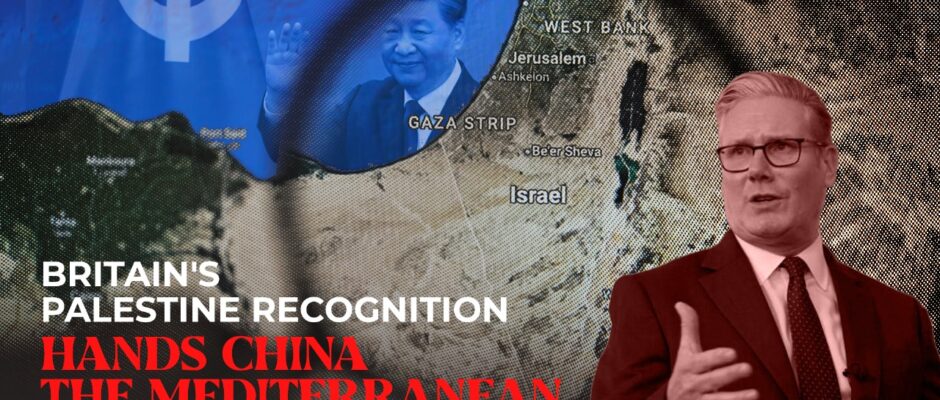
Britain's Palestine Recognition Hands China the Mediterranean

Britain’s Palestine Recognition Hands China the Mediterranean

CCP spent six decades cultivating Palestinian movements, embedding influence in Western activism and positioning itself as the indispensable power in a post-American WestAsia. Britain just made that job easier. Rahul Pawa On 21 September 2025, Prime Minister Keir Starmer broke with decades of U.K. policy formally recognising the state of Palestine. It was Britain’s most consequential West East move since the 1917 Balfour Declaration, made over explicit U.S. objections and Israeli fury. In London’s rush to show moral leadership, one reality was ignored: Beijing had spent six decades preparing for this moment. The CCP’s Palestinian project began in the 1960s. Between 1965 and 1970, Beijing sent small arms, mortars and anti-tank weapons to the Palestine Liberation Army and the Popular Front for the Liberation of Palestine. It trained cadres at the Whampoa Military Academy in Nanning and dispatched instructors to Syria and Algeria. In May 1966 Palestine Liberation Organization Chairman Ahmad al-Shuqairy thanked “Peking” for constant arms and training shipments. After the Six Day War in 1967, Israeli commanders displayed captured Chinese-made AK-47s, 81mm mortars and chemical decontamination gear seized in Gaza and Sinai. Alongside, Beijing also built a diplomatic bridge. In December 1995 it opened a foreign office in Gaza; a de facto embassy to the Palestinian Authority, decades before most Western states considered recognition. Its message to Palestinians was consistent: you can count on us when the West won’t. By Xi Jinping’s era the posture turned strategic. In 2017 the PLA opened its first overseas military base in Djibouti, a Red Sea hub housing thousands of Chinese troops. Beijing secured port stakes from Gwadar in Pakistan to Haifa in Israel, embedding itself along the arteries that supply Europe and the Gulf. A 25-year strategic agreement with Iran in 2021 locked in $400 billion in Chinese investments across oil, gas and transport corridors. CCP’s pattern is clear: first ports, then troops. Djibouti proved it, Hambantota confirmed it, Gaza may be next. Beijing has already demonstrated how commercial access becomes military power, and a recognised Palestine gives it the opening to repeat the same playbook on the Mediterranean. While Beijing built bricks abroad it built narratives at home. State-aligned Arabic media channels and TikTok streams pump out Gaza content at scale. A July 2025 Program on Extremism report mapped how the CCP’s influence runs through Western activism itself. That report details how Shanghai-based tech investor Neville Roy Singham, a onetime Huawei adviser, poured millions into U.S. and U.K. activist groups after Hamas’s October 7, 2023 attack. Groups like the People’s Forum, ANSWER Coalition and “Shut It Down for Palestine” became organising hubs for anti-Israel protests. BreakThrough News, their media arm, live-streamed marches while praising Xi Jinping Thought and Maoist revolution. Investigators concluded the effect was “to project the CCP as a defender of justice while undermining U.S. influence.” In December 2023 the People’s Forum hosted a “China75” event lauding Beijing’s governance model; by early 2024 its funding spiked from under $500,000 to $4.4 million as it expanded pro-Palestinian actions. The same network underwrote protests at Columbia University and in Whitehall, echoing CCP state rhetoric about “imperialist Zionism.” When Starmer spoke to recognise Palestine, Beijing didn’t improvise. Chinese State media instantly framed Britain’s recognition as vindication of the CCP’s “historic” support for Palestinian independence. Chinese diplomats in Ramallah pointed out they had welcomed Mahmoud Abbas to Beijing two years earlier and had pushed a ceasefire plan in 2023. They reminded Palestinian officials who had invested in them when no one else would. With London’s imprimatur, a Palestinian government now has every incentive to turn to CCP for reconstruction finance and infrastructure contracts. Beijing can bolt these onto its Belt and Road Initiative, locking in leverage over a new state at the heart of the Levant. U.S. influence, already eroded by drift and divided Congresses, will shrink further. China’s record speaks for itself. In Djibouti, commercial port access became a PLA base within three years. In Sri Lanka, Chinese loans turned into a 99-year lease at Hambantota. CCP has cultivated a pattern: ports, logistics, security co-operation and then military presence. If Palestine’s future leadership wants investment and security guarantees, CCP will deliver both. Even a small PLA signals unit or intelligence station would tilt the Eastern Mediterranean’s security balance. By presenting any facility as humanitarian or anti-piracy, Beijing can minimise Western backlash while gaining a front-row vantage on Israel, Egypt and NATO operations. Britain’s recognition may have been meant as a rebuke to Israel. However, in practice it is a strategic gift to Beijing. It signals to the Arab world that the West’s will is fractured and that China, not America, not Europe is the constant patron. It creates a diplomatic vacuum China is already moving to fill, from Gaza reconstruction bids to Palestinian security training. This is not hypothetical. Chinese firms dominated Iraq’s post-2003 oil fields; they built most of Africa’s new ports in the last decade. Palestine is a likely next. And unlike the United States or the U.K., the CCP fuses infrastructure with intelligence collection and military access as policy. Starmer’s Downing Street statement marks not the dawn of West Asia peace but a milestone in Beijing’s global ascent. The CCP spent six decades cultivating Palestinian movements, embedding influence in Western activism and positioning itself as the indispensable power in a post-American West Asia. Britain just made that job easier. (Rahul Pawa is director, research at New Delhi based think tank Centre for Integrated and Holistic Studies)

Read More

‘Terror is anti-humanity’

Bharat’s strategic independence was displayed while it rejected Hamas terror on Israel but extended support to free, viable Palestine with a message to friends & foes alike K.A.Badarinath Strategic independence has been the key to Bharat’s foreign policy formulation while engaging with global powers. And, furthering Bharat’s offensive and defensive interests is primacy to this policy. Globally, zero tolerance to expansionist, jingoistic political thought and rejecting every form of terror irrespective of caste, creed, gender, region, religion, faith and colour is something Bharat feels strongly about. Concept of ‘Vasudaiva Kutumbakam’ – entire humanity as one big global family – has been the corner stone to Narendra Modi government’s engagement internationally in last nine years. These three basic tenets of foreign policy have worked reasonably very well when Bharat stayed away from joining the pro or anti-Russian fronts. Instead of joining the NATO forces blindly or going Russia way whole hog, Bharat espoused its own line. Strategic independence in thought and actions saw Bharat condemning the violence and bombardment by Russian forces that invaded Ukraine. Bharat did not join hands with European Union or for that matter US to single out Russia. In the same vein, Ukraine was given all possible humanitarian assistance and extricated Indians that were stuck in the war zone. Such independent line is expected to deliver results for Bharat in dealing with Islamist terror outfit Hamas attack on neighbouring Israel, home to Jews. In a week, the conflict between Islamist terrorists and Jews has escalated into full war having adverse impact in the gulf region and beyond. War between Jews and Hamas terrorists is expected to heighten further with no end in sight anytime soon. It was important for New Delhi to get its act right in dealing with the situation given that her interests in middle-east are too huge and Israel has been a dependable partner in half a dozen areas. Within first few hours, Prime Minister Narendra Modi described the Hamas campaign as ‘terror attack’ and condemned unequivocally in two tweets. Prime Minister Modi’s telephonic conversation with his Israeli counterpart Benjamin Netanyahu fortified India’s position against terror, terrorism and terrorists that wreaked havoc on Israel and Jews. At G-20 Parliament Speakers conclave that’s underway in New Delhi, Prime Minister Modi elaborated further and said ‘terrorism was against humanity’. Second part to Bharat’s policy on Hamas – Israel war was unveiled at a foreign media briefing this Thursday. India reiterated its decades old position for ‘an independent, viable and sovereign’ Palestine state that co-exists peacefully with Israel’ in West Asia. While Bharat does not tolerate, terror, terrorism and terrorist outfits like Hamas, it is not against carving out a Palestinian state. Drawing distinct differentiation between Hamas and Palestine is a significant point in Bharat’s Middle-East policy. This differentiation is conceptually and strategically significant vis-à-vis the Western powers and European nations. Subrahmanyam Jaishankar led foreign policy team seems to have sent out clear signals to both friends and foes alike by reiterating its support for Palestine state. The message from Bharat is straight and simple. The US and its partners in NATO cannot take Bharat for granted on the issue as was the case in Russia – Ukraine conflict. Coming out strongly in favour of a ‘free, independent and viable’ Palestine state and rejecting Hamas is also important given that Muslims rallied in country after country either in support of Hamas or advocating Palestinian cause. In the fast evolving situation, Bharat recognized her responsibility towards Middle East Muslims that seek a ‘peaceful’ Palestine state and at the same time stood like a rock with Jews in Israel. Bharat’s position is in continuation of its historic association with the Palestine movement. This policy has however taken twists and turns, evolved over the years in light of ‘terror’ outfits like Hamas posing serious threat to humanity. Bharat’s continued engagement with both Sunni and Shia dominated nations on political and economic fronts seem to have dictated her nuanced position. This policy also factors in the importance of aligning with Jews in Israel, US and Europe while rejecting Hamas ‘in toto’. By extending support to independent Palestine state via bilateral negotiations, Bharat has been pragmatic in finding lasting solution for peace in Middle East. It may not have been a cake walk for Bharat to evolve her position on Israel – Hamas conflict given her recent engagements with United Arab Emirates, Saudi Arabia, players in the Gulf and North Africa including Egypt, Iran, Qatar, Kuwait, Bahrain etc. Even the Muslim world is divided in the middle on terrorist organizations like Hamas. For instance, UAE and Bahrain that are party to Abrahams accord with US have limited to extending tactical support to cause of Palestine and not toed the Hamas ‘terror’ line. Similarly, Saudi Arabia has been muted in its responses to Hamas terror. Egypt is not with Hamas. Jordan and Qatar have different positions vis-à-vis Palestine state and Hamas. Organizations like Hezbollah from Lebanon and Islamic State fighters may have extended their unqualified support to Hamas. Iran’s supreme leader Seyyed Ali Hosseini Khamenei is yet another significant figure that stood behind Hamas terror act. But, Muslim world as such is not united completely. Apart from the fault lines among Arab nations, Bharat being home to over 210 million Muslims – both Sunnis and Shias – cannot ignore the impact of conflict within its own minorities. Isolation and elimination of terror outfits like Hamas, ISIS, Hezbollah, Taliban or such religious fundamentalists should be the global priority. For this to happen, a common definition of ‘terror’ may have to be achieved internationally without ‘ifs and buts’. (Author is Director & Chief Executive of New Delhi based non-partisan think tank, Centre for Integrated and Holistic Studies)

Read More