
CIHS – Centre for Integrated and Holistic Studies

Date/Time:

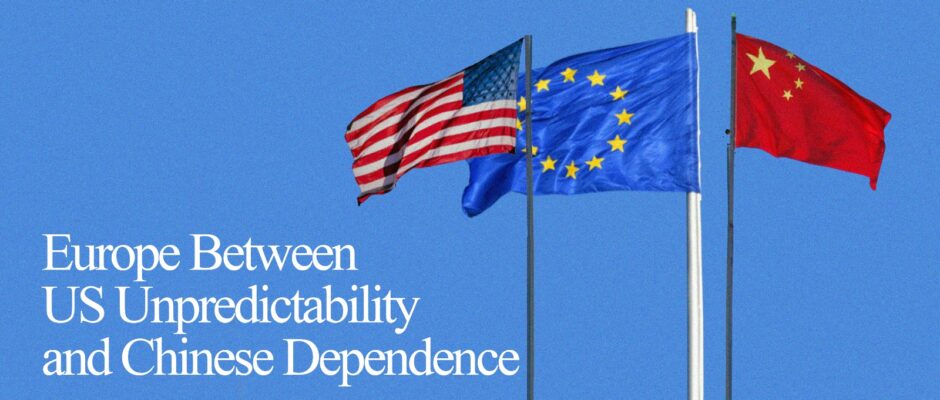
Europe Between US Unpredictability and Chinese Dependence

Europe Between US Unpredictability and Chinese Dependence

In a world where tariffs, export controls, and supply-chain restrictions are instruments of statecraft, Europe’s new realism is simple: it isn’t choosing a side; it is buying room to manoeuvre. Rahul PAWA | x – iamrahulpawa Mario Draghi sketched Europe’s predicament in blunt, unsentimental terms. The economist and former Prime Minister of Italy argued that the old operating system of the global economy is breaking down, and Europe is exposed in ways its balance sheets can’t fix. He warned that Europe’s strengths, its market size, regulatory reach, and industrial base don’t automatically shield its vulnerabilities: security dependence on the United States, and material dependence on supply chains that run through China. That diagnosis is landing in European capitals because it maps onto an everyday reality: the EU is being pushed from two directions at once. Washington has become harder to predict, more transactional, more willing to dangle tariffs, and more comfortable turning alliance relationships into leverage. Beijing, meanwhile, has spent two decades building choke points in critical inputs; minerals, magnets, processing capacity so quietly essential to Europe’s green transition and defence production that they barely feature in public debates until something breaks. Europe’s new mood isn’t choosing China over America. It is something colder: hedging against both. Europe’s current security architecture still rests on U.S. power. That fact doesn’t change because of a tense summit or an angry speech. But the confidence in how that power will be deployed, how reliable it will be, what it will cost, what conditions it will carry has thinned. In early February, Germany’s foreign minister Johann Wadephul made the point Europe keeps trying to thread: Berlin remains closer to Washington than Beijing, and sees the U.S. as its most important partner, especially on security, yet Europe is also confronting transatlantic strains, including U.S. pressure over NATO burden-sharing and Europe’s reliance on American defence support. This is the tension Draghi is pointing to: Europe can be economically formidable and still strategically dependent. In practical terms, it means every new episode of U.S. unpredictability; tariff threats, pressure campaigns, sudden demands raise the same question in Brussels and Berlin: what happens to Europe’s risk model if America’s commitments come with more volatility and a higher price tag? That question becomes sharper when allies feel they must keep economic channels open with China partly because their industries need access, partly because diversification takes time, and partly because U.S. politics may punish them either way. China doesn’t need to “win Europe over” to gain leverage. It needs only to remain central in the parts of the supply chain Europe cannot quickly replace. The EU’s own institutions have started putting hard numbers on what used to be hand-waving. The European Commission notes that Europe doesn’t produce rare earth elements itself, and that 98% of the EU’s total rare-earth magnet demand is met by imports from China, magnets that sit inside EV motors, wind turbines, robotics, and advanced electronics. Then came the auditors. A European Court of Auditors report amplified widely across European media lays out dependence with uncomfortable specificity: the EU imports all of its 17 rare earth elements; it is fully dependent on imports for 10 of 26 critical minerals; and it relies heavily on China for key materials such as magnesium (97%) and gallium (71%), alongside major shares of rare-earth materials used in permanent magnets (including neodymium and praseodymium). The report also underlines the time problem: mines and processing capacity can take a decade or more to bring online, sometimes far longer. The strategic implication is straightforward: even if Europe is politically determined, it is physically constrained. China’s leverage isn’t mainly a threat of tanks or missiles; it is the ability to slow, raise the cost of, or selectively disrupt the material flows that power Europe’s industrial priorities, green tech, advanced manufacturing, and rearmament. Europeans increasingly talk about “de-risking” because they have lived through a dependence shock before. The Russian gas crisis was the tutorial. Now the lesson is being applied to China, except the inputs are more embedded and the substitution is harder. Europe is learning that resilience is not a slogan but an industrial timeline. It cannot “regulate” its way out of dependence, and it cannot “summit” its way back to certainty. What is emerging is neither a pivot to China nor a break from America, but a recalibration shaped by hard experience. Dependence has become exposure, and exposure is something others can price, punish, or exploit. The EU will remain anchored to the United States for security because the alternatives are not yet credible, but it will try to shrink the extent to which U.S. politics can whipsaw European strategy. It will keep channels open with China because European industry still runs on Chinese inputs, while working to cap single-country choke points in the minerals, magnets, and processing that underpin the green transition and defence production. This is the colder mood Draghi was pointing to, less faith in any single guarantor, more investment in self-insurance. In a world where tariffs, export controls, and supply-chain restrictions are instruments of statecraft, Europe’s new realism is simple: it isn’t choosing a side; it is buying room to manoeuvre. (The author is an international criminal lawyer and director of research at New Delhi based think tank Centre for Integrated and Holistic Studies (CIHS).

Read More

French culture, core values under threat!

Entire Western Europe face challenges in integrating refugees & immigrants that are mostly Muslims, forging diverse & united society Rahul Pawa In the wake of tragic police shooting of Nahel M., a seventeen-year-old teenager of Algerian-Moroccan heritage in the Parisian suburb of Nanterre on Tuesday, June 27, 2023, French Republic finds itself engulfed in a tempestuous storm of violent protests, as impassioned demonstrations, riots, and looting cascade through its streets. Against backdrop of persistent allegations of entrenched discrimination, this surge of violent events has cast a stark light on disconcerting societal fissures that run deep within French Republic. More-so, the untimely demise of teen delivery driver Nahel during a routine traffic stop, serves as a poignant reminder of the profoundly intricate and multifaceted predicament that now grips the nation. Evoking disquieting parallels to haunting events of three-week-long 2005 French riots, during which police actions resulted in the tragic deaths of two immigrant teenagers who sought refuge in an electrical substation, tensions surged again. Discrimination and police harassment in impoverished immigrant residential areas resurfaced as pressing concerns, casting a shadow over societal harmony. Meanwhile, President Emanuel Macron’s sudden departure from critical discussions within European Union (EU) regarding Russia -Ukraine conflict, coupled with his government’s contemplation of a potential declaration of emergency, leaves France teetering on the precipice of uncertainty. Gravity of the situation cannot be overstated: France, along with several other Western European nations, is facing an ongoing crisis in terms of integrating immigrants and refugees. This crisis is exacerbated by a significant loss of trust within society, intensifying an already unstable situation and sparking tensions with far-reaching consequences. Recent discourse on demise of the teen delivery driver Nahel has centered around French immigration and refugee protection and return elucidating a wide spectrum of perspectives on crucial themes of discrimination, integration and cohabitation. France, renowned for its opulent cultural heritage spanning the realms of art, literature, music, fashion, cuisine, and philosophy, occupies an eminent position on the global cultural stage. Nevertheless, the nation has faced challenges in effectively assimilating diverse populations and nurturing a sense of unity. A study commissioned by France’s national statistics agency, INSEE, has revealed that immigrants comprised approximately 10.3% of the population in 2021, amounting to nearly seven million individuals. This figure signifies an increase when compared to 6.5% of foreign-born residents in 1968. Migration has played momentous role in shaping the multifaceted tapestry of the country with approximately a third of the citizenry having a connection to immigration across three generations. In recent years, immigrants from former French colonies in North Africa, sub-Saharan Africa, and Asia have constituted a significant contingent within the immigrant community. Significantly, a substantial portion of immigrants in France hail from Algeria, accounting for over 12% of the immigrant population. Similarly, around 12% of immigrants come from Morocco, while approximately 4% originate from Tunisia. Additionally, there is a notable influx of immigrants from Portugal, comprising over 8% of the total, followed by Italy at 4%, Turkey at more than 3%, and Spain at approximately 3%. Interestingly, women make up the majority of these immigrant communities. It is worth noting that many immigrants have chosen to settle in major urban centres including capital Paris, where nearly one-fifth of the population embraces their immigrant heritage. Despite this significant presence, it is intriguing that France’s immigration rates remain lower than the European average, lagging behind countries like Germany and Spain. The rise in immigration can also be attributed to challenges faced by the European Union (EU) during the refugee crisis that began in 2015. As part of the EU’s collective response to the crisis, member states, including France, agreed to accept a specific number of refugees based on a quota system. These quotas are determined collectively, considering factors such as the country’s population size, GDP, and capacity to integrate and support refugees. Based on available data and estimates, it is reported that as of December 31, 2020, the French Office for the Protection of Refugees and Stateless Persons (OFPRA) identified 455,295 refugees and individuals under other forms of international protection in France. The complexities surrounding immigrant integration extend beyond mere numbers and require a concerted effort to foster inclusivity, provide adequate support systems, and ensure equal opportunities for all members of society. Although France has made progress in addressing these challenges, there is still much work to be done to bridge the gaps and create a cohesive society that embraces diversity while upholding the principles and values that define French culture. Within this landscape, divergent viewpoints emerge, with some advocating for strict assimilation, emphasizing French national identity and values, while others champion a more pluralistic approach, extolling the worth of cultural diversity and the recognition of different identities. These contrasting perspectives reflect broader conversations about finding equilibrium between preserving French cultural heritage and embracing the multicultural reality of a globalised world. The concept of “coexistence” remains nuanced and ever-evolving within French society, requiring sustained dialogue, understanding, and efforts to bridge divisions and foster an inclusive and harmonious environment for all. Nevertheless, France has faced a multitude of contentious issues throughout its recent history, encompassing critical matters such as cultural identity, religious expression, and social integration. These conflicts arise from cultural disparities and conflicting ideologies. Samuel Huntington’s theory of a ‘clash of civilisations’  suggests that divergent cultural and religious beliefs among civilisation’s could lead to strife and disharmony. In the French context, this clash has taken various forms, particularly concerning the integration of Muslim immigrants. Over the years, the French society has been subject to intense debates regarding religious practices, secularism, democracy and the role of Islam within French society. One key point of contention revolves around the delicate balance between the Islamic way of life and French liberal ethos. Incidents of alleged discriminatory practices targeting racial and religious minorities, including unjust arrests, harassment, and excessive use of force, have eroded trust among immigrant communities and perpetuated a perception of discrimination and inequality in French society. While French legislation, such as the 2004 law prohibiting

Read More