
CIHS – Centre for Integrated and Holistic Studies

Date/Time:

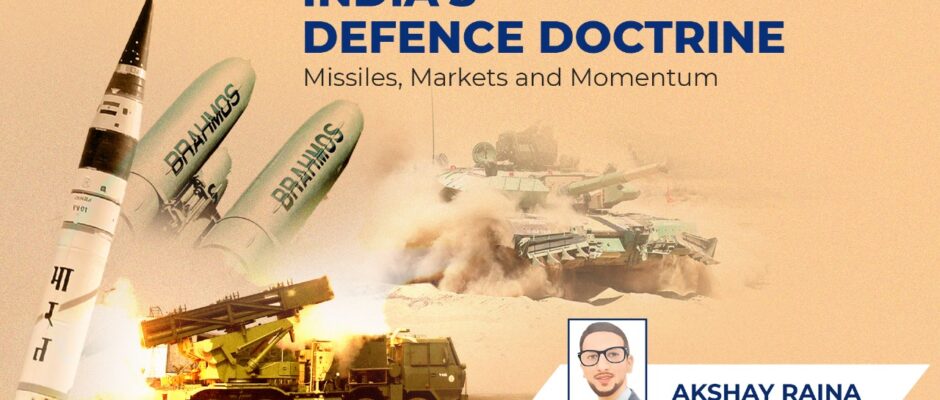
India's Defence Doctrine: Missiles, Markets, and Momentum

India’s Defence Doctrine: Missiles, Markets, and Momentum

India’s defence sector is undergoing a strategic renaissance evolving from self-reliance to global leadership as an exporter of cutting-edge, indigenous military technologies and a trusted partner in the international security architecture. Akshay Raina When it comes to national security, a country’s ability to rely on its own resources in times of conflict is crucial. For India, a rapidly growing global power with diverse security concerns, achieving self-reliance in defence production has become a top priority. This shift from dependency to self-sufficiency is no longer just a strategic aim; it’s a vital step toward safeguarding India’s defence needs while simultaneously strengthening its position in the global defence market. The country’s focus on enhancing indigenous defence production, through initiatives like Make in India, has completely transformed the landscape of defence manufacturing. In recent years, India has dramatically reduced its dependence on foreign imports, thanks to forward-thinking policies, increased collaboration between government agencies and private industries, and a strong emphasis on developing homegrown defence technologies. These efforts have also contributed to a significant rise in defence exports, signalling India’s emerging role as a major global defence producer and exporter. From Import Dependency to Self-Reliance India has historically been one of the world’s largest importers of defence equipment. However, this trend is rapidly changing. The introduction of the Defence Acquisition Procedure (DAP) 2020 by the Ministry of Defence was a pivotal move in this transformation. The DAP focuses on promoting the indigenization of defence production, strengthening India’s military capabilities and reducing the country’s reliance on foreign suppliers for key military hardware. A key aspect of this procedure has been the development of indigenization lists, alongside fostering innovation from domestic startups and MSMEs (Micro, Small, and Medium Enterprises), which are now integral to India’s defence ecosystem. The government’s investment in defence corridors and its efforts to promote collaboration between public sector undertakings (PSUs) and private entities have further accelerated this progress. Moreover, the relaxation of Foreign Direct Investment (FDI) limits in defence has encouraged global defence companies to establish manufacturing hubs in India, helping to fuel the growth of the domestic defence industry. Milestones in Indigenous Defence Production India’s move toward self-sufficiency in defence is marked by significant technological advancements and strategic achievements. India’s capabilities in defence manufacturing are no longer limited to just assembling products; the country is now designing and producing world-class technologies for its defence needs. Some of India’s notable indigenous defence products include: These products, alongside ongoing advancements in electronic warfare, radar technologies, and advanced fighter jets, exemplify India’s growing capability to design, develop and produce defence technologies to meet its strategic needs. With sustained investments in research and development, India is poised to reduce its dependence on foreign defence imports even further. India’s Expanding Defence Export Market India’s increasing self-reliance in defence is not only reducing the country’s dependence on imports but is also positioning India as a significant player in the global defence export market. Over 100 countries now purchase defence products from India, including helicopters, naval vessels, missiles, armored vehicles and aircraft. The rise in defence exports is largely attributed to the government’s focus on high-quality manufacturing, innovative technologies and streamlining the defence procurement process. Key achievements in India’s defence exports include: For instance, as per recent reports, India supplied over $250 million worth of Pinaka multi-barrel rocket launchers, anti-tank munitions and other ammunition to Armenia in 2022. India has also exported naval platforms and torpedoes to Mauritius, Myanmar, Sri Lanka and Vietnam and military trucks to Thailand. Additionally, Tata 8×8 LPTA trucks, based on the Tata 1623 platform, are being exported to the Royal Moroccan Army, marking another achievement in India’s defence exports. Future of India’s Defence Exports India’s defence exports are on an upward trajectory. As the country enhances its defence production capabilities, its growing export footprint positions India as a trusted supplier of affordable, high-quality defence products. The government’s ambitious target of reaching ₹50,000 crore in defence exports by 2029 reflects India’s determination to become a global leader in defence manufacturing. This rise in exports is not just about economics—it’s also about strengthening India’s strategic alliances globally. Deals with countries like the UAE, Armenia and Myanmar reflect India’s growing influence and the trust placed in its defence capabilities. By providing cutting-edge defence solutions at competitive prices, India is offering an alternative to traditional Western and Russian defence suppliers, which only further solidifies the country’s position in the global defence market. India’s Strategic Vision for Global Defence Leadership India’s defence sector has undergone a remarkable transformation over the past decade. Once one of the world’s largest importers of defence equipment, India is now rapidly becoming a top producer and exporter of world-class defence technologies. The government’s support for indigenous defence production, increased foreign investments and strategic initiatives like the Defence Acquisition Procedure (DAP) 2020 have paved the way for India to become self-reliant in defence production. India’s defence exports have surged significantly, from ₹686 crore in 2014-15 to ₹21,083 crore in 2023-24. With cutting-edge products like BrahMos, Pinaka and Tata 8×8 trucks, India is providing high-quality, reliable, and affordable defence solutions to the world. The country’s goal of achieving ₹50,000 crore in defence exports by 2029 is a clear indicator of India’s growing influence on the global defence stage. As the geopolitical landscape evolves, India’s role as a trusted defence partner and manufacturing leader will continue to grow, securing both its own defence needs and its position as a global strategic power. By prioritizing self-reliance, innovation and global partnerships, India is not just preparing for its future defence requirements but is also positioning itself as a leader in the global defence market. (Author is a seasoned media professional, content strategist and news analyst)

Read More

U.S.-India Relations Forge New Frontiers with Technology and Defense Deals

Prachi Mishra The recent visit of Indian Prime Minister Modi to the United States resulted in several key technology deals, MoUs, and collaborations. With growing penetration of emerging technologies in the socio-economic-political and security fabric of nation states, it is imperative for global leaders to come together and work on challenges that impact everyone. The bilateral ties between the United States and India have taken a significant leap forward with Prime Minister Narendra Modi and President Joe Biden unveiling a series of groundbreaking technology and defense agreements. During his address to the joint session of the U.S. Congress, PM Modi emphasised the global benefits of collaboration on semiconductors and critical minerals, highlighting the role it plays in enhancing the resilience and diversity of supply chains. With defense cooperation blossoming over the years, the United States has emerged as one of India’s key defense partners. Former diplomats and analysts are optimistic about the future of this relationship, foreseeing strengthened ties and more lucrative deals on the horizon. Atul Keshap, President of the U.S.-India Business Council and former charge d’affaires at the U.S. Embassy in New Delhi, expects the expansion to extend to military agreements, heralding positive outcomes for both nations, democracy, and the Indo-Pacific region as a whole. The remarkable scope of the announced deliverables has impressed observers and sparked confidence in the trajectory of U.S.-India relations. Some key highlights are showcased below; Institution building – Both President Biden and Prime Minister Modi agree that as their collaboration grows, technology will become increasingly important.  The founding of the Initiative on Critical and Emerging Technology (iCET) in January 2023 was welcomed by the leaders as a significant turning point for relations between the United States and India.  They urged institutions of higher learning, corporations, and governments to carry out their common goal for the strategic technological partnership.  The leaders reaffirmed their commitment for the United States and India to support an open, approachable, safe, and trust-based digital ecosystem that upholds their shared ideals and democratic institutions. Space – By the end of 2023, NASA and ISRO will have created a strategic plan for working together on human spaceflight. Indian astronauts will receive advanced training at NASA’s Johnson Space Center in Houston, Texas, with the intention of staging a cooperative mission to the International Space Station in 2024. This news was applauded by both the US and India. The NASA-ISRO Synthetic Aperture Radar (NISAR) satellite was sent to the U.R. Rao Satellite Center in Bengaluru, India, and NISAR’s launch from India in 2024 was anticipated.  The leaders praised India’s Space Policy – 2023 and urged greater commercial cooperation between the American and Indian corporate sectors along the full value chain of the space economy, as well as to resolve export restrictions and promote knowledge transfer. The Artemis Accords, which establish a shared vision of space exploration for the benefit of all humanity, were signed by India, and President Biden was very grateful for this.  Tech trade – Both India and the US applauded the interagency-led Strategic Trade Dialogue’s commencement in June 2023 and instructed both parties to make ongoing efforts to resolve export restrictions, look for measures to boost high technology trade, and ease technology transfer between the two nations. Semiconductors and supply chains – A Memorandum of Understanding (MoU) on Semiconductor Supply Chain and Innovation Partnership as a significant milestone in coordinating the semiconductor incentive programs of India and the US was highly talked about. This will support the growth of commercial possibilities, research, talent, and skills. The decision of Micron Technology, Inc. to work with the Indian government to invest up to $825 million in the construction of a new semiconductor assembly and testing plant in India was applauded by the leaders. Up to 5,000 new direct jobs and 15,000 community work possibilities might be created over the course of the next five years thanks to the joint investment, estimated at $2.75 billion. The leaders also praised Lam Research’s proposal to expedite India’s aspirations for semiconductor education and workforce development by training 60,000 Indian engineers through its Semiverse Solution virtual manufacturing platform, as well as a statement from Applied Materials. Telecom – Two Joint Task Forces on Advanced Telecommunications were established by the leaders, with a focus on Open RAN (O-RAN) and research and development in 5G/6G technologies. The Bharat 6G Alliance in India and the Next G Alliance in the United States will be in charge of the public-private collaboration between vendors and operators. With the support of funding from the U.S. International Development Finance Corporation (DFC), both India and the US are collaborating on Open RAN field trials and rollouts, including scaled deployments, with operators and vendors from both markets. The leaders praised Indian businesses’ involvement in the American “rip and replace” program. They supported an ambitious plan for 6G networks that called for collaboration on standards, easier access to chipsets for system development, and the creation of cooperative R&D initiatives. Quantum tech – The creation of a joint Indo-U.S. Quantum Coordination Mechanism to promote cooperation between business, academia, and government, as well as their efforts to reach a comprehensive Quantum Information Science and Technology agreement, was hailed by President Biden and Prime Minister Modi. The Quantum Economic Development Consortium and the Quantum Entanglement Exchange both warmly welcome India’s involvement in order to promote professional and business interactions with other prominent, quantum-minded countries. Programs for quantum training and exchange will be maintained and expanded, and the US and India will endeavour to remove obstacles to cross-border scientific cooperation. The leaders hailed the start of a $2 million grant program under the U.S.-India Science and Technology Endowment fund for the combined research and commercialisation of quantum technologies and artificial intelligence (AI), and they urged public-private partnerships to develop these technologies. Science collaborations – The leaders welcomed 35 creative joint research initiatives in emerging technologies that were supported by the Indian Department of Science and Technology (DST) and the American National Science Foundation (NSF). Together, the NSF and DST will

Read More