
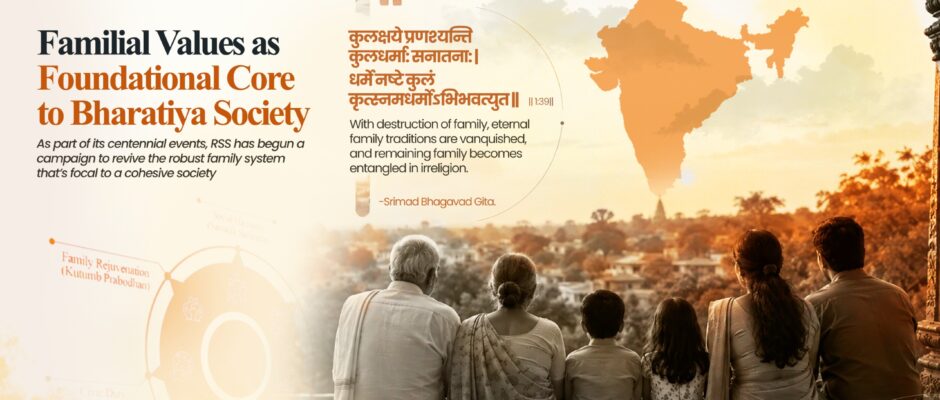
Familial Values as Foundational Core to Bharatiya Society
As part of its centennial events, RSS has begun a campaign to revive the robust family system that’s focal to a cohesive society. Vinod Kumar Shukla Bharat has historically been a tightly knit society where Kutumb or family served as foundational unit of existence. It is very essence of this nation’s civilizational ethos. Bharatiya scriptures suggest that alongside origin and evolution of mankind, first social institution to emerge was Kutumb referred to as Kul in Vedic literature and Srimad Bhagavad Gita, conceived specifically for sustenance, harmony and development of society. A Kutumb provides more than just a shared identity; it acts as an anchor and robust social security net for vulnerable children and elderly members alike. It offers individuals a sense of purpose, meental strength, economic stability and a nurturing environment for personality and social development. Most importantly, it establishes and safeguards core cultural values. The catastrophic impact of compromising these household values and principles is vividly illustrated in the Srimad Bhagavad Gita: कुलक्षये प्रणश्यन्ति कुलधर्मा: सनातना: | धर्मे नष्टे कुलं कृत्स्नमधर्मोऽभिभवत्युत || 1:39|| “With destruction of family, eternal family traditions are vanquished, and remaining family becomes entangled in irreligion.” (1) Social Continuity & Ancestral Debt Family serves as an individual’s primary school for human relations, acting as a bridge that keeps society cohesive and culture vibrant. Beyond immediate emotional bonds, it connects individuals to a broader social architecture, facilitating distribution of nourishment, nurturing children, instilling civic sense in youth and caring for the elderly and infirm. In Bharatiya worldview, concept of family is also intricately tied to redeeming ancestral debt (Pitri Rin) through one’s progeny. Putting it simply, an individual owes his or life, physical form and cultural heritage to their parents and ancestors. This debt is honoured by raising a family, continuing the lineage, caring for elderly and living righteously in accordance with family traditions. Deep respect for living elders, alongside commemorative rites like Shraddh and Tarpana (offering food and water), particularly during annual Pitri Paksha, are vital facets of this familial duty. A poignant medieval anecdote beautifully highlights this cultural contrast. When the Mughal emperor Aurangzeb severely restricted the water supply to his imprisoned father, Shah Jahan, the deposed emperor lamented: ऐ पिसर तू अजब मुसलमानी, ब पिदरे जिंदा आब तरसानी आफरीन बाद हिंदवान सद बार, मैं देहदं पिदरे मुर्दारावा दायम आब “O son! You are a strange Muslim, making your living father yearn for water. Praise be to the Hindus a hundred times, who offer water even to their departed ancestors.” Modern Crisis of Disintegration Regrettably, a fractured mind set has begun creeping into many contemporary Hindu households. Over time, the institution of family and its core values have faced severe disruption, largely due to isolating influence of modern Western materialism. Families are disintegrating and foundational values are being compromised. There are many couple (Dampatti) who have decided not to have children even after entering into matrimony and despite not having any medical issues. This erosion manifests in trends like Double Income, No Kids (DINK) phenomenon where couples consciously choose global consumerism over parenthood, detached from ancient purpose of family life. Furthermore, a weakened family structure and a deteriorating value system have left individuals vulnerable to large-scale religious conversions, often driven by misinformation campaigns targeting Sanatan Dharma. These shifts run entirely counter to Sanatana ideals. Today, it is common to find elderly parents and their adult children living separately within the very same locality. Conversely, Vedic scriptures envision multi-generational joint families living under one roof. For instance, a newlywed bride was traditionally welcomed into her new home with the blessing: स॒म्राज्ञी॒ श्वशु॑रे भव स॒म्राज्ञी॑ श्व॒श्र्वां भ॑व । नना॑न्दरि स॒म्राज्ञी॑ भव स॒म्राज्ञी॒ अधि॑ दे॒वृषु॑ “Be a queen to your father-in-law, be a queen to your mother-in-law, be a queen to your husband’s sister, be a queen to your husband’s brother.” (2) This blessing reveals two profound truths: first, a woman in the household held a position of high dignity and was never subservient; second, it assumes a household where at least three generations coexisted harmoniously. Similarly, mutual respect and harmony under head of the family are emphasized in Atharva Veda: “अनु॑व्रतः पि॒तुः पु॒त्रो मा॒त्रा भ॑वतु॒ संम॑नाः। जा॒या पत्ये॒ मधु॑मतीं॒ वाचं॑ वदतु शन्ति॒वाम् ॥” “May the son be devoted to his father and be of one mind with his mother. May the wife speak sweet, gentle and peaceful words to her husband.” (3) These social norms evolved over millennia. Scriptures carefully outlined responsibilities, code of conduct and divine qualities required of family members. As Lord Krishna instructs Arjuna in Srimad Bhagavad Gita: अभयं सत्त्वसंशुद्धिर्ज्ञानयोगव्यवस्थिति: |दानं दमश्च यज्ञश्च स्वाध्यायस्तप आर्जवम् ||अहिंसा सत्यमक्रोधस्त्याग: शान्तिरपैशुनम् |दया भूतेष्वलोलुप्त्वं मार्दवं ह्रीरचापलम् ||तेज: क्षमा धृति: शौचमद्रोहो नातिमानिता |भवन्ति सम्पदं दैवीमभिजातस्य भारत || “Fearlessness, purity of heart, steadfastness in knowledge and yoga, charity, control of senses, sacrifice, study of scriptures, austerity, straightforwardness, non-violence, truthfulness, absence of anger, renunciation, tranquillity, absence of malicious talk, compassion for all beings, non-covetousness, gentleness, modesty, absence of fickleness, vigour, forgiveness, fortitude, purity, absence of hatred and absence of pride, these belong to one born with divine qualities, O Bharata.” (4) Kutumb Prabodhan: Six Pillars for Revival To arrest and reverse this cultural degeneration, protect and nourish family as foundational institution of Bharatiya society, Rashtriya Swayamsevak Sangh (RSS) has begun Kutumb Prabodhan (Family Enlightenment) as a socio-cultural intervention within its centennial campaign. Kutumb Prabodhan operates on conviction that a family is not merely a group of people sharing a roof, but primary school where values, culture and national consciousness are instilled from childhood. The initiative encourages families to actively integrate Six Essentials (The Six ‘Bs’) into their daily lives: Bhasha (Language): Conversing in one’s mother tongue within the home. This preserves local dialects, idioms and unique regional cultural traditions that are lost when a language dies. Bhoosha (Attire): With a diverse society like Bharat, wearing traditional, culturally rooted Bharatiya attire must be encouraged at family gatherings and get-togethers to begin with. While modern life has displaced traditional wear, people have almost relinquished wearing traditional attire. This can be started at