
CIHS – Centre for Integrated and Holistic Studies

Date/Time:

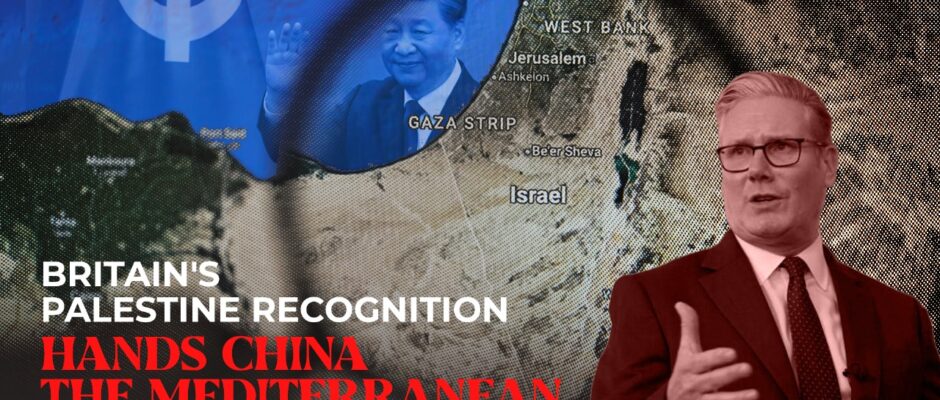
Britain's Palestine Recognition Hands China the Mediterranean

Britain’s Palestine Recognition Hands China the Mediterranean

CCP spent six decades cultivating Palestinian movements, embedding influence in Western activism and positioning itself as the indispensable power in a post-American WestAsia. Britain just made that job easier. Rahul Pawa On 21 September 2025, Prime Minister Keir Starmer broke with decades of U.K. policy formally recognising the state of Palestine. It was Britain’s most consequential West East move since the 1917 Balfour Declaration, made over explicit U.S. objections and Israeli fury. In London’s rush to show moral leadership, one reality was ignored: Beijing had spent six decades preparing for this moment. The CCP’s Palestinian project began in the 1960s. Between 1965 and 1970, Beijing sent small arms, mortars and anti-tank weapons to the Palestine Liberation Army and the Popular Front for the Liberation of Palestine. It trained cadres at the Whampoa Military Academy in Nanning and dispatched instructors to Syria and Algeria. In May 1966 Palestine Liberation Organization Chairman Ahmad al-Shuqairy thanked “Peking” for constant arms and training shipments. After the Six Day War in 1967, Israeli commanders displayed captured Chinese-made AK-47s, 81mm mortars and chemical decontamination gear seized in Gaza and Sinai. Alongside, Beijing also built a diplomatic bridge. In December 1995 it opened a foreign office in Gaza; a de facto embassy to the Palestinian Authority, decades before most Western states considered recognition. Its message to Palestinians was consistent: you can count on us when the West won’t. By Xi Jinping’s era the posture turned strategic. In 2017 the PLA opened its first overseas military base in Djibouti, a Red Sea hub housing thousands of Chinese troops. Beijing secured port stakes from Gwadar in Pakistan to Haifa in Israel, embedding itself along the arteries that supply Europe and the Gulf. A 25-year strategic agreement with Iran in 2021 locked in $400 billion in Chinese investments across oil, gas and transport corridors. CCP’s pattern is clear: first ports, then troops. Djibouti proved it, Hambantota confirmed it, Gaza may be next. Beijing has already demonstrated how commercial access becomes military power, and a recognised Palestine gives it the opening to repeat the same playbook on the Mediterranean. While Beijing built bricks abroad it built narratives at home. State-aligned Arabic media channels and TikTok streams pump out Gaza content at scale. A July 2025 Program on Extremism report mapped how the CCP’s influence runs through Western activism itself. That report details how Shanghai-based tech investor Neville Roy Singham, a onetime Huawei adviser, poured millions into U.S. and U.K. activist groups after Hamas’s October 7, 2023 attack. Groups like the People’s Forum, ANSWER Coalition and “Shut It Down for Palestine” became organising hubs for anti-Israel protests. BreakThrough News, their media arm, live-streamed marches while praising Xi Jinping Thought and Maoist revolution. Investigators concluded the effect was “to project the CCP as a defender of justice while undermining U.S. influence.” In December 2023 the People’s Forum hosted a “China75” event lauding Beijing’s governance model; by early 2024 its funding spiked from under $500,000 to $4.4 million as it expanded pro-Palestinian actions. The same network underwrote protests at Columbia University and in Whitehall, echoing CCP state rhetoric about “imperialist Zionism.” When Starmer spoke to recognise Palestine, Beijing didn’t improvise. Chinese State media instantly framed Britain’s recognition as vindication of the CCP’s “historic” support for Palestinian independence. Chinese diplomats in Ramallah pointed out they had welcomed Mahmoud Abbas to Beijing two years earlier and had pushed a ceasefire plan in 2023. They reminded Palestinian officials who had invested in them when no one else would. With London’s imprimatur, a Palestinian government now has every incentive to turn to CCP for reconstruction finance and infrastructure contracts. Beijing can bolt these onto its Belt and Road Initiative, locking in leverage over a new state at the heart of the Levant. U.S. influence, already eroded by drift and divided Congresses, will shrink further. China’s record speaks for itself. In Djibouti, commercial port access became a PLA base within three years. In Sri Lanka, Chinese loans turned into a 99-year lease at Hambantota. CCP has cultivated a pattern: ports, logistics, security co-operation and then military presence. If Palestine’s future leadership wants investment and security guarantees, CCP will deliver both. Even a small PLA signals unit or intelligence station would tilt the Eastern Mediterranean’s security balance. By presenting any facility as humanitarian or anti-piracy, Beijing can minimise Western backlash while gaining a front-row vantage on Israel, Egypt and NATO operations. Britain’s recognition may have been meant as a rebuke to Israel. However, in practice it is a strategic gift to Beijing. It signals to the Arab world that the West’s will is fractured and that China, not America, not Europe is the constant patron. It creates a diplomatic vacuum China is already moving to fill, from Gaza reconstruction bids to Palestinian security training. This is not hypothetical. Chinese firms dominated Iraq’s post-2003 oil fields; they built most of Africa’s new ports in the last decade. Palestine is a likely next. And unlike the United States or the U.K., the CCP fuses infrastructure with intelligence collection and military access as policy. Starmer’s Downing Street statement marks not the dawn of West Asia peace but a milestone in Beijing’s global ascent. The CCP spent six decades cultivating Palestinian movements, embedding influence in Western activism and positioning itself as the indispensable power in a post-American West Asia. Britain just made that job easier. (Rahul Pawa is director, research at New Delhi based think tank Centre for Integrated and Holistic Studies)
Read More
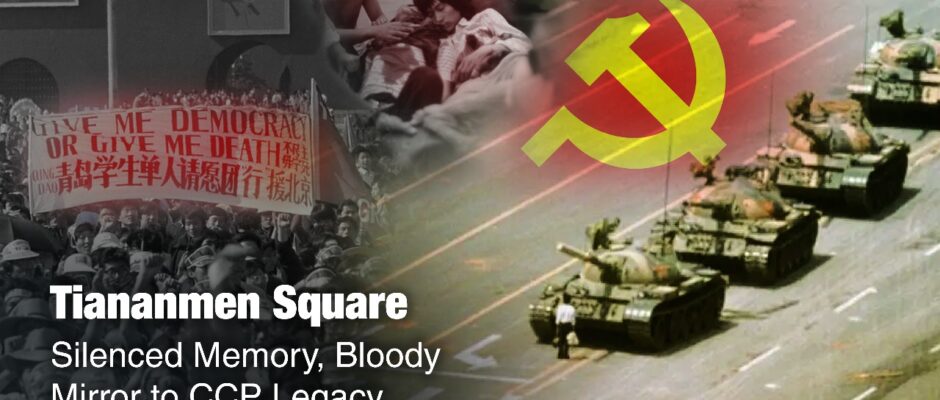
Tiananmen Square: Silenced Memory, Bloody Mirror to CCP Legacy

Tiananmen Square: Silenced Memory, Bloody Mirror to CCP Legacy

History, if buried, becomes a tool of tyranny. Memory, if preserved, becomes a weapon of liberty. The ghosts of Tiananmen still march in silence.  It is up to the world to give them voice. Pummy Pandita On June 3rd and early morning of June 4th, 1989, Chinese Communist Party (CCP) showed its draconian fangs and massacred the country’s youth and workers at Tiananmen Square. Thousands of unarmed workers and students protesting for democratic reforms and freedom from corruption were confronted with tanks, bullets and ferocity. Thirty-six years on, the Chinese dictatorship continues to erase, censor and sanitize that blood-soaked chapter from national psyche. But for the world at large, Tiananmen is still a beacon of defiance and a cautionary tale of enduring authoritarian rule. Although the death toll is veiled by censorship, estimates vary from hundreds to several thousand. What is undeniable is that CCP directed People’s Liberation Army (PLA) to suppress peaceful protests with iron fists and running the tanks over protestors. The iconic image of “Tank Man”, a solitary protester facing a line of tanks, was not mere momentary bravery. It was condemnation of a ruthless regime that perceived students waving placards as a danger to state security. Now, Chinese internet censors even suppress digits “64” and “1989.” Victims’ families, Tiananmen Mothers are subjected to surveillance, harassment and house arrests each anniversary. The attempt by state to rewrite history is a testament to its own fear: that memory is revolutionary and truth is subversive. Tiananmen was not an aberration; it was harbinger of CCP’s authoritarianism that changed but did not disappear. The censorship technologies, surveillance knowhow and suppression tactics that spawned in the wake of 1989 have since metastasized into contemporary surveillance state we witness in Xinjiang, Hong Kong, Tibet and increasingly within mainland China. The party that ran over students in Beijing constructed virtual concentration camps in Xinjiang in the name of “counter-terrorism.” And, the regime that shook at placards in 1989 now shakes at hashtags, virtual dissent and international scrutiny. Tiananmen was the bloody blueprint. Refinement, not remorse, followed. The world witnessed Tiananmen with horror in 1989. But it wasn’t long before trade interests and geopolitical convenience swept the outrage away. Within a few years, China was mainstreamed into global economy. In 2001, it was admitted to the WTO. Western firms poured in, drawn by cheap labour and state-forced exploitation, even as dissidents went missing and Nobel Peace laureates like Liu Xiaobo died in detention. This ideological bankruptcy, where democratic nations get friendly with the totalitarian ones in the interests of immediate gain, has only encouraged Beijing. West’s dependency on Chinese markets has made it an accessory to muffling Tiananmen’s memory. Why recall Tiananmen today? Because China’s political system, techno-authoritarian one-party rule with economic influence, is being shipped out; Chinese young people are coming off age in a state that not only revises the past but eliminates it and the struggle over narrative sovereignty is a battleground in the greater war for liberty in 21st century. Remembering Tiananmen is not about nostalgia. It is about marking the line in red between authoritarianism and civilization. It is about remembering that CCP’s “rise” rests upon coffins of protestors, bones of those it muzzled. The tanks are no longer rolling down Chang’an Avenue, but the infrastructure of fear, censorship and ideological control remains. For a world in which China’s economic influence and digital footprint become increasingly dominant, remembering Tiananmen is not merely historical amnesia—it is geopolitical suicide. It is imperative that governments, civil societies and international institutions not only to remember but act to raise voices that Beijing wants to suppress, to respond to Beijing’s international narrative warfare with unyielding truth and to see to it that those who stood in Tiananmen Square – armed with nothing but ideals and signs – did not die for nothing. (Author is head of operations at Centre for Integrated and Holistic Studies, a non-partisan think tank based in New Delhi)

Read More
How CCP is Architecting a New World Order

How CCP is Architecting a New World Order

CCP is positioning itself not just as a regional power but as the central player in an emerging new world order. With every move, Beijing is sending a clear signal: the era of Western dominance is drawing to an end, and China’s moment has arrived.  In recent years, Chinese Communist Party (CCP) has embarked on a series of bold, strategically transformative initiatives that are not only reshaping global order but also redefining the very concept of national security. Seizing the moment, Beijing has advanced a comprehensive strategy aimed at strengthening its position while challenging post-Cold War world order that has long been dominated by Western powers. The scope of Beijing’s ambitions has expanded to unprecedented levels—ranging from large-scale infrastructure projects spanning continents to advancements in technology and energy. Each initiative showcases a determined effort to reposition China at the centre of a new global hierarchy. Unfolding, an era of calculated moves, technological breakthroughs, and strategic posturing, all of which are poised to fundamentally shift global power dynamics and shape international landscape for decades to come. It started with a quiet, yet signifiant move into the heart of Africa. Under Belt and Road Initiative, a series of 30 clean energy projects has begun to take shape across the continent, weaving a complex web of CCP influence in countries long neglected by the West. Solar farms, wind turbines, and hydroelectric plants are rising where darkness and poverty once reigned, promising economic growth and energy independence. To many, it seems like the kind of philanthropy the world needs—Beijing is playing the role of the benevolent superpower, offering solutions where others have failed. Yet, as Beijing’s footprint expands, its motives become clearer. This is not just about lighting up villages or building infrastructure—it’s about creating a sphere of influence. The “Green Silk Initiative,” as some have called it, is a tool for political leverage, an economic dependency cloaked in the rhetoric of environmentalism and mutual benefit. For the CCP, Africa’s energy future is not just about growth; it’s about aligning a vast continent with its own vision for the global order, a vision that has no place for Western hegemony. Simultaneously, high in the Tibetan plateau, another monumental CCP project is taking shape—one that threatens to reshape the region’s future and leave its critics scrambling for answers. The CCP’s proposed hydropower dam, set to generate 300 billion kilowatt-hours annually, is poised to become the world’s largest hydropower project, with an estimated cost of $137 billion. Beyond the eye-popping numbers, the scale of this project has sparked intense controversy. Tibetan exiles and environmental groups warn that the dam could irrevocably damage fragile ecosystems and desecrate landscapes that have been sacred for centuries. The Dalai Lama, exiled since the CCP’s occupation of Tibet, has repeatedly voiced concerns, cautioning that such large-scale developments, masked as progress, would scar a land steeped in ancient culture and unparalleled natural beauty. For many, the dam is not simply an energy project—it is a symbol of cultural and ecological destruction, a stark manifestation of a regime willing to sacrifice the sacred in its relentless pursuit of power. The ambitions of the CCP, however, extend far beyond energy and infrastructure, reaching into the very heart of technological advancement. The unveiling of the CR450 high-speed train serves as a striking demonstration of China’s emerging engineering prowess, as well as a symbol of its strategy to dominate the global transportation landscape. The CR450, now recognised as the world’s fastest train, is more than a marvel of modern engineering—it is a direct challenge to the West’s technological supremacy. Designed to connect major cities across China with unprecedented speed and efficiency, the train cuts through the landscape with such force that it feels less like a transportation system and more like a statement. The rapid development and deployment of such projects place Beijing not only at the cutting edge of infrastructure but in a strategic position to export its technology globally, further entrenching its economic and political reach across the globe. This is not a game of pure infrastructure, however. As much as the CCP seeks to dazzle the world with its technological feats, it also seeks to control the future of energy and power itself. The “Artificial Sun” project, another CCP innovation, has captured the global imagination. Under the banner of the Celestial Fusion programme, Chinese scientists recently set a world record by sustaining plasma for an unprecedented 1,066 seconds. This achievement, presented with immense fanfare by the Chinese state, positions the China as a leader in the race for clean, limitless energy. But in many ways, the artificial sun represents more than just a scientific breakthrough. For many critics, it is a carefully choreographed piece of state-sponsored propaganda, designed to project power and technological dominance. CCP is positioning itself not just as a global economic power but as a potential monopoly on the energy sources of the future. The implications of such a shift cannot be understated. The ability to control global energy markets and dictate terms for future energy access will fundamentally reshape the power structures of the 21st century. Beijing’s naval ambitions, too, have grown exponentially. The unveiling of the Type 075 amphibious assault ship is a powerful signal of the CCP’s People’s Liberation Army (PLA) growing military might and its intent to dominate the seas. This vessel, one of the largest of its kind, is capable of deploying large forces quickly and efficiently across vast stretches of the ocean. The message is clear: CCP is ready to assert itself as a maritime power capable of protecting its interests in critical regions such as the South China Sea, where tensions with Southeast Asian nations and the United States have been escalating for years.The Type 075, with its cutting-edge technology and imposing size, epitomises Beijing’s broader naval ambitions to challenge both South Asian and Western naval presences in the region. More than just a weapon, the ship serves as a floating symbol of Beijing’s power projection—an embassy on water, reinforcing the message

Read More

Chinese Pangs Continue to Stifle Buddhists

US, India should devise a plan to stop President Xi from hijacking selection of next Dalai Lama and preserve Tibetan culture & resources Brahma Chellaney As Dalai Lama, spiritual leader visits US, to receive medical treatment for his knees, concerns over who will succeed him have become acute. While Tibetans around the world pray that 88-year-old Tenzin Gyatso, 14th Dalai Lama still has plenty of life ahead of him, China is eagerly awaiting his demise so that it can install a puppet successor. Tibetans regard Dalai Lama as living incarnation of Buddha with a total of 13 reincarnations since 1391. When one Dalai Lama dies, the search for next one begins, with a council of senior disciples taking responsibility for identifying the figure based on signs and visions. But in recent years, Chinese government has insisted that only it has the right to identify next Dalai Lama. This would not be first time China selected a leader of Tibetan Buddhism. In 1995, it anointed its own Panchen Lama, whose spiritual authority is second only to that of Dalai Lama, after abducting actual Panchen Lama — six-year-old boy who had already been confirmed by Dalai Lama. Almost three decades later, real Panchen Lama is among the world’s longest-serving political prisoners. China also appointed Karmapa, Tibetan Buddhism’s third most important spiritual leader and head of the Karma Kagyu sect. But in 1999, its appointee Ogyen Trinley Dorje fled to India. The ease with which 14-year-old Karmapa escaped China raised suspicions among Indians about his loyalties. After imposing travel restrictions on him, India decided in 2018 to no longer recognize China-anointed Karmapa as legitimate head of his sect. Now, he and his rival Karmapa Trinley Thaye Dorje have issued a joint statement pledging to cooperatively resolve leadership split in Karma Kagyu sect. But, Dalai Lama is China’s white whale. The incumbent — who was identified as Dalai Lama in 1937, at age two  — has been a thorn in the side of Chinese Communist Party (CCP) since Beijing’s 1951 annexation of Tibet. With his relentless espousal of nonviolence, Dalai Lama who won Nobel Peace Prize in 1989 embodies Tibetan resistance to Chinese occupation. (Had Tibet remained self-governing like Taiwan, it would be the world’s tenth-largest country by area.) In his past incarnations, Dalai Lama was not only Tibet’s spiritual leader, but also its political leader, making him a kind of cross between a pope and a president. But the Dalai Lama ceded his political role in 2011 to a Tibetan government-in-exile which is democratically elected every five years by Tibetan refugees living in India and elsewhere. Dalai Lama has declared that he might choose not to be reborn — a decision that would undermine legitimacy of any Chinese-anointed successor. He knows that for China, a Dalai Lama devoted to CCP is much more useful than no Dalai Lama at all. He knows that while he has retained his mental acuity, his body is weakening. In 2016, he underwent radiation therapy for prostate cancer. He says he was “completely cured,” but continues to struggle with his knees. Given his advanced age, more health problems are to be expected. Dalai Lama’s frailty is one reason why his travel schedule has slowed considerably. But it is not the only one: Bowing to Chinese pressure, most countries — including European democracies and Asia’s Buddhist states (except Japan) — are unwilling to grant him entry. Fortunately, some countries have retained their backbones. US is hosting Dalai Lama for knee treatment and India has been his home for more than 65 years. India has officially designated Dalai Lama it’s “most esteemed and honoured guest,” while the Tibetan leader describes himself as a “son of India.” India is home to vast majority of Tibetan exiles and has played a central role in helping to preserve Tibetan culture including by supporting Tibetan-language schools. By contrast, China has been working actively to destroy Tibetan culture and identity, especially since Chinese leader Xi Jinping has been in charge. China’s appropriation of Tibetan natural resources has gone into overdrive with consequences that extend far beyond the Tibetan Plateau. Resource-rich Tibet is a source of fresh water for more than one-fifth of the world’s population and a global biodiversity hotspot. The plateau influences Asia’s weather and monsoonal patterns, as well as Northern Hemisphere’s “atmospheric general circulation” — the system of winds that helps transport warm air from the equator toward higher latitudes, creating different climate zones. US and India should work together to foil China’s plan to handpick next Dalai Lama. Already, America’s Tibetan Policy and Support Act which took effect in 2020, says that “the wishes of the 14th Dalai Lama, including any written instructions, should play a determinative role in the selection, education, and veneration of a future 15th Dalai Lama.” And it calls for sanctions on Chinese officials who interfere with Tibetan Buddhist succession practices. But more must be done. For starters, US President Joe Biden should take the opportunity presented by Dalai Lama’s knee treatment to fulfil a 2020 campaign promise to meet with the spiritual leader. More broadly, Washington should work together with India to devise a multilateral strategy to counter Xi’s plan to capture the more than 600-year-old institution of Dalai Lama. This must include efforts to persuade Dalai Lama to spell out, once and for all, rules that must be followed to identify his successor. (Author is professor emeritus of strategic studies at New Delhi-based Center for Policy Research; fellow at Robert Bosch Academy in Berlin. He is author of “Water, Peace, and War: Confronting the Global Water Crisis” (Rowman & Littlefield, 2013). © Project Syndicate, 2024. This write up was first published in Japan Times)

Read More

Games that China Plays

Psychological warfare, media propaganda, narratives coupled with operations beyond diplomatic relations is what China is known for. Is the world listening? Dr Amritpal Kaur Prima Facie, diplomacy is a well-rehearsed hard bargain negotiation among countries to achieve the best possible outcomes for a nation without resorting to crude force. What does not however meet the eye is that it is an incessant process to resolve outstanding issues lurking around the corners, brewing for years before the final settlement, if ever, is achieved. With core interests at the heart of diplomatic deliberations, the high stakes make this complicated dance on eggshells all more crucial. It is assumed that deliberations conducted by diplomats are a standard process with similar training in negotiation processes and the parlance used in discussions. In reality, diplomatic negotiation is a high-voltage tussle with deep and far-reaching consequences. Even more astounding is that it does not end on the negotiation table but runs like an undercurrent. In the era of Globalization or ‘Complex interdependence’ as much as the international community is reality of domestic national life, diplomacy and diplomatic signals become more significant for nations. If diplomatic engagement is mired in psychological games with the intention of one-upmanship, bilateral engagements become complex and if one of the parties is contemporary China, it raises its own share of issues. Conspicuous silence President Xi Jingping maintained when Prime Minister Modi assumed office for historic third consecutive term was marked by world leaders. This silence seems to have sent out an eloquent underlying message. Though Chinese Premier Li Qiang joined top world leaders in congratulating Prime Minister Modi ahead of swearing in on June 9, 2024, President Xi’s silence was ostensibly aimed at mounting psychological pressure on India. Post-second world war, China and its international relations give us glimpse into the country’s thinking on its relations with others including India. Beginning with Zhau Enlai, average Chinese have relentlessly pursued overt and covert ways to achieve its desired bilateral outcomes with an astonishing disregard for international treaties and modus operandi. Indo-Chinese agreement of 1993, intermittent border skirmishes and war (1962) since 1948 reiterates the point that it’s not over, until the last bell rang. Border dispute with India and People’s Liberation Army operations on Indo-Chinese border comes at crucial junctures. Former National Security Advisor Shiv Shankar Menon recounted in his book Choices (2016) that in 2014 when the first Modi government took office and President Xi came to India, PLA engaged in border skirmishes with India. Similarly, during Prime Minister Modi’s visit to China, a similar tactic unfolded. Probable explanation to such acts, according to Menon is to create psychological pressure on the newly elected Indian prime Minister as to who is the sheriff in town. Richard Solomon, former diplomat in US and former Foreign Secretary of India Vijay Gokhale have written respectively about the Chinese style of diplomacy which is remarkably different from diplomacy of democratic countries. Chinese engage in psychological warfare even in diplomacy at various levels. From setting agenda to building narratives, Chinese are adept at controlling the whole process and go beyond closed doors of diplomatic negotiations. One pattern is to engage in crude coercion and use of force while the other is to leverage media to create narratives. Two examples can be cited here, one is that of 1950s when Pt. Jawaharlal Nehru was called the ‘Bourgeoise Imperialist’ by Chinese media. Earlier this month, the state-sponsored Chinese media and related ecosystem described Prime Minister Modi as ‘weakened’ leader. These reports also suggested possible use of counter measures by China if India maintains policy status quo. Why is it that Chinese takes recourse to multi-pronged games in strategic and diplomatic relations with other countries eventually leading to disturbing regional peace and tranquility? Nature of Chinese state perhaps necessitates such behaviour. To begin with, Henry Kissinger in On China argued that since antiquity China has believed in ‘Middle Kingdom’ phenomenon which places the Chinese state over rest of the world and only beneath the heaven. This perceived middle Kingdom phenomenon has percolated to Communist China as well and hence they believe that other countries can only be vassals to the dragon power. There have been suggestions to the effect that Chinese communist expansionists harbor the idea that bilateral relations cannot be between equal sovereigns. These relations should centre on ‘superior’ China and ‘inferior’ other nations. With regards to Bharat, Chinese terminology includes ‘legalized hegemony’ and perceives India as an inferior state given that it does not have a permanent seat in United Nations Security Council. Chinese may have effortlessly used this aspect to tip balance of power in their favour, as former NSA Shiv Shankar Menon calls it.  Former foreign secretary Gokhale argued that Chinese engage in such tactics to keep power equation in their favour. Communist Party of China is the state itself and officials are appointed by the Party and not the state. Hence, their allegiance is with the Party and not the state per se. Menon sums the Chinese position succinctly when he argues that China is a lonely state rising in a crowded neighbourhood with an acute need for regime survival and internal harmony. Hence, its no wonder that being adventurous in foreign relations was to offset domestic attention from key issues. Since China is viewed as a formidable power, there is critical need to find a mutually beneficial bilateral mechanism. But, there’s no letup in tricky Chinese games loaded with psychological operations that have implications for outstanding bilateral issues. China experts, time and again, underscore that if we had to deal with China, understanding its game is more important. Only then can we find favourable outcomes in diplomatic negotiations. Jiang Zemin was famous for saying in English that it takes two to tango and it is true in this case well. For bilateral relations to succeed, it takes two to clap and a possible egalitarian approach in Chinese diplomacy. (Author is Assistant Professor in Political Sciences, Dayal Singh College, Delhi University, New Delhi)

Read More

China Spins Jingoistic Narrative

Bharat hits back on Chinese Communist Party’s false claims on Arunachal Pradesh. Global community including US recognize the dragon ploy. Rohan Giri There’s something innate in China that cannot change. It’s in its DNA to encroach on others. As part of its grand plan to usurp others land, properties and expand its hegemony, China and its ruling Communist Party of China (CPC) have tasted success in few areas while they eagerly look at grabbing neighbours’ territories. Tibet is one area where Chinese Communist Party has had large success in altering names of places, assert control on large swaps of land and change, culture, languages and life of ordinary citizens. Through coercion, China constructed certain structures to also advance on its border regions through coercive means. Similar attempts have been made with Bharat’s territories especially Arunachal Pradesh to assert its dominance in the region. Communist Party of China and its life time General Secretary Xi Jingping announced Chinese names to places in and around Arunachal Pradesh. Latest in the Chinese ploy of old and deceitful rhetoric is evidenced by statements made by People’s Liberation Army’s Senior Colonel Zhang Xiaogang, spokesperson for Chinese Defense Ministry. By intention, he claimed that southern region of Xizang, the Chinese nomenclature for Tibet, was integral component of China’s territory.  This was obvious reference to Arunachal Pradesh which China thinks is its own territory. Chinese Defense Ministry raked up the bogey on Bharat’s north-eastern state of Arunachal Pradesh after Sela Tunnel was constructed to enhance civic and military connectivity and capabilities in the state. The latest overtures by China expose the Chinese Communist Party ploy to initially seize Tibet and subsequently move in on Arunachal Pradesh. Bharat along with 17 other countries, mostly neighbours, has experienced adverse consequences of persistently making unsubstantiated claims by Chinese Communist Party. Henry McMahon, then foreign secretary of Britain drew an 890-km border between Bharat and Tibet in 1914. Arunachal Pradesh was formerly referred to as North Eastern Frontier Agency before the establishment of the McMahon Line. On one side of McMahon, Tibet existed as an autonomous region while on the other Arunachal Pradesh was an Indian state. Chinese communist party falsely maintains that Tibet is one component of China and refuses to acknowledge this demarcation. China’s aspirations for territorial expansion had begun to gain momentum at this point. The act of manipulating maps to include some regions of Bharat has been observed since ancient times, hence its innate to its nature. Bogus claims of Chinese communists were undermined when Japanese forces launched an invasion of Arunachal Pradesh, north-eastern state of Bharat during Second World War. Additionally, emergence of Chinese expansionism posed an enormous threat to Bharat’s territorial integrity. During that period, the British-led Indian Army provided protection to Tawang of Arunachal Pradesh. Bharat has had consistently maintained a firm stance against China’s claims and Arunachal Pradesh residents have historically rejected  China’s expansionist aspirations and unsubstantiated assertions. Latest PLA statements on Arunachal Pradesh have come after Chinese Communist Party misleading names of 11 locations in Arunachal Pradesh. In addition to expressing their outrage, local populace actively engaged in peace marches on the roads, demonstrating their opposition to China. The protesting people were holding placards that read, “We stand by India” and “Arunachal is not part of China.” The posters in their possession had the message, “Don’t we know… How China is oppressing the people of Tibet and is always engaged in looting it? At any cost, we would not like the condition of Arunachal Pradesh to become like that of Tibet…” Individuals hailing from Arunachal Pradesh, holding tricolor flags, asserted that similar demonstration were held when China changed the names of six locations in 2017 and 15 locations in 2021. The misleading names were in the Chinese and Tibetan languages. In 2023, the controversy over stapled visas gained attention as Indian Wushu players were granted such visas by China. New Delhi-based think tank Center for Integrated and Holistic Studies, at that time, had reported that the “Stapled visas incident is seen more as one step further in China’s grand expansionist plan and communist vision to occupy others’ land disregarding international treaties, pacts and ‘gentlemen’ agreements to not change on-the-ground goal posts. Only way to put an end to this psycho-warfare like stapled visas is to firmly retake ‘Aksai Chin’ under its ‘illegal’ occupation since 1950s and held after the 1962 war.” Bharat and its government always said that Arunachal Pradesh was, is, and will remain integral to the country. China’s illegal expansionist strategy extended much beyond Arunachal Pradesh, Tibet, or Nepal. Countries and international communities need to be alert to such machinations and not succumb to mechanisms like debt trap, infrastructure development or other forms of avarice. (Author: Rohan Giri is a journalism graduate from Indian Institute of Mass Communication (IIMC) New Delhi, and Manager Operations at CIHS.)

Read More

Maldivian turn in the Tide: India’s safety net to China’s debt web

Shift in island nation’s strategic relations to curry favour with Chinese Communist Party bosses is fraught with danger of instability Rahul Pawa Maldives that has historically been a significant beneficiary of Bharat’s Neighbourhood First policy and a proximate maritime neighbour in the Indian Ocean Region, is re-positioning itself from the perspective of defense and security ties with Bharat. This reassessment is direct consequence of actions taken by newly anointed Maldivian President Mohamed Muizzu, who rose to power advocating an ‘India Out’ campaign. Influenced by the pro-Chinese Communist Party (CCP) stance of former President Abdulla Yameen, President Muizzu has made a decisive move away from the cooperative relationship his predecessor, Ibrahim Mohamed Solih, maintained with Bharat. This shift became particularly evident with a statement issued on November 18, in which President Muizzu’s office formally requested withdrawal of Indian military personnel from Maldives. This request, signifying a departure from longstanding military cooperation between the two nations was earlier  presented during a meeting with India’s Earth Sciences Minister Kiren Rijiju, who was in attendance at Muizzu’s swearing-in ceremony.  Escalating the situation further, Maldives is now scrutinizing over 100 agreements signed with India during Solih’s tenure, covering areas of defense and security. Mohamed Firuzul Abdul Khaleel, the undersecretary for Public Policy in Presidential Office, disclosed the stationing of 77 Bharatiya military personnel in Maldives, spanning various military assets covered this scrutiny. This reevaluation of ties and November 18 announcement underscore a significant geopolitical shift in the region, marking a potential realignment of Maldives’ foreign policy away from Bharat and marks a tilt towards China. Maldives’ strategic pivot towards China, away from its traditional alignment with Bharat, brings a multitude of vulnerabilities and challenges for the island nation as well. This shift not only strengthens China’s influence in a region historically under Indian sway but also risks exposing the Maldives to economic and political instability. The alignment with China poses significant risk of ensnaring Maldives in a debt trap, akin to Sri Lanka as in the case of Hambantota Port and other infrastructure projects. Considering the Maldivian economy’s heavy reliance on tourism, financial burden of Chinese investments could be unsustainable. Moreover, this shift in foreign policy may lead to internal political strife. Opposition to the ‘China-triggered’ policies and concerns over national sovereignty could ignite domestic unrest, potentially resulting in a divided and unstable political landscape. On international front, moving away from India might strain the Maldives’ relationships with other regional powers and Western allies, who view China’s expanding influence with apprehension. This could lead to lesser foreign aid and support from these nations. The strategic shift under influence of Chinese Communist Party (CCP) represents significant departure from Maldives’ historical relationship with India, a partnership that has been a bedrock of stability and support, instrumental in the nation’s development and security. India’s role has been particularly pivotal during times of crisis, such as the 1988 coup attempt, 2014 water crisis and 2004 tsunami, offering a balance of economic assistance, defense cooperation, and diplomatic support.  However, the new trajectory in favour of China opens Maldives to a host of risks that could have far-reaching consequences for its stability and wellbeing. Possible economic dependency on China, with looming threat of a debt trap, poses a significant danger to the Maldivian economy. This shift might not only leads to internal political instability but also exacerbate the nation’s environmental challenges. Maldives, already grappling with adverse impact of climate change and rising sea levels, may face further environmental degradation due to large-scale Chinese construction projects.  In essence, moving away from India could isolate the Maldives from a historically reliable and benevolent partner, steering it away from the sources of strength and stability that have been crucial for its growth and prosperity. As President Muizzu seeks to establish new geopolitical alignments, the Maldives navigates towards a precarious future. The allure of Chinese economic support, while tempting, carries substantial risks, including the potential loss of traditional allies and internal political turmoil. This strategic pivot could leave the Maldives in a vulnerable position, both economically and geopolitically, with limited room to manoeuvre in an increasingly complex and competitive international arena. The future, as it unfolds, is fraught with uncertainty and potential instability for the Maldives as it navigates these significant geopolitical shifts. (Author is Director – research at New Delhi based non-partisan think tank, Centre for Integrated and Holistic Studies)

Read More

Chinese Puppetry on Show!

Probing charges of money laundering, peddling of Chinese propaganda by NewsClick is not suppression of press freedom  K.A.Badarinath Noise on suppression of press freedom and free speech has not yet reached a crescendo. This noise has just begun in India with Left parties, their frontal organizations and anti-Modi political alliance partners going for the kill. Few activists from these political formations hit the streets on Wednesday protesting a probe against alleged China funded portal ‘NewsClick’ that reportedly laundered  money to bankroll the dragon’s ‘propaganda’ vehicle. Portal’s founder Prabir Purkayastha and his human resources head were rounded up by special operations unit of Delhi Police after having questioned over a dozen journalists, consultants and later seized their devices for further investigation. Big question therefore is why all the noise on purported suppression of press freedom in India? Well, this is not the first time that such false narrative was peddled or reported in domestic and foreign media outlets in last ten-odd years. Two big charges against ‘NewsClick’ and its front-enders is that the organization worked as ‘propaganda vehicle’ for China. And, second serious charge is that foreign funds were routed through a millionaire businessman Neville Roy Singham to take forward nefarious Chinese Communist Party agenda in India. Well, only an in-depth investigation will bring out the facts and stick out separated from the organized noise of fringe Left parties that claim to protect, cherish and embellish Mao’s jinxed political thought. Firstly, is it a crime to investigate possible wrong doing by anyone concerned with ‘NewsClick’? The probe was launched by Delhi Police, Enforcement Directorate and other agencies only after having filed a detailed first information report against the accused on August 17 taking cognizance of ‘Chinese Propaganda machine’ related reports that appeared in The New York Times. These very political formations and self-styled proponents of ‘free press’ that hit the streets have had sworn by NYT on more than one occasion to hit out at the Modi government. Now, what’s wrong in investigating ‘NewsClick’ based on newspaper reports and Enforcement Directorate’s own research? The New York Times had pointed to a global web of Chinese propaganda that involved American non-profits which stretched from Chicago to Shanghai. This web as per NYT had NewsClick as an active participant.   Now, why can’t the law enforcement agencies do their job of enforcing probity in public life, negate possible China propaganda campaign and stem laundering of foreign funds that made their way into ‘NewsClick’ during 2018 – 21 and used ‘against the Indian state’?  Does this tantamount to suppressing press freedom? Or, is initiation of an inquiry anti-democratic by any stretch of imagination? It’s rather surprising that newspapers like ‘The Hindu’ and ‘Indian Express’ that were at forefront of investigating Bofors scam in early ‘80s and ‘90s editorialized the police action on ‘NewsClick’ as smacking of supressing press freedom. And, it is rather laughable. Crackdown against suspected crime by elements inimical to Bharat’s interests or exposing ‘NewsClick’ handlers in US and China cannot be equated with Smt Indira Gandhi’s decision to suspend basic citizens’ rights, impose internal emergency and curb press freedom in 1975 after an adversarial verdict of Allahabad High Court. Wouldn’t Ramnath Goenka, founder of Indian Express and Kasturi Ranga Iyengar of ‘The Hindu’ turn in their graves at the suggestion of curbing press freedom for investigating against ‘NewsClick’ management and their handlers? As in case of any individual or organization, don’t journalists have basic responsibility to submit before law enforcement agencies seeking to get at the truth? Making hue and cry of a probe may not drown the truth about irregularities at ‘NewsClick’. At best, NewsClick is a scrappy outlet that used invectives and propaganda to try and corner Narendra Modi government. And, it gained prominence only after The New York Times investigation linked it to a network that funded pro-China campaigns. Similar noise and public outrage was on show after BBC India operations were scrutinized for violation of Indian taxation laws. Tax sleuths assessment forced BBC to admit that it had under-reported revenues, profits and thereby evaded taxes. Reuters, The Hindustan Times and The Mint newspapers reported that BBC under-reported incomes worth Rs 40 crore to evade taxes. Well, income tax assessment of UK government funded BBC accounts was blown out of proportion and several of these very propagandists had jumped in to cite suppression of press freedom. There was no plausible explanation on how enforcement of domestic tax laws was same as suppression of press freedom. In the first place, big question was how did a foreign government funded media organization gather courage to evade taxes? Certainly, India is neither a banana republic nor subservient outpost of the erstwhile British imperialist rulers. When news laundry, yet another website were surveyed by Income Tax officials in 2021, similar charges of ‘intimidation and press freedom’ were heaped against the law enforcement agencies. Rule of law is what matters. Whether it is Bharat Samachaar or Dainik Bhaskar, media organizations need to be upfront given their distinct responsibility to readers, people that go by what appears in the media and the country. If thousands of websites, newspapers, TV Channels, social media handles owned by Indians, domestic corporates and foreign collaborations have been freely undertaking news operations, then where’s this suppression of press freedom? Seeking accountability is not equivalent to suppression of press freedom and rights. Newspapers, magazines and other media outlets in India like elsewhere have taken an independent editorial line in sync with their beliefs, understanding and assessment of a government, its policies and political ideologies. Editorial positioning of a media organization is distinctly different from resorting to irregularities, wrong doing, anti-India propaganda or joining flanks with the enemy. Let’s not equate press freedom with irregularities and anti-India tacit operations. Freedom comes with responsibility. (Author is Director& Chief Executive of New Delhi based non-partisan think tank, Centre for Integrated and Holistic Studies)

Read More

Quirky Chinese leadership undependable!

Retake ‘Aksai Chin’ under Chinese occupation, stop its draconian expansionist aggression and bring peace to Indian borders K.A.Badarinath China is at its old dark ways again. Otherwise, there’s no reason why three Indian Wushu sports persons from Arunachal Pradesh, Nyeman Wangsu, Onilu Tega and Mepung Lapgu, were given stapled visas. India’s Wushu team was to head for Chengdu to participate in the World University Games beginning Friday. The stapled visas issue is symptomatic of China’s war games and its claim on Arunachal Pradesh that’s integral to Bharat. The latest fracas seems to be scripted and directed by none other than the Chinese Oligarchs’ frontman and President, Xi Jingping who’s into his third term as head of Chinese Communist Party and also head of all powerful military commission. Most significant Chinese claim on Arunachal Pradesh ala indirectly through stapled visas comes on a day when three key developments were reported. Dichotomy in Chinese military checkers comes to fore on a day when Prime Minister Narendra Modi and Chinese President Xi Jingping spoke on phone to bring about stability on the borders. In fact, this was the first recorded conversation of the two leaders after their brief in person informal interaction at Bali as part of G-20 group at the invitation of Indonesian President. After the Galwan valley Chinese misadventure, there has been no engagement between heads of state and President Xi Jingping was busy ensuring third Presidential term for himself apart from ‘cleansing’ the party from his political rivals and policy antagonists. ‘Stapled visas’ hogged headlines also on a day when reports poured in about the two leaders’ discussion on military standoff during April – May 2020 in Eastern Ladakh. What has induced ‘stapled visas’ issue larger significance is the reports of Peoples Liberation Army (PLA) heightened build up from Eastern Ladakh to Arunachal Pradesh borders during last few weeks? Nineteen rounds of corps commander level talks between Indian and Chinese side have not yielded results nor have led to sensitizing PLA Generals or belligerent Communist leadership in China that rules its own people with an iron fist. Sense that one gets is China’s outright refusal to disengage from at the strategic Depsang plains and Charding Ninhlunh nallah track junction at the Demchock in Eastern Ladakh. On the other hand, reports suggest continued build-up of bunkers, posts, artillery positions, surface to air missile systems, radar sites and ammunition storages. Development of new helipads, roads, dual use villages development and last mile connectivity has also been on the rise across the border leading to beliefs that negotiations at political level may ‘not yield’ on the ground results but discussions have to happen. Stapled visas incident is seen more as one step further in China’s grand expansionist plan and communist vision to occupy others’ land disregarding international treaties, pacts and ‘gentlemen’ agreements to not change on-the-ground goal posts. Only way to put an end to this psycho-warfare like stapled visas is to firmly retake ‘Aksai Chin’ under its ‘illegal’ occupation since 1950s and held after the 1962 war. China’s claim on Aksai Chin was made a couple of years after Indian Constitution was adopted in 1950 that included whole of Jammu and Kashmir along with Ladakh. Aksai Chin was part of Ladakh till the Chinese claim leading to its occupation in ‘50s. In fact, no Chinese maps till 1920s even showed Aksai Chin as part of China. Even in 1930s map of Sinkiang or Xinjiang, Kunlun mountains were marked as Chinese boundary and not the Karakoram range. Chinese posturing and war games that were shaped in ‘wolf warrior’ diplomacy doctrine is essentially unsustainable in any bilateral relations. Beijing will have to realize that false claims, wolf warrior diplomacy combined with on-ground, air and water bound aggression may not help in positioning itself as a leader as well. In fact, Qin Gang who’s been closest aide to President Xi Jingping and later anointed a state councillor was considered architect of wolf warrior diplomacy doctrine adopted by Chinese Communist Party as one of its key principles in engaging with the world. While there’s no trace of ‘missing’ Qin Gang, bringing Wang Li back as top Chinese diplomat and foreign minister may not help clear the air. Openness, flexibility and clarity of thought and attitude make great world powers. China has a long way to go leaving its shady past, false claims and drudgery that the communist regime is known for.  (author is Director and Chief Executive, Centre for Integrated and Holistic Studies,  non-partisan think tank based in New Delhi)

Read More

PLA ploy in Nepal may come a cropper

Nepalese maoist leadership move to stop enlisting Gurkhas in Indian Army point to China’s dragon net cast wide to tighten its stranglehold Rahul Pawa Earliest reference to Gurkhas can be found in Hindu epic treatise, the Mahabharata. This poem tells the tale of Bhima, one of the heroes, and his encounter with Kichaka, a fierce warrior who was the chief of Kiratas tribe. This tribe inhabited present-day Himalayan region of Nepal and Kichaka was known for his strength and ferocity in battle. Bhim found it challenging to defeat him but he eventually emerged victorious and spared Kichaka’s life, accepting him as his ally. This encounter is believed to be the first mention of the tribe that later became popular as ‘Gurkhas.’  Known for their bravery and martial prowess, the term ‘Gurkha’ is derived from Gorkha district, part of Gandaki province in western Nepal. The region was ancestral home to Shah dynasty that was founded in 1559 by King Dravya Shah, a descendant of Rajput warriors from northern India. Gurkhas as we know them today came to limelight late 18th and early 19th centuries when they were recruited in British East India Company and later the British Indian Army. It is unclear who precisely coined the term ‘Gurkha,’ but believed to have been popularised by the British during the Anglo-Nepalese War of 1814-16. The term was used to refer to soldiers from the Gorkha district and surrounding regions that were recruited into the British Indian Army. Since then, Gorkhas became synonymous with Nepalese soldiers known for their fighting skills and reputation for bravery, who continued to serve both British and Indian armies. Recently, rumours were rife on Chinese Communist Party’s (CPC) plans to recruit Gorkhas into People’s Liberation Army (PLA). This renewed concerns over CPC’s influence over Nepalese Prime Minister and maoist ideologue Pushpa Kamal Dahal a.k.a Prachanda and his Communist -dominated Nepalese government. In the elections held on November 20 last year, Prachanda ‘s Maoist Centre secured third largest number of seats with 32 in the 275- member House of Representatives. Prachanda was sworn in as Nepal’s Prime Minister on 130th birth anniversary of Mao Zedong, who was a significant ideological influence on Prachanda. As per a report by EPardafas, CPC activities in Nepal spread far and wide after Dahal-led government took reins of the Himalayan Kingdom. CPC’s attempts to influence Nepal’s politics through targeted information operation appear to be a page from Chinese communist’s larger strategy book to whip up anti-India sentiment in the country. CPC strategy seems to be consistent with Mao Zedong’s historical “Five Fingers of Tibet” policy that was first articulated in his speeches during 1940s. The clandestine formulation was to “liberate” Sikkim, Bhutan, Ladakh, and the NEFA from what Mao perceived as “Indian imperialism.” On the contrary, CPC’s expansionist agenda seem to have led to providing financial assistance in order to advance their neatly designed work programme among Nepal’s 30 million habitants. Over the years, CPC floated or supported several think-tanks in Nepal through Chinese Study Centre (CSC) at Katmandu established in 2009. Thirty two  such study centres came into being as part of larger design to set up one centre each in the country’s77 districts. These centres played a key role to provide ground research to push CPC aspirations in Nepal.  In addition to teaching Mandarin, these centres researched in different subjects with funding support from China. One subject study was aimed at assessing young Nepali – Gurkhas interest and motivation to joini Indian Army. The study was also to evaluate financial expectations of Nepali youngsters from their stints in Indian Army. This provides perfect backdrop to Nepalese communist leadership request to their Indian counterparts for putting on hold Gurkhas recruitment. This request not only flummoxed the Indian army recruiters but also Nepali youngsters that showed keen interest the new Agnipath scheme. The maoist government justified its stand with the contention that Nepalese lawmakers were yet to discuss the ‘Agnipath’ recruitment issue. This request from Nepal government also provides a window of opportunity to CPC for enlisting Gurkha warriors into PLA. Big question therefore is if the Maoist led Nepalese government turning its youth as “force on hire” for PLA. For most Gurkhas serving as soldiers in the Indian army, it is not just about money, schemes for Nepalese people or the decades-old tripartite agreement. It is about a shared unique closeness and oneness of tradition and faith. Shared history, mutual respect and an inalienable link unite Nepal and India.  This bond of combat brotherhood is maintained by the Gurkha troops who serve between the two nations.  Nepal and India have had shared more than just this idea for thousands of years. Soldiers of Nepalese and Indian ancestry have formed a common relationship as Gurkhas and brotherhood that bonds them. Nepal and India relations go beyond contemporary disputes and conflicts with both countries sharing a distinctive tradition of anointing each other’s Chiefs of Army Staff as Honorary Generals. The Gurkha hat and Khukuri are not just symbols of courage and bravery but represent the brotherly relationship and cultural affinities shared by both nations. They won several gallantry awards together including the Param Vir Chakra and Maha Vir Chakra for their bravery and sacrifice. Indian Army and CPC’s PLA contrast hence becomes significant. In particular, PLA’s differential treatment of their own people and that of neighbours come to the fore. CPC occupation of Nepali land, attempt to sow discord within Nepal and luring the country into a debt trap have become points of larger public discourse. CPC’s actions in Nepal and its disregard for universal human rights and freedoms make it an unlikely recruiter for the proud Gurkhas. Nepalese people and Gurkhas will have to remain vigilant against attempts by foreign powers to interfere in its internal affairs. Decisions on Gurkhas recruitment must be made in the best interests of the Nepalese people and not influenced by external pressures or agendas. Gurkhas have served both Nepal and India with distinction for many years and

Read More
  • 1
  • 2