
CIHS – Centre for Integrated and Holistic Studies

Date/Time:

India, Japan, and Buddha

India, Japan, and Buddha

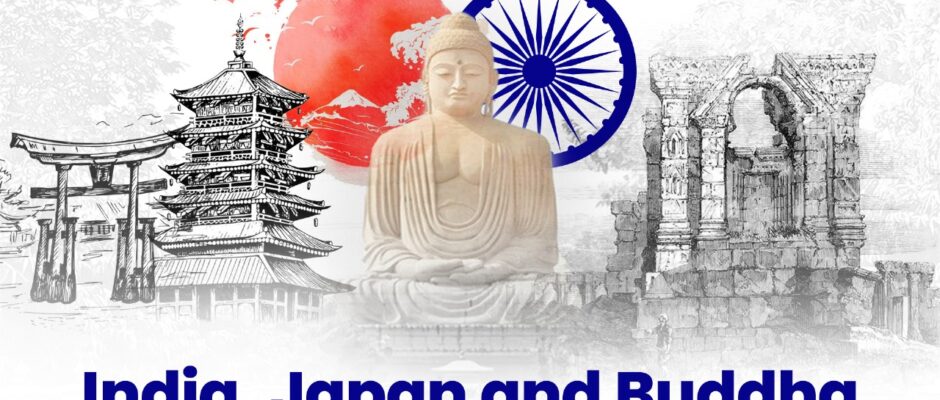
Dr. Jay Prakash Yadav Japan’s National Day embodies a legacy shaped by cultural wisdom and strategic foresight. Since Buddhism’s arrival from India in 552 AD, Japan has integrated its principles into governance. The history of cultural friendship between India and Japan dates to AD 552, the time when Japan was introduced to Buddhism. It was the time when Japan began to drink from the Indian spring of culture, sharing the Buddhist ideals of wisdom and compassion, faith and sacrifice, purity and enlightenment. India resulted in ushering in of a new era. Since then, Buddhism has remained the core and culmination of our friendship and will continue for generations to come. Japan drew its first constitution based on the Buddhist principles of Panchasila, Triratna- Buddha, Dharma and Sangha thus gave a humanized face to the administrative system in Japan. India and Japan have a unique relationship devoid of ideological, cultural, or geographical disagreements. It is distinct and exudes warmth from giving deeds and feelings of support for one another in difficult times. Japanese culture and thinking have been influenced by Indian culture, which has been filtered through Buddhism. This is precisely why Japanese people feel very close to India. A global vision of peace, security, and shared prosperity founded on sustainable development is now shared by Japan and India. The foundation of the two nations’ international cooperation is their shared democratic principles and dedication to pluralism, human rights, open society, and the rule of law. A wide convergence of India and Japan’s long-term political, economic, and strategic interests, aspirations, objectives, and concerns can be seen in their worldwide relationship. Japan and India see each other as partners who can and should respond to regional and global issues in a way that is consistent with their global cooperation. Thus, India’s strength, prosperity, and vibrancy are beneficial to Japan, and vice versa. It has been determined to strengthen the strategic focus of Japan-India’s global collaboration in light of the given circumstances and the state of the world. With a shared interest in and complementary roles in furthering global peace and equitable development as well as the security, stability, and prosperity of Asia, India and Japan are peace partners. In April 2005, during the then-Japanese Prime Minister Junichiro Koizumi’s visit, it was decided that the two nations would deepen their cooperation and work toward a comprehensive and all-encompassing development of their bilateral relations, with a specific and pressing emphasis on bolstering economic ties by making the most of their economies’ potential and current complementarities. It was determined that both nations will work to establish stronger communication and cooperation in order to safeguard peace, stability, and prosperity in Asia; advance democracy and development; and investigate a new framework for tighter regional cooperation in Asia. Taking advantage of and expanding upon existing strategic convergences, two nations also decided to increase collaboration in a variety of fields, including energy, disarmament, non-proliferation, security, and the environment. In the context of globalization and the growing concern over the use of military power for achieving foreign policy objectives, the importance of soft power has increased considerably, and Buddhism offers many advantages. Buddhism has international appeal and is highly conducive to spreading among all nations, cultures, and civilizations because of its core teachings, which include equality, non-violence, and its dialogical approach. Furthermore, there is no more effective soft power tool for Asian nations that share a Buddhist spirituality. Buddhism has played a significant role in Japanese culture and religion for over 1500 years, despite its foreign appearance. It is currently Japan’s soft power diplomacy’s most enduring tenet. Through several private and government agencies, Japan has been from time to time at the forefront in restoring the Buddhist relics, developing the major Buddhist pilgrim sites in various countries including India. Japan has thus rendered a great service to Buddhism and the land of its birth by rediscovering, reclaiming, and keeping alive the ‘wonder that was India. India has now woken up and is using Buddhism as the focal point of its soft-power campaign throughout Asia to highlight its strong Buddhist credentials. During the past one-decade, Indian policy-makers are making conscious efforts to utilize its allure for fostering deeper engagement with Asian countries – especially in the east and southeast, as part of its “Act East” policy. This involves not just sprucing up and showcasing Buddhist sacred sites and monuments, but also establishing people-to-people contacts and promoting cultural exchanges via tourism. (Author is Assistant professor at Dr. B.R. Ambedkar University of social sciences, Mhow, Madhya Pradesh and Scholar of Buddhist Studies.)
Read More
Japan & Bharat: Friends for Eternity

Japan & Bharat: Friends for Eternity

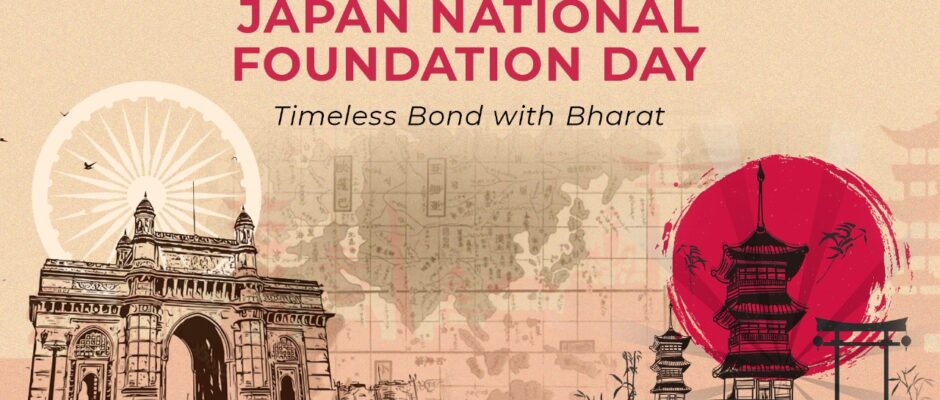
As Japan rings in its national foundation day, Bharat is on the curve joining this momentous occasion in shared values & principles of righteousness based on ‘dharma’. Rahul Pawa Across vast expanse of time and geography, few relationships between nations carry the depth and grace of one shared by Bharat (India) and Japan. Rooted in shared values, spiritual kinship and mutual admiration, this bond transcends transactional nature of alliances. Instead, it thrives on profound cultural, philosophical and historical ties that unite these two ancient civilizations. It is a connection that reflects the very essence of human harmony, a quiet testament to enduring power of shared ideals and aspirations. In rich history of human civilization, where threads of culture, faith and tradition intertwine, relationship between Bharat and Japan stand out as a masterpiece of enduring harmony and shared aspirations. This bond, etched into hearts of both nations, is not merely a product of modern diplomacy but connection spanning millennia. As Japan commemorates its National Foundation Day on February 11, celebrating ascension of Emperor Jimmu in 660 BCE and founding of the nation, it is an opportune moment to reflect upon rich and layered bond between these two great civilizations. In intricate cartography of Edo period, Japan placed India at centre of the world. Not out of geographical ignorance, but as a conscious act of reverence. Bharat—Tenjiku, as they called it—was more than a distant land; it was a spiritual homeland, birthplace of a philosophy that shaped Japan’s moral compass. For a nation that revered teachings of Buddha, India was not a foreign country but sacred extension of its identity. Long before ink of modern diplomacy touched parchment, flow of ideas between these two ancient civilizations had begun. When Indian monk Bodhisena arrived in Japan during eighth century, it was not a fleeting encounter but a moment of profound resonance. Invited to preside over consecration of the Great Buddha at Todai-ji Temple, he embodied the living bridge between two people united by in search for enlightenment. The ceremony, performed with sacred intent, symbolized more than the completion of a statue—it was consecration of a bond, a promise that these two cultures would remain intertwined. Maps of Edo period tell another story, quiet but potent. They show an India shaped not by geography but by imagination—a land of myths, wisdom and cosmic order. For Japan, steeped in Buddhist cosmology, India was not merely a place but metaphor for spiritual awakening. These maps, with their sprawling ovoid depictions of Tenjiku held India as axis of a world harmonized by Dharma. Such reverence is rare, even in annals of history. It speaks of a relationship not driven by conquest or commerce but by shared ideals and mutual awe. As tides of time shifted, threads of this bond remained unbroken. The rise of Zen Buddhism in Japan was deeply inspired by Indian Mahayana traditions transforming not just religious practice but essence of Japanese culture. The simplicity of Zen gardens, quiet grace of tea ceremony and meditative depth of haiku—all bear faint yet indelible imprint of India’s spiritual heritage. In turn, Japan’s refinement of these traditions added new dimensions to them, demonstrating unique capacity to absorb and elevate what it embraced. Culinary exchanges between Bharat and Japan are yet another testament to this quiet partnership. The artful simplicity of Japanese sushi finds an echo in intricate preparation of Indian thalis. The reverence for natural flavours in Japanese cuisine resonates with vegetarian traditions of India born from principles of ahimsa. Every shared meal, every borrowed recipe, is a silent acknowledgment of the kinship that transcends borders. The 20th century, with all its upheavals, tested this ancient bond but never weakened it. During India’s struggle for independence, figures like Fujii Guruji, founder of the Nippozan Myohoji Buddhist Order, stood in solidarity with India. His belief that the land of Buddha must be free to realize its spiritual destiny reflects depth of understanding between the two nations. Even as Japan pursued its own path of modernization, the connection to India remained alive, quietly influencing its worldview and aspirations. Today, the relationship between Bharat and Japan has evolved into a partnership of equals.  “Special Strategic and Global Partnership” is not a mere diplomatic phrase but continuation of an ancient dialogue. It is a collaboration born out of trust and shared values, manifesting in initiatives like Mumbai – Ahmedabad High – Speed Rail and Quad Alliance. These are not just projects or policies—they are modern expressions of an enduring friendship that began in monasteries and temples. Yet, essence of this bond lies not in its politics but in its people. Japanese tourists bow in reverence at Bodh Gaya, site of Buddha’s enlightenment, while Indian students embrace precision and innovation of Japanese education. The principle of Vasudhaiva Kutumbakam—the world as one family—and Kizuna—bonds of friendship—find living expression in these interactions. They remind us that this is not a relationship of convenience but one of conviction. As Japan celebrates its National Foundation Day, it is a moment to reflect on the legacy of this bond. February 11, marking ascension of Emperor Jimmu, symbolizes beginning of a journey, not just for Japan but for a relationship that has stood test of time. It is a day to honour ideals that have united Bharat and Japan: pursuit of harmony, reverence for tradition, and unyielding belief in a better tomorrow. This is not just a tale of two nations—it is a story of two spirits, kindred and enduring. As the cherry blossoms bloom in Japan and sacred rivers flow in Bharat, they carry with them whispers of an ancient friendship, timeless and unbroken. (Author is Research Director at Centre for Integrated and Holistic Studies, New Delhi based non-partisan think-tank)

Read More

Chinese Pangs Continue to Stifle Buddhists

US, India should devise a plan to stop President Xi from hijacking selection of next Dalai Lama and preserve Tibetan culture & resources Brahma Chellaney As Dalai Lama, spiritual leader visits US, to receive medical treatment for his knees, concerns over who will succeed him have become acute. While Tibetans around the world pray that 88-year-old Tenzin Gyatso, 14th Dalai Lama still has plenty of life ahead of him, China is eagerly awaiting his demise so that it can install a puppet successor. Tibetans regard Dalai Lama as living incarnation of Buddha with a total of 13 reincarnations since 1391. When one Dalai Lama dies, the search for next one begins, with a council of senior disciples taking responsibility for identifying the figure based on signs and visions. But in recent years, Chinese government has insisted that only it has the right to identify next Dalai Lama. This would not be first time China selected a leader of Tibetan Buddhism. In 1995, it anointed its own Panchen Lama, whose spiritual authority is second only to that of Dalai Lama, after abducting actual Panchen Lama — six-year-old boy who had already been confirmed by Dalai Lama. Almost three decades later, real Panchen Lama is among the world’s longest-serving political prisoners. China also appointed Karmapa, Tibetan Buddhism’s third most important spiritual leader and head of the Karma Kagyu sect. But in 1999, its appointee Ogyen Trinley Dorje fled to India. The ease with which 14-year-old Karmapa escaped China raised suspicions among Indians about his loyalties. After imposing travel restrictions on him, India decided in 2018 to no longer recognize China-anointed Karmapa as legitimate head of his sect. Now, he and his rival Karmapa Trinley Thaye Dorje have issued a joint statement pledging to cooperatively resolve leadership split in Karma Kagyu sect. But, Dalai Lama is China’s white whale. The incumbent — who was identified as Dalai Lama in 1937, at age two  — has been a thorn in the side of Chinese Communist Party (CCP) since Beijing’s 1951 annexation of Tibet. With his relentless espousal of nonviolence, Dalai Lama who won Nobel Peace Prize in 1989 embodies Tibetan resistance to Chinese occupation. (Had Tibet remained self-governing like Taiwan, it would be the world’s tenth-largest country by area.) In his past incarnations, Dalai Lama was not only Tibet’s spiritual leader, but also its political leader, making him a kind of cross between a pope and a president. But the Dalai Lama ceded his political role in 2011 to a Tibetan government-in-exile which is democratically elected every five years by Tibetan refugees living in India and elsewhere. Dalai Lama has declared that he might choose not to be reborn — a decision that would undermine legitimacy of any Chinese-anointed successor. He knows that for China, a Dalai Lama devoted to CCP is much more useful than no Dalai Lama at all. He knows that while he has retained his mental acuity, his body is weakening. In 2016, he underwent radiation therapy for prostate cancer. He says he was “completely cured,” but continues to struggle with his knees. Given his advanced age, more health problems are to be expected. Dalai Lama’s frailty is one reason why his travel schedule has slowed considerably. But it is not the only one: Bowing to Chinese pressure, most countries — including European democracies and Asia’s Buddhist states (except Japan) — are unwilling to grant him entry. Fortunately, some countries have retained their backbones. US is hosting Dalai Lama for knee treatment and India has been his home for more than 65 years. India has officially designated Dalai Lama it’s “most esteemed and honoured guest,” while the Tibetan leader describes himself as a “son of India.” India is home to vast majority of Tibetan exiles and has played a central role in helping to preserve Tibetan culture including by supporting Tibetan-language schools. By contrast, China has been working actively to destroy Tibetan culture and identity, especially since Chinese leader Xi Jinping has been in charge. China’s appropriation of Tibetan natural resources has gone into overdrive with consequences that extend far beyond the Tibetan Plateau. Resource-rich Tibet is a source of fresh water for more than one-fifth of the world’s population and a global biodiversity hotspot. The plateau influences Asia’s weather and monsoonal patterns, as well as Northern Hemisphere’s “atmospheric general circulation” — the system of winds that helps transport warm air from the equator toward higher latitudes, creating different climate zones. US and India should work together to foil China’s plan to handpick next Dalai Lama. Already, America’s Tibetan Policy and Support Act which took effect in 2020, says that “the wishes of the 14th Dalai Lama, including any written instructions, should play a determinative role in the selection, education, and veneration of a future 15th Dalai Lama.” And it calls for sanctions on Chinese officials who interfere with Tibetan Buddhist succession practices. But more must be done. For starters, US President Joe Biden should take the opportunity presented by Dalai Lama’s knee treatment to fulfil a 2020 campaign promise to meet with the spiritual leader. More broadly, Washington should work together with India to devise a multilateral strategy to counter Xi’s plan to capture the more than 600-year-old institution of Dalai Lama. This must include efforts to persuade Dalai Lama to spell out, once and for all, rules that must be followed to identify his successor. (Author is professor emeritus of strategic studies at New Delhi-based Center for Policy Research; fellow at Robert Bosch Academy in Berlin. He is author of “Water, Peace, and War: Confronting the Global Water Crisis” (Rowman & Littlefield, 2013). © Project Syndicate, 2024. This write up was first published in Japan Times)

Read More

Swami Vivekananda: An eternal youth icon

Born on Pausha Krishna Saptami in 1919 (January 12, 1863 C.E. ), Narendranath Dutta, famously known as Swami Vivekananda, was raised in an Indian Bengali middle class family. Renowned around the world for introducing and serving as India’s  advocate for Bharatiya (Indian) wisdom and ideals in the West. It is strongly believed that Swami ji’s philosophy and the values he upheld throughout his life, continue to serve as the fundamental source of inspiration for Indian youth. India so recognises and remembers the great philosopher and spiritual thinker by designating January 12 of each year as its “National Youth Day.” India is one of the youngest countries in the world, with more than 65% of the population under 35 and more than 50% under 25. The teachings of Swami Vivekanand continue to inspire this energetic and vibrant segment of the population and have had a profound impact on thousands of young people’s lives. Swami Vivekanand transcended caste and creed emphasising the idea of universal brotherhood. His words accurately capture the profound impact his ideas have had on young people. A symbol of India youth’s never-ending vitality and their unrelenting search for the truth. He attained a divinity early in life as a result of his spiritual pursuits and rooting in ideas and ideals about simple living and elevation of the self. Swami ji was one of the most well-known spiritual figures, educators, and professors of Vedantic wisdom with a fresh outlook. He was a pupil of Ramakrishna Paramahamsa and revered for his unflinching bravery and inspiring words to the young. Coming from a family of scholars, including Swami Vivekananda’s grandfather Durgacharan Dutta, who studied Sanskrit and Persian, and his father Vishwanath Dutta, who practiced as a lawyer at the Calcutta High Court. Vivekananda has been drawn to spirituality and religious thought at an early age. At the home of his neighbour in 1881, he first met his spiritual mentor Shri Ramakrishna Paramahamsa. From his master, Vivekananda gained a profound understanding of the Sanatan spiritual traditions and started to recognise the possibilities for spreading these teachings to people all over the world. Vivekananda started his journey throughout India after Paramahamsa passed away in 1886, spreading his guru’s teachings and advocating for a “practical Vedanta,” which emphasised the use of spiritual concepts in daily life. Additionally, he started to form his own ideas about the faith, the self, and the cosmos. In his historic address to the World’s Parliament of Religions in 1893 in the United States, Vivekananda introduced Sanatan Dharma to the America and urged religious tolerance and an end to fanaticism. His speech since then, is one of the most famous in the world. An exceptional educator Vivekanand demystified Bharatiya ideals and values in both America and Europe thanks to a series of renowned speeches and talks. In his teachings, Vivekananda highlighted the value of self-realisation and the possibility of spiritual enlightenment for everyone. He also underlined the necessity of social and economic reform as well as the significance of charitable work. He held that all religions were different roads leading to the same ultimate goal and that true spirituality could be discovered through the practise of selfless service.  Swami Vivekananda played a significant role in inspiring young people by placing a strong emphasis on education and personal development. He held that a healthy and vibrant society can only be built via education, which is the key to releasing a person’s full potential. Young people were urged by him to take charge of their education and pursue greatness in all facets of their lives. Swami Vivekananda felt that people could control their own destiny and could do great things provided they were prepared to put in the necessary effort and push through any challenges in their path. He urged young people to establish high ideals for themselves and to toil diligently toward achieving them, even in the face of adversity. According to Swami ji, serving others and improving the overall state of the world is the true goal of life. He exhorted young people to engage in volunteer work and employ their skills and abilities to benefit others. Swami Vivekananda so captures the essence of young India.

Read More