
CIHS – Centre for Integrated and Holistic Studies

Date/Time:

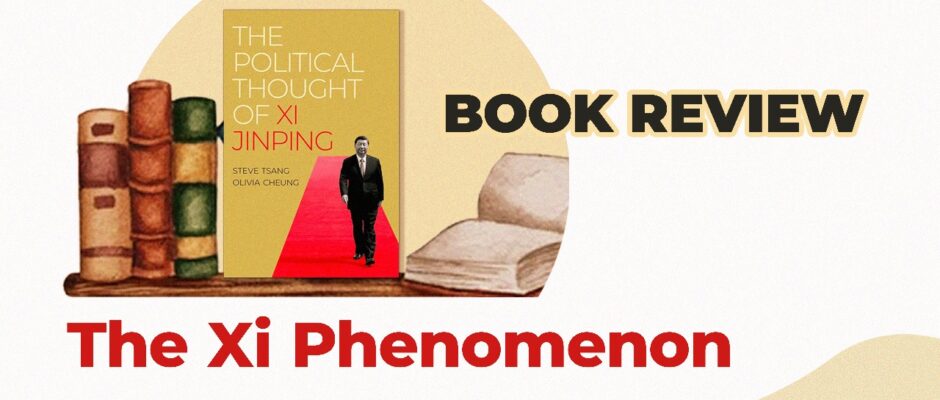
The Xi Phenomenon

The Xi Phenomenon

Book by Tsang, Steve and Olivia Cheung: The Political Thought of Xi Jinping, Oxford University Press, New York, (2024). Dr Amritpal Kaur There are rare moments in contemporary, post second world war history where a single country could challenge international order so comprehensively while sitting in the wings for most of the time. It can only be facilitated by mercurial rise in its fortune and prosperity to propel or make any entity so significant that their actions and reactions generate waves around the world. China story is exactly that which captures its economic rise while the politico-economic-historical antecedents continue to be an enigma for global communities. Yet, it is a country that’s challenging accepted norms for nation-states in international order. At the centre of this debate on China’s rise and its aggressive behaviour is the leadership of President Xi Jinping who has turned a virtual dictator in the communist party order. The book, The Political Thought of Xi Jinping, seeks to deal with the phenomenon called Xi Jinping. Xi’s political thought has become important to understand contemporary China essentially because unlike his predecessors led by Deng Xiaoping, Xi grabbed and held onto the supreme political power within Chinese Communist Party and Peoples’ Republic of China. This surreal rise of Xi’s dictatorship is unprecedented since days of Mao Zedong with implications largely unknown for future of Party-state of China. The book contextualizes Xi thought within Marxist-Leninist framework where the party helmed by a singular entity is lynchpin of domestic political system and international posturing. As far as domestic system is concerned, the debate is largely settled since supremacy of CCP is unquestionable and is unchallenged. Both the power and propaganda of CCP are aimed to ensure regime’s iron-clad grip on the people, their lives and destiny including families. Xi’s over-bearing influence along with his close inner circle coterie is so huge that, even CCP fades away pathetically before this towering personality propped up by business tycoons and oligarchs.  Since China has no democracy, lack of political liberties for the people is sought to be offset by all-encompassing comprehensive state propaganda where Party and its supreme leader Xi are branded as their saviours. Via his politics and propaganda, President Xi has been successful in taking complete hold over the party by appointing his close buddies to key posts. In the process, he has equated allegiance to him akin to the party. Through his Thought he has projected himself as the party and nothing else. The book argues that leaders before Xi had worked in collective leadership mode. Xi on the contrary does not share power with anyone else and hence there is a greater need to project the threat to Chinese state in the absence of Xi and his indispensability as the competent and core Helmsman of China. Centralization of power by Xi has its international implications. It is one thing for Xi to mould Chinese political system as per his ‘whims and fancies’ and portraying it as the Marxist-Leninist-Maoist ideology. But it’s altogether a different ball game if that state becomes second largest economy and second largest state in terms of population. The sheer power projection of Chinese state internationally is concerning enough if President Xi prominently discusses the ‘external dangers’. Under him overt docile appearance of China, given by Deng and his famous quote of ‘Bide the time and hide the capacity’ has been decidedly shed away and in its place has come the aggressive posturing in neighbourhood and ‘wolf-warrior’ diplomacy. The signals are clear, Xi is pressing the accelerator of Chinese foreign policy to bring it at par with ‘comprehensive power’ of China and with the command and respect it should get as one of the leading powers. The book in effect is soft landing the impact of China’s feverish growth aspirations on countries in its vicinity and larger international system. For example, discussion on critical technologies that China seeks to master has a dual purpose; to make it self-sufficient and making the world dependent on it rather the other way round. These technologies include frontier areas like Artificial Intelligence, machine learning and at the same time developing ‘asymmetrical assassin’s maces’ technologies which can give China decided edge over other countries. Coupled with oft-quoted Xi concept of Tianxia which is ‘Sino-centric world order’, a concentration of cutting-edge technologies will only accentuate the Chinese power. If there is one power differential which will decide true security of any country with other dimensions being near equal, it will be technology. The power of future is not much in number of armed personnel or billions in GDP, but in growth sprouts of cutting-edge technology and human endeavour which can fundamentally change human condition itself. President Xi understands this crucial aspect and hence the focus on the scientific developments in China. Secondly dual circulation of economy also seeks to keep the world dependent on China. China must be self-sufficient economically and this too seeks to insulate PRC from global headwinds and to keep the world from weaponizing trade in its dealing with China. Ironically, if that happens international community will be taking a leaf out of the Chinese manual. President Xi, through his thought is asking people of China to be prepared for difficult times ahead. However, the question is, China is preparing for ‘difficult times ahead’ and ‘external danger’ then surely, it’s not seeking to cooperate with comity of nations. The book does not clearly discuss this implication of Xi’s thought. The present book attempts to chart political thought of President Xi in the times when he has emerged as the strongman. It seeks to understand the impact of Xi’s thought on China and countries around China, albeit in a very limited way. For example, the book discusses only East Asian countries and Africa in the segment of China and ‘Common Destiny of Humankind’. Both these segments of international community are either harmless or weak in comparison to PRC. However, real depth of analysis would have come had the book discussed

Read More

Fuelling Discontent Dishonestly

Ziya Us Salam’s propagandist anti-Hindu book, “Being Muslim in Hindu India” promoted by habitual offender The New York Times Dr Shailendra Kumar Pathak The book, “Being Muslim in Hindu India,” by Ziya Us Salam, an author infamous for his agenda driven writings has sparked controversy and debate, particularly due to its propagation of what many perceive as a narrative steeped in victimhood and misinformation. A recent article in The New York Times edition of May 18, 2024, titled ‘Strangers in Their Own Land: Being Muslim in Modi’s India’ by Mujib Mashal and Hari Kumar seems to be an attempt at amplifying this very min-information.  Assertions made in the book that are one-sided may have suited anti-Hindu and anti-Bharat agenda of The New York Times.  Media outlets like ABC News, AFP News from US also echoed the packaged mis-information peddled by Ziya Us Islam. On closer scrutiny, it becomes evident that claims made in the book and related articles are riddled with inaccuracies and lack substantive evidence. A few media outlets had to cut a sorry figure as US State Department debunked their claims on lack of religious freedom in Bharat. On May 20, US foreign ministry spokesperson Matthew Miller said that the state rejects such reports outright. “We are deeply committed to promoting and protecting universal respect for the right to freedom of religion or belief worldwide. We have engaged many countries including India on the importance of equal treatment for members of all religious communities,” Miller said at a briefing. In this write up, claims made by Ziya Us Islam in his book and related foreign media reports are being closely scrutinised to expose the fallacies and distortions that underpin them. Salam’s book propagates false victimhood narrative suggesting that Muslims in Bharat are constantly oppressed and marginalized due to their religious identity. This portrayal ignores the socio-political realities of Bharat where Muslims have held significant positions in government, businesses, academia and arts. Dharmic ethos has led Bharat to accommodating diverse religious communities and faiths including Muslims over the millennia. It may not be an exaggeration to say that Bharat is the only country that’s home to most sects and sub-sects of Muslims.  Overplay by foreign media sporadic localised incidents involving minorities in Bharat are absurd. Prime Minister’s Economic Advisory Council said in a report that from 1950 to 2015, muslim population in Bharat increased by 43.15 per cent. On the contrary, a decline of 7.82 per cent has been reported for Hindus during the same period. If muslims faced atrocities or were under attack as Ziya Us Islam and his media friends claim, will the absolute number of muslims surge? The research found that Christian, Sikh and Buddhist numbers increased while Jain and Parsi populations fell. Is there, any country across the world where any community faced discrimination and wrath of majority but its number grew consistently over 65-year time frame? Propagandist book alleges systemic discrimination by Indian state against Muslim citizens. On the contrary, Bharat’s Constitution guarantees equal rights and opportunities to all its citizens, irrespective of religion. Government policies and initiatives aim to uplift marginalized communities including Muslims, through affirmative action and welfare schemes. Accusations of state-sponsored discrimination lack evidence and serve only to fuel divisive agendas. One glaring flaw in Salam’s book is his selective interpretation of history. He conveniently ignores instances where Hindu-Muslim harmony prevailed and exaggerates isolated incidents of conflict to paint a grim picture of interfaith relations in Bharat. In reality, Bharat’s cultural tapestry is woven with threads of coexistence and mutual respect, exemplified by centuries-old syncretic traditions and shared cultural practices. Salam’s work ventures to perpetuate stereotypes about Hinduism, portraying it as inherently hostile towards Muslims. This misrepresentation not only undermines the rich tapestry of Hindu philosophy and spirituality but reinforces divisive narratives that fuel communal tensions. Hinduism encompasses diverse beliefs and practices embodied by principles of tolerance, compassion and pluralism. Salam’s lies hit the roof when he claims that ancestors of Bhagwan Ram were Muslims. It has been proved with scientific research that Ram existed more than 3000 years before Islam took birth on this earth. The book sensationalizes Hindu – Muslim relations by highlighting isolated incidents of communal violence while ignoring the vast majority of harmonious interactions between two communities. Bharat’s cultural fabric is woven with threads of diversity and tolerance where Hindus and Muslims coexisted peacefully celebrating each other’s festivals and sharing social bonds. Instances of communal harmony far outweigh sporadic conflicts, a fact conveniently overlooked in the propaganda narrative. Salam illustrates some incidents where those accused in murder of Muslims were given heroic welcome. The author deliberately keeps silent on targeted killing, rape and sexual abuse of Hindu girls and women perpetuated by Muslims through predesigned means and campaigns. Salam appears very upset towards laws against ‘love jehad’ encouraged by Muslim families through fake identity. His conscience does not stir when reports appear each day on rapes, murders, discords, divorce, abuse of Hindu girls. By singularly portraying Muslims as victims of purported Hindu oppression, Salam overlooks the agency and resilience of the Muslim community in Bharat. Despite facing challenges, Muslims have made significant contributions to Bharat’s cultural, economic and social fabric. From art and literature to science and technology, Muslims have excelled in various fields enriching the nation’s diversity and heritage. Attributing violence to Hindu extremism oversimplifies complex socio-political dynamics. Like any other country Bharat also grapples with various forms of violence including caste-based and intra-religious conflicts. Blaming Hindu nationalism for all instances of violence undermines efforts to address broader issues of social justice and communal harmony. Salam’s book risks exacerbating sectarian tensions by essentializing Hindu-Muslim identities and reinforcing a binary narrative of “us versus them.” Such divisive rhetoric not only undermines Bharat’s secular ethos but plays into the hands of extremists on both sides who seek to sow discord and hatred. Instead of fostering unity and understanding, Salam’s work could fuel polarization and mistrust. The propaganda propagated in Ziya Us Salam’s book, “Being Muslim in Hindu

Read More

Half-Truths Presented to Debunk Hard Reality of Jihad

Jain, S., Alavi, M., & Sharma, S. (2024). Love Jihad and Other Fictions: Simple facts to counter viral falsehoods (1st ed.). Aleph. Dr Amritpal Kaur American novelist Colson Whitehead had said, ‘what isn’t said is as important as what is said’. The Book Love Jihad and Other Fictions is an apt example of what is left out of the narrative. To begin with, the book deals with the phenomenon of Love Jihad and several other forms of Jihad that its authors believe as works of fiction. To them there is no solid ground to base the argument of Love Jihad. Broadly, the book attempts to debunk three forms of Jihad namely, Love Jihad, Population Jihad and conversion of people from Hinduism to Christianity. It argues that these ‘jihad’ or Muslim holy wars (by means of Marriage and progeny) are works of fiction. On the contrary it seeks to find ground reality to set the record straight. As the reader goes through the analysis, it is glaring that the said “facts” are rather subjective interpretations of individuals and often one-sided. In fact, it’s precisely the reason for not being able to convince the reader about the realities. To begin with, in the chapter on Love Jihad, the book sites Kerala’s very first Love Jihad case in the country where luring of a woman in the name of love and marriage led to her marriage and eventual conversion to Islam. The chapter discusses in detail about the thoughts and feelings of the man involved. However, we do not hear about the side of the Girl or her parents primarily as to why she left the man, Shahan Sha. It is important to acknowledge that in a huge majority of inter-faith marriages, it is the Hindu woman who has to convert to Islam. It seldom happens, if at all that the Muslim man converts to Hinduism. There are a number of cases where girls have reported physical and sexual abuse after initial courting period to forcefully convert to Islam. In many cases it has led to their untimely and often violent deaths.  In subsequent analysis on Love Jihad, the book emphatically deals primarily with English media as the ‘next best source’ for information. However, neutrality of Media and objectivity of facts is questionable. It would be anybody’s guess as to if the analysis is mainly based on media reports and not the unbiased information, it would be coloured by political leanings of the author and media house concerned. On population jihad, the book tries to debunk the idea that higher muslim birth rate has led to larger size of muslims population, The ‘facts and comparisons it gives are rather mind-boggling. For example, it argues that fertility rate of Muslims in South India is lower than that Hindus in the North India. Polygamy is not cited as one of the reasons for such spurt in Muslims numbers crossed 210 million in recent years. Comparative analysis of fertility levels should have been based on samples from the same region rather than mixing up data by design and intention.  Same spin on facts has been given in the case of Muslims in Assam. The book argues that muslims fertility rates in Assam is higher than that of Hindus but is not much different from national average. Can there be a true comparison when the question they seek to answer is higher population growth of Muslims in the state? The true comparison would have been between Hindus and Muslims numbers, growth rates and percentages in the same north-eastern state of Assam. That would have shown shift in population composition. By bringing the variable on aggregate Indian growth rate, the book attempts to muddy waters in favour of one individual group. Third issue dealt with is conversion of Hindus primarily into Christianity. The book argues that threat of conversion into Christianity is unreal. The case cited to elucidate the point is that of Lavanya, a teenage girl who committed suicide due to psychological pressure put on her to change her religion. The book sees the suicide as ‘complex phenomenon’ based on the family life of the girl without giving categorical ‘facts’ to either prove that Lavanya died due to conversion pressure or otherwise. Since Lavanya died due to complex issues it cannot be attributed to Christian warden of her hostel. What saves this analysis otherwise is the fact that the case is being heard by the courts. By questioning integrity and attachment of her family it sought to discard the forceful conversion of a bubbly teenage girl as main reason for her death. Ironically, had it been the case otherwise, the authors would have been a wee bit harsh in the name, calling a spade a spade. Similar courtesy has not been extended in this case as the girl is a Hindu. It is important to realize and acknowledge that muddled facts can be misleading too, views from different sources were to be heard from all the sides to derive a value neutral and objective assessment. However, the book presents one-sided analysis and by placing only convenient bits of information with wrong comparative set narratives, it paints a wrong picture. It undermines the concerns of those who have suffered at hands of such propaganda. Scores of girls’ families that died at hands of vengeful and violent suiters who pressure them to convert to Islam would vastly disagree with the book’s analysis. In fact, it is a classic case of how facts can be used to lie. (Author is Assistant Professor in Political Sciences, Dayal Singh College, Delhi University, New Delhi)   

Read More

Dr Hedgewar: Rare Gem, True Leader & Visionary

Dr. Aniket Pingley Every time I visit Reshim Bagh Karyalaya of Rashtriya Swayasevak Sangh in Nagpur, I pay my tributes at the Smriti Mandir. Firmly nestled, there is a statue of Dr. Keshav Baliram Hedgewar, carved in black stone, depicting a sentinel of this great nation of Hindus. In his chiselled form, ‘Doctor ji’ as he’s popular, appears calm and resolute, watching over the swayamsevaks who are expanding the work of RSS in every realm possible. To say that the statue stands as a symbol of inspiration is an understatement, as is saying that the man was an institution. When man first landed on the moon, the whole world believed that it was a giant leap for mankind. Dr. Hedgewar also took one such giant leap for mankind, albeit a few decades earlier, when he founded the RSS. But unlike many visionaries, he put everything into action through ‘Shakhas’, basic units of Sangh and created a universal roadmap for ‘Vyakti-Nirmaan’ (personality development) that would diligently serve not only Bharat but humanity transcending borders. More than a dozen biographies of Dr. Hedgewar have been written thus far; perhaps the most remarkable one is in Marathi by Shri Nana Palkar, titled ‘Dr. Hedgewar Charitra‘. Shri Palkar, writer and poet himself was also a lifelong pracharak of RSS. Dr. Anil Nene recently translated his book into English under the title ‘Man of the Millennia: Dr. Hedgewar.’ It was released on March 2, 2024. Almost a century since RSS inception, its key figures remain the most under-researched and bordering on enigmatic, but amply vilified, mostly due to a lack of due diligence that often stems from malicious intent. For the English-dominated intellectual space in metropolitan regions of India and the global audience, ‘Man of the Millennia: Dr. Hedgewar’ is a ‘go to’ book as it was originally authored by a Pracharak who not only had opportunities to meet Dr. Hedgewar personally but also internalized the vision-in-action laid down by the fountainhead of the RSS. The book takes us through many notable incidents in Dr. Hedgewar’s life. Since his childhood, the signs of a freedom fighter, a revolutionary and a leader have been evident. From refusing to celebrate Queen Victoria’s birthday in school to raising slogans of Vande Mataram which eventually led to his rustication from school, Dr. Hedgewar’s moral compass was palpable. He went to Kolkata for higher studies. With revolutionary moorings, he played an active role in movement of fellow revolutionaries in Bengal and assisted with supplying them ammunition. To readers, it may come as a shock that before founding the RSS in 1925, Dr. Hedgewar was an active member of Indian National Congress! His speeches against colonial rule as a grassroots’ organizer of Congress led to British charging him with sedition and imprisoning him for almost a year in 1921. When he was released from jail, he was not only met with a rousing welcome from the Congress cadre, but senior leaders like Motilal Nehru felicitated him in a public gathering. Dr. Hedgewar was imprisoned second time for leading ‘Jungle Satyagraha’ during Civil Disobedience Movement in 1930. Dr Hedgewar truly believed in collaboration without any consideration for recognition. Not just with Congress and Anushilan Samiti, he aworked closely with a spectrum of leaders like Dr B.S. Moonje, Shri Babarao Savarkar, followers of Shri Lokmanya Tilak, who also had revolutionary tendencies but deep rootedness in the cultural and civilizational position of Bharat. There must be no doubt that Dr. Hedgewar not only believed in an independent and self-reliant Bharat but made solid contributions to freedom struggle. Through all learning of working at grassroots with people holding divergent view points and methodologies, Dr. Hedgewar also experienced that sporadic passion among people and a sentimental up-tick in emotions for the freedom struggle would fade away quickly. He also saw that Hindus were divided due to narrow considerations of language, caste, region, etc. He realized that being disciplined and organized is fundamental to having lasting conviction for a unified nation. This led him to change gears and steadfastly focus organizing Hindus via the instrument of a ‘Shakha’. Now, in its 100th year since inception, the RSS has expanded to sphere of national life. Dr. Hedgewar’s genius lies in selflessness. He did not create anything for himself. Instead, through genuine affection and razor sharp focus on the goal, the world’s largest brotherhood of volunteers stands before humanity ever ready to do the needful without personal considerations. Dr. Hedgewar is a legend in his own league who continues to live on through the generations of swayamsevaks he inspires. A lot of people talk, some walk the talk, very few walk more than they talk and the rarest of the rare create a roadmap for others to walk. Dr. Hedgewar is that rare gem—a true pathfinder who once walked alone, leaving footprints in Bharat’s history. (Author is an accomplished computer scientist, educator, and holds expertise in media content strategy)

Read More