
CIHS – Centre for Integrated and Holistic Studies

Date/Time:

Hindu Manifesto 2024

On Saturday, June 8, the British Hindu community officially unveiled the Hindu Manifesto 2024. A long-overdue manifesto will emphasise a shared commitment to the advancement of not just British Hindus but the entire nation. Rohan GIRI             With the United Kingdom’s (UK) general election set for July 4, 2024. British Hindus are at a critical juncture. Due to its historical unwillingness to engage in political discourse, the community frequently regarded politics as a taboo subject. Many people do not vote, whereas some vote without thinking about the long-term consequences for themselves, their community, and the nation at large. According to the 2021 UK Census, British Hindus make up about 1.7% of the UK population, or approximately one million people. Despite their small numbers, their contributions to the British economy are unparalleled. As a community, they are among the top taxpayers, and their contributions to UK’s National Health Service (NHS) are imperative, with a large number of doctors, nurses, engineers, and other professionals. Additionally, Indians employ tens of thousands of individuals. British Hindus are a well-educated community that is self-sufficient, independent, and prosperous. Their commitment to prosperity and the rule of law reflects their extremely low numbers in British prisons, accounting for less than 0.3 percent of the total prisoners. Despite the community’s alignment with British values and society, it has minimal influence in British politics. This arena, where policies are formulated, laws enacted, and narratives established, demands a significant voice to shape the future. Unfortunately, British Hindus are often underrepresented or misrepresented in education, academia, media, and politics, both locally and nationally. They frequently face attacks, vilification, and maligning, with no substantial collective response to defend their interests and set the record straight. The next general election presents a crucial opportunity for the community to voice their thoughts. Parliamentary candidates must understand that British Hindu votes cannot be taken for granted. The community seeks fair representation and recognition of its contributions, highlighting Sanātan Hindu Dharma as an asset to Britain. The next general election presents a crucial opportunity for the community to voice their thoughts. Parliamentary candidates must understand that British Hindu votes cannot be taken for granted. The community seeks fair representation and recognition of its contributions, highlighting Sanātan Hindu Dharma as an asset to Britain. It is time for British Hindus to claim their seat at the table, shaping and influencing the country’s future. This involvement is not just a right but also a duty, or Dharma. The Hindu Manifesto 2024, launched by the British Hindu community, contains seven crucial pledges that the community expects from parliamentary candidates and future governments. These assurances are designed to ensure the protection, promotion, and progress of Hindu values and interests within the broader British society. The Seven Assurances of the Hindu Manifesto UK 2024: “Recognising Anti-Hindu Hate as a Religious Hate Crime: This expectation demands the identification and prosecution of groups and individuals that perpetrate anti-Hindu hatred. Recognising such acts as religious hate crimes will ensure that they are taken appropriately and addressed accordingly. Protecting Places of Hindu Worship: Ensuring the safety and purity of Hindu temples and places of worship is critical. This promise aims to preserve these precious areas from damage and attacks. Access to Fairer Education: This involves advocacy for an education system that accurately represents Hindu culture and contributions, as well as ensuring that textbooks are inclusive and unbiased. Equal Representation and Opportunities for Hindus: This protection aims to address Hindus’ underrepresentation in numerous sectors by struggling for equal opportunities in employment, politics, and other areas. Streamlining Immigration: The need for fair and efficient immigration laws that make it easier for people looking to join family in the UK or contribute to the British economy. Healthcare and Social Care: Encourage and enhance access to healthcare and social care services for Hindus while also addressing their special needs and concerns. Acknowledging and Protecting Dharmic Values: It aims to understand and respect the Hindu Dharmic way of life by consulting with the community while legislating on intra-community issues affecting the UK Hindu community, by facilitating infrastructure for religious ceremonies such as marriage and cremation, by commissioning a memorial for Hindu soldiers who served and died for the UK, and by understanding that the connection between UK Hindus and India (Bharat) is spiritual rather than political.” The Hindu Manifesto is a call to all parliamentary candidates and political parties to engage with and support the Hindu community in their respective areas. It has already received endorsements from various parliamentary candidates who have declared their support for the manifesto and its goals. As the general election approaches, the Hindu Manifesto will act as a guide for British Hindus, reminding them of their ability to shape the political landscape and ensure their community’s interests are reflected and safeguarded. This election is a critical opportunity for British Hindus to establish their presence, demand fair representation, and contribute to determining the future of the UK in a way that recognises and appreciates their substantial contributions. The election is an opportunity for British Hindus to turn their contributions, concerns, and expectations into legitimate political influence. The substantial participation and widespread support for the Hindu Manifesto 2024 can demonstrate to political leaders that the community is a force to be reckoned with, worthy of representation and consideration in policies. The ramifications of this participation will extend far beyond election day, potentially ushering in an era where British Hindus’ voices are fundamental to national conversations, their needs are met, and their values are upheld in the halls of government. (Author: Rohan Giri is a journalism graduate from Indian Institute of Mass Communication (IIMC) New Delhi, and Manager Operations at CIHS.)
Read More

Propagating ‘Truth’ That Never Existed!

Both, US and China used devious means to force a tilt, influence outcomes of recently concluded Lok Sabha elections in Bharat Vinod Kumar Shukla Cognitive warfare is the new tool deployed by a few global powers to ensure their continued dominance on others throwing ethics and internationally accepted practices to wind. These powers have attempted suppression of fair practices in election of a government especially in countries where there is a vibrant democracy. Among others, India too faced challenges where democratic process was allegedly tried to be influenced by creating false narratives with help of Artificial Intelligence (AI) and Social Media influencers. Most of these falsehoods were not only funded by foreign countries but ideas too were generated on foreign soil. Investigations revealed that STOIC, an Israeli company attempted to interfere in Lok Sabha elections by peddling anti-BJP agenda dubbed as ‘Zero Zeno.’ Efforts were made to manipulate public opinion even in Canada, US, Israel, and Ghana. With help of AI, web articles and social media, comments and content were generated and pushed across Instagram, Facebook, and X focusing on criticizing the BJP and praising the Congress. AI was used to create fictional characters and fake social media accounts with specific variables like age, gender and location. Bogus accounts were created to engage people with such posts that gave the impression of genuine audience interaction. China too was actively involved in this disinformation campaign and escalated its campaign for changing the government in India after People’s Liberation Army was humiliated both in Doklam and Galwan Valley. Artificial intelligence was craftily used to construct propaganda content, images and videos targeting parties and politicians opposed to Chinese hegemonic design. Microsoft had cautioned that China was poised to use generative AI to sway elections all across scheduled for this year. Chinese interference is deeply rooted in its expansive ‘influence operations’ (IO) targeting leaders of other countries with its disinformation campaign to undermine leaders by portraying them as weak and vulnerable. Spamouflage Dragon or Dragon Bridge or Storm 1376, a key Chinese disinformation propagator network has been functioning since 2017-18 on social media. Its activities came to notice when around 9,000 Facebook and Instagram accounts linked to this network were shut down by Meta in August 2023. In November 2023, approximately 4,800 fake Chinese social media accounts impersonating Americans were shut down for disseminating narratives designed to polarise public opinion through biased political content ahead of US elections. The same was done in Australia and the Philippines during 2022 elections. Beyond social media, Chinese IO strategies include both overt and covert tactics involving cultivation of assets like local and independent media, influential personalities, political parties, business figures and NGOs. Preference for particular candidates was subtly communicated not through direct diplomatic utterances but via Chinese state-affiliated media and United Front Work Department (UFWD) which is dedicated to exerting overseas influence. On the parallel, investigation on Chinese funding of NewsClick in Bharat is underway and the matter being heard in the court. Chinese objective of meddling in elections is to ensure that elected candidates or parties should adopt a pro-China stance. These disinformation campaigns aim to sway election outcomes by undermining voters’ confidence in candidates not favoured by China. Recent escalation in Chinese disinformation involves leveraging generative AI technology to prepare propaganda images and videos. These AI-generated materials target parties and politicians critical to China. Initially this technology was used during presidential elections of Taiwan to undermine Taiwan’s democratic framework, promoting a pro-unification narrative, and weakening Taiwan’s ties with the US. In fact, Chinese disinformation campaigns on the national security of various countries have prompted many to ban popular Chinese social media platform TikTok. But, reports indicate that China continues to meddle in foreign elections to emerge as a global power. Besides China and Israel, millions of dollars were spent to impact elections in India. Western interference from European Union and US too were in the game. Media outlets with tacit, explicit funding and a few funded by organizations with background in peddling agenda based narratives through stories on ‘random WhatsApp groups’ by creating heroes out of Pak-sponsored stooges. Recent elections in India witnessed the most intrusive foreign reporting with overwhelming negative and brazen reports about ruling dispensation. All this was done to have a Parliament with leaders who can help impose political agenda of countries which are instrumental in spreading these canards. The objective is to secure a favourable outcome aligning with its strategic interests. Western media was found indulging in mud-slinging to sully the image of select leaders and their party in a sinister attempt to impact voter’s minds. Dangerous narratives were peddled by a so-called Indologist Christophe Jaffrelot as the ‘caste census’ narrative allegedly came from France. Jaffrelot extensively writes on India. The French media had shown special interest in these elections with extensive reporting by Le Monde, Le Soir, France 24, La Croix (International), Le Temps, Reporterre, and Radio France Internationale (RFI) to shape up a particular narrative to impact Indian elections with Jaffrelot as an expert on almost everything in India. With the help of Trivedi Centre for Political Data (TCPD) at Ashoka University, Jaffrelot and his disciple Gilles Verniers aggressively peddled a narrative that ‘lower castes’ had lesser representation in politics, quoting profile of MPs in 2014 Lok Sabha. However, the expert duo immediately changed their stand when the 2019 Lok Sabha had a higher representation from lower castes. In fact, never before was he referred by so many outlets in such a short time. He wrote a paper on ‘need of caste census’, in September 2021. US and China attempted to play dirty in just concluded elections with startling discourse being Caste Census which certainly was not organic. Jaffrelot had allegedly received massive funding from the US-based ‘philanthropic’ organization Henry Luce Foundation (HLF) around the same time. HLF was founded by Henry Luce, the founder of TIME magazine. Lesser known fact about Luce is his alleged deep-state connections. He was born to Presbyterian Christian Missionaries and supported by

Read More

Fresh Set of Challenges for Modi 3.0

Khalistanis, Naxalites, Kashmiri subversives gaining legitimacy in Parliament demands fresh thinking and strategy K.A.Badarinath As Bharat’s Prime Minister Narendra Modi readies to take reins at centre for a third consecutive term, challenges, known and unknown may have to be dealt with on priority basis. Commentators of every hue and shade have written copiously on Prime Minister Modi’s tenacity or lack of it to run a coalition government with Telugu Desam and Janata Dal (United) and half a dozen others in tow. Challenges identified here are different and mostly new to tackle right away. For a year, Amritpal Singh, a Khalistani extremist who waged a war on Punjab Police has been put away in Dibrugarh jail of Assam. Waris Punjab De chief who hitherto owned a logistics company in Dubai is being tried for crimes including possible treason after having led a mob on Ajnala police station in Punjab. He’s being tried under National Security Act (NSA) from April 2023. His reported linkages with Pakistani spy agency, ISI to source weapons to spill violence on streets of Punjab are some of the allegations against Amritpal Singh. The 31-year old radical Khalistani separatist will have to be dealt with by Modi government when eighteenth Lok Sabha opens for newly elected members of Parliament to take oath. From Khadoor Sahib in the Punjab, Amritpal Singh was elected a member of Lok Sabha after having trounced his Congress rival. Security forces that laid trap in and around Punjab after the Ajnala incident will now have to provide security cover to the ‘Honourable Member of parliament’. Singh was successful in recent elections with highest majority of 1.97 lakh votes in Punjab. Member-elect from Khadoor Sahib will have to be respectfully escorted by the very security forces from jail to Parliament. Election Commission of India (ECI), Lok Sabha Speaker and the new government apart from courts will have to bear with his idiosyncrasies on Khalistan, the imaginary separate Sikh state. One big positive however is that the avowed Khalistani will have to take a pledge as per Bharat’s Constitution and work within the country’s governance system. Protocols to deal with him will change overnight. Second case will be Sarabjeet Singh Khalsa, son of Beant Singh who killed then Prime Minister Indira Gandhi following Operation Blue Star. Sarabjeet is the new Member of Parliament elected from Faridkot and a fundamentalist. Though an independent candidate, hitherto Sarabjeet Singh Khalsa was with Siromani Akali Dal – Amritsar. This party has had Simranjit Singh Mann as its member in Lok Sabha from Sangraur previously represented by Chief Minister Bhagwant Singh Mann. Sarabjeet Singh Khalsa’s plank as an independent in Faridkot was to seek justice for desecration of Guru Granth Sahib in October 2015. On October 12 that year, Sikhs’ holy book was desecrated in Behbal Kalan and a couple of days later two sikh youth were killed. This very is part of Faridkot constituency. Even after election, Khalsa and Mann along with several Khalistani separatists shouted slogans for a separate Sikh state at Golden Temple, the highest seat of Sikh Panth in Amritsar. While Sarabjeet is regarded a fundamentalist, his election and allegiance to Bharat’s Constitution as a Parliament Member may ring in some positivity. But, there’s denying that going forward Sikh panthic politics has come here to stay and traditional Sikh parties like Shiromani Akali Dal will have to make way for new alignments and forces especially aligned with extremist and terror elements globally. Modi government will have to redraw its Punjab strategy in sync with new realities. Third member who could turn tricky for Narendra Modi government is Sheikh Abdul Rashid who’s serving his term in Tihar jail. He’s been elected to lower house from Baramulla after trouncing former Chief Minister Omar Abdullah of National Conference. Popularly known as engineer Rashid, he’s been in high security Tihar jail for over five years in cases relating to money laundering and funding terror in the Kashmir valley from across the border and elsewhere. Oppression, revenge and jail term were emotionally put forth by his sons to garner votes for engineer Rashid. While Rashid’s swearing in as Lok Sabha member would turn an eyeball event, abrogation of Article 370, Jammu and Kashmir assembly elections may come back to focus. Courts have to take a call on his interim bail to facilitate his swearing in. After a gap of 25-years, Communist Party of India – Marxist Leninist (Liberation), Left extremist group will enter the parliament with two  of its members in Rajaram Singh from Karakat constituency. His comrade, Sudhama Prasad defeated BJP minister and high profile R K Singh from Arrah. Both these constituencies are in Bihar. The party that draws inspiration from one of left extremist movement, Charu Mazumdar, has moved into public space from arms struggle and is part of the opposition, Indi alliance. CPI-ML Liberation shifted gears and moved away from Kondapalli Seetaramaiah faction’s Peoples’ War group that still is in the midst of waging a war against the state.  Mainstreaming of naxalites with entry into Parliament and state legislatures is a tribute to Bharat’s democracy. But, spread of Left extremist political ideology overtly may demand a fresh strategy from Modi government. Chandrashekhar Azad alias Ravan is yet another figure from Uttar Pradesh that BJP-led alliance that needs to watch out for.  Chandrashekhar will represent Nagina Lok Sabha constituency in the lower house after having won the seat with a margin of over 1.51 lakh votes. He is regarded as a self-established Dalit leader after having setup the Bhim Army. His activism extends to a decade. On March 15, 2020, Chandrashekhar launched Azad Samaj Party (Kanshiram) to mainstream his political activism overtly. Initially, he looked at a tango deal with Akhilesh Yadav’s Samajwadi Party (SP). But, Chandrashekhar felt let down when his party was offered just two seats in the Lok Sabha elections by SP. Azad’s direct involvement in Saharanpur violence led to his arrest under National Security Act by the Uttar Pradesh government. Delhi Police denied him

Read More

Interview – RSS Pursues Five Grand Transformative Ideas

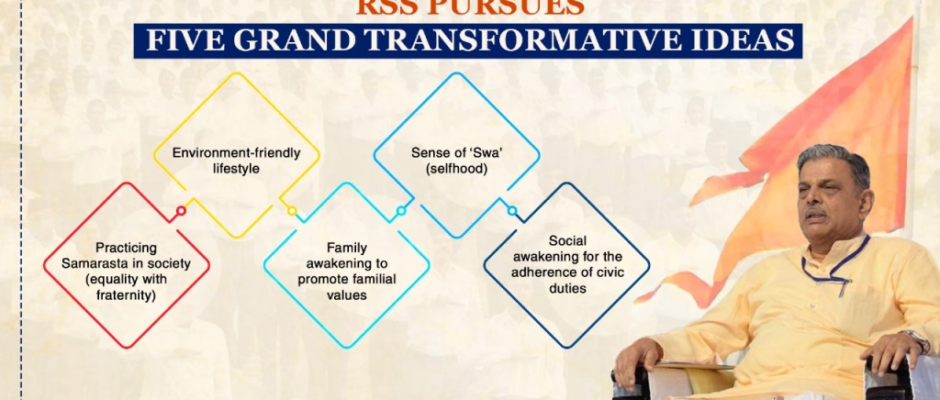
It is beyond doubt that the work of the RSS is progressing steadily. Bharat is fast assuming a distinct and powerful identity on the global stage. Rashtriya Swayamsevak Sangh has contributed significantly towards social enlightenment by championing the aforementioned truth, and also by countering the challenges posed by demonic detractors of Bharat. To proliferate nationalistic thoughts at an even greater pace and to deepen and expand its work, the Sangh is now ready with the idea of ‘Panch Parivartan’ (Fivefold Transformations). On the occasion of the Akhil Bharatiya Pratinidhi Sabha held in Nagpur from March 15 to 17, 2024, decisions have been made to work on dimensions that will mark the completion of a century of the Sangh’s existence. This year, the number of representatives present in the Pratinidhi Sabha seems to have suddenly increased. How did this happen? It is not true that the number has suddenly increased; it has happened gradually. With the expansion of our work, the number of Swayamsevaks was bound to jump, and as a result, the number of representatives also increased. When the Shakhas grow, the number of active Swayamsevaks automatically increases, and based on that, the number of representatives also increases. Additionally, a large number of invited brothers and sisters are also present in this Pratinidhi Sabha. Several inspired organisations were also invited to send representatives in Nagpur. Finally, due to the COVID-19 pandemic in the past three years, there were some restrictions on the number of representatives. We had to keep the number limited, so we didn’t invite some groups as expected. For example, in a certain year, the Vibhag Pracharaks were not expected, and in another year, workers from various fields were not expected. This is the reason why the number was low at that time, and now it seems to have suddenly increased. What special goals and objectives have been set for the centenary year of the RSS? In the context of the centenary year, we have identified two goals from an organisational perspective—increase the number of Shakha units and the qualitative improvement in the activities. All the members are expected to have this common goal in mind. By increasing the quality of work, its impact will increase too. The thrust is on qualitative growth along with the quantitative expansion. Secondly, from a social perspective, we have put forth the subject of Panch Parivartan (Fivefold Transformation). Our objectives include changing the intellectual narrative  from a national perspective, and to mobilise the sajjan shakti ( righteous power of the society) for social change. Therefore, in the centenary year of the RSS, we have made plans to take initiatives on all these subjects at both organisational and societal level. How do you propose to explain this entire concept of Panch Parivartan to the common masses and what challenges do we see there? When times are favourable and circumstances are conducive, extra caution, more effort, and deep contemplation become all the more necessary. Today, the time seems favourable for the dissemination of national thoughts. However, this favourability is not for sitting idly and enjoying the good time; it is a time to reach the very zenith of endeavours. The idea of Panch Parivartan is to deepen our approach to fundamental reforms by making the workers of the Sangh and various organisations its torchbearers. Anyway, today, Panch Parivartan is the need of the society in general. Panch Parivartan includes dimensions such as the insistence of practicing Samarasta in society (equality with fraternity), environment-friendly lifestyle, family awakening to promote familial values, inculcating sense of ‘Swa’ (selfhood) based on Bharatiya values in all aspects of life and social awakening for the adherence of civic duties; all these issues concern the society at large. Secondly, these topics need to be addressed to individuals, families, and the areas in the vicinity of Shakha. It needs to be taken to a wider society. We have kept these topics in front of the Swayamsevaks in general. Therefore, there should be an effort to bring about change through self-examples. This is not just a subject of contemplation and academic debate, but one of action and behavior. Also, we hold meetings of social leaders on social harmony and goodwill. We have contacts in wider society. So, we will take this subject among them and appeal from this perspective. In this year’s Pratinidhi Sabha, there was a special mention of Devi AhilyaBai Holkar. Do we have special programmes planned for her tercentenary year? The name of the Devi Ahilyabai Holkar, a symbol of valour and Shakti, appears in our Ekatmata Stotra with reverence. If we analyse her history properly, she has presented several excellent examples in various fields—from society, religion, governance, to administration. Today, on her tricentenary (300th birth anniversary), we have identified two to three objectives. Generally, in Hindu society, there is a flawed perception that the deprived sections of society did not get any opportunity to contribute towards nation building. Similarly, there is a distorted perception about women. However, if we delve deeper, Devi Ahilyabai Holkar’s life provides a precise answer to all such flawed perceptions. From a social perspective, the way she emerged from her community, and the way she set a shining example of administration, even after her husband’s untimely demise, present a powerful statement in Hindu society. Secondly, there is a lot of discussion about the empowerment and participation of women in present society. This year as well, our sisters in the Rashtra Sevika Samiti and Mahila Samanvay of other organisations have organised more than 400 conferences across the country, ensuring the participation of more than five lakh women. From this perspective, Devi Ahilyabai’s tercentenary is a good opportunity to further that good work too. Instead of organising programmes specifically by the Sangh, a Celebration Committee will be formed under a comprehensive plan, which will organise celebrations along with other women’s organisations and other members of society. We have plans for lectures and discussions on various dimensions of the great lady, including  publishing literature. “Panch Parivartan is the need of the society in general. Panch Parivartan includes dimensions such as insistence of practicing Samarasta

Read More

Bharat, An Evolving, Chaotic but Vibrant Democracy

From being ‘gana rajyas’ to going high-tech in campaigns & voting, Bharat has covered huge space and willing to experiment with spiritual democracy Dr Aniruddh Subhedar Like people, nations too have a distinct nature, character and history of their own. Bharat is no exception to this and has its own uniqueness in all these three aspects. Studying Bharat diligently and objectively, one will find that ideal of democracy and freedom to choose leaders has been ingrained in her ethos since times immemorial. No doubt the modern democratic institutions of Bharat took their form after British colonization but roots of democracy in Bharat are as old as it gets. When Greece was enjoying its city states, in Bharat there were Gana-Rajyas. Ganas means the people making up a state and Gana-Rajya translates to “rule of people”. Scholars tell us that even before Gana-Rajyas, during evolution of Bharatiya civilization, in Vedic period we find existence of assemblies like Sabha, Samiti and Vidath, which used to administer people and whose leaders were elected by the people only. The Ganas were basically units as cohesive as families or clans. Later when monarchy became the norm in Bharat, it was not too far away from this basic ideal. The word ‘praja‘, which means people / subjects, literally translates to ‘offspring’ or children. In essence, Raja (King) was supposed to take care of his people as his own children. And, even during that era of monarchy, at the village level panchayats or village assemblies, usually made up of community elders, were thriving in Bharat; respected and accepted by the State. Therefore, transition to modern democratic political setup was not too hard for Bharatiyas. As soon as Bharat freed itself from colonial clutches, it made universal adult franchise one of the defining characteristics of its political system. In Letter & Practice In modern times, democratic ethics are too well entrenched in Bharat’s polity in letter and practice. Preamble of Bharat’s Constitution pledges to constitute the country into “a democratic republic”. Free and fair elections are bedrock on which this democratic systems stands upon. The Constitution ensures that there is a permanent and independent body- ‘Election Commission of India’ (ECI) which has the power to control and regulate elections to parliament, state legislatures, office of president and vice-president. Measures relating to elections are so stringent that once ‘Model Code of Conduct’ is implemented by the Election Commission, the government is prohibited from making any announcements or policy decisions that could potentially influence people’s voting choices. This means government cannot start any populist scheme and even government bodies cannot start any recruiting process. Provisions of Constitution are not a dead letter. In fact, it’s followed quite strictly. General elections in Bharat are not some run-of-the-mill affair; it is of gigantic proportions. General elections in 2024 Bharat will be the largest exercise ever in the world surpassing even the one held in 2019. Total 90 million people are eligible to vote in this election. It will be the longest-held general election in Bharat (except for the first general election of Independent Bharat in 1951-52) spanning over 44 days. One of the reasons Bharat’s democracy has endured test of time is the seriousness about voting rights and fair elections. Otherwise in Bharat’s neighbourhood there’s hardly a country which can pride itself as a true democracy. In fact, in Bharat’s west, it is hard to find a truly functioning democracy till one crosses the Middle-Eastern countries. Being one of the most populous and diverse countries in the world, Bharat plays a major role in ensuring that democracy and human rights are secure in South East Asia. Bharatiyas take their right to vote seriously and don’t like anyone meddling with it. The closest Bharat came to dictatorship was during 1975-77 emergency imposed by then Prime Minister Indira Gandhi. But what preceded and followed this 21-month stint with dictatorship is worth mentioning here. Among the other reasons, the immediate cause of Indira Gandhi implementing emergency was that the courts concluded that malpractices were used in her election and declared it as null and void. Indira Gandhi paid the price for imposing the Emergency when she and her party Congress were wiped out in elections post-emergency. Interestingly enough, she was re-elected by the people again and later her son Rajiv Gandhi won highest number of seats in Bharat’s political history owing to sympathy wave caused by Indira Gandhi’s assassination by Khalistani terrorists. It shows that Indira Gandhi always had a political stature but even Prime Minister of her standing wasn’t spared by Bharatiya people when she tried to curb their freedom. Credibility of Election Process Given the vast geographical area and size of the electorate, ECI has modernized the process by using Electronic Voting Machines (EVMs) for polling and counting votes for more than two decades. Making the process more credible and faster, EVMs were first used in 1980s, and they are used in general elections since 2004. In 2017 many Opposition parties like Congress, Bahujan Samaj Party, Aam Admi Party harboured doubts on credibility of EVMs after they lost elections in some states. It was alleged that BJP is tempering with EVMs. The allegations went as bizarre as claiming that EVMs (a self-contained, stand-alone machine, lacking any networking capability) is being hacked via internet. A leader of AAP even brought a machine to the Delhi Assembly which looked like EVM and demonstrated how it could be hacked. All this hullabaloo was silenced when in May-June 2017 the ECI invited these parties and gave them the real EVM to prove that it could be hacked. Parties like AAP did not even participate in the challenge, while other two other parties, CPI (M) and NCP, who sent their representatives said that “they just came to understand how EVMs work”. Even without going into technical know-how the allegations against EVMs could be easily dismissed by looking at the fact that even in these 2017 elections, BJP lost in Punjab and Congress won. AAP won Punjab state

Read More

Bharat Championing Global Humanitarian Leadership

Citizenship Amendment Act unequivocally embodies Bharat’s commitment to provide sanctuary to persecuted minorities from Afghanistan, Bangladesh and Pakistan Rahul Pawa In a historic move that ignited a firestorm of debate both within and internationally, Bharat’s Parliament took a decisive step on December 11, 2019 by passing Citizenship (Amendment) Act (CAA). This landmark legislation marked a momentous shift in the nation’s approach to citizenship, amending the Citizenship Act of 1955 to offer an expedited pathway to Bharat’s nationality for certain persecuted religious minorities originating from Afghanistan, Bangladesh, and Pakistan who had arrived in Bharat by the end of 2014. The Act specifically extends olive branch to Hindus, Sikhs, Buddhists, Jains, Parsis, and Christians delineating a clear classification based on religious affiliation.  In alignment with Prime Minister Narendra Modi’s administration’s pledge to enact CAA prior to 2024 national elections, Ministry of Home Affairs delivered a crucial update on March 11, 2024 by notifying related rules. This announcement, which detailed regulatory framework supporting CAA represents a significant move towards making the Act operative. It also echos the government’s commitment in sync the manifesto and reflect the mandate given by people of Bharat. Critically, CAA represents first instance in current day Bharat’s legal history where religion has been explicitly utilised as a criterion for citizenship. This aspect of the law has spurred a plethora of opinions and interpretations sparking an intense discussion about its implications and underlying motivations. While critics argue it undermines Bharat’s constitution by excluding Muslims sparking accusations of discrimination, proponents view the CAA as a humanitarian gesture extended to protect and provide citizenship to persecuted religious minorities. In the heart of this historic decision to enact CAA, lies a complex mosaic of historical events, demographic and ideological shifts that shaped its creation. The genesis of CAA can be traced to tumultuous Partition of imperialist British-occupied Bharat in 1947. An era was marked by fallacious stance of Muslim League led by Muhammad Ali Jinnah that propagated the notion that Hindus and Muslims could not coexist. This was put to rest as millions of Muslims chose to remain in what became Bharat despite formation of East and West Pakistan exclusively for Muslims. The violent emergence of Bangladesh from Pakistan obliterated Jinnah’s claim that a singular Muslim state was the panacea for communal harmony and coexistence. Their path to a harmonious or rights respecting states has been fraught with challenges. The aspiration to uphold and foster Islamic tenets often translated into systemic and legislatively endorsed persecution of minorities—Hindus, Sikhs, Buddhists, Jains, Parsis, and Christians—who found their historical roots in the erstwhile cultural landscape of Bharat. These communities have faced and continue to confront relentless religious persecution and systematic violence. Their ordeals have been marked by forced conversions, marriages, massacres, extreme violence against women and desecration and destruction of sacred sites and educational institutions. Despite1950 Liaquat–Nehru Pact and Bangladesh Constitution of 1972 espousing minority rights and secularism, the reality remains fraught with contradictions, particularly as these nations declared Islam as their state religion. This was also echoed in Afghanistan’s constitutional journey, from the 1931 endorsement of Hanafi Shariah to the 2004 Constitution that sought to balance Shia and Sunni Islam yet declared that no law could contradict Islamic tenets, laying the groundwork for state-endorsed discrimination against minorities. The Taliban years starkly exemplified this, as their strict interpretation of Sharia law further marginalised religious and ethnic minorities evidenced by the tragic destruction of the giant Buddha statues of Bamiyan, and extreme persecution leading to almost no Christians, Hindus, Jains, Buddhists or Skilhs in Afghanistan , underscoring a history of entrenched discrimination, intolerance and violence against minorities in Afghanistan. These historical nuances highlight the backdrop against which Bharat’s CAA was conceived and implemented, setting the stage for a law aimed at providing refuge to persecuted minorities from these countries, whose cultural footprints emanate from Bharat, positioning it as a beacon of human rights and humanitarian leadership in the region and beyond. The CAA, thus, is not merely a legislative act but a response to a historical legacy of division, persecution, violence and discrimination, offering a new path towards inclusivity and protection for those fleeing persecution. In the intricate mosaic of global legislation addressing the plight of persecuted minorities, Bharat’s CAA emerges with a distinct humanitarian ethos, paralleled yet contrasted by international counterparts. Notably, the United States’ Lautenberg Amendment, introduced in 1990, similarly targets religiously persecuted minorities, facilitating their resettlement from the Soviet Union and, following a 2004 extension, from Iran. Like the CAA, it identifies specific religious communities as historically persecuted, excluding Muslims from the Soviet Union and Iran, thereby hastening the path to citizenship for these selected groups. In stark contrast, the United Kingdom’s Nationality and Borders Act of 2022 embodies a markedly different approach, empowering the government to revoke citizenship without notification under Clause 9—a provision that has sparked controversy for its potential to disproportionately affect British Muslims, highlighting ethnic and religious divides. The case of Shamima Begum, often cited in debates, underscores the law’s focus on revocation rather than protection, raising ethical and human rights concerns. While the Lautenberg and Specter Amendments in the United States echo the CAA’s intent to shelter historically persecuted groups, the UK’s Nationality and Borders Act diverges, prioritising national security over humanitarian considerations. This juxtaposition illuminates the CAA’s unique position in the international legal landscape as a beacon of refuge, distinguishing Bharat’s legislative approach to addressing religious persecution without resorting to the revocation of citizenship To conclude, the CAA unequivocally embodies Bharat’s commitment to providing sanctuary to persecuted minorities, standing out as a beacon of humanitarian leadership on the global stage. It is crucial to reiterate that the CAA is not an act designed to revoke citizenship nor is it anti-Muslim or discriminatory in nature. Instead, it represents a unique and targeted legislative effort aimed at extending a hand of protection to those with historical and cultural ties to Bharat who have and continue to suffer from injustices in Afghanistan, Pakistan and Bangladesh. By enacting this legislation, Bharat

Read More

Smear And Non-Stop Campaign Against Sanatan Dharma!

Do political upstarts understand sanatan dharma and idea of Bharat? Or, their smear campaign is designed to push for linguistic subversion? Vinod Kumar Shukla Diversity, dialogue, disagreement and harmonious co-existence have been eternal values of Bharat and its Sanatan way of life. But, disrespect, threats and abuses is what they have been getting all long. Sanatan have always been subjected to onslaught in the past by those active with anti-Sanatan and anti-India narrative ecosystem in the contemporary times. Apparently, those resorting to abuses against Sanatan, Hindutva and Bharat have actually run out of arguments to put forth their views with logic, reasoning and rationale. Hence, they seem to have unleashed a smear and non-stop campaign against Sanatan, Hindutva and Bharat. This eco-system of anti-sanatan include constituents of the political alliance that they bracket themselves to be I.N.D.I.A. Also, attempts have been made to cause artificial divide between north and south. These elements however appear to be puppets in the hands of dismantling Bharat brigade active within and outside the country. Balkanisation of Bharat is a global project that some organisations within the country are also part of. Stirring regional and linguistic sentiments, Dravida Munnetra Kazhagam (DMK) leader and former Union minister A Raja claimed that India is not a nation but a subcontinent where states like Kerala, Tamil Nadu and Odisha have their unique identity. He has threatened that these states will secede. His party colleague Udayanidhi Stalin, son of Tamil Nadu chief minister M K Stalin forcefully argues to eradicate Sanatan dharma and likens it to Dengue, Malaria and AIDS. Udayanidhi Stalin seems to have enlisted support of yet another disrupter in Priyank Kharge, Karnataka minister and son of Congress President Mallikarjuna Kharge. Even senior Kharge spoke against Sanatan on an earlier occasion A Raja likened the ‘Sanatana Dharma’ to HIV and leprosy. DMK Member of Parliament DNV Senthilkumar S contemptuously said in Parliament, “The power of this BJP is only winning elections mainly in the heartland states of Hindi, what we generally call the ‘Gaumutra’ states.” Rahul Gandhi too spoke the same language when he described Bharat as a Union of States which means it is not a nation. He made valiant efforts to differentiate Hindutva and Hinduism. This is contrary to Justice J S Verma’s ruling that described Hindutva as a way of life. Communists that have largely become irrelevant in Bharat and elsewhere seem to be seeking to re-establish their relevance by peddling India as a state with multiple nationalities. Interestingly, parties with Sanatan abusers found some traction in Karnataka, Tamil Nadu or West Bengal having 84.00 per cent, 87.58 per cent and 71 per cent Hindu population by inciting regional and linguistic subversion. When Indian Prime Minister Narendra Modi talked of decolonising Indian minds, he’s well aware of the narrative fed for ages that replaced ‘Varna’ with ‘Caste’ introduced by Portuguese. English education system that drove Indians from their Sanatani ethos to certainly an alien knowledge system if one hesitates to call it superficial as India respect every knowledge system. Fortunately, people of Bharat have begun to reclaim their civilisational and cultural glory. Though India that came into being on January 26, 1950 as a political entity, its civilisational predecessor, Bharat existed for millennia. Bharat intrinsically celebrates diversity since ages in the geographical entity and has been identified as Sanatan from civilizational point of view. Vishnu Puran aptly described Bharat as: उत्तरं यत् समुद्रस्य हिमाद्रेश्चैव दक्षिणम् । वर्षं तद् भारतं नाम भारती यत्र सन्ततिः ।। It means, “The country that lies north of the Ocean & south of the Himalaya is called Bhārat and there dwell the descendants of Bharat.” Apart from trashing Bharat periodically, Lord Ram is targeted by a few leaders to hog headlines or seek relevance. DMK leader Raja said that his party was not concerned if they were dubbed as “enemies of Ram”. C Rajgopalachari (Rajaji) in preface to his book ‘Ramayana Retold’ wrote, “In presenting this English version (of Ramayana) to a wider circle of readers spread all over the world, I think I am presenting to them the people of Bharat just as they are, with all their virtues and their faults. Our classics really embody our national character in all its aspects and it is well the world sees us as we really are, apart from what we wish to become.” And, most Sanatan scriptures in East, West, South and North India are written in Sanskrit which for them is a language of the divine. Languages evolve over a period and henceTamil, Kannadiga, Malyalam and Telugu etc evolved in southern states while Hindi or Hindavi became prevalent in northern states with more Arabic and Persian effect due to Islamic invasion. Trinamool Congress leaders in West Bengal brand themselves as Shakti worshipers that have nothing to with Lord Ram. Why do political minions forget that Ram Krishna Paramhans in West Bengal was initially named Gadadhar Chattopadhyay. Gadadhar was in reverence to Lord Hanuman. So, nothing could be more ignorant than to say that Ram only belongs to North India. ‘Dravid’ in Sanskrit obliquely means ‘the land with water on three sides’ – a peninsula referring to peninsular Indians as Dravidians and not a race by any stretch of imagination or definition. Adi Shankaracharya was called Dravida Sishu who travelled length and breadth of Bharat to set up ‘Maths’ in four corners of the country in Sringeri of Karnataka, Jyotir Math in Garhwal, Kalika Math in Dwarka and Govardhan Math in Puri. But, political lightweights of today fail to appreciate Bharat’s essence. While addressing a public gathering at Thiruvananthapuram in February 2021, Wayanad Member of Parliament, Rahul Gandhi said, “For the first 15 years, I was an MP in the North. I had got used to a different type of politics. For me, coming to Kerala was very refreshing as suddenly I found that people are interested in issues and not just superficially but going into detail in issues.” Minister in Karnataka government Priyank Kharge was quoted as saying

Read More