CIHS – Centre for Integrated and Holistic Studies

Date/Time:

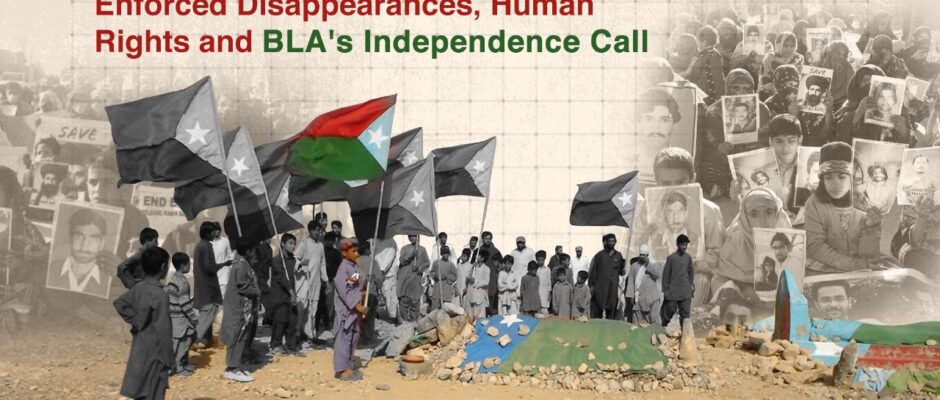
Enforced Disappearances, Human Rights and BLA’s Independence Call

By N. C. Bipindra Balochistan has yet again entered a dangerous phase of political and humanitarian uncertainty. Recent declaration by the Balochistan Liberation Army (BLA) to form an independent army and seek international recognition as a sovereign nation has brought decades-long freedom struggle against Pakistan’s reported occupation into sharp focus. While BLA’s statement marks a new and more assertive phase in the struggle to take governance into their own hands, it also threatens to worsen an already grim human rights landscape. For years, enforced disappearances, extrajudicial killings, and suppression of dissent have scarred the province. Now, with renewed calls for being recognized as a separate nation, Balochistan risks sliding deeper into vortex of violence and repression that shows little sign of abating. Pakistan’s army and security establishment has come down heavily on Baloch people seeking their basic rights to live peacefully and honourably. Islamabad’s new found friend in US President Donald Trump may be oblivious to this grim situation and only interested in excavating the high value rare earth metals and specialized molecules with high precision application across industries in America. A Province in Perpetual Conflict Balochistan, rich in natural resources but poor in development and representation has long been a theatre of conflict between Pakistani state and various Baloch nationalist groups. The grievances are old and deep, rooted in reported political marginalization, economic exploitation and cultural erasure. BLA’s recent announcement seeking international recognition and establishment of diplomatic missions represents a bold political escalation. It reframes the struggle from one of autonomy within Pakistan to outright independence. Predictably, such a declaration is being treated in Islamabad not as political dissent but as a direct challenge to national sovereignty, setting the stage for intensified military operations. Beneath the political grandstanding lies a darker humanitarian crisis that predates this declaration: persistent phenomenon of unexplained disappearances and human rights abuses that have come to define life in Balochistan. Missing People of Balochistan For families in Balochistan, the phrase “missing persons” has become an everyday horror. Thousands of Baloch men — students, teachers, activists, and ordinary civilians — have disappeared over the years, allegedly picked up by security forces or intelligence agencies. Many are never seen again; others turn up dead, often bearing signs of torture. According to the Human Rights Council of Balochistan (HRCB), 123 enforced disappearances and 26 killings were recorded in just August 2025. Earlier in March that year, the group documented 151 disappearances and 80 killings. Such numbers are staggering for a single province, and they are likely underestimates, given the difficulty of reporting in militarised areas. The Pakistan Commission of Inquiry on Enforced Disappearances (COIED) has received over 10,000 cases nationwide, with a disproportionate number from Balochistan. Yet, rights groups say that official mechanisms lack independence and transparency. Investigations rarely lead to prosecutions, and security agencies operate with near-total impunity. The HRCB and other local NGOs have documented a recurring pattern: night-time raids, arrests without warrants, and bodies discovered days or weeks later in desolate areas. Families often face intimidation when they speak out or join protests demanding the return of their loved ones. Many have spent years camped outside press clubs or government offices, holding faded photographs and placards that ask a simple question: “Where is my son?” Fear and Silence: A Society Under Siege The psychological toll on the province is immense. Entire communities live under a shadow of fear. In cities like Turbat, Kech, Awaran, and Gwadar, once bustling trade hubs, silence has replaced debate. Even student activism is seen as a potential act of rebellion. Students have been frequent victims of disappearances, especially those affiliated with Baloch student organisations. Human rights defender Dr. Mahrang Baloch, who spearheaded a peaceful movement for missing persons, was herself detained in 2024, a move widely condemned internationally as an attempt to crush dissent. Journalists, too, face censorship and threats. Many have been warned against reporting on disappearances or military operations. The result is a near-total blackout on independent information from much of Balochistan, leaving only official narratives and sporadic social media updates from activists who risk their lives to post them. Extrajudicial Killings and the “Kill-and-Dump” Policy One of the most disturbing aspects of the crisis is what local activists describe as the “kill-and-dump” policy. Individuals who disappear are later found dead, their bodies dumped on roadsides or in remote deserts. These victims are often presented by authorities as “terrorists” killed in encounters, but human rights groups say many of these encounters are staged. The state’s security establishment insists its operations target armed insurgents, not civilians. Yet the blurred line between militant and civilian in such operations has made accountability nearly impossible. In some cases, the victims had no political affiliation at all. Families are left with bodies to bury and no answers about why their loved ones were taken or killed. Legal and Institutional Failures Pakistan is a signatory to major international human rights treaties, including the International Covenant on Civil and Political Rights (ICCPR) and the UN Convention Against Enforced Disappearances. Yet, in practice, these obligations remain largely unfulfilled. The COIED, established to investigate missing persons cases, has been criticised as toothless. It lacks the authority to compel powerful agencies like the Inter-Services Intelligence (ISI) or the Frontier Corps (FC) to produce detainees or disclose information. Its reports are rarely made public, and few cases have led to convictions. In the absence of credible accountability, enforced disappearances have become normalised as a tool of control. Human rights lawyers describe it as a deliberate policy, a way to silence opposition without legal consequence. BLA’s Declaration and Its Fallout The BLA’s move to declare a separate “army” and seek global recognition adds a dangerous new layer to this human rights tragedy. The Pakistani state, already hypersensitive to any challenge in Balochistan, is likely to respond with harsher counter-insurgency measures, which could lead to more disappearances, arrests, and extrajudicial killings under the banner of fighting terrorism. Civilians will, as always, bear the brunt. In areas where the BLA has

Read More
Balochi Struggle Hits a Milestone!

Balochi Struggle Hits a Milestone!

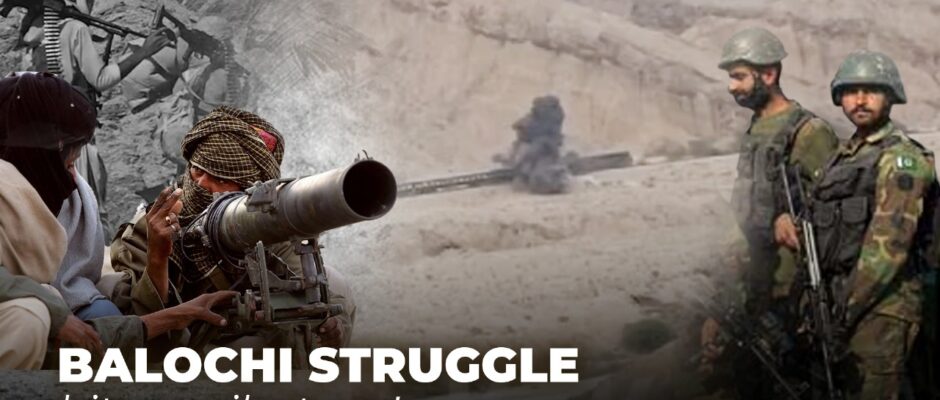
Balochi fighters under BRAS with centralized military command pose significant challenges to both Pakistan, China. Rohan Giri & Dr. Shailendra Pathak Given continued rejection of their rights, how long can one ignore Balochis’ call for justice? Balochistan has a long history of identity crisis and struggle for Balochis’ rights that are closely entwined. For decades in continuum, Balochi population suffered political marginalization, financial difficulties and cruel suppression of their dreams. Evolving Balochi resistance marks a significant shift in this long-lasting conflict, potentially influencing the region’s political dynamics and bringing the ongoing suffering to the forefront of global attention. An alliance of Baloch fighters, Baloch Raji Aajoi Sangar (BRAS) has revealed a major re-organisation, bringing several factions under one centralized military command. This stage marks an ideological unity of all forces not limited to just military plan of action. BRAS have plans for strengthening its position in response to challenges in the area by moving from broken guerrilla tactics to methodical and coordinated armed operation. A thorough and orderly military force produced by this reorganisation would provide the foundation for a “Baloch National Army.” Under a common strategic framework, this reform seeks to unite leaders and activists from all factions, thereby strengthening a more powerful and long-lasting resistance. Immediate consequences of this re-organization are severe. For Pakistan, it presents a protracted and strong opposition with significant challenges in implementing its military and economic agenda. For instance, stability is essential to China’s investments in forced occupation area under China-Pakistan Economic Corridor (CPEC). On the parallel, BRAS declaration raises questions on security of CPEC projects. Regrouping of Balochi fighters, highlights a battle, often overlooked, that significantly impacts regional stability. The conflict in itself is shaped by long history of disputed sovereignty and political unrest. Balochistan which comprises four former princely states of Kharan, Makaran, Las Bela and Kalat was declared an independent state along with India and Pakistan. During partition, princely kingdoms had the freedom to remain independent, join India or align with Pakistan. Khan of Kalat, Mir Ahmed Yar Khan chose to be independent while three others chose to be with Pakistan. Pakistan objected to this proclamation, nevertheless, which set off several forceful policies. By unilaterally declaring accession of Kharan, Makaran and Las Bela in March 1948, Muhammad Ali Jinnah isolated Kalat and drove its ultimate integration into Islamic Republic of Pakistan. With political persecution, economic marginalization and breaches of human rights defining Balochi struggle, this controversial union set the stage for fresh challenges. Balochistan boasts of immense natural resources while its people live in extreme poverty. Pakistan’s businesses have been powered for decades by the Sui gas field of Dera Bugti. But, unfortunately most Baloch houses still cook on woodfire. Reko Diq mines in Chagai district have large copper and gold deposits, but only international companies and Islamabad gain from them leaving Balochi people impoverished. Balochistan’s enforced economic structure has long been a cause of conflict since failures in equitable distribution of resources. BRAS seek to highlight its struggles against what it regards as economic marginalization. The effort includes halting highways, targeting infrastructure associated with CPEC and advocating for Balochi sovereignty over resources. Linked with long-standing demand for nondiscriminatory development, the revolt now has an economic aspect in addition to a fight for political acceptance. Under BRAS, establishment of a Baloch armed force could offer a mechanism for strategic action that has the potential for tipping the regional power balance. Immediately after BRAS declared its restructuring, Balochi fighters burst into a breathtaking display of force. A significant ally in BRAS, Balochistan Liberation Army (BLA) hijacked Jaffar Express train in Balochistan on March 11, 2025 carrying about 500 people. In a shootout, Baloch fighters killed at least 20 persons and kidnapped about 182 allegedly military and police personnel, blowing up the tracks. The BLA had issued an ultimatum threatening to execute hostages if their demands were unfulfilled. Pakistani government backed by Chinese powers that be responded with military action, resulting in continued confrontations. Hijacking the Jaffar Express was seen as direct reaction to official persecution and forced disappearances which had destroyed Baloch towns over decades. The Jaffar Express hijacking proved BRAS capacity for large-scale, well-coordinated operations and flashed a considerable rise in opposition activity. Balochistan still struggles with major human rights abuses and forced disappearances top the list of concerns. Human rights groups say thousands of Balochi men, students, activists and political workers have vanished over time. Human Rights Council of Balochistan (HRCB) reported that in February 2025, they recorded 144 cases of forced disappearances. Out of these, one person was reported dead, 102 remained untraced and 41 have come back. On top of that, 46 people lost their lives including some who were killed without a fair trial. They’ve identified 40 of these victims but six remain unknown. There is a substantial human cost associated with these disappearances. Families march thousands of kilometres in search of missing near and dear ones, carry images of their lost loved ones. Though demand for responsibility and openness is growing, international community’s intervention in yet to gain momentum. On the other hand, BRAS has continued with its struggle for rights and respect. Balochistan’s battle is not a lonely endeavour. It is entwined with regional and global issues. Seeing Baloch nationalism as a constant security issue, Pakistan has deployed strong militarism and intelligence operations to limit the uprising. Balochistan is seen by China as a component of its larger strategic objective with projects like Gwadar Port through its Belt and Road Initiative having enormous financial value. Nonetheless, BRAS’s most recent activities suggest a continuous risk to regional stability. BRAS have time and again expressed concerns about foreign investments that do not benefit local communities. If the alliance increases frequency of disruptions to CPEC projects, there could be more security issues. China has asked Islamabad to ensure protection of its interests in the wake of infrastructure attacks. The evolving conditions present a challenging chore for all relevant stakeholders. Grave situation in Balochistan receives very little international

Read More

Balochistan, an Inhuman Laboratory for Pakistan

Balochis are oppressed at home, neglected abroad, and treated as an inconvenient relic from the past that would not go away. Rohan Giri / New Delhi Last week’s attacks on Pakistan Army Frontier Corps bases at Panjgur and Naushki by Balochistan Liberation Army (BLA) brings to fore the struggle of Baloch people seeking independence from the repressive security regime led by General Qamad Javed Bajwa. BLA’s Majeed Brigade attack on Pakistan’s army establishment is yet another grim reminder of state-sponsored disappearances, day light murders and abuse of Baloch people that serve as inhuman nuclear laboratory for Pakistan that’s long been a rogue state. While Balochis under forceful occupation of Pakistan faced reprisals’ of grave nature and human rights violation, two separate attacks last week bring to fore their struggle to regain lost self-respect and statehood. Lack of basic amenities in Balochistan also highlights the highhandedness of Pakistan’s army and the government led by Prime Minister Imran Khan. Khan may not have been on equitable terms with his army chief General Baweja. But then, the duo seems to have been one in dealing a death blow to Balochis campaign for freedom. Balochis have also been seeking trial of both General Bajwa and Prime Minister Khan by UN-led Human Rights Organizations that wax eloquent on other mundane issues. Balochistan that’s been least populous area under forceful occupation of Pakistan is rich in natural resources but figures at the bottom on human development indicators like education, employment, and medical amenities. Independent & Sovereign Balochistan Balochistan is flanked on the east by Pakistani provinces of Punjab, Sindh, and the Federally Administered Tribal Areas (FATA), and on the west by Afghanistan, Iran, and Arabian Sea. Prior to 1947, Balochistan region was made of four princely states, Kalat, Lasbela, Kharan and Makran. Three months before independence from British rule, Muhammad Ali Jinnah demanded an independent state of Kalat that would have four Baluchi ruled princely states. Through a communiqué on August 11, 1947, Kalat was awarded the status of an independent and sovereign state. However, by October 1947, Muhammad Ali Jinnah had changed his mind and asked that Kalat be formally part Pakistan as a province. The Khan of Kalat was passionate about maintaining their independence and sovereignty. Pakistani army went to Balochistan fraudulently on March 26, 1948 and all the four princely states run by Balochis were occupied on April 1 1948. Pakistani army’s crimes, abuses, torture, arbitrary arrests, executions, and indiscriminate violence increased in the aftermath of capturing Kalat. From then on, Balochistan’s people had embarked on path of liberation struggle due to these excesses. Baloch Freedom Movement In 1948, Muhammad Ali Jinnah forcibly merged this larger princely state with Pakistan by mounting pressure on Nizam Ali Khan of Balochistan. Ali Khan had to give in under pressure. The Baloch do not consider this deal legal and since then, nationalist Baloch have been on warpath to get rid of slavery under successive Pakistani regimes. Nawab Nauroz (Nowroz) Khan also known as Babu Nowroz has been the symbol of Balochistan freedom movement. They were waging a guerrilla war against Pakistan for the independence. Navroz was arrested and thereon reports suggested his murder in Pakistani captivity. Hundreds and thousands of Baluchis have sacrificed their lives in the freedom struggle. Now, Balochis have openly countered Pakistani army brutalities with weapons. Several organizations like Balochistan Liberation Front (BLF), Balochistan Liberation Army (BLA) and Balochistan Nationalist Army (BNA) have had repulsed Pakistani Army’s inhuman ingression on their lives. Balochistan has been in constant state of instability following Pakistan army’s occupation and its intent to resolve the issue through force. Reports also suggest that Pakistan security apparatus was not against deployment of army contingents and conduct raids through Pakistan Air Force to crush the rebellion in Balochistan. In 1974, Pakistan’s Army led by General Tikka Khan, whose tactics earned him fame as the ‘Butcher of Balochistan’. He dropped bombs on Balochis. On May 28, 1998, Chagai, the occupied region of Balochistan was shaken by a series of nuclear bombings that were designed to test Pakistan government’s nuclear capabilities. Since then, Balochistan became central to inhumane nuclear testing for Pakistan. ‘Kill and Dump’ policy Balochistan is a neglected, exploited and ignored region. On the pretext of territorial security and integrity, Pakistan and its security agencies have made it their hobby to violate human rights of Baloch people. Over years, human rights activists in Baloch have been accused of sedition, labeled as terrorists and subsequently kidnapped by security forces or killed in clashes. In several cases, their dead bodies were found on roadside, brutally disfigured or their skeletal remains found in mass graves. Karima Baloch’s assassination in Canada on December 20, 2020 had signature imprint of Pakistan’s ISI. Karima had gone missing before she was murdered, and her body was eventually discovered near Toronto’s waterfront. The Pakistani army launched a “kill and dump” policy in 2009 with zero tolerance for Baloch dissent. Pakistani military establishments utilised brute force to demoralise those demanding freedom and destroy the Baloch national spirit. Never ending brutalities notwithstanding, Pakistan’s security establishment has failed till now in breaking the determination and dedication of Balochis indigenous struggle. A non-violent community has been resorting to violence to protect itself. Pakistani army repeatedly unleashed violence and inhuman acts on the Baloch people each day. Baloch community has taken up arms for humanitarian and defence while the world’s famed human rights organizations and leaders remained mute witnesses to excesses of Pakistan’s army. Pakistan Army had illegally occupied Balochistan on the strength of arms. It is well known that Pakistan is a haven for terrorists. Although Pakistani terrorists have been linked in several terrorist attacks around the world, Balochistan refused to be involved in such acts of terror barring incidents that are part of their freedom struggle. Balochis espouse peace and tranquility. (Author is an operations manager at CIHS, New Delhi) E-mail – [email protected] Reference: http://southasiajournal.net/accession-of-independent-balochistan-to-pakistan/ https://www.vifindia.org/sites/default/files/Balochistan-Forgotten-War-Forsaken-People.pdf https://www.eurasiareview.com/06102020-pakistan-kill-and-dump-in-balochistan-analysis/

Read More