
CIHS – Centre for Integrated and Holistic Studies

Date/Time:

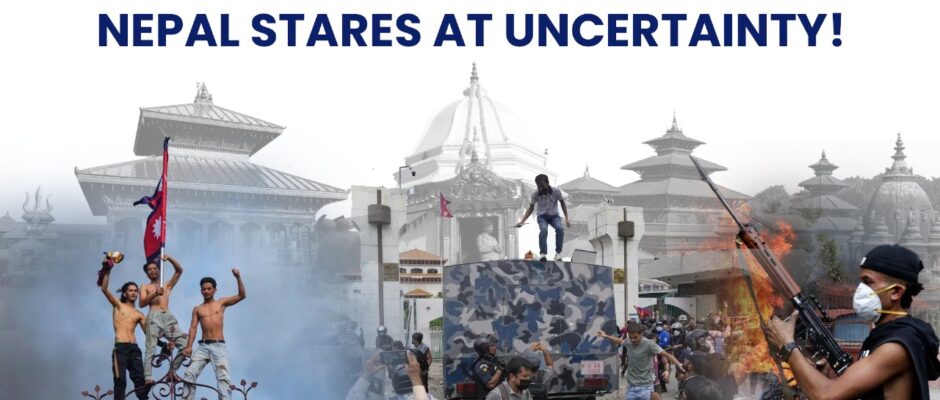
Nepal Stares at Uncertainty!

Nepal Stares at Uncertainty!

A stable, open, vibrant Himalayan nation retaining its Hindu core with cultural, civilizational and spiritual underpinning is most sustainable. K.A.Badarinath Peace and tranquillity, political stability and nursing the tiny Himalayan nation, Nepal to normalcy is pivotal to enduring growth and sustained development in South Asia. Bharat’s nearest and one of the most trusted partners, Nepal went through a lot in last couple of weeks. Disturbing and painful scenes of complete anarchy, loss of 19 young lives, scores injured, iconic Parliament, Supreme Court and other top-end buildings burning to ashes in part or completely painted a distressing picture of this picturesque country. There’s no place for corrupt, authoritarian or anti-people regimes that let down their own people. Be it Bangladesh, Nepal or Sri Lanka, zero tolerance to corruption is something that each will have to prioritize as basic tenant of a democratic polity. And, Nepali political leadership of all hues and shades have got thoroughly exposed after they failed to provide corrupt-free governance. Social media related policies were incidental and served as trigger for youngsters to hit the road. Eight major political formations with diverse ideologies and linkages like Nepali Congress, CPN-UML, Moist Centre, Jan Samajwadi Party, CPN – United Socialist, Loktantrik Samajbadi Party, Rashtriya Janmorcha that dominated the political arena today find themselves out of the system after K.P.Oli led coalition was forced out by the youngsters. Kathmandu Mayor Balen Shah and Sudan Gurung that apparently played a key role during the protests seem to have shifted behind the screen in their activities. While uncertainty stares in Nepal, an interim government headed by Prime Minister Sushila Karki and her three ministers do not fit into any of these political parties. And, they would find it difficult to find their in moving forward. Given that the young protesters did not have centralized leadership or entity that led the violent protests, the interim government will have to carve out its own socio-political space. Home Minister Om Prakash Aryal, Power Minister Kulman Ghising and finance Minister Rameshwar Khanal appointed by the first lady Prime Minister reportedly enjoy clean image and do not come with political baggage of any kind. Their work in respective areas stands out. All the four including Prime Minister Karki seem to have western orientation either due to their profession or outlook. Hence, their work in the government would be subjected to closer scrutiny by all stakeholders in Nepal. For the first time, overtly professional Nepal army had to play a semi-political role leading to dissolution of Parliament, formation of interim government that will lead the country into general elections in March 2026. To its credit, Nepal Army displayed exemplary professionalism by not taking reins of governance and backed the Karki regime to see through difficult transition next few months. Also, it is immensely possible that political parties that lost people’s confidence may realign to bounce back to centre stage seeking a second chance. After adoption of the new constitution ringing in democracy in 2008, fourteen governments were formed, dislodged with political alignments happening all through. None of these political formations were able to complete the mandated five-year term after an election. In these 18-years of political turbulence marked by twists, turns and realignments, India stood as beacon of strength to lend a helping hand in the Himalayan nation’s transition to democracy. Notwithstanding political ideologies of a government that ruled Kathmandu, India stood firmly with Nepal in its socio-economic development journey as a steadfast partner with no strings attached. If Prime Minister Narendra Modi and external affairs minister S.Jaishankar’s statements are any indication, India continues to be firmly behind Nepal. One also needs to watch out for cold play from Communist China and Republican US while Nepal struggles to end uncertainty and get back its rhythm. Hard part for Nepal would be to retain its basic Hindu character while diverse ideological formations and external forces come into play. There were wild guesses that the former monarchs were behind protests which were proved wrong. An open, vibrant and bustling Nepal retaining its Hindu core in terms of its cultural, civilizational and spiritual orientation is what would sustain itself as a sovereign nation. (Author is Director and Chief Executive of non-partisan New Delhi based think-tank, Centre for Integrated and Holistic Studies)

Read More

‘Army Out’ Mandate By The Pakistani People

The adage, ‘Pakistan Army is the only army in the world that has never won a war but has never lost an election’ seems poised to manifest yet again. Yet the people’s mandate is unequivocally clear: Army Out. Rahul Pawa Pakistan stands at a critical juncture in its political history, marked by rapid developments and significant electoral ambivalence. On February 8, the country held elections for its 16th National Assembly amidst large-scale allegations of pre-poll rigging and widespread electoral fraud. Despite these challenges, independent candidates backed by the Pakistan Tehreek-e-Insaf (PTI), founded by Imran Khan, emerged as the leading force, securing nearly 33 million votes despite its jailed founder facing corruption convictions and an ten year ban on holding public office. As the elections unfolded in Pakistan, PTI-backed candidates faced severe repression of political activities, criminalisation of affiliations with PTI, systemic hindrances, and efforts to sideline the party. Nonetheless, it secured 101 seats in the 266-member national legislature and more than 85 percent of the seats in the Khyber Pakhtunkhwa province, signalling a clear, long held mandate against the Pakistan Army’s involvement in politics. However, the adage “The Pakistan Army is the only army in the world that has never won a war but has never lost an election” seems poised to manifest yet again. Despite trailing in the electoral polls, the Pakistan Army-backed Pakistan Muslim League-Nawaz (PML-N), founded by Nawaz Sharif, and the Pakistan Peoples Party (PPP), founded by Zulfikar Ali Bhutto and currently led by his grandson Bilawal Bhutto Zardari, are well on their way to forming the governing coalition, deepening the challenges for Pakistan’s 241 million people more than ever before. Recent elections in Pakistan have created a stir shaping broader discussion on democracy, governance, and the role of the military in the political sphere. The PML-N—PPP coalition being formulated in the wake of a hung Parliament, highlights the overbearing influence of the Pakistan Army in  in political affairs. The revelation by Rawalpindi Commissioner Liaquat Ali Chattha, asserting the manipulation of election results to favour certain candidates, is not merely an indictment of the electoral process but a clarion call for introspection and reform within Pakistan’s political and judicial systems. The resignation of Commissioner Chattha, coupled with his allegations implicating high-ranking officials in the electoral fraud, paints a grim picture of the challenges facing Pakistani democracy. This apprehension furthered by Pakistan’s Supreme Court’s, as it deliberates on a petition for the annulment of the elections and the court’s decision to proceed with the case, even after the withdrawal of the petition, underscores the gravity of the situation and the imperative for judicial independence and political transparency. Internationally, the response to Pakistan’s electoral controversy has been significant, with lawmakers from the United States expressing concern over the allegations of interference and fraud. The bipartisan calls for investigation into these allegations, along with statements from the US State Department, reflect global implications of Pakistan’s political crisis. Pre-election remarks made by Ajay Bisaria, the Former High Commissioner of India to Pakistan, inject an additional layer of regional concern and scrutiny over the electoral process in Pakistan. His assertion that elections were more akin to a “selection than an election,” with pre-election engineering by Pakistan army to install a preferred government, underscores the apprehension regarding the integrity of Pakistan’s democracy and the pervasive influence of its military in political matters. This critique from a senators and a seasoned diplomat not only reinforces the global and regional voices of dissent and calls for reform but also amplifies the international call for a transparent, free, and fair electoral process in Pakistan is in benefit of the global peace and stability. This recent electoral turmoil in Pakistan transcends mere domestic concerns. It highlights a growing opposition to the long-standing and deep-seated interference of the military in politics, reflecting a worldwide demand for governance that genuinely aligns with the aspirations of the Pakistani people. The establishment of a coalition government, despite PTI’s substantial seat victories, along with global concerns about electoral integrity, marks a significant shift in the consciousness of the Pakistani populace. This shift is towards a mindset that values the nation’s true needs—transparency, accountability, and democratic governance—above the traditional dominance of military power. This movement represents the most forceful ‘Army Out’ sentiment witnessed since the creation of Pakistan following the partition of Earstwhile British India. At this pivotal moment, Pakistan’s choice will not only carve its democratic path but also shape its international persona and influence. The nation is caught between a fervent call for democracy, unencumbered by military influence, and the entrenched power of the Army within its political sphere. This clash presents a formidable obstacle to progress in democracy, diplomacy, and development, spotlighting the military’s indisputable impact on governance. Pakistan’s journey ahead is fraught with complexity, demanding a steadfast commitment to forging a genuinely democratic governance structure. The imperative for Pakistan is clear: to bridge the chasm between current realities and the democratic ideals of its citizens, paving the way for a future where governance reflects the true will of the people. (Author is Research Director at Centre for Integrated and Holistic Studies, a New Delhi based non-partisan think tank)

Read More