
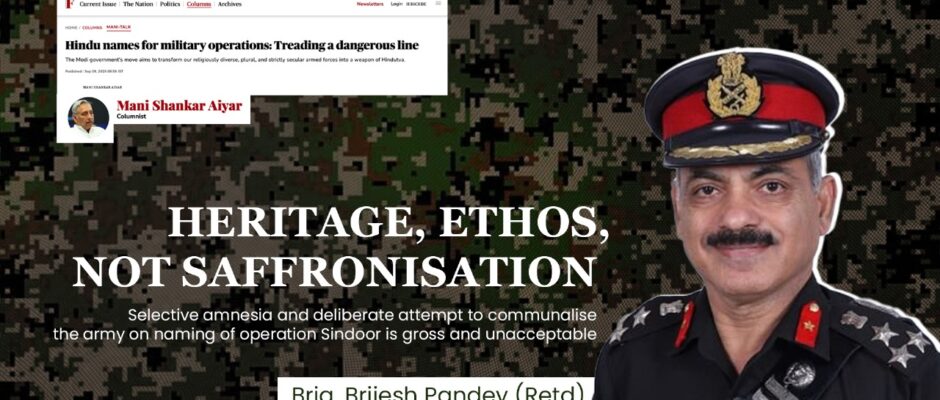
Heritage, Ethos, Not Saffronisation
Selective amnesia and deliberate attempt to communalise the army on naming of operation Sindoor is gross and unacceptable. Brig Brijesh Pandey Frontline column “Hindu Names for Military Operations: Treading a Dangerous Line” by Mani Shankar Aiyar published on 09, September 2025 argues that naming of military operations by the present government – most recently Operation Sindoor reflects a deliberate “saffronisation of Indian Army.” The argument is provocative, selective and highly misleading. Having served for 35 years in Indian Army, I never felt that I’m a Hindu or so to say only a Hindu. Being from a pure Sikh Regiment, felt more like a SIKH, behaved like a Sikh and whenever there was a chance to name an institution, exercise or force, the first name that would come to the mind was one that related to Sikh traditions of valour. Yet no one, including my parents, questioned my secular or Hindu credentials. This is so, because anyone who understands armed forces – the history, military tradition and institutional structure – knows that operation or force names are cultural symbols, not ideological manifestos. The culture of naming operations and exercises is older than modern warfare and militaries across the globe use evocative names for operations and exercises – sometimes as a code for secrecy, motivation and more often for messaging deterrence to the adversary as much as public consumption. From earliest days of independent India, armed forces have drawn names from mythology, Sanskrit, geography and abstract concepts. This practice cuts across political regimes led by Congress, BJP or coalitions. In 1984, almost four decades prior to the debate, Indian Army launched Operation Meghdoot to secure Siachen Glacier. The name comes from Kalidasa’s Sanskrit classic Meghaduta (Cloud Messenger from Hindu Cosmology) where an exiled Yaksha asks a cloud to carry a message to his beloved in the Himalayas. Name was chosen, as it was apt reflection of the nature of operation wherein Indian troops were airlifted like clouds into Himalayan heights. It was nothing but a cultural resonance. The name of recently concluded operation Sindoor has been used as evidence to create a discourse that Army is getting communalized or saffronised. Rationale for the name is very clear. Terrorists in Pahalgam targeted married Hindu men, widowing women overnight. Sindoor (vermilion) symbolizes marital bond in Indian culture. Naming the operation which was primarily a retaliatory action against such a heinous crime selectively inflicted on the majority community of the country was meant to be a tribute to victims and their families, not as a religious decree. Branding it as ideologically motivated reflects ignorance as well as crafty effort to question secular credentials of the armed forces. The act of symbolism and resolve when questioned post-operation Sindoor, a defense ministry official had said, “There is no single written policy on naming. Choices are pragmatic, contextual and meant to evoke resolve.” More often than not, the ideas get generated at very junior level and accepted as such to keep the initiative alive. The writer of “Hindu Names for Military Operations: Treading a Dangerous Line” has been selective about names in recent times, without considering full spectrum since evolution of Indian Armed Forces. When names like Operation Trident (1971), Operation Shakti (1998) or Exercise Ashvamedha (2007) were chosen, no one accused the government of the day – the Congress-led in each case – of religious indoctrination. In the name “Operation Trident”, famous naval strike on Karachi in 1971, “trident” is nothing else than “Trishul”, the weapon of Lord Shiva. Operation Shakti, India’s nuclear test in 1998 drew the name from Goddess power in the Hindu philosophy. But then, these names were accepted as civilizational, not sectarian. When no questions were Congress raised then, why do it now? To illustrate that there is neither any disruption in naming the operations nor is any correlation with appointment of CDS, it is important to analyze few names that relate to the pre and post-2014 era. Era Operation/Exercise Name Year Origin/Meaning Mythological/ Cultural link Pre-2014 Operation Meghdoot 1984 Kalidasa’s Meghadoota Yaksha sends clouds to Himalayas Operation Trident 1971 Trident (Trishul) Weapon of Lord Shiva Operation Pawan 1987 Pawan = Wind Vedic Deity Operation Shakti 1998 Shakti = Power Goddess Power Exercise Ashvamedha 2007 Royal Horse sacrifice Ancient Hindu Ritual Exercise Sudarshan Shakti 2011 Sudarshan Chakra Vishnu’s discus Missiles Prithvi, Agni, Akash, Nag Ongoing Fire, Earth, Sky, Serpent Vedic / Hindu roots Exercise Indra Ongoing Indra = God of rain Vedic deity Post 2014 Operation Maitri 2015 Maitree = Friendship Sanskrit, Budhist ethos Exercise Shatrujeet 2016 Shatrujeet = Enemy Conqueror Sanskrit motivational If Armed Forces were being transformed to suit a particular religion, their names and demography would also have started changing. Instead, the regimental system remains plural – Sikh Regiment, Rajputana Rifles, Maratha Light Infantry, Punjab Regiment, Assam Regiment, Madras regiment, Gorkha Regiment, Brigade of Guards, and so on – each maintaining regional, caste or faith-based traditions. The very regimentation of Indian Armed Forces is proof of pluralism. If the army was being saffronised as claimed by Aiyar, there would be a written directive mandating Hindu names. Whether it is regiments, exercises or operations, they would all start assuming names relating to Hindu religion only. Unlike compulsory recruitment of persons of religions based on which regiments exist only Hindus will get recruited. Likewise, promotion criteria will change. There would be no non-Hindu tenanting critical appointments such as Chief of Army / Navy / Air Force. Contrary to this, what we see is continuity: a mixture of neutral, mythological and cultural names chosen for operational and symbolic value. Seen through Cognitive Warfare lens, such narratives follow a familiar toolkit: disinformation (casting doubts on facts by portraying cultural symbolism as ideological capture), amplification (mainstreaming selective examples while ignoring historical continuity) and de-legitimization (eroding trust in one of the most patriotic institutions). We saw a similar pattern when opposition leaders questioned authenticity of 2016 Surgical Strikes and 2019 Balakot airstrike. In each case, rumour and